
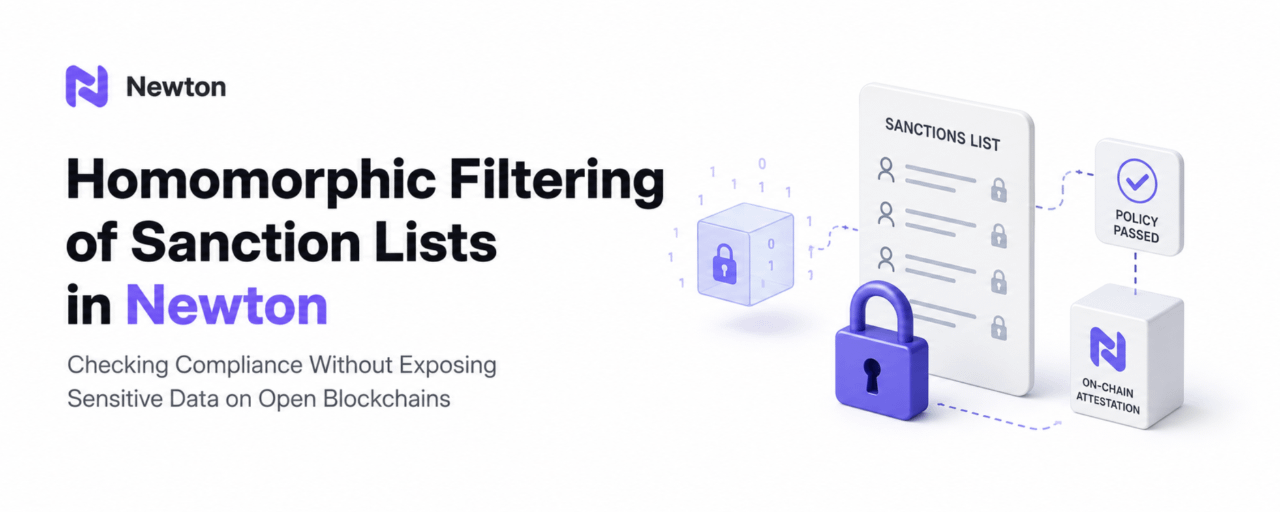

The more I read about Newton Protocol, the less I think it is trying to build another compliance tool. It feels more like it is questioning how compliance should exist on an open blockchain in the first place.
One detail that caught my attention was the discussion around privacy architecture and future support for fully homomorphic encryption. That immediately made me think about something much bigger than transaction approval.
What if a sanctions list could be checked without exposing the list itself?
That sounds simple on paper, but it changes the trust model quite a bit.
Normally, sanctions screening depends on someone holding a database. Every transaction is compared against that database, and the system returns a result. Even if the process is decentralized later, the sensitive data still has to exist somewhere in readable form.
Newton seems to be moving toward a different direction. Its current architecture already separates policy evaluation from smart contract execution through decentralized operators, cryptographic attestations, and external policy data oracles. Longer term, the privacy roadmap even points toward fully homomorphic encryption, where policies could eventually be evaluated over encrypted data instead of decrypted information.
That is where homomorphic filtering of sanctions lists becomes interesting.
Instead of distributing a readable sanctions database across multiple operators, the matching process itself could happen while the underlying information stays encrypted. The blockchain only receives proof that the policy passed or failed, not the sensitive dataset used to reach that decision.
From a privacy perspective, that feels like a cleaner design.
But it also creates new questions.
Sanctions lists are not static. They change constantly. Wallet labels evolve. False positives get corrected. Entire entities can be removed or added with little warning.
Updating encrypted datasets is rarely as straightforward as replacing a normal database. If updates become slow or operationally expensive, then privacy starts competing directly with usability.
That trade-off does not disappear just because stronger cryptography exists.
Another thing I keep thinking about is verification.
Newton's policy engine depends on operators reaching consensus around the same external data before producing aggregated attestations. The protocol already has a two-phase consensus process specifically because independently fetched offchain data can differ between operators. That works well for dynamic information like prices or sanctions checks, but adding encrypted computation could introduce another layer of latency and complexity that developers would have to accept.
There is also the practical question of adoption.
Most projects today are satisfied if they can prove that screening happened. They rarely ask whether the screening method itself leaks unnecessary information.
Newton seems to be asking that second question.
I think that is the more interesting one.
The protocol already treats sanctions screening as just another programmable policy that can consume external oracle data alongside identity or risk signals. That modular design means privacy improvements could strengthen multiple policy types instead of solving only one compliance problem.
Whether homomorphic filtering becomes practical is still uncertain. Fully homomorphic encryption has improved dramatically, but it still carries computational costs that ordinary software does not. Efficiency will probably decide whether this remains an academic feature or becomes something developers actually enable by default.
For now, I see Newton less as a compliance protocol and more as an experiment in reducing how much trust every compliance decision requires. That feels like a harder problem than checking a sanctions list, but probably the one that matters more if open financial systems keep growing.
