


i kept comparing Newton Protocol to other infrastructure launches this week, trying to figure out why the team background felt like it should matter more than the usual "experienced founders" line every whitepaper includes.
then i found the specific number that made the comparison concrete, and it changed how i was reading the rest of Newton's architecture.
the distinction that actually matters
there's a meaningful difference between a team that understands how wallet infrastructure should work and a team that has operated wallet infrastructure at a scale where failure has immediate, visible consequences for real users holding real money.
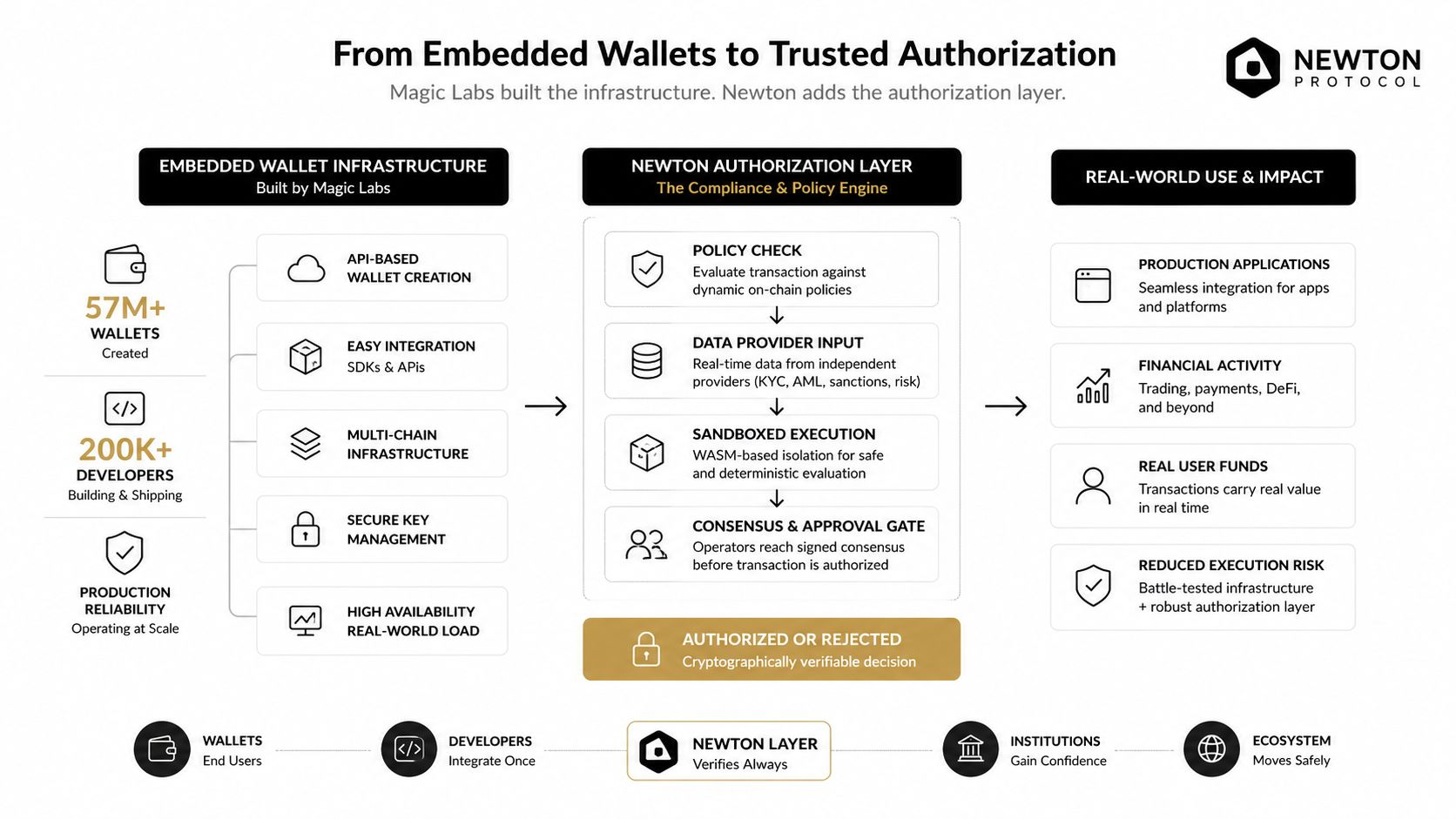
Magic Labs is the second kind. before Newton existed as a project, Magic Labs built embedded wallet technology — API-based wallet creation that lets applications give users a wallet without the user ever touching a seed phrase or installing an extension. that infrastructure now sits behind more than 57 million wallets and is used by over 200,000 developers.
one of those developers is Polymarket. when Polymarket users trade on election outcomes or sports events, many of them are interacting with a wallet that Magic Labs' infrastructure created and maintains behind the scenes. that's not a pilot integration or a case study written for a pitch deck; it's production infrastructure carrying real trading volume, where downtime means users can't access funds during active markets.
PayPal Ventures backed Magic Labs years before NEWT Newton Protocol was conceived. that timing matters. it means the backing wasn't a bet on Newton's compliance thesis just it was a bet on Magic Labs' ability to operate wallet infrastructure reliably, made by an institutional investor with every incentive to evaluate operational competence carefully before writing a check.
why this specific history changes Newton Protocol risk profile
here's the comparison i kept returning to. imagine two teams both proposing to build an authorization layer that sits in the critical path of onchain transactions; where every gated transaction depends on the layer being available, correct, and fast enough not to introduce unacceptable latency.
team one has strong engineers, a well-reasoned whitepaper, and no prior production system carrying real user funds at scale. team two has spent years operating wallet infrastructure where 57 million users depend on uptime, where a bug doesn't get caught in a testnet but it gets caught by someone unable to access their money.
both teams can write the same architecture document. only one of them has already lived through what happens when embedded infrastructure fails in production. rate limiting under load. handling malformed requests from thousands of independent applications simultaneously. debugging an intermittent failure affecting a subset of users across different chains, different wallets, different client versions. and the operational reality of infrastructure that can't just be redeployed cleanly when something breaks.
that operational memory doesn't show up in a whitepaper. it shows up in what a team chooses to build defensively, which edge cases they've already hardened against, and which failure modes they're not encountering for the first time when it matters.
Newton Protocol architecture; sandboxed WASM data providers, two-phase consensus for handling live data disagreement between operators, explicit DataProviderError handling separate from ordinary policy denial, and reads differently once you know it's written by a team that has already had to handle "the data provider returned something malformed" as a production incident, not a hypothetical test case.
the developer network as a distribution advantage
there's a second dimension to this that's easy to underweight: 200,000 developers already building on Magic Labs' infrastructure.
a brand-new authorization protocol faces a specific adoption problem regardless of how good its architecture is. developers have to discover it, evaluate it, and choose to integrate it into systems that already work without it. that adoption curve is slow by default, because integrating a new compliance layer into an existing production system carries real switching cost and real risk for the integrating team.
Newton doesn't start that curve from zero. a developer already building on Magic Labs' wallet infrastructure encounters @NewtonProtocol Newton Protocol as an extension of tooling they already trust and already use — not as an unfamiliar protocol requiring a first-principles evaluation. that's a meaningfully different starting point than a protocol with no existing developer relationship trying to earn adoption purely on architectural merit.
whether that translates into faster real integration is a separate question from whether the architecture is sound. but it's a distribution advantage that most competing authorization layers, built by teams without an existing developer base, simply don't have.
what this history doesn't guarantee
i don't think prior wallet-infrastructure experience automatically transfers to running a decentralized policy engine coordinating BLS signatures across a permissioned operator set evaluating live compliance data.
those are genuinely different engineering problems. wallet infrastructure optimizes for consistent uptime and predictable request handling. NEWT Protocol authorization layer has to coordinate multiple independent operators reaching cryptographic consensus on data that changes in real time, under adversarial conditions where someone may be actively trying to manipulate a policy outcome for financial gain.
Magic Labs track record is evidence they can operate infrastructure at scale without breaking under pressure. it isn't evidence they've solved decentralized consensus at the same scale, because until Newton mainnet matures under real institutional load, nobody has direct evidence of that yet.
what the history changes is the baseline assumption. "first production system, hope it holds" and "team that has already operated comparable-scale infrastructure without catastrophic failure" are different starting points for evaluating execution risk. That's even before a single line of NEWTon Protocol @NewtonProtocol specific code is stress-tested by real adversarial volume.
does Magic Labs' wallet-scale track record meaningfully reduce the execution risk of Newton's harder, more adversarial coordination problem — or does every new category of infrastructure reset the risk clock regardless of who's building it?
