Identity verification in traditional finance works one way.
You hand your documents to an institution. The institution keeps them. Every time you interact with a new platform, you hand documents to another institution, which also keeps them.
By the end, your identity data lives in a dozen databases you don't control, in jurisdictions you may not have consented to, accessible to breach events you'll never be notified about in time.
Onchain identity tokens tried a different approach: put the credential on the blockchain.
The problem is that a public blockchain is visible to everyone. An onchain credential that proves you completed KYC exposes that fact permanently to every address that wants to look.
@NewtonProtocol 's Newton Identity Oracle takes a third path.
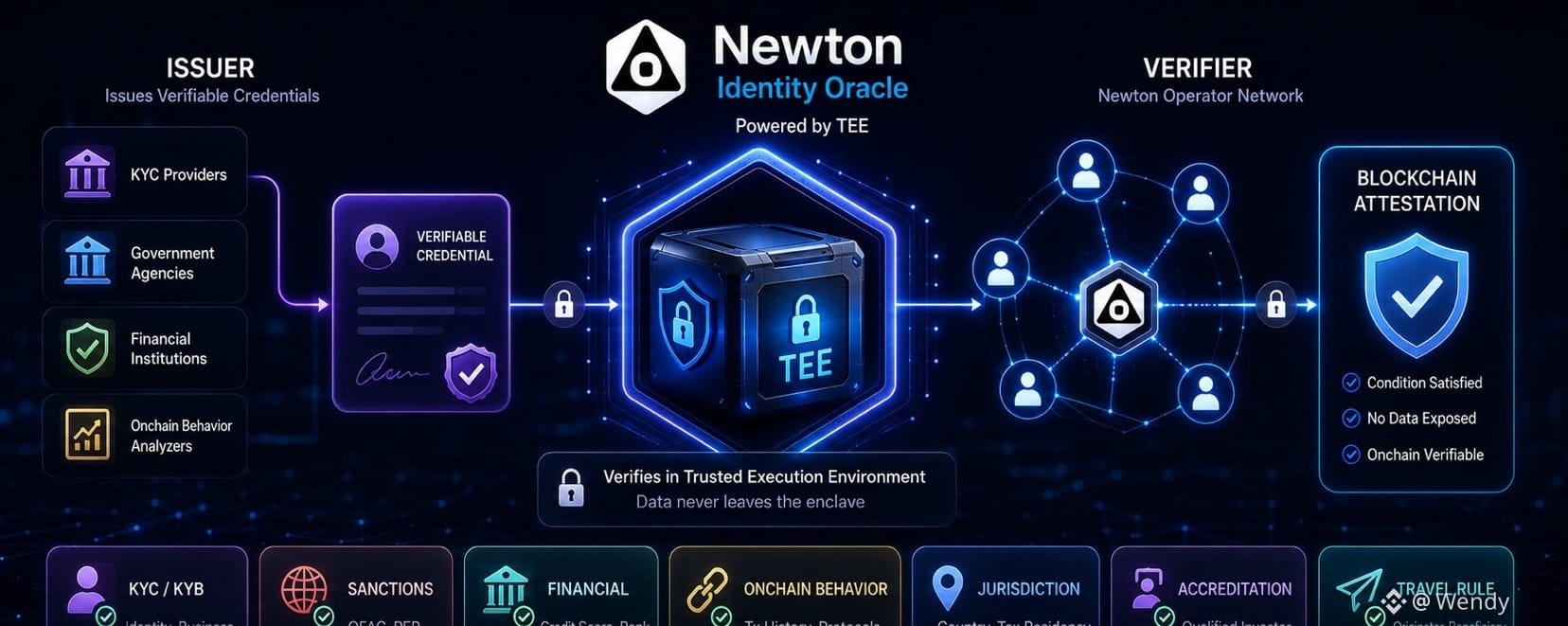
It's built on the W3C Verifiable Credentials standard and an Issuer, Holder, Verifier model.
The Issuer is whoever attests to an identity attribute — a KYC provider, a government agency, a financial institution, an onchain behavior analyzer. The Issuer produces a signed credential that the user receives.
The Holder is the user. The credential lives in their wallet, encrypted at rest. They control it. They decide when to present it and to whom.
The Verifier is Newton — specifically, Newton's operator network and the Newton Identity Oracle, which runs inside a Trusted Execution Environment. The TEE ensures the underlying credential data is never exposed to the operator's host system. The verification result that comes out is a boolean or minimal output: this condition is satisfied or it isn't.
This selective disclosure model is the part worth paying close attention to.
A user can prove their jurisdiction is in the US without revealing which state they live in.
They can prove their KYC level meets the required threshold without revealing the documents that established it.
They can prove accredited investor status without revealing net worth or income.
The blockchain sees none of the underlying data. It sees the attestation that a verification ran and produced a result.
The credential categories Newton supports cover the full range of what onchain compliance requires.
KYC and KYB credentials cover identity verification, business registration, and beneficial ownership — verified through issuer signature plus TEE evaluation.
Sanctions and watchlist credentials cover OFAC screening, PEP status, and adverse media — checked in real time through live feed attestation.
Financial credentials cover credit score, bank balance, and income verification — with zero-knowledge proofs for the numeric predicates.
Onchain behavior credentials cover transaction history, protocol interactions, and wallet age — derived from onchain analysis and attested.
Jurisdiction credentials cover country of residence, tax residency, and IP geolocation — with selective disclosure so users don't expose their exact location to pass a jurisdiction check.
Accreditation credentials cover qualified investor and institutional status — issuer-signed.
Travel Rule attribution credentials carry originator and beneficiary information for qualifying transfers.
Each credential type uses the verification method appropriate to its data sensitivity and issuer model.
Portability is a core property of the system.
A KYC credential issued for one application can be re-presented to another without repeating the full verification process. It's valid across Newton's supported chains. It carries expiration metadata and can be refreshed incrementally when the issuer supports updates.
The friction reduction this creates is non-trivial.
A user today who wants to interact with three institutional DeFi products completes KYC three separate times, for three separate companies, each keeping a copy of the documentation.
With Newton Identity Oracle, the same credential — held by the user, verified in a TEE, attested without data disclosure — covers every application that accepts Newton attestations.
One verification, portable across the ecosystem.
The issuer landscape Newton supports is intentionally open.
Any entity that meets the issuance standards can issue credentials into Newton's system — expanding coverage without requiring Newton itself to become a credential authority.
$NEWT $BTC
#Newt

مقالة
Newton Identity Oracle: How Newton Protocol Verifies Who You Are Without Seeing Your Data

--
إخلاء مسؤولية: يتضمن آراء جهات خارجية. لا تُعدّ نصيحة. يُمكن استخدام Binance AI دون أي ضمان. اطلع على الشروط والأحكام.