Newton's Attestations Turn Approval Into Proof
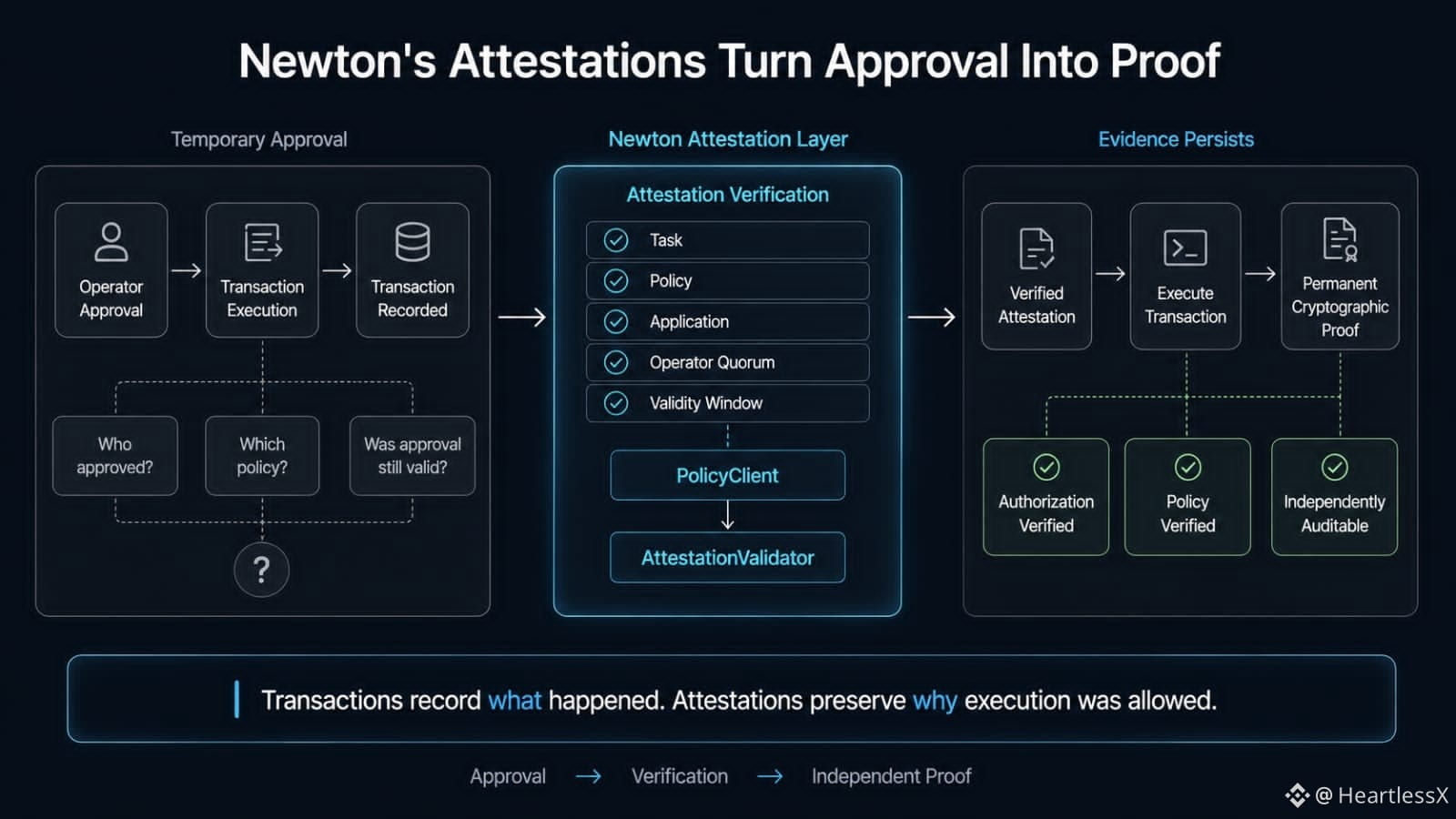
Most blockchain transactions are easy to verify after they happen. The approval behind those transactions usually isn't. You can see that value moved, but proving who authorized it, under which policy, and whether that approval was still valid at execution is a much harder question.
Newton approaches approvals differently. Instead of treating them as temporary signals, its attestation system turns them into cryptographic evidence. Before execution, PolicyClient verifies that the attestation matches the correct task, policy, application, operator quorum, and validity window. If those conditions fail, the transaction never proceeds.
The interesting consequence isn't another verification step. It changes what operators optimize for. A careless approval is no longer something the network simply forgets after execution. Every attestation can be checked later, and incorrect or conflicting approvals expose operators to slashing. The safest strategy becomes producing decisions that remain defensible long after the transaction is finished.
That creates a different standard for network accountability. Trust gradually shifts away from remembering who approved something and toward independently verifying that the approval actually followed the required policy.
Of course, stronger guarantees come with additional engineering work. Coordinating BLS signatures, validating attestations, and managing expiration windows make the system more complex. The trade-off is straightforward: simpler infrastructure or stronger evidence.
The part I keep thinking about isn't that transactions become easier to verify. It's that approvals stop being promises made by operators and start becoming proof the network can independently check.
Source: Newton Protocol Documentation (Attestation System, BLS Signatures, AttestationValidator & Expiration Blocks). Personal analysis. #newt $NEWT @NewtonProtocol
Most blockchain transactions are easy to verify after they happen. The approval behind those transactions usually isn't. You can see that value moved, but proving who authorized it, under which policy, and whether that approval was still valid at execution is a much harder question.
Newton approaches approvals differently. Instead of treating them as temporary signals, its attestation system turns them into cryptographic evidence. Before execution, PolicyClient verifies that the attestation matches the correct task, policy, application, operator quorum, and validity window. If those conditions fail, the transaction never proceeds.
The interesting consequence isn't another verification step. It changes what operators optimize for. A careless approval is no longer something the network simply forgets after execution. Every attestation can be checked later, and incorrect or conflicting approvals expose operators to slashing. The safest strategy becomes producing decisions that remain defensible long after the transaction is finished.
That creates a different standard for network accountability. Trust gradually shifts away from remembering who approved something and toward independently verifying that the approval actually followed the required policy.
Of course, stronger guarantees come with additional engineering work. Coordinating BLS signatures, validating attestations, and managing expiration windows make the system more complex. The trade-off is straightforward: simpler infrastructure or stronger evidence.
The part I keep thinking about isn't that transactions become easier to verify. It's that approvals stop being promises made by operators and start becoming proof the network can independently check.
Source: Newton Protocol Documentation (Attestation System, BLS Signatures, AttestationValidator & Expiration Blocks). Personal analysis. #newt $NEWT @NewtonProtocol