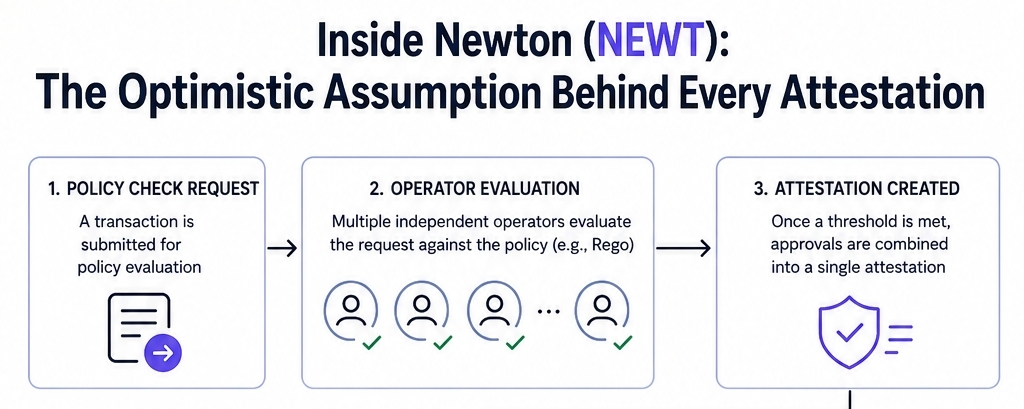

I was reading through the part of Newton Protocol's documentation that explains how operators get held accountable, and I found myself lingering on the dispute window mechanism longer than I expected. The basic idea is that once enough operators sign off on a policy check, their approvals combine into one attestation, but that attestation isn't treated as final the instant it's produced. There's a window afterward where any independent party can challenge it and prove the error with a zero-knowledge fraud proof, and if they're right, the operator that signed off incorrectly gets slashed. I sometimes wonder how many people using systems like this actually register that the "verified" stamp they're relying on has a built-in period where it could still be overturned.
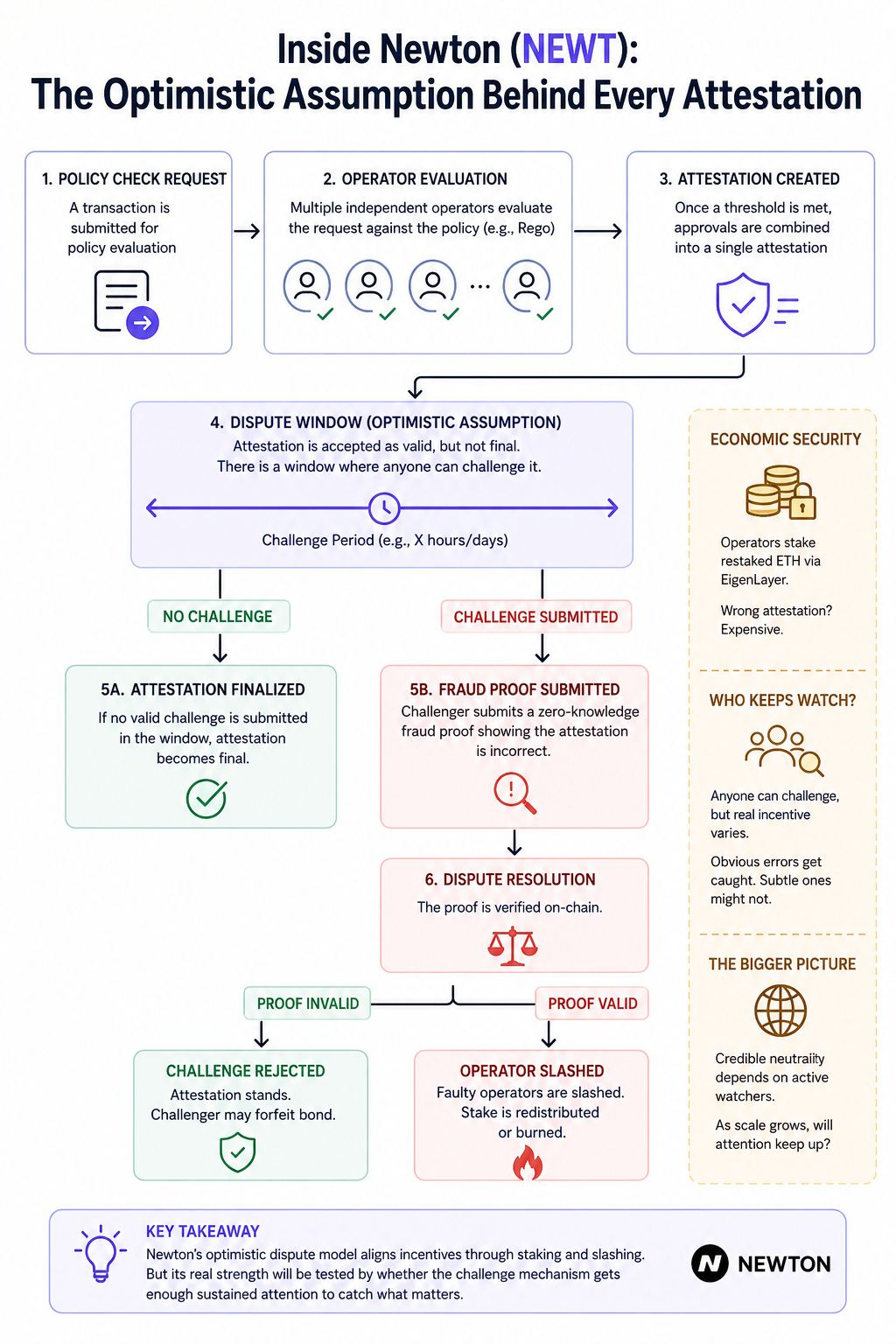
What seems interesting is how this design borrows from a pattern that already exists in optimistic rollups, where you assume things are correct unless someone proves otherwise, rather than requiring every party to independently verify everything upfront. Applying that same logic to compliance attestations feels like a genuinely different use of the pattern, since optimistic verification is usually about state transitions or transaction ordering, not whether a transaction actually satisfied someone's jurisdictional rule or spending policy. The economic security comes from operators staking restaked ETH through EigenLayer, so getting caught signing off on a wrong answer costs them part of that stake. On paper that alignment looks clean, dishonesty becomes expensive and honesty becomes the rational default. But it makes me think about how that plays out when the "wrong answer" isn't a simple binary but something depending on interpreting a nuanced policy against messy real-world data.
The question that comes to mind is who actually has the expertise and incentive to catch a subtle error during that dispute window. Catching an operator that clearly signed off on a transaction violating an obvious sanctions rule seems straightforward enough for someone to notice and challenge. But what about a borderline case, where a policy's Rego logic is ambiguous, or an oracle feed used in the evaluation was slightly stale? I'm not completely sure the incentive to challenge scales evenly across every kind of error, since some mistakes are financially rewarding to catch and others might be technically correct according to the letter of the policy while missing its intent. It makes me wonder whether the dispute mechanism polices the loud, obvious failures well while quieter, more ambiguous ones slip through simply because nobody found it worth the effort to formally challenge them.
Looking at the bigger picture, there's a tension between wanting Newton to feel credibly neutral, meaning no single party controls the outcome, and the practical reality that slashing and disputes require real economic actors paying attention and acting rationally at every step. The system depends on enough independent parties actually watching operator behavior closely enough to catch and prove faults, and I'm not sure how that watchfulness holds up once the network scales past its beta phase, when policy evaluation volume could grow much faster than the number of people capable of auditing it individually. It's a bit like relying on a jury pool that has to stay engaged and technically sharp indefinitely, and it makes me wonder whether this monitoring role ends up concentrated among a small set of sophisticated actors rather than genuinely distributed the way the architecture implies.
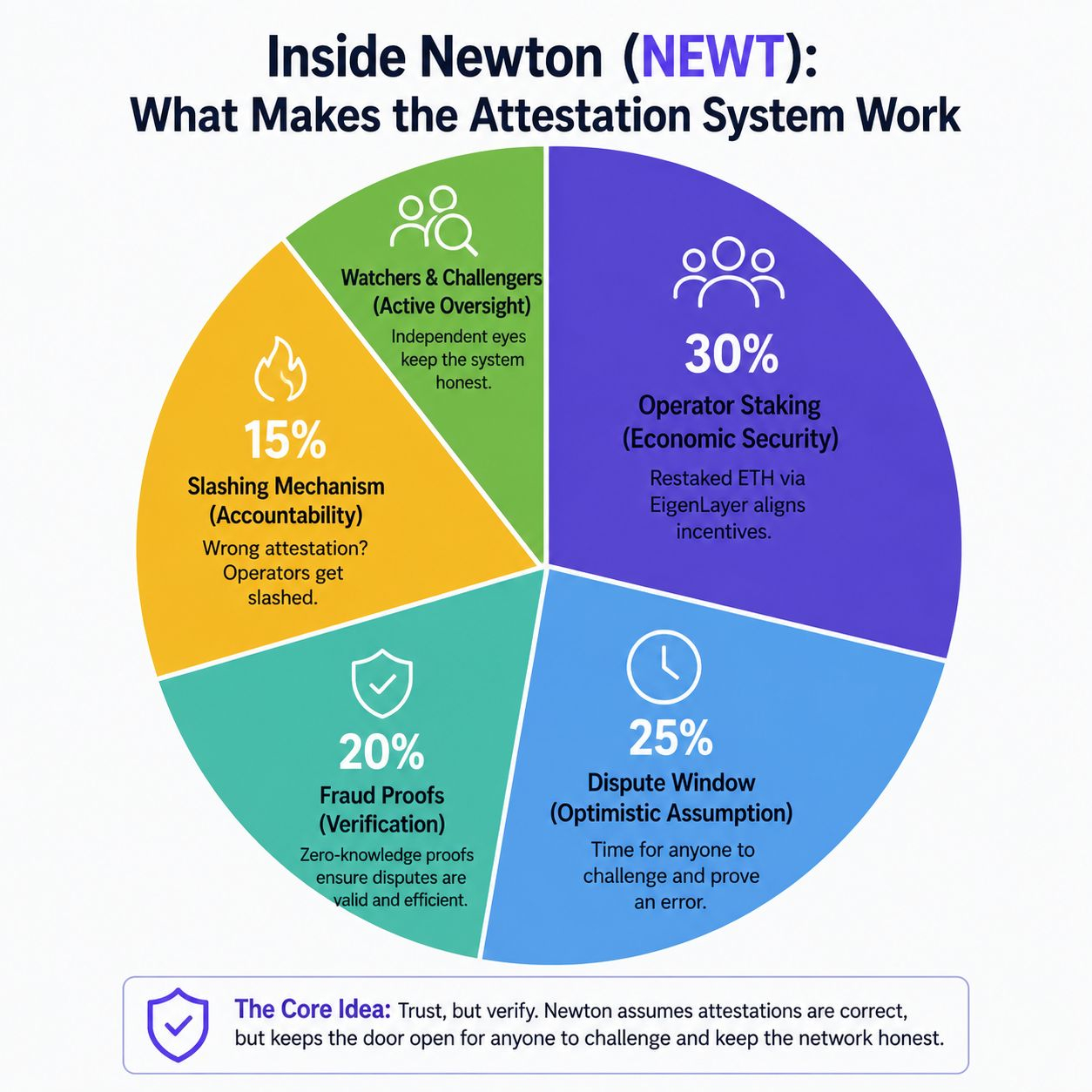
I don't think there's a way to judge from the outside yet whether this economic security model holds up once real disputes start happening at meaningful frequency and scale, since a mechanism that looks sound in a litepaper and one stress tested by actual adversarial behavior are different things entirely. NEWT's staking and slashing structure gives operators a financial reason to behave honestly, but the more interesting question to me is whether the challenge and dispute side gets enough sustained attention to function as the check it's designed to be, rather than becoming a theoretical safeguard that rarely gets exercised in practice. Maybe that is the real test ahead... anyway, time will tell👍