
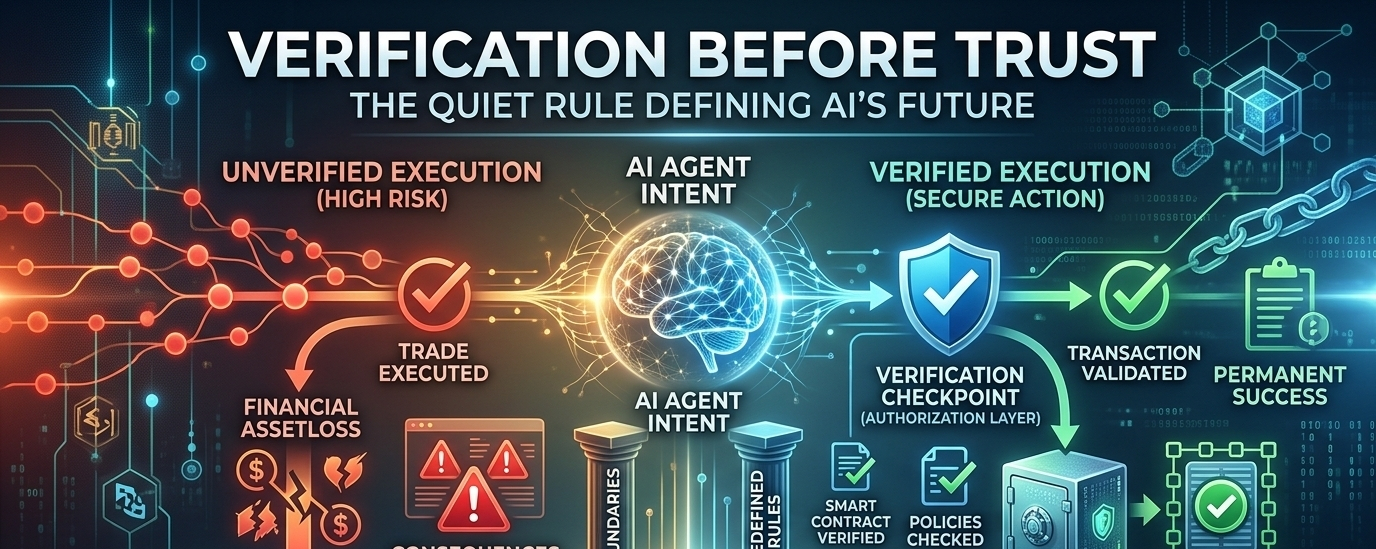
It’s easy to think that the systems we rely on every day are built on trust, but when you look closely, you start to notice something different. The most dependable systems in the world don’t begin with trust at all. They begin with verification. It happens so seamlessly that we barely notice it anymore. At airports, luggage doesn’t move forward until it’s been scanned. In banking, large transactions aren’t processed instantly without checks in place. In hospitals, doctors don’t proceed with critical procedures until identities and details are confirmed again and again. These systems were never designed because people are assumed to be dishonest or dangerous. They exist because relying on assumptions has never been enough at scale. What actually works, what consistently holds up under pressure, is verification. That’s the quiet principle that has protected the most important systems around us for decades, long before artificial intelligence entered the conversation.
Now, as AI continues to evolve, that principle is starting to matter even more. What we’re seeing today is only the beginning. AI is already writing, designing, answering, assisting. But the next phase is something entirely different. AI agents are slowly stepping into roles where they don’t just assist but act. They manage wallets, execute trades, interact with smart contracts, and move digital assets without needing someone to approve every single step. And that shift changes the nature of the conversation. The question is no longer just about what AI is capable of doing. It’s about whether it should be allowed to do it. Capability and responsibility are not the same thing, and confusing the two is where real risk begins. The more autonomy these systems gain, the more important it becomes to define clear boundaries before actions are taken, not after.
The interesting part is that the crypto space has already been built around a similar mindset. It doesn’t run on blind trust. It runs on rules that anyone can verify. Transactions don’t go through because we believe in them; they go through because they meet predefined conditions that are transparent and enforceable. That’s what makes the system resilient. As AI starts interacting directly with these environments, handling real value instead of just data, the stakes increase instantly. Every decision an autonomous agent makes is no longer just technical. It carries financial weight, real consequences, and sometimes irreversible outcomes. And once something is executed on-chain, there’s no undoing it. That reality alone changes how we need to think about AI behavior.
This is where a more thoughtful approach begins to stand out. While much of the space is focused on making AI faster, smarter, and more capable, there’s a deeper question that doesn’t get asked enough. Who decides if an action should happen in the first place? Instead of rushing toward execution, there’s a growing need to pause at the point of intent. To introduce a layer that evaluates decisions before they turn into actions. This kind of authorization layer acts like a checkpoint, sitting quietly between what an AI wants to do and what it is actually allowed to do. It doesn’t wait for mistakes to happen. It prevents them from happening at all. Policies are checked before signatures are created, before assets move, before transactions are finalized. It’s a simple shift in thinking, but it changes everything. It mirrors the same logic we already trust in critical systems across industries, now being adapted for a world where machines are making decisions involving real value.
As these ideas begin to move from theory into real-world application, their importance becomes even clearer. It’s one thing to describe secure systems in whitepapers and discussions, but it’s something entirely different to build infrastructure that enforces rules consistently in live environments. That’s where the real test begins. Because as AI agents become more autonomous, this kind of control won’t feel like an added feature anymore. It will become a necessity. Without it, we’re not just increasing efficiency, we’re increasing risk at the same time. And in a system where actions are permanent, even small mistakes can carry significant consequences.
In the end, the future of AI won’t simply belong to the most advanced models or the fastest technologies. It will belong to the systems that quietly decide what is allowed and what is not. The ones that put boundaries in place before anything happens. The safest systems have never been the ones that trust the most. They’ve always been the ones that verify first, building confidence not from assumptions but from proven checks. As AI continues to grow more powerful, maybe the real evolution isn’t about making it smarter, but about making sure it knows when not to act. That missing layer, the one that sits between intention and execution, might be the difference between progress and risk in the years ahead.