
A protocol becomes operationally important when its records settle an argument before reputation has to.
That is the adoption signal I would watch around Newton Mainnet Beta.
Most crypto adoption is measured too early.
A team announces an integration.
A campaign gets engagement.
A vault adds a new automation layer.
A dashboard shows activity.
Those signals can matter, but they are not enough for me. Real adoption is not proven when a product is added to the stack. It is proven when the team starts depnding on it during uncomfortable moments.
The uncomfortable moment I care about is a dispute.
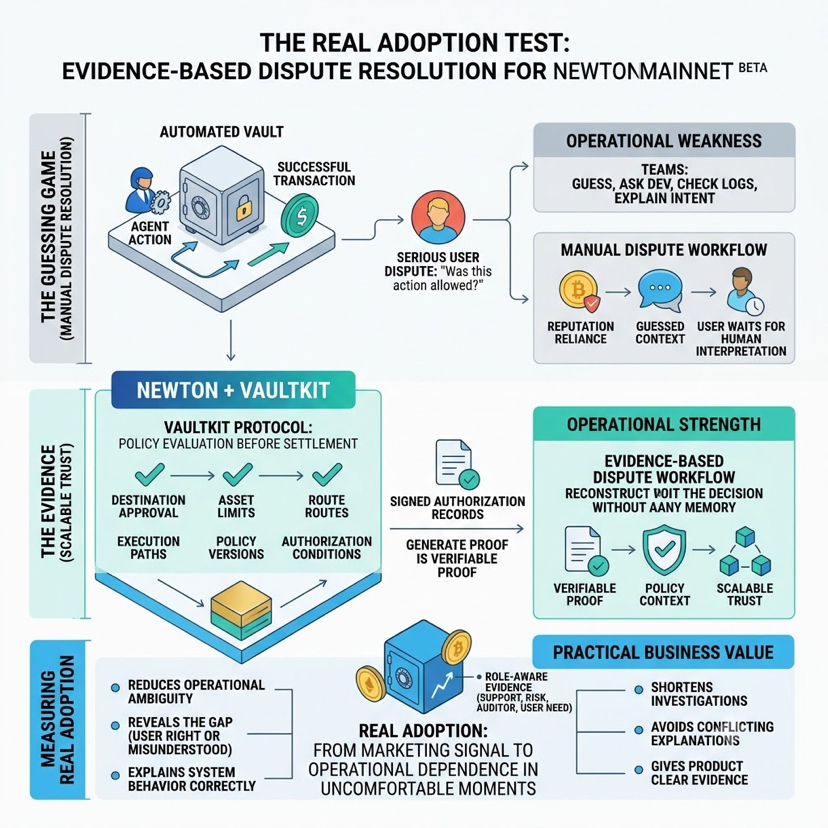
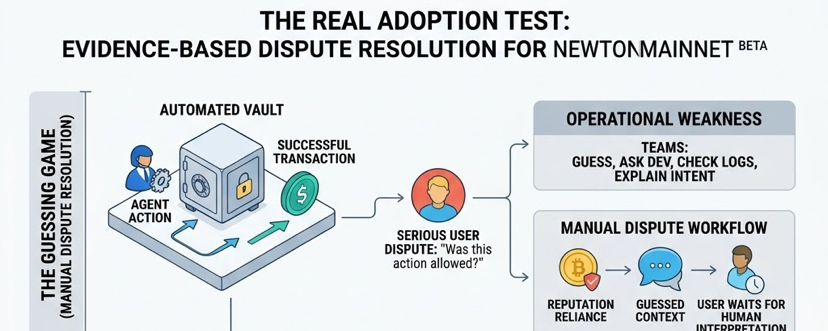
Imagine a user claims an automated vault moved beyond the mandate they approved.
The manager says the action was valid.
The agent followed its configured strategy.
The transaction settled successfully.
The destination was approved.
The amount was within the active limit.
From the outside, the action may look normal. But the user’s question is not only whether the transaction executed.
The user is asking:
“Was this action actually allowed under the rules I trusted?”
That is where many automation systems become operationally weak. They can show a transaction hash. They can show the vault state after settlement. They can show that funds moved. But they may struggle to reconstruct the authorization path that made the action acceptable before value moved.
In a serious financial product, that gap becomes expensive.
Support teams start guesing.
Risk teams ask developers for context.
Developers check logs.
Managers explain intent.
Users wait for a human interpretation of a machine decision.
That is not scalable trust.
That is manual dispute resolution around automated execution.
This is where Newton becomes interesting from an adoption perspective.
Through VaultKit, applications can place policy evaluation before settlement. Actions can be checked against approved destinations, asset limits, routes, execution paths, policy versions, and authorization conditions before value moves. Signed authorization records can help show what was evaluated and under which policy context.
That does not automatically prove every decision was wise.
But it can reduce the most damaging kind of operational ambiguity:
Nobody knows why the action was allowed.
For me, that is a stronger adoption signal than a launch announcement.
If a team uses Newton records only for marketing, adoption is shallow.
If a team uses them when a user asks a hard question, adoption becomes operational.
A serious dispute workflow should be able to reconstruct the decision without depending on memory.
Which policy version was active?
Which agent requested the action?
Which route or destination was evaluated?
Which limit mattered?
Was the request approved before settlement?
Was it rejected first and later resubmitted?
Did a policy update happen shortly before the action?
Was the approval tied to the same execution path that later settled?
These questions determine whether the team can explain automation with evidence.
This is not just about defending the protocol.
It is about protecting the relationship between automation and the user.
If the user was right, the record should help reveal the gap.
If the system behaved correctly, the record should help explain why.
If the issue sits between user expectation and policy wording, the record should show where the product needs clearer consent, not hide behind technical correctness.
That is why dispute adoption is different from incident review.
An incident asks what broke.
A dispute asks what was understood, authorized, and provable.
A vault can avoid losses and still lose trust if the user cannot understand why an agent had power to act.
The business value is also practical.
Good authorization history can reduce suport ambiguity. It can shorten internal investigations. It can help risk teams avoid conflicting explanations. It can give product teams clearer evidence about where users misunderstand agent authority. It can help compliance or audit teams review decisions without rebuilding context from scattered spreadsheets, chat messages, and transaction links.
That is real operational value.
Not abstract “AI automation.”
Not temporary campaign energy.
Actual reduction in confusion when money and responsibility are both on the line.
There is a trade-off.
Too much detail in a dispute record can expose sensitive strategy information. Not every user, counterparty, or public observer should see the same evidence. Privacy and access control still matter.
But too little detail creates a different problem. If the record only says “approved,” it may not help anyone understand the decision. A vague approval is better than no record, but it is not enough for serious operational dependence.
The better standard is role-aware evidence.
A support team may need a plain-language explanation of the permission boundary.
A risk team may need policy version route category, and limit context.
An auditor may need signed authorization history.
A user may need to know whether the action stayed inside the mandate they accepted.
Each audience needs enough evidence to resolve the dispute without exposing unnecessary operational intelligence.
This is where adoption can be measured honestly.
Does Newton help the team answer hard user questions faster?
Does it reduce internal disagreement over what happened?
Does it turn authorization history into a default support artifact?
Does it help teams distinguish policy failure from user misunderstanding?
Does it make agent behavior explainable after the fact without pretending that every approved action was automatically wise?
These are the signals I would watch around Newton Mainnet Beta.
Not just whether applications integrate VaultKit.
Whether they build real workflows around the records VaultKit can help produce.
The strongest adoption is not when a team says, “we use this.”
It is when the team stops asking people to trust memory, screenshots, and informal explanations.
Because in automated finance, the first serious user dispute is not a PR problem.
It is a test of whether authorization has become evidence.
$NEWT @NewtonProtocol #Newt $LAB $VANRY #Velvet #XAU #VANRY #Labs