

The real question is not whether a system can check a rule, but whether it can do that reliably when money is moving fast.
Newton Protocol seems built around that tension. It is trying to put policy checks closer to the transaction itself, instead of leaving them as an offchain afterthought.
That matters because real finance is messy. Transfers can involve identity checks, sanction lists, spending limits, reserve proofs, and reporting obligations, all at once.Most blockchains are not designed for that kind of context.
A contract can see inputs onchain, but it usually cannot tell whether the action fits a broader compliance rule.
So the bottleneck is simple: the chain knows what was sent, but not always whether it should have been allowed.
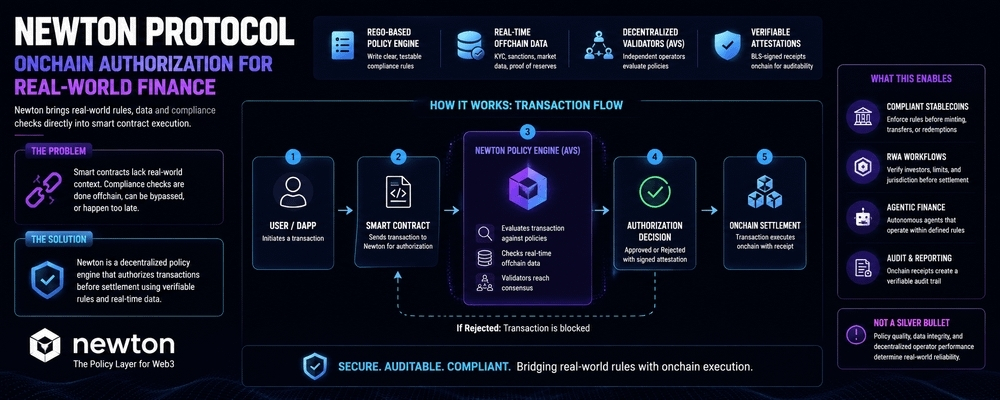
Newton is trying to solve that by making authorization a shared service rather than a private backend patch.The idea, as described in the docs, is a policy layer that can evaluate a transaction before it settles. That gives builders a clearer rule set, but it also makes the policy layer itself very important.
One part of the design uses formal policy logic, which helps because rules become explicit and testable. The downside is that strict rules can also be unforgiving when edge cases appear.
Another part depends on outside data, such as compliance status, reserve information, or other signals the chain cannot generate by itself.That is useful, but it creates a new dependency. If the data is late, incomplete, or wrong, the system can make a clean decision for the wrong reason.
The transaction flow is therefore not just “send and settle.” There is a check in the middle, and that check decides whether the rest of the path is allowed to continue.
In practice, that middle step is where things get uncomfortable. Latency, outages, and operator mistakes matter more once a rule becomes part of execution rather than part of review.The quiet failure mode is overconfidence. A signed authorization can look strong even when the underlying policy was poorly written or the data feed was stale.
To trust a design like this, I would want to see how often it blocks valid transfers, how fast it responds, and how it behaves when inputs are missing.
Builders may also face integration friction. They have to map real business rules into code, connect data sources, and decide what happens when the policy service cannot answer.Newton does not solve regulation itself. It can enforce a rule, but it cannot decide whether that rule is right, updated, or accepted in every jurisdiction.
A practical example is a stablecoin flow that must pass a compliance check before settlement. That can reduce manual review, but it also means one faulty rule can interrupt ordinary users.
The strongest reason this could matter is that it treats authorization as infrastructure. The strongest reason for caution is that infrastructure only works when its rules, inputs, and operators stay dependable over time.
The larger lesson is clear: in serious onchain systems, “can this execute?” is no longer enough. The harder question is whether the system can explain why it executed, and prove that the answer was sound.
That is the question Newton Protocol still has to answer in real use, not just in documentation.
