
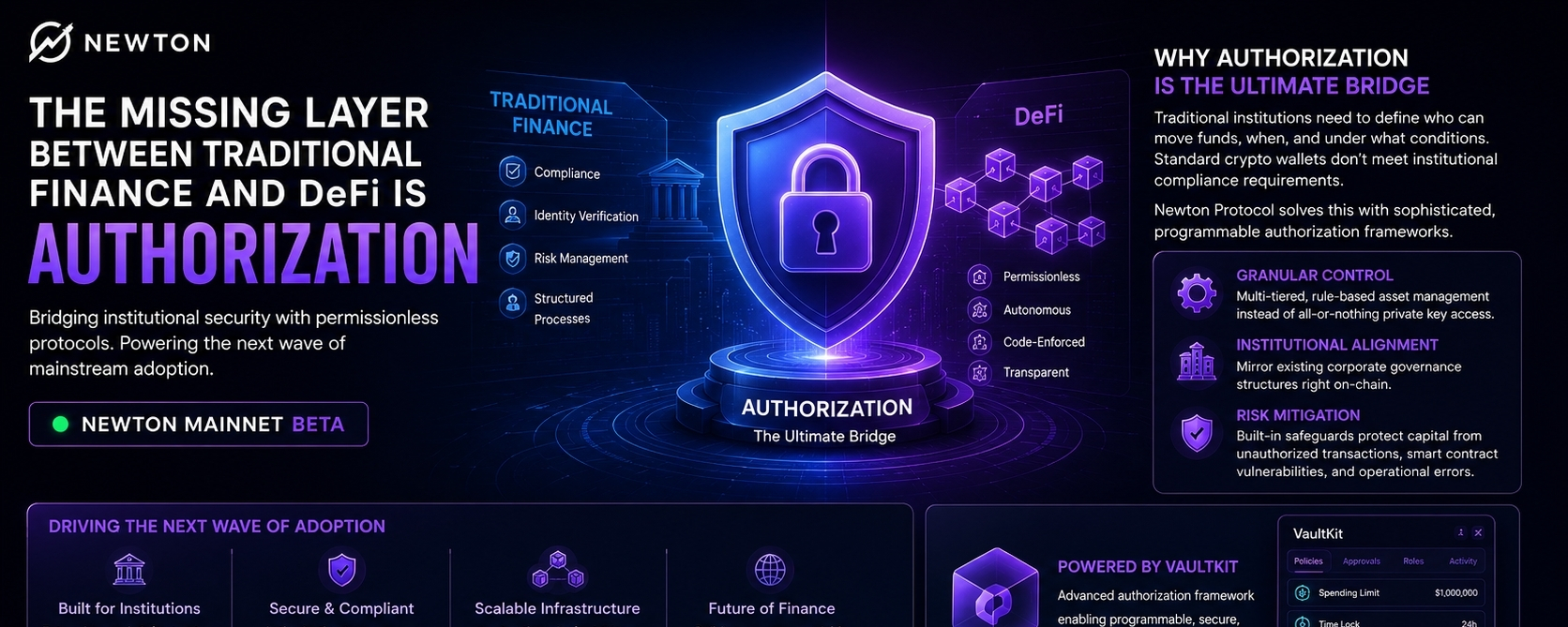
For years, the mainstream adoption of Decentralized Finance (DeFi) has faced a massive roadblock: the friction between institutional security and permissionless protocols. Traditional finance (TradFi) relies heavily on strict compliance, identity verification, and structured risk management. DeFi, on the other hand, thrives on speed, autonomy, and code-enforced execution.
So, what bridges this gap? The answer isn't just more liquidity or faster transaction speeds—the missing layer between traditional finance and DeFi is Authorization.
Without a secure, enterprise-grade authorization framework, institutions simply cannot interact with public blockchains safely. This is precisely why the advancements coming from @NewtonProtocol are drawing so much attention right now.
Why Authorization is the Ultimate Bridge
Traditional institutions operate under strict fiduciary duties. They need to define who can move funds, when they can move them, and under what conditions. Standard crypto wallets operate on a simple private key model—whoever holds the key holds absolute power. This binary approach is a nightmare for institutional compliance.
With the launch of the Newton Mainnet Beta, the ecosystem is systematically solving this problem. By introducing sophisticated, programmable authorization frameworks like VaultKit, the protocol introduces a nuanced layer of control.
Granular Control: Instead of all-or-nothing private key access, frameworks like VaultKit allow for multi-tiered, rule-based asset management.
Institutional Alignment: It allows traditional finance players to mirror their existing corporate governance structures right on-chain.
Risk Mitigation: Built-in safeguards protect capital from unauthorized transactions, smart contract vulnerabilities, and operational errors without sacrificing the decentralization that makes DeFi valuable.
Driving the Next Wave of Adoption
By building this vital infrastructure on the Newton Mainnet Beta, @NewtonProtocol is laying down the rails for trillions of dollars in traditional capital to securely migrate over to Web3. It provides the exact compliance-friendly, risk-mitigated environment that enterprise participants have been waiting for.
As the ecosystem continues to mature and mature fast, the importance of these robust authorization layers cannot be overstated. It is no longer just about trading or swapping; it is about building a secure, scalable foundation for the future of global finance. Keep a close eye on this space as the mainnet continues to roll out features that redefine how we look at digital asset management.