In older libraries, a book carried a small paper pocket on the inside cover. Each borrower left behind a stamped date, sometimes a name, sometimes only the evidence that the book had passed through other hands. It was a crude system, easily replaced by databases, yet it captured something modern software often forgets: use has a history. Knowledge was not just stored in the book, but in the trail of people who touched it, trusted it, returned it, or failed to.
Automation has a strange relationship with memory. It promises to remove delay, hesitation, and human inconsistency, but in doing so it can also erase the visible path between intention and outcome. A trade happens, a model allocates capital, an agent responds to a market condition, and afterward we are left asking not only what occurred, but why it occurred at that particular moment. In finance, this question has always mattered. In AI-driven finance, it becomes structural. A system that acts without a durable memory of its reasoning begins to resemble an institution without archives.
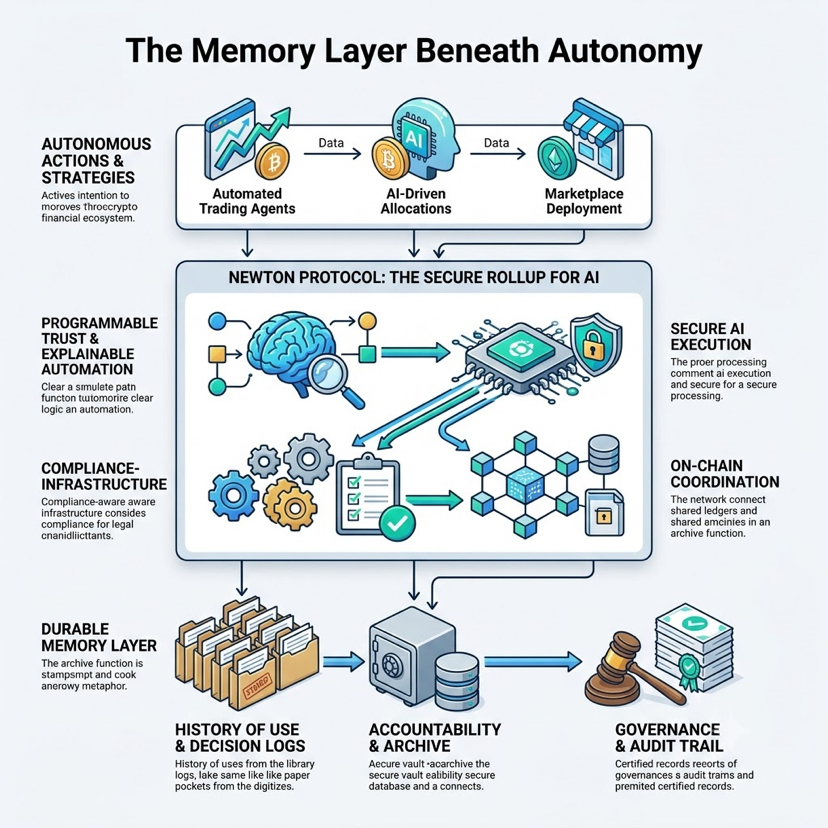
This is the angle from which Newton Protocol becomes worth examining. Its secure rollup is being built for AI-driven strategies, automated trading, and a marketplace where developers can deploy, monetize, and share intelligent agents. But beneath those functions is a quieter concern: how autonomous systems remember their own actions. Programmable trust, explainable automation, secure AI execution, compliance-aware infrastructure, and on-chain coordination are not merely technical features. They are attempts to create a public grammar for machine behavior, so that agents can act without turning accountability into vapor.
I sometimes wonder whether our desire to record everything will solve one problem while creating another. Memory can protect against abuse, but it can also harden mistakes into permanent evidence. Explainability can clarify decisions, but it can also become ritual language that satisfies auditors without informing users. A system may prove that an action followed the rules, while still leaving open the more human question of whether the rules were good.
Perhaps autonomous finance will force us to rebuild something older than software: the habit of remembering decisions well enough to govern them. The future may not belong to machines that act most intelligently, but to societies that refuse to let action outrun memory.