
😳 The blockchain didn’t fail.
It simply obeyed.
Bybit.
Cetus.
Nobitex.
Different incidents.
Same outcome.
Every transaction carried a valid signature.
Every smart contract executed exactly as designed.
So maybe we’ve been asking the wrong question.
Not “Was it signed?”
But “Should it have been allowed?”
🔐 Authentication is not authorization.
Blockchains are exceptional at authentication.
They verify ownership.
They verify signatures.
They verify cryptographic truth.
But they don’t understand intent.
They don’t evaluate context.
They don’t assess risk.
A valid signature is treated the same whether it’s coming from a trusted treasury manager, a compromised wallet, or an AI agent behaving unexpectedly.
The chain doesn’t judge.
It executes.
Because that’s exactly what it was built to do
💳 Now compare that with traditional finance.
When you tap your Visa card…
Your money doesn’t move just because your card is genuine.
Invisible systems evaluate hundreds of policies first.
✅ Identity.
✅ Spending patterns.
✅ Risk scores.
✅ Geography.
✅ Merchant behavior.
✅ Compliance.
Only after those checks does settlement happen.
Authorization comes first.
Settlement comes second.
That’s the missing primitive in most blockchain infrastructure today.
🌍 The next wave of crypto changes everything.
We’re no longer building only for retail wallets.
We’re building for:
🔹 Tokenized RWAs
🔹 Stablecoins
🔹 Institutional capital
🔹 Autonomous AI agents
🔹 Automated trading systems
As onchain finance evolves, signatures alone are no longer enough.
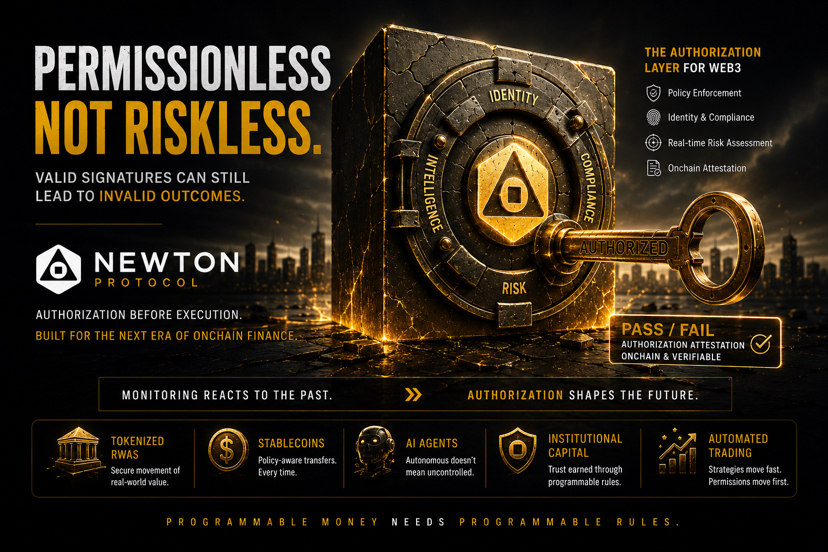
Programmable money now needs programmable rules.
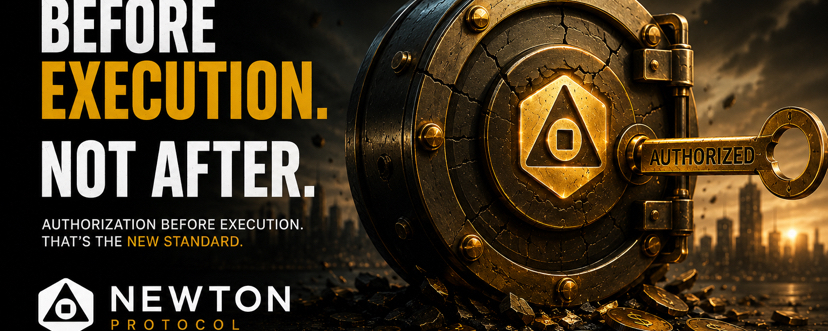
Not after execution.
Before execution.
🚀 This is where Newton Protocol enters the picture.
Newton Protocol ($NEWT ) is building what could become Web3’s equivalent of an authorization network.
Not another monitoring dashboard.
Not another alert system.
An Authorization Layer that evaluates transactions before settlement using programmable policies.
It can evaluate:
🪪 Identity & eligibility
🛡️ Compliance requirements
🧠 Security intelligence
⚠️ Risk controls & spending limits
🌐 Jurisdictional policies
🤖 Guardrails for AI-driven strategies and automated trading
Instead of asking only:
“Is this signature valid?”
Newton asks:
“Does this transaction satisfy the rules that were defined?”
The result is an onchain Pass/Fail Authorization Attestation that smart contracts can verify before allowing execution. It’s designed as a decentralized policy engine that brings real-world context into onchain decision-making while preserving verifiability.
📈 That’s a fundamental shift.
Monitoring tells you what already happened.
Authorization influences what happens next.
One is reactive.
The other is preventative.
As AI agents begin executing financial strategies and institutions move larger pools of capital onchain, this distinction becomes increasingly important.
💡 Crypto spent the last 15 years making finance permissionless.
The next 15 years may be about making permissions programmable.
Not to reduce openness.
But to enable trust at scale.
Do you believe blockchain’s next breakthrough is faster execution… or smarter authorization?
 #Newt @NewtonProtocol $NEWT #NEWT
