


I used to think the future of AI would be measured by one number: how much more it could do than humans.
Then I caught myself asking the wrong question.
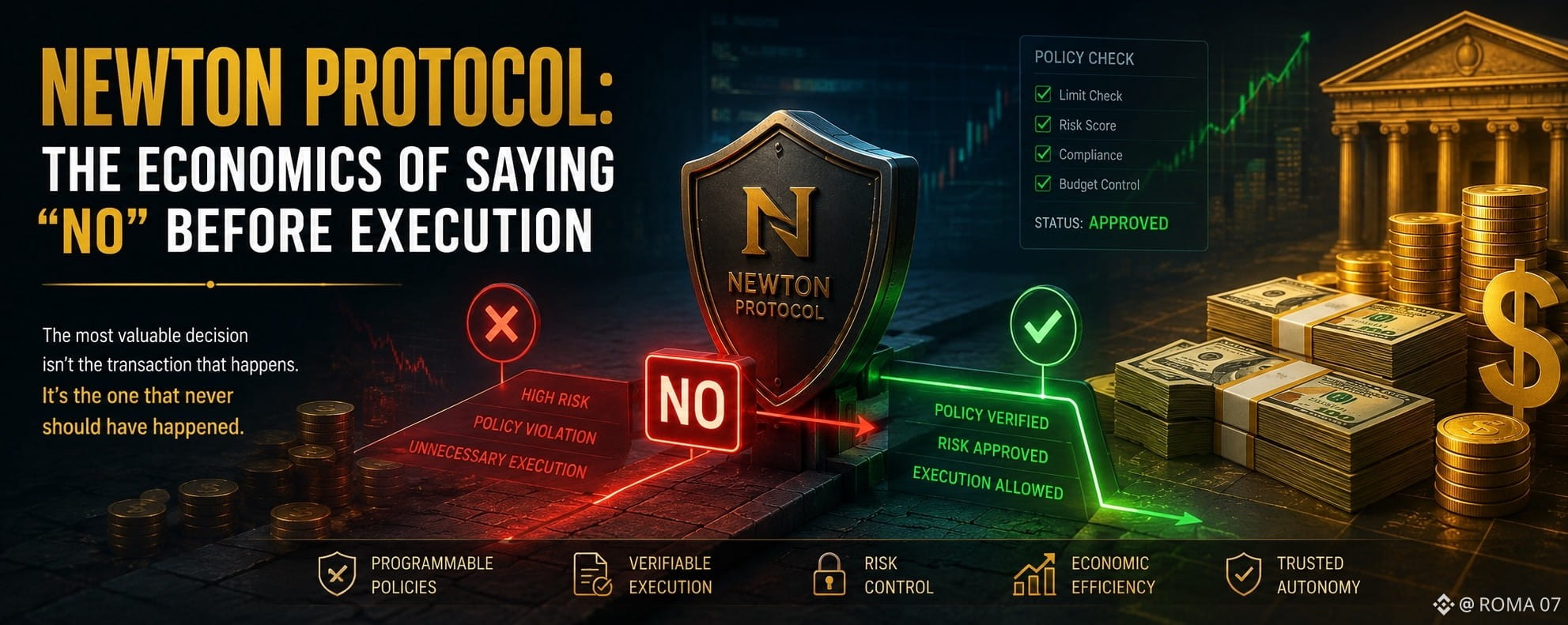
The real question isn’t how many decisions an AI can make. It’s how many decisions it should refuse to execute.
That shift completely changed how I looked at Newton Protocol.
We’re entering a world where AI won’t just recommend actions. It’ll move assets, manage treasuries, coordinate smart contracts, and interact with financial infrastructure without waiting for someone to click “Confirm.” That’s exciting—but it’s also where the cost of a bad decision changes dramatically.
A chatbot giving a wrong answer is annoying.
An autonomous agent making a wrong on-chain decision can be expensive.
Once value moves across a blockchain, there’s rarely an undo button. That’s why I’ve started thinking less about the intelligence of AI and more about the economics of restraint.
Every unnecessary transaction has a hidden price.
It’s not just gas fees. It’s wasted liquidity, increased operational risk, broken user confidence, and time spent recovering from mistakes that never needed to happen. Most people calculate the cost of execution. Far fewer calculate the value of preventing execution in the first place.
That’s where Newton Protocol feels different.
Instead of assuming an AI recommendation automatically deserves authority, the protocol introduces programmable policies that define when execution is allowed—and when it isn’t. Those decisions can then be backed by cryptographic attestations, creating evidence that predefined conditions were satisfied before anything reached the blockchain.
I don’t see that as adding friction.
I see it as filtering out unnecessary risk.
It reminds me of something traditional finance learned decades ago. Banks don’t create approval systems because they enjoy slowing people down. They do it because preventing one costly mistake is often cheaper than fixing hundreds after they’ve already happened.
AI-driven finance faces a similar reality.
The smarter autonomous systems become, the more valuable good judgment becomes. And good judgment isn’t measured by how often a system acts. Sometimes it’s measured by how confidently it decides not to act.
That’s an economic advantage that rarely gets discussed.
Developers spend countless hours building safeguards around automated applications. If policy verification becomes part of the underlying infrastructure instead of something every team has to reinvent, builders can spend more time improving products and less time recreating security logic from scratch.
That changes incentives across the ecosystem.
Applications become easier to trust. Organizations gain clearer governance. Users gain stronger confidence that autonomous software isn’t operating without boundaries. Those benefits don’t appear in transaction counts, yet they may become some of the most valuable metrics over time.
What also stands out to me is that Newton Protocol doesn’t seem obsessed with making AI more powerful. It appears more interested in making AI more accountable.
To me, that’s a healthier direction.
History rarely rewards technologies that simply move faster. It rewards technologies that reduce uncertainty. Blockchain reduced uncertainty around ownership through cryptographic verification. Newton Protocol explores whether autonomous execution can be held to the same standard.
The more I think about it, the more I believe the next generation of AI infrastructure won’t compete over who can automate the most.
It’ll compete over who creates the highest confidence in automation.
Because in finance—and eventually across Web3—the most valuable decision may not be the transaction that happens.
It may be the one that never should have happened at all.
That’s why the economics of saying “no” before execution might become one of Newton Protocol’s most underrated ideas.