
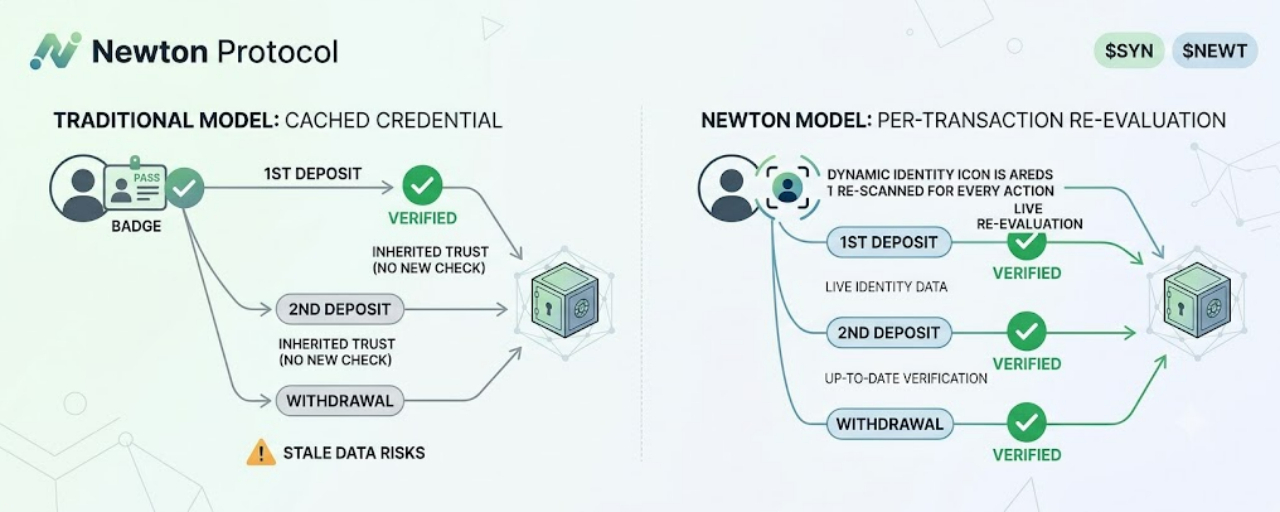
I spent a weekend testing Newton's identity domain against a vault I'd set up myself in a sandbox environment, one configured to require investor eligibility verification before any deposit or withdrawal could go through. My plan was simple and a little adversarial: verify once, then see how far I could push the system on actions that should have required re-checking. I wanted to find the gap.
The entry point was deliberately mundane. I connected a wallet, ran through the eligibility check Newton's identity policy required, and got approved. Nothing dramatic, the same flow anyone deploying real capital into a regulated vault would go through. I deposited a small amount, watched the transaction clear, and started planning the part I actually cared about: what happens on the next action, the one I assumed would just inherit the trust from the first check.
What actually happened surprised me, mostly because of how unsurprising it should have been if I'd thought about Newton's architecture more carefully before testing it. I attempted a withdrawal a few hours later, expecting it to pass through quickly since I'd already verified. Instead, the policy re-evaluated eligibility as part of that specific transaction, checking the same conditions again rather than treating my earlier approval as a permanent credential. It wasn't a friction-heavy process, the check ran in the background as part of the transaction's authorization, but it was a real re-evaluation, not a cached "already verified" flag waved through automatically.
I tried a second test after that, simulating a jurisdiction change on the same wallet to see if the system would catch a credential that had effectively gone stale between my deposit and my next action. It did. The withdrawal that would have cleared under my original eligibility status got blocked under the updated one, evaluated fresh, at the moment of the transaction, not against whatever status I'd had hours earlier when I first connected.
The turn for me wasn't the blocking itself, plenty of systems can block a transaction. It was realizing the architecture treats identity as a condition checked at the moment of every action, not a badge issued once and trusted indefinitely. Most onchain identity systems I've tested work like a front desk: verify at the door, hand someone a pass, and let them move freely after that. Newton's identity domain works more like a building where the elevator itself won't open for the wrong floor, no matter how long ago the badge was issued or how legitimate it looked at the time.
This matters more than it sounds like it should, because the failure mode it prevents is exactly the kind of thing that doesn't show up in a demo or a pitch deck, it shows up months later, when a credential has quietly gone stale and nobody noticed because the system never bothered checking again. A front-desk model is convenient until the moment someone's jurisdiction changes, or their verification tier lapses, or a regulatory requirement shifts, and the system has no mechanism to catch any of it because it stopped looking after the first approval.
The honest trade-off I noticed during testing is friction. Re-evaluating eligibility on every transaction adds a small step a one-time verification model skips entirely, and for a vault processing high transaction volume, that overhead is a real cost, not a hypothetical one. Whether that friction is worth the security it buys depends entirely on what's actually at stake in a given vault, a low-stakes strategy might reasonably tolerate a lighter-touch model, while a regulated RWA vault almost certainly shouldn't.
There's also a question I couldn't fully answer from a sandbox environment alone: how the identity domain behaves when multiple conditions interact at once, a jurisdiction change happening at the same moment a verification tier is mid-renewal, say, rather than the clean single-variable tests I ran. Real users don't change one credential at a time in a controlled order, they accumulate messy, overlapping changes, and a system that handles a single clean test case well doesn't automatically handle three overlapping edge cases the same way. That's the part no weekend of sandbox testing can fully settle, and it's the part that matters most once real capital and real users are involved instead of a deliberately adversarial test account.
Newton Protocol's identity domain evaluates eligibility as a live condition tied to each transaction rather than a credential trusted indefinitely after a single check, which is a structurally different model from how most onchain identity verification still works today. What I still don't know after a weekend of testing is how that re-evaluation overhead scales once a vault is processing thousands of transactions an hour instead of the handful I ran through a sandbox.