
In 2026, Dusk Foundation takes a decisive step forward with the launch of DuskEVM, introducing an Ethereum-compatible execution layer that embeds zero-knowledge privacy directly into a production Layer 1. The result is a blockchain environment where real-world assets can be issued, traded, and settled under full regulatory alignment without exposing sensitive financial data. I see this moment as a structural shift rather than an incremental upgrade: developers retain Ethereum familiarity, institutions gain confidentiality, and regulated RWAs finally move on-chain without compromise.
This article explores how DuskEVM reshapes RWA tokenization by uniting Solidity compatibility, native privacy, MiCA-aligned compliance primitives, and institutional-grade performance positioning Dusk as a serious alternative to Ethereum’s increasingly fragmented L1/L2 landscape.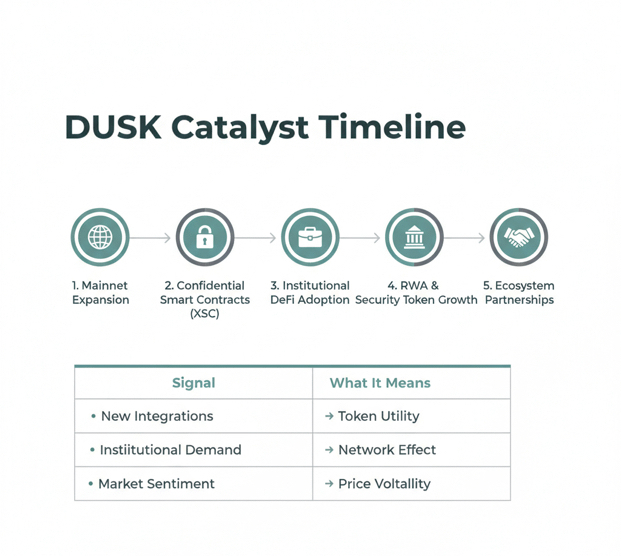
Ethereum Compatibility Without Transparency Tradeoffs
DuskEVM goes live in early 2026 as a fully Ethereum-compatible environment that allows Solidity smart contracts to run without modification. Through LLVM-based compilation, existing Ethereum bytecode is transformed to execute inside Dusk’s zero-knowledge virtual machine. From a developer’s perspective, the workflow feels familiar: the same tooling, the same contract logic, and the same deployment patterns. The difference lies beneath the surface.
Where Ethereum exposes balances, positions, and transaction flows by default, DuskEVM encrypts them. Contract state, transfer amounts, and user positions remain shielded through PLONK proofs that validators verify without ever revealing the underlying data. For RWAs, this changes everything. Issuers no longer leak capitalization structures, investors avoid broadcasting trade sizes, and funds operate without advertising strategy to competitors or MEV bots.
This privacy-first execution also eliminates the need for complex wrappers or off-chain compliance layers that dominate Ethereum-based RWA deployments today. What runs on DuskEVM is private by design, not by add-on.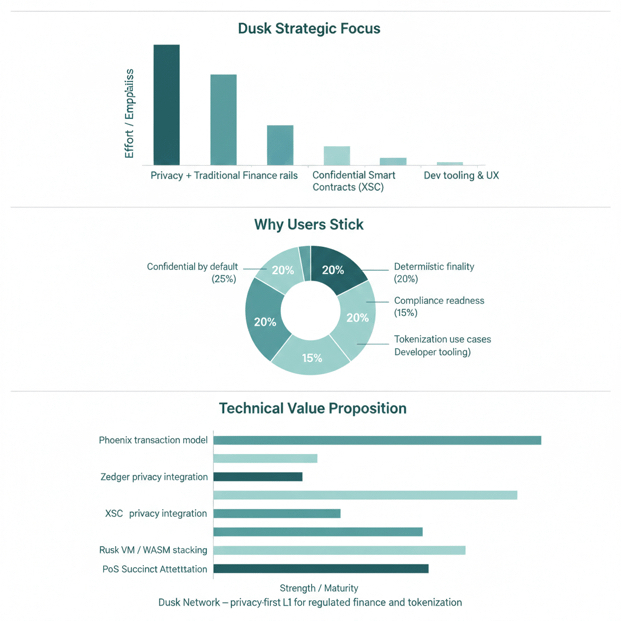
RWA-Native Contracts Built for Regulation
At the core of Dusk’s RWA strategy is a contract standard designed specifically for regulated assets. Confidential security tokens enforce investor eligibility, lock-up periods, and issuer controls directly within shielded smart contracts. Ownership thresholds are proven cryptographically, not displayed publicly. Revenue distributions occur privately, yet remain verifiable when required.
On Ethereum, similar logic exists only through transparent standards or centralized enforcement. On DuskEVM, compliance becomes programmable and invisible at the same time. Issuers can prove that rules are followed without disclosing who holds what, or in what size. For institutions operating under MiCA and GDPR constraints, this combination is not optional—it is foundational.
Compliance as a Native Blockchain Feature
Dusk’s compliance layer replaces traditional identity disclosure with zero-knowledge credentials. Users prove attributes such as jurisdiction, accreditation, or KYC status without revealing personal information. These proofs execute on-chain during minting and settlement, creating cryptographic compliance rather than administrative compliance.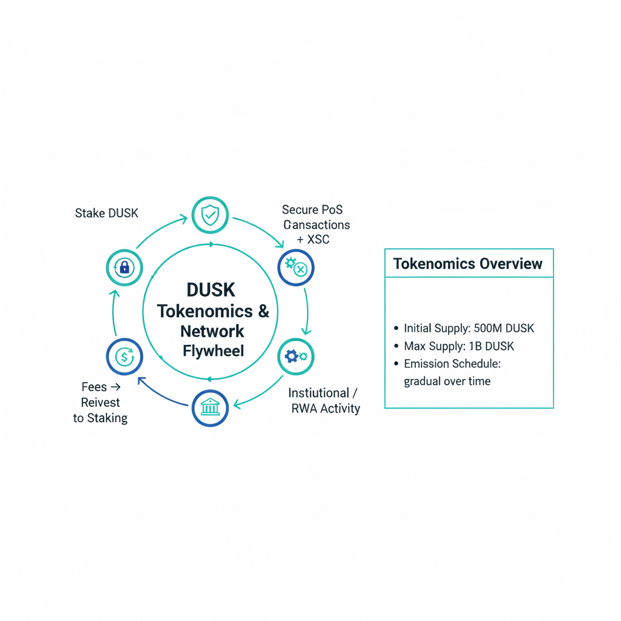
Regulators retain access through selective disclosure. Audit trails can be reconstructed after the fact using viewing keys, allowing oversight without real-time surveillance. Compared to Ethereum’s reliance on external oracles and centralized KYC providers, DuskEVM internalizes regulation into protocol logic, reducing trust assumptions and operational overhead.
Regulated Markets Through NPEX
The partnership with NPEX anchors DuskEVM in Europe’s regulated financial system. Through this collaboration, a pipeline exceeding €300 million in SME equity, bonds, and venture instruments is prepared for issuance and secondary trading. These assets operate under licensed MTF and ECSP frameworks, with compliance enforced at the smart contract level.
Secondary markets scheduled for mid-2026 enable continuous trading of tokenized securities with instant settlement. Unlike Ethereum-based RWAs that rely on offshore structures or limited jurisdictions, Dusk assets are designed to trade legally within the EU from day one. This distinction matters as institutions increasingly demand regulatory certainty alongside innovation.
Oracles, Stable Settlement, and Composability
DuskEVM integrates trusted oracle infrastructure to feed market data into confidential contracts without breaking privacy guarantees. Pricing, NAV calculations, and benchmark references enter shielded environments securely, enabling sophisticated financial products such as private funds and yield-bearing instruments.
Settlement occurs in euro-denominated stable assets aligned with MiCA, removing FX exposure and simplifying accounting for European issuers. Cross-chain interoperability preserves privacy attributes when assets interact with external ecosystems, avoiding the dilution that typically occurs when moving RWAs between chains.
Performance Without Layer 2 Friction
From a technical standpoint, DuskEVM operates where Ethereum struggles most. Transactions finalize in under a second with throughput exceeding 2,000 TPS, all on a single Layer 1. There are no seven-day withdrawal windows, no sequencer risks, and no fragmented liquidity across rollups.
Costs reflect this efficiency. Shielded RWA transactions execute for fractions of a cent, even during peak usage. In contrast, Ethereum L1 remains vulnerable to congestion spikes, and L2 solutions introduce operational complexity that institutions must explain to auditors and regulators. Dusk’s architecture simplifies the stack by keeping execution, settlement, and privacy on one layer.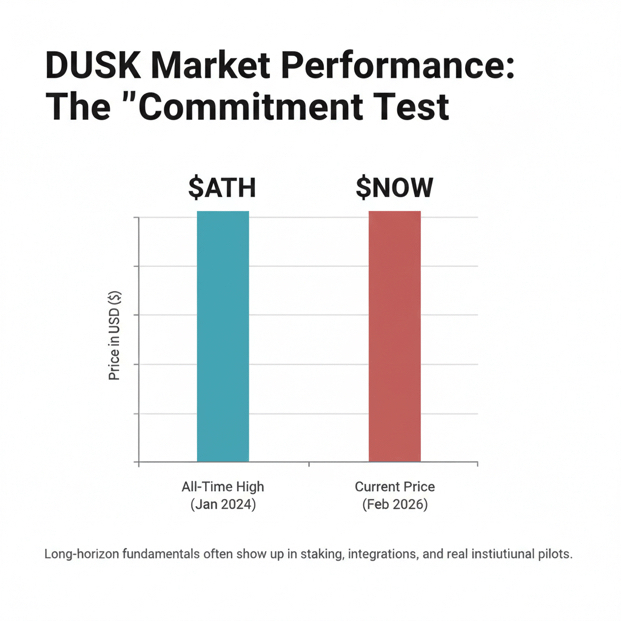
Familiar Tooling for Immediate Adoption
Despite its advanced cryptography, DuskEVM does not impose a steep learning curve. Solidity developers deploy with existing frameworks, wallets integrate without special handling, and infrastructure providers support standard workflows. Grants and ecosystem funding accelerate the development of privacy-native DeFi, confidential trading venues, and RWA-focused applications.
This ease of migration is not a minor detail. It determines whether Ethereum-native teams can move quickly enough to meet institutional demand without retraining entire engineering organizations.
Economic Alignment for Institutional Use
The DUSK token underpins the network as gas, staking collateral, and governance asset. Activity tied to RWA issuance and settlement generates fees that feed directly into network security and long-term sustainability. Staking yields align validators with institutional uptime expectations, while fee dynamics link token value to real economic throughput rather than speculative cycles.
A New Standard for Tokenized Finance
DuskEVM reframes what Ethereum compatibility can mean. Instead of replicating Ethereum’s transparency and layering privacy on top, it inverts the model: privacy first, transparency only when justified. With regulated markets live, developer tooling in place, and performance suited for real financial flows, Dusk positions itself as Europe’s confidential settlement layer for tokenized assets.
As trillions in RWAs move on-chain over the coming decade, institutions will gravitate toward environments that respect both regulation and competitive discretion. DuskEVM answers that demand directly, raising a final question that lingers: when sensitive assets finally go on-chain at scale, will public execution remain acceptable, or will confidential infrastructure become the new default?
