
Elon Jamess
19.5k منشورات

Elon Jamess
 تحقُّق Binance Square الإضافي
Dream big trust big move big and your outcomes will grow big too.✨ BINANCE creator👇

Traders League Badge Expert
مُتداول مُتكرر
2.4 سنوات
53 تتابع
58.0K+ المتابعون
86.6K+ إعجاب
1 الشارات
منشورات
الكل
اقتباسات
مقاطع فيديو
Live
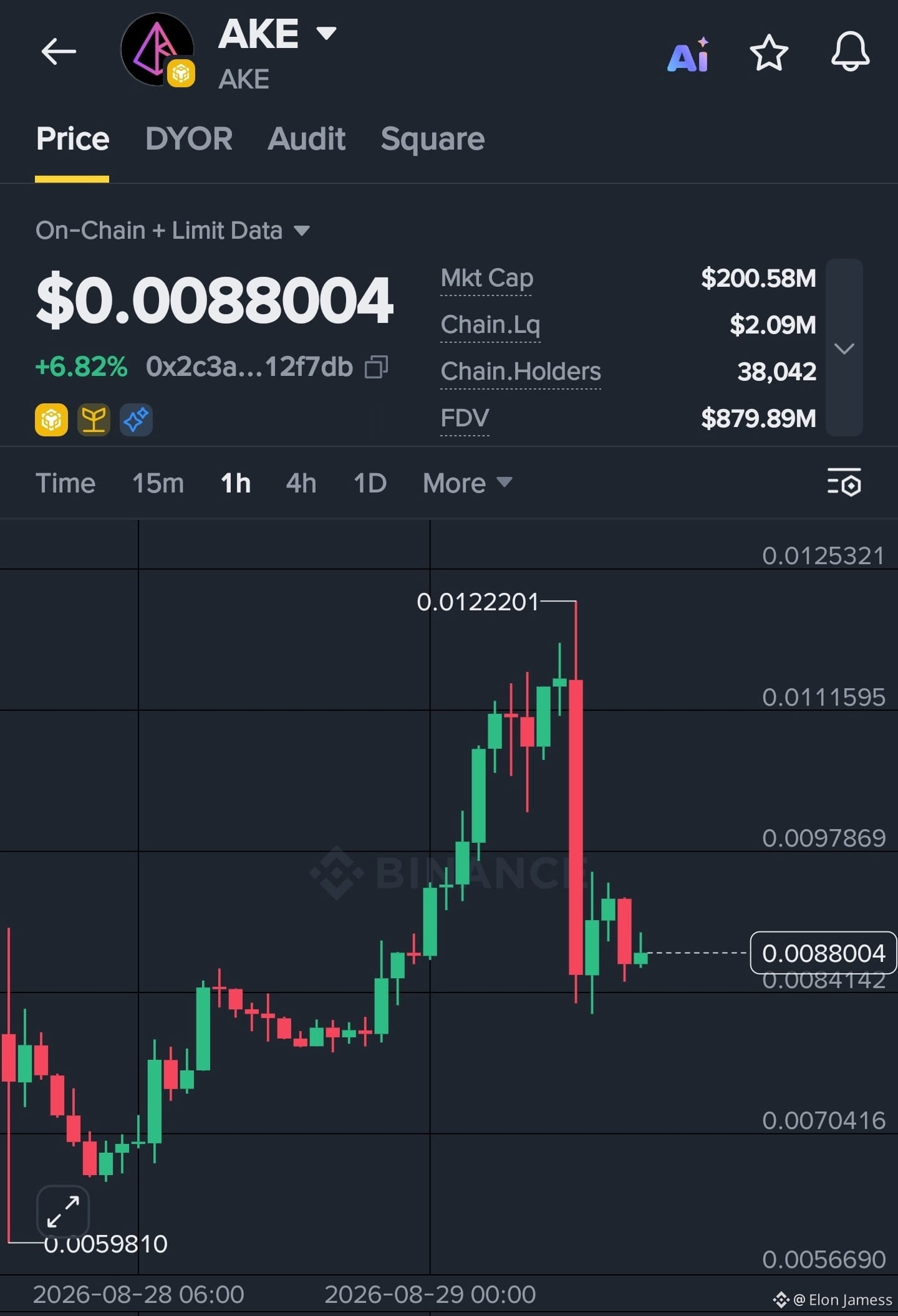
$AKE is showing an interesting setup on the 1H chart 👀
After pushing from around $0.006 to $0.0122, AKE saw a sharp rejection and pulled back toward the $0.0084 support area.
Right now, price is around $0.0088, and this zone is important.
Key levels: • Support: $0.0084 • Resistance: $0.0098 • Next resistance: $0.0111 • Major high: $0.0122
If $AKE can hold $0.0084 and reclaim $0.0098 with volume, a move back toward $0.0111–$0.0122 could become interesting.
But if $0.0084 breaks decisively, the chart could see further downside.
For me, the key thing to watch is how price reacts around $0.0084–$0.0098, rather than chasing the move after a big pump.
Educational only. Not financial advice. DYOR.
#ALPHA🔥
After pushing from around $0.006 to $0.0122, AKE saw a sharp rejection and pulled back toward the $0.0084 support area.
Right now, price is around $0.0088, and this zone is important.
Key levels: • Support: $0.0084 • Resistance: $0.0098 • Next resistance: $0.0111 • Major high: $0.0122
If $AKE can hold $0.0084 and reclaim $0.0098 with volume, a move back toward $0.0111–$0.0122 could become interesting.
But if $0.0084 breaks decisively, the chart could see further downside.
For me, the key thing to watch is how price reacts around $0.0084–$0.0098, rather than chasing the move after a big pump.
Educational only. Not financial advice. DYOR.
#ALPHA🔥
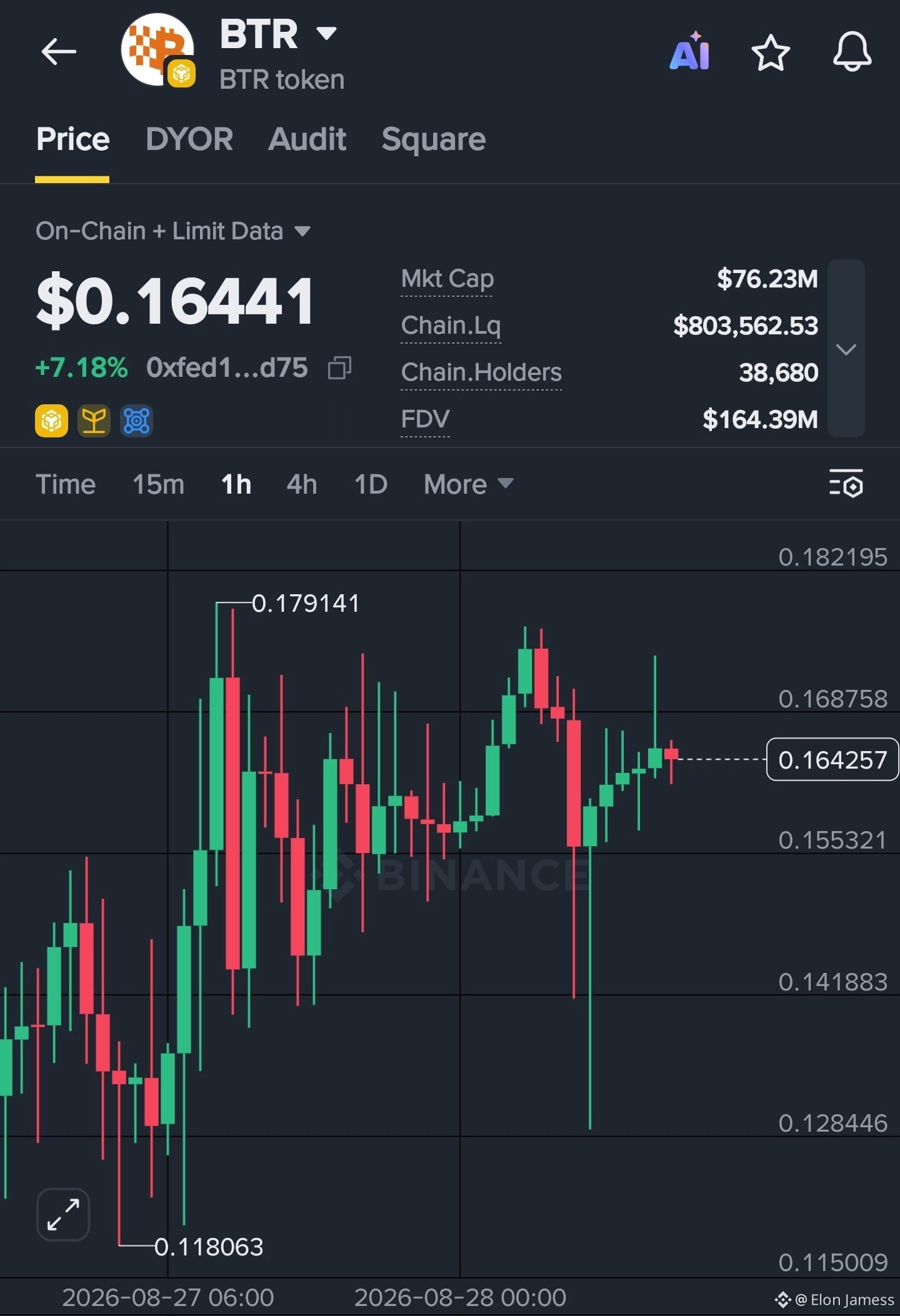
$BTR is showing an interesting setup right now 👀
BTR is trading around $0.1644, up roughly 7.18%, with a market cap of around $76.2M.
On the 1H chart, price has bounced strongly from the recent $0.128 area and is now holding above the $0.155 zone.
Key levels I’m watching: → Support: $0.155
→ Resistance: $0.168–$0.179
→ Recent high: $0.1791
The next move could depend on whether BTR can hold above $0.155 and push through the $0.168 resistance.
Volume, liquidity and holder distribution are also worth checking before making any decision.
Interesting chart, but confirmation matters more than chasing candles. DYOR.
#ALPHA🔥
BTR is trading around $0.1644, up roughly 7.18%, with a market cap of around $76.2M.
On the 1H chart, price has bounced strongly from the recent $0.128 area and is now holding above the $0.155 zone.
Key levels I’m watching: → Support: $0.155
→ Resistance: $0.168–$0.179
→ Recent high: $0.1791
The next move could depend on whether BTR can hold above $0.155 and push through the $0.168 resistance.
Volume, liquidity and holder distribution are also worth checking before making any decision.
Interesting chart, but confirmation matters more than chasing candles. DYOR.
#ALPHA🔥
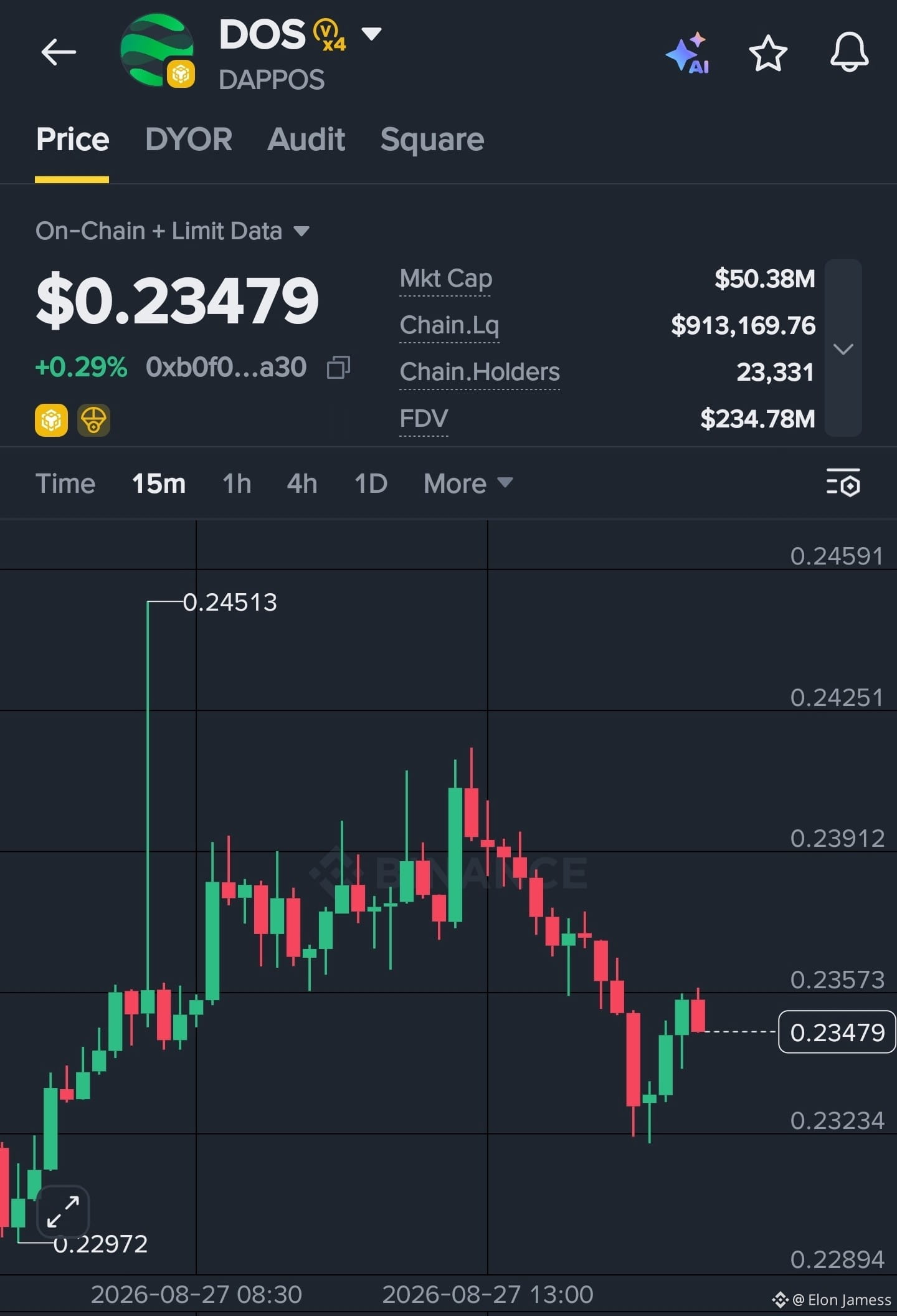
$DOS is showing an interesting setup right now.
The token is trading around $0.2348, with a market cap near $50.4M and over 23K holders.
On the 15M chart, price recently pushed up toward $0.2451 before facing resistance and pulling back toward the $0.2323–$0.2340 area.
What I’m watching now:
→ Can DOS hold the current support zone?
→ Can buyers reclaim $0.2391?
→ A move above $0.2451 could change the short-term structure.
→ Losing the $0.2323 area could bring more downside pressure.
For me, the key is not chasing the candle. The next confirmation matters more than the current move.
DYOR. Educational only, not financial advice.
#ALPHA🔥
The token is trading around $0.2348, with a market cap near $50.4M and over 23K holders.
On the 15M chart, price recently pushed up toward $0.2451 before facing resistance and pulling back toward the $0.2323–$0.2340 area.
What I’m watching now:
→ Can DOS hold the current support zone?
→ Can buyers reclaim $0.2391?
→ A move above $0.2451 could change the short-term structure.
→ Losing the $0.2323 area could bring more downside pressure.
For me, the key is not chasing the candle. The next confirmation matters more than the current move.
DYOR. Educational only, not financial advice.
#ALPHA🔥
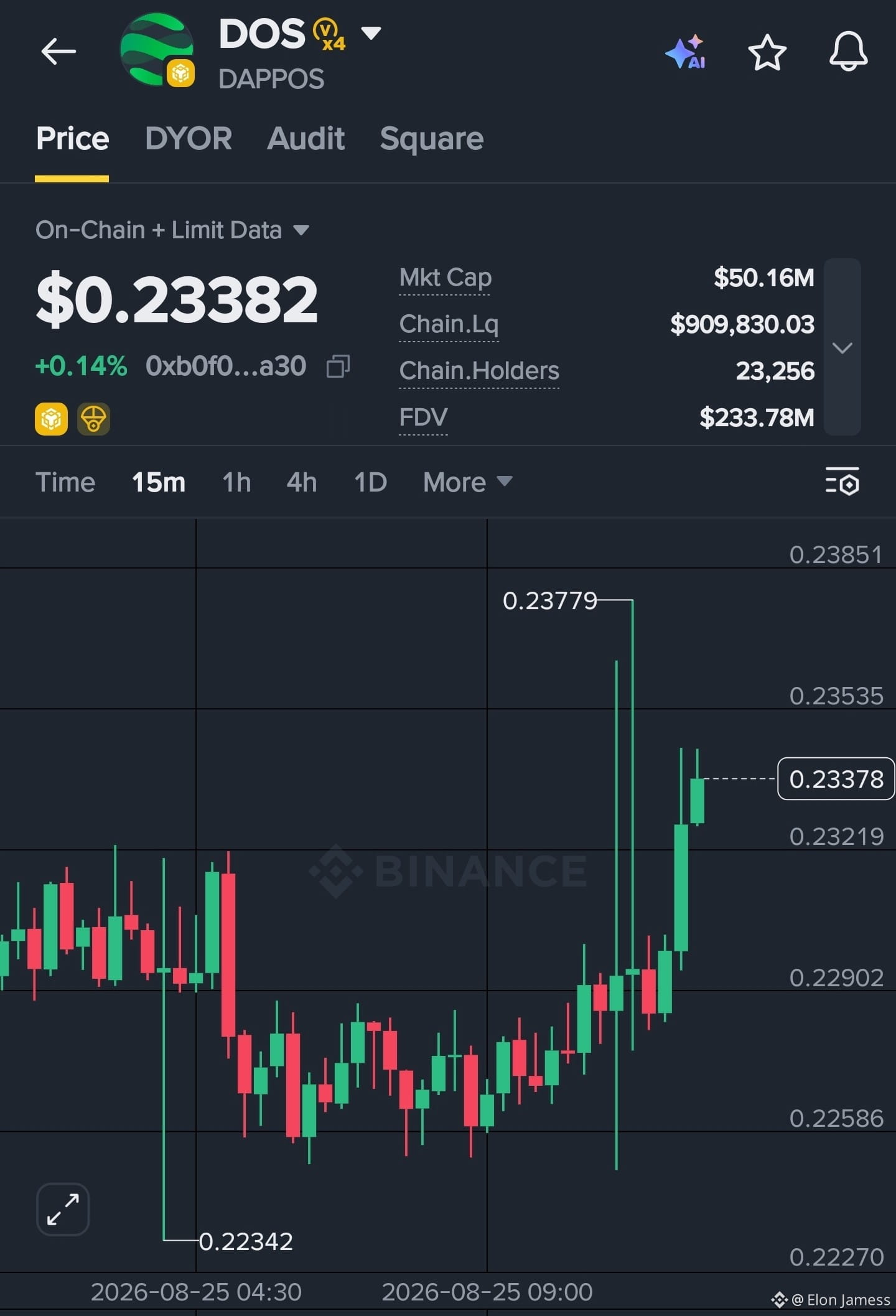
$DOS is showing some interesting price action on the 15M chart 👀
Price is currently around $0.2338 after briefly touching $0.23779.
Short-term momentum is clearly picking up.
The key level to watch is $0.23219.
If DOS can hold above this area, it could indicate that buyers are maintaining control in the short term.
On the upside, $0.2378 is the next important zone.
A clean breakout and hold above this level could bring stronger momentum.
But if price falls back below $0.2290, the current setup could weaken.
The chart looks interesting, but short timeframes can move fast and create plenty of noise.
Don’t chase candles. Watch the key levels and manage your risk.
DYOR Educational only, not financial advice.
#ALPHA🔥
Price is currently around $0.2338 after briefly touching $0.23779.
Short-term momentum is clearly picking up.
The key level to watch is $0.23219.
If DOS can hold above this area, it could indicate that buyers are maintaining control in the short term.
On the upside, $0.2378 is the next important zone.
A clean breakout and hold above this level could bring stronger momentum.
But if price falls back below $0.2290, the current setup could weaken.
The chart looks interesting, but short timeframes can move fast and create plenty of noise.
Don’t chase candles. Watch the key levels and manage your risk.
DYOR Educational only, not financial advice.
#ALPHA🔥
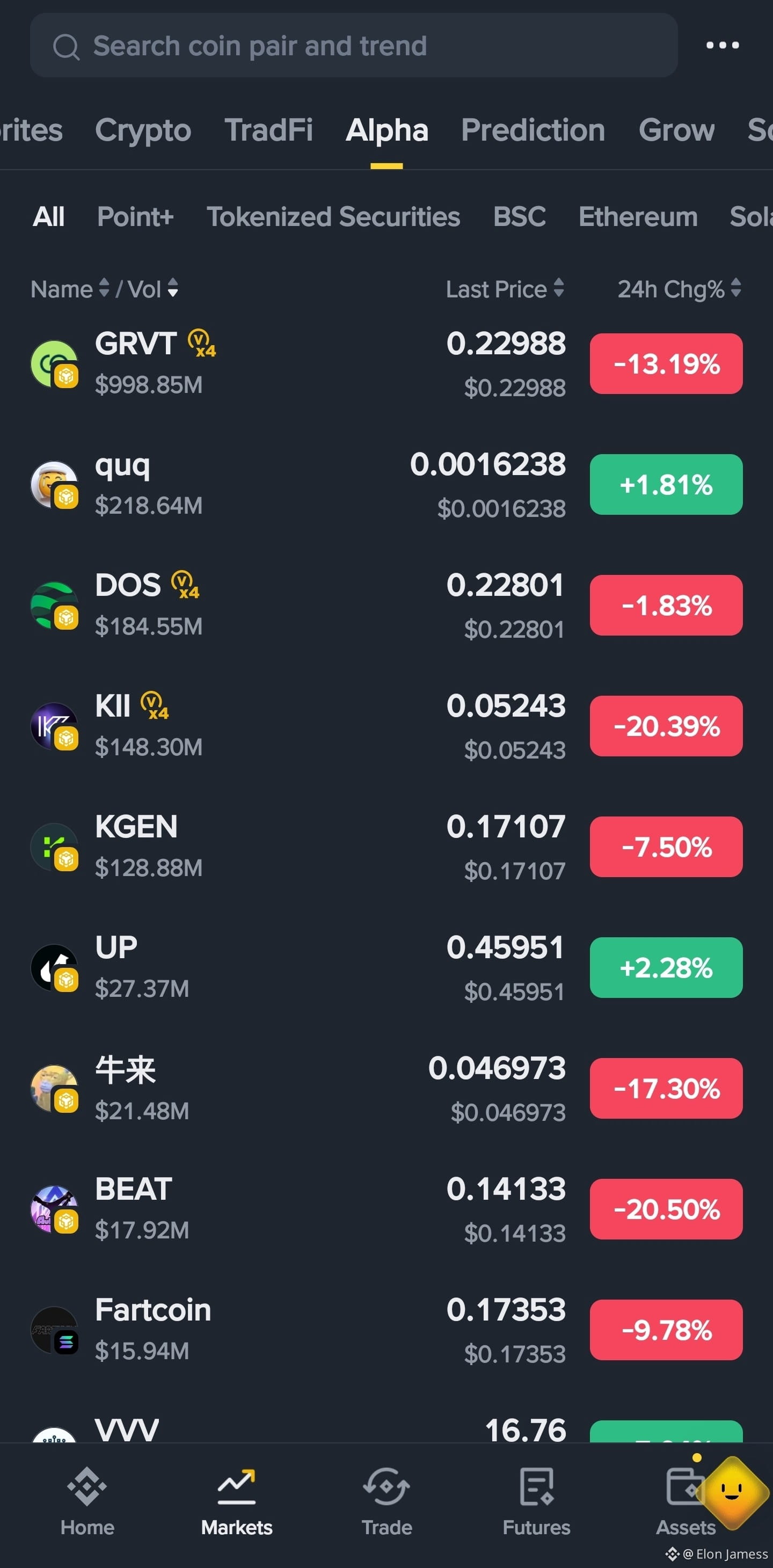
Crypto Alpha is looking rough right now
A quick look at the market shows heavy selling across several tokens.
$GRVT is down 13.19%
$KII is down 20.39%
$BEAT is down 20.50%
$牛来 is down 17.30%
$KGEN is down 7.50%
$Fartcoin is down 9.78%
Not everything is red though 👀
QUQ is +1.81%
UP is +2.28%
This is a good reminder that the Alpha market can move extremely fast.
Green candles can attract attention, but sharp red moves can come just as quickly. Instead of chasing whatever is moving, I’d focus on volume, liquidity, and how price behaves after the initial move.
Crypto rewards patience more than FOMO.
#ALPHA🔥
A quick look at the market shows heavy selling across several tokens.
$GRVT is down 13.19%
$KII is down 20.39%
$BEAT is down 20.50%
$牛来 is down 17.30%
$KGEN is down 7.50%
$Fartcoin is down 9.78%
Not everything is red though 👀
QUQ is +1.81%
UP is +2.28%
This is a good reminder that the Alpha market can move extremely fast.
Green candles can attract attention, but sharp red moves can come just as quickly. Instead of chasing whatever is moving, I’d focus on volume, liquidity, and how price behaves after the initial move.
Crypto rewards patience more than FOMO.
#ALPHA🔥
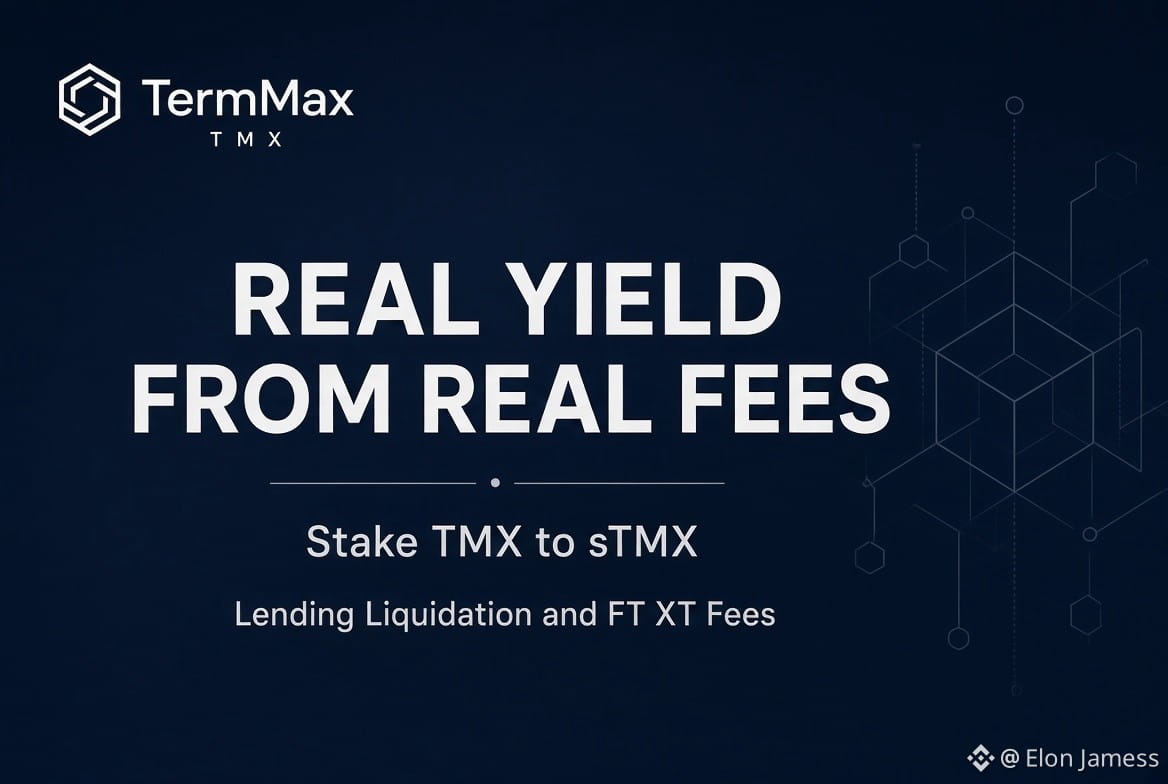
TermMax Locks August 25 for TMX and the Split Feels Steady
TermMax finally locked the TGE date for August 25. Total supply sits at one billion tokens fixed. Around twenty percent starts circulating at launch. Team and investors both face a twelve month cliff. Ecosystem takes twenty nine percent. Investors get twenty eight. Community gets fifteen.
The split looks plain. No low float games to pump day one price. No huge community dump either. It feels like they kept a long incentive budget for years ahead instead of chasing quick chart moves.
What matters more is the fee side. You stake TMX and get sTMX. Rewards come from real protocol money like lending fees liquidation fees and FT XT trading fees. That is different from a plain governance token that only lets you vote now and then.
The open question is whether nineteen thousand dollars in monthly protocol revenue can one day support a token with real yield. Fixed rate DeFi still needs volume first before the token can carry real weight.
@TermMax #TermMax
TermMax finally locked the TGE date for August 25. Total supply sits at one billion tokens fixed. Around twenty percent starts circulating at launch. Team and investors both face a twelve month cliff. Ecosystem takes twenty nine percent. Investors get twenty eight. Community gets fifteen.
The split looks plain. No low float games to pump day one price. No huge community dump either. It feels like they kept a long incentive budget for years ahead instead of chasing quick chart moves.
What matters more is the fee side. You stake TMX and get sTMX. Rewards come from real protocol money like lending fees liquidation fees and FT XT trading fees. That is different from a plain governance token that only lets you vote now and then.
The open question is whether nineteen thousand dollars in monthly protocol revenue can one day support a token with real yield. Fixed rate DeFi still needs volume first before the token can carry real weight.
@TermMax #TermMax
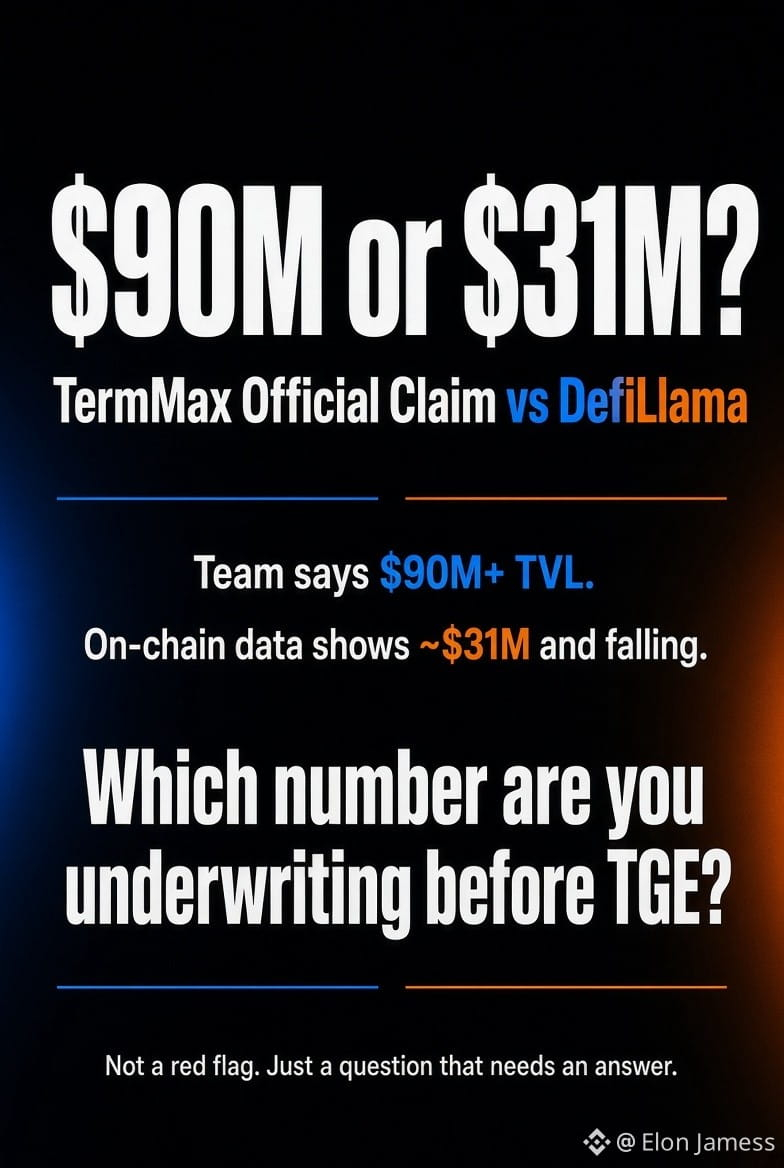
Two Stories on TermMax TVL Right Before TGE
I used to trust TermMax official stats until I lined up their TGE note next to DefiLlama. The team claims over 90 million TVL.
DefiLlama shows about 31 million locked on chain and that number fell more than 7 percent last month. This is no small gap. It feels like two separate tales about the same protocol. Maybe they add up all past deposits or campaign wallets or a wider time frame.
Or DefiLlama could be missing some chains. Neither idea has been spelled out clearly with five days left till TGE.
Fees sit near 20 thousand over 30 days which works out to around 310 thousand yearly revenue. Okay for a focused lending setup yet not strong enough alone to back that big TVL claim.
I am not waving a red flag. I just think the team should clear this up before the token trades and sharper eyes start checking every figure. Which number are you using for your allocation?
@TermMax #TermMax
I used to trust TermMax official stats until I lined up their TGE note next to DefiLlama. The team claims over 90 million TVL.
DefiLlama shows about 31 million locked on chain and that number fell more than 7 percent last month. This is no small gap. It feels like two separate tales about the same protocol. Maybe they add up all past deposits or campaign wallets or a wider time frame.
Or DefiLlama could be missing some chains. Neither idea has been spelled out clearly with five days left till TGE.
Fees sit near 20 thousand over 30 days which works out to around 310 thousand yearly revenue. Okay for a focused lending setup yet not strong enough alone to back that big TVL claim.
I am not waving a red flag. I just think the team should clear this up before the token trades and sharper eyes start checking every figure. Which number are you using for your allocation?
@TermMax #TermMax
Why TermMax TMX Token Numbers Matter More Than The Hype
TermMax just released the TMX whitepaper and the first thing I looked at was the unlock plan. One billion tokens total fixed supply with no new ones ever added. Only twenty percent start circulating at launch. Team and investors both wait a full twelve months before any of their tokens unlock. On paper this setup feels careful. No big insider dumps right away and space left later for ecosystem rewards.
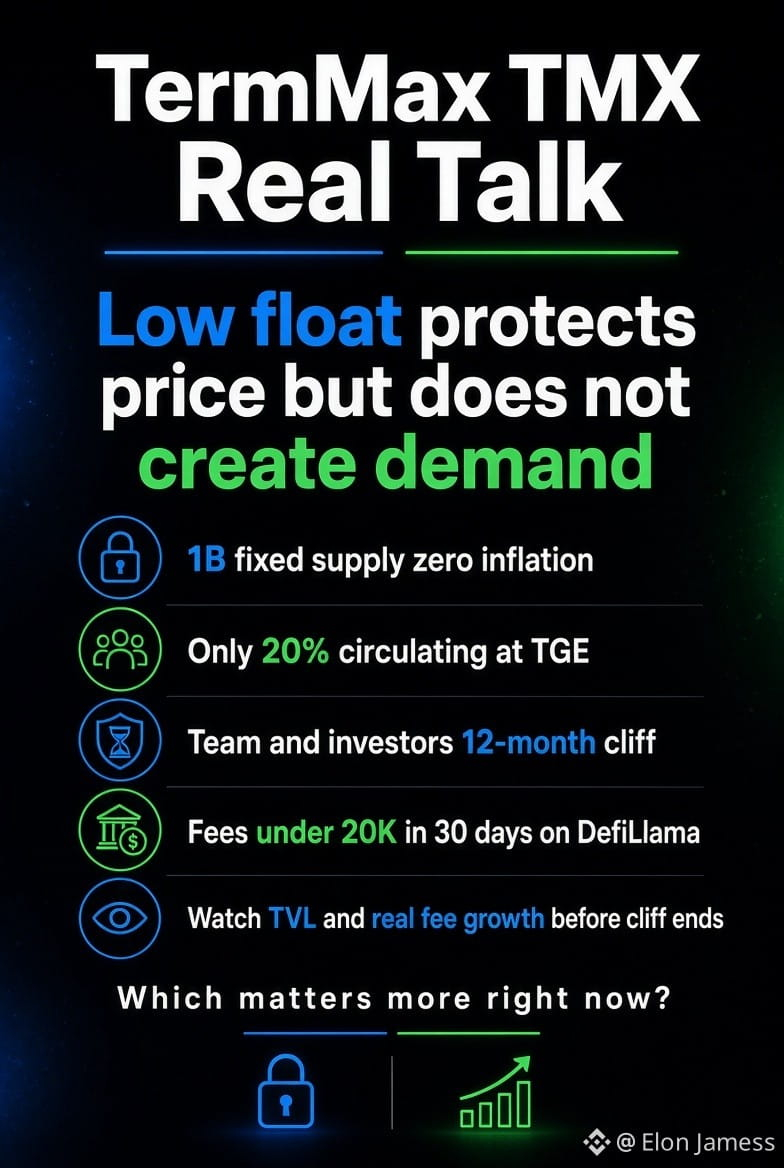
A clean unlock plan still leaves the real question open. sTMX rewards come from actual fees on FT XT trading lending and liquidations. DefiLlama shows the protocol made under twenty thousand dollars in fees over the last thirty days. That is a weak base for any governance token value story. Low float can hold the price steady for a while but it does not create real demand by itself.
What I will watch closely is not the circulating supply. It is whether TVL and fee income grow fast enough to match the token hopes before that twelve month cliff finishes. Low float buys time. Real usage decides if the time counts. Which one matters more right now the schedule or the actual growth.
@TermMax #TermMax
TermMax just released the TMX whitepaper and the first thing I looked at was the unlock plan. One billion tokens total fixed supply with no new ones ever added. Only twenty percent start circulating at launch. Team and investors both wait a full twelve months before any of their tokens unlock. On paper this setup feels careful. No big insider dumps right away and space left later for ecosystem rewards.
A clean unlock plan still leaves the real question open. sTMX rewards come from actual fees on FT XT trading lending and liquidations. DefiLlama shows the protocol made under twenty thousand dollars in fees over the last thirty days. That is a weak base for any governance token value story. Low float can hold the price steady for a while but it does not create real demand by itself.
What I will watch closely is not the circulating supply. It is whether TVL and fee income grow fast enough to match the token hopes before that twelve month cliff finishes. Low float buys time. Real usage decides if the time counts. Which one matters more right now the schedule or the actual growth.
@TermMax #TermMax
TermMax Might Fix the Messy Side of Trading
Trading is not only about picking the right entry. You also need good tools clean data and solid execution the second the market starts moving.
That is the reason TermMax grabbed my attention lately. The team is putting together one ecosystem that joins the main parts of trading in a single spot.
Active traders can handle markets without jumping from one tool to another all the time. I am watching how TermMax keeps growing to see if it really brings the smoother connected feel that traders want every day.
@TermMax #TermMax
Trading is not only about picking the right entry. You also need good tools clean data and solid execution the second the market starts moving.
That is the reason TermMax grabbed my attention lately. The team is putting together one ecosystem that joins the main parts of trading in a single spot.
Active traders can handle markets without jumping from one tool to another all the time. I am watching how TermMax keeps growing to see if it really brings the smoother connected feel that traders want every day.
@TermMax #TermMax
Why TermMax Still Has Me Watching Not Jumping
I quit getting hyped over mainnet dates long ago. So many came and went quiet with nothing left but some Notion list. When TermMax said theirs was set I checked the words twice before I let any interest in.
Most projects here fix issues no one really faces. They invent new yield tricks for yields nobody asked for. TermMax goes after something basic and old. DeFi lending still cannot show you straight if the stuff backing your spot is truly there.
After FTX the usual reply was just wallet screenshots. That feels like proving cash by holding up a picture of your wallet. ZK proof of reserves works different. It shows the numbers add up without opening anything. Not loud or shiny. Just solid and that is rarer than it should be.
I still wonder if fixed rate lending will get real use at big size. Mainnet will show the truth quick. For now I watch and stay clear of buying the full tale.
@TermMax #TermMax
I quit getting hyped over mainnet dates long ago. So many came and went quiet with nothing left but some Notion list. When TermMax said theirs was set I checked the words twice before I let any interest in.
Most projects here fix issues no one really faces. They invent new yield tricks for yields nobody asked for. TermMax goes after something basic and old. DeFi lending still cannot show you straight if the stuff backing your spot is truly there.
After FTX the usual reply was just wallet screenshots. That feels like proving cash by holding up a picture of your wallet. ZK proof of reserves works different. It shows the numbers add up without opening anything. Not loud or shiny. Just solid and that is rarer than it should be.
I still wonder if fixed rate lending will get real use at big size. Mainnet will show the truth quick. For now I watch and stay clear of buying the full tale.
@TermMax #TermMax
Binance Alpha Watchlist 👀
Here are all the coins catching my attention:
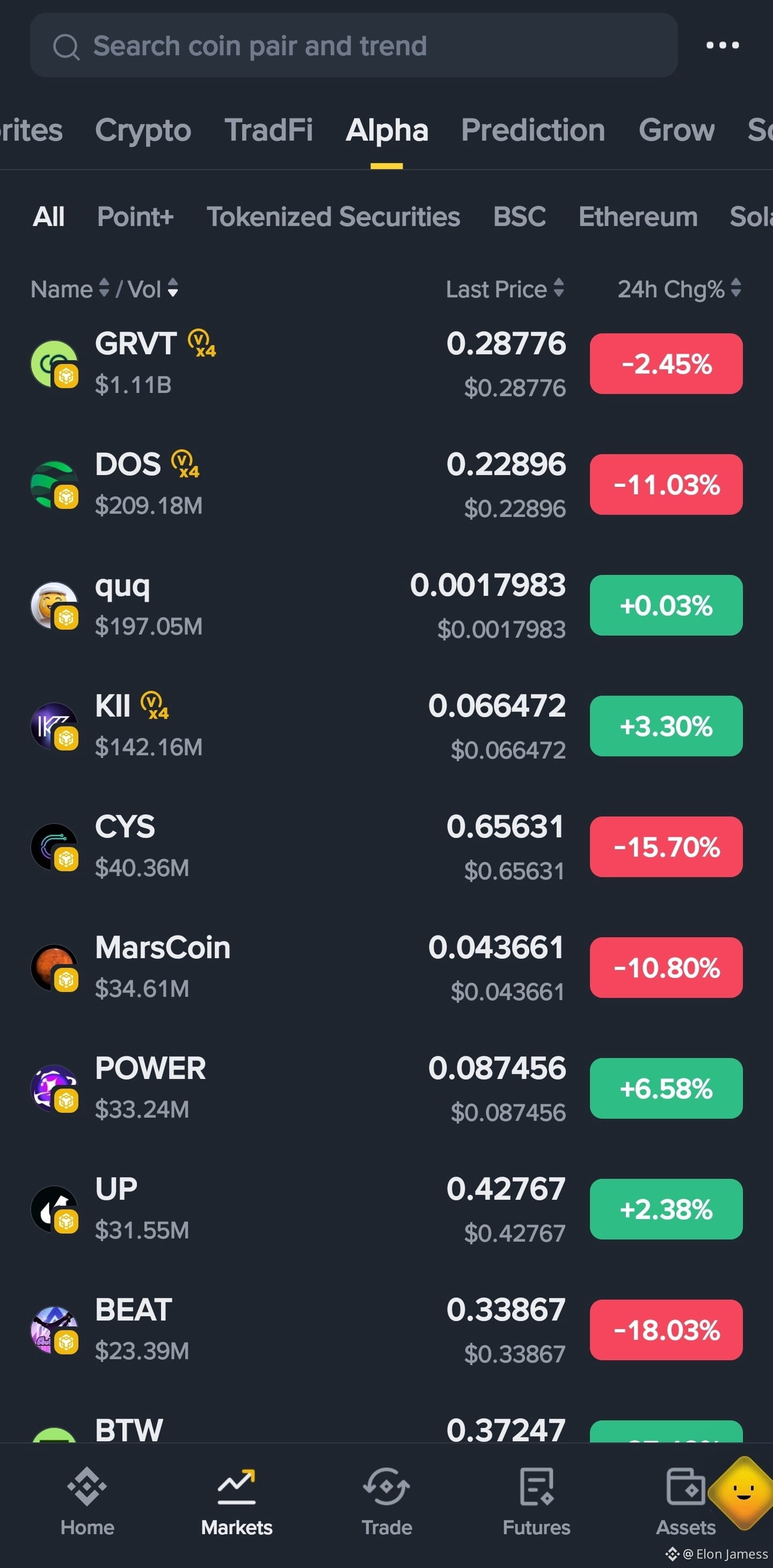
🟢 $GRVT — $1.11B volume | -2.45%
🔴 $DOS — $209.18M | -11.03%
🟢 $quq — $197.05M | +0.03%
🟢 $KII — $142.16M | +3.30%
🔴 $CYS — $40.36M | -15.70%
🔴 $MarsCoin — $34.61M | -10.80%
🟢 $POWER — $33.24M | +6.58%
🟢 $UP — $31.55M | +2.38%
🔴 $BEAT — $23.39M | -18.03%
Alpha is moving fast.
High volume + big moves = opportunity, but also higher risk.
Keep them on the radar and DYOR. 👀
#ALPHA🔥
Here are all the coins catching my attention:
🟢 $GRVT — $1.11B volume | -2.45%
🔴 $DOS — $209.18M | -11.03%
🟢 $quq — $197.05M | +0.03%
🟢 $KII — $142.16M | +3.30%
🔴 $CYS — $40.36M | -15.70%
🔴 $MarsCoin — $34.61M | -10.80%
🟢 $POWER — $33.24M | +6.58%
🟢 $UP — $31.55M | +2.38%
🔴 $BEAT — $23.39M | -18.03%
Alpha is moving fast.
High volume + big moves = opportunity, but also higher risk.
Keep them on the radar and DYOR. 👀
#ALPHA🔥
I’ve been looking deeper into Dusk, and the staking model tells a more interesting story than the usual privacy angle.
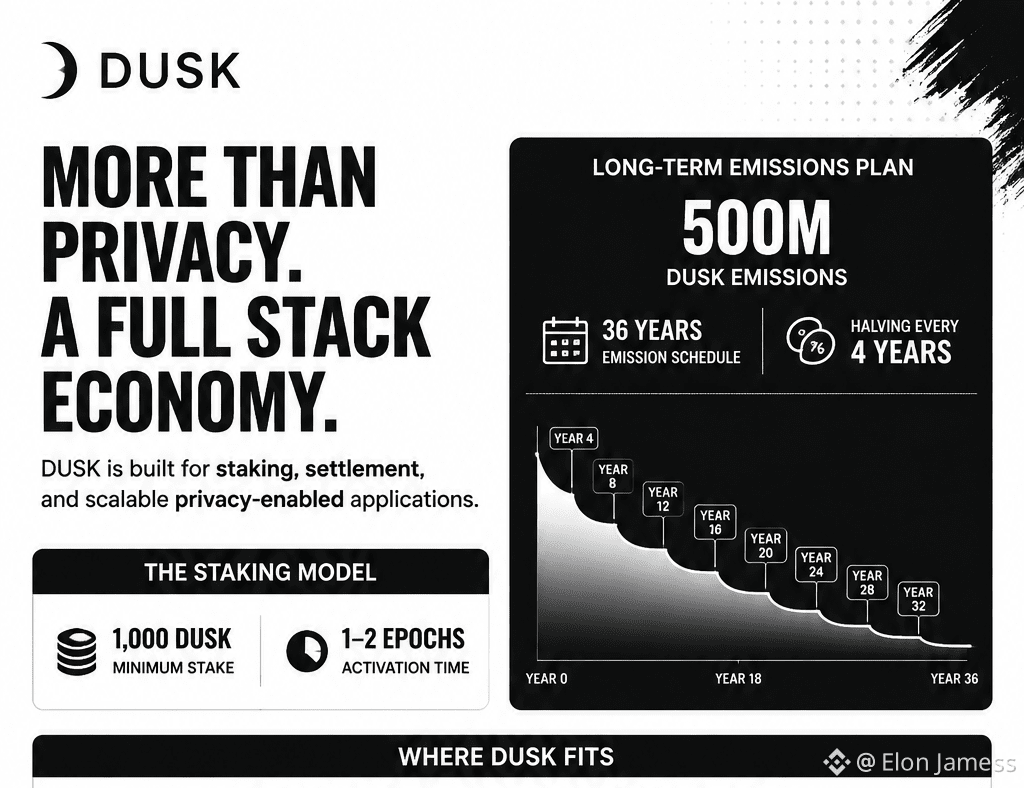
$DUSK requires a 1,000-token minimum stake, with activation after roughly 1–2 epochs.
The protocol is also designed around 500M DUSK emissions over 36 years, with emissions halving every 4 years.
What matters more is where the token fits.
$DUSK is positioned across staking, settlement, and gas as Dusk expands through:
• DuskDS — settlement & data availability
• DuskEVM — EVM applications
• DuskVM — privacy-focused applications
That creates an interesting possibility: if real applications start gaining traction across these layers, DUSK demand could come from more than just network security.
Stake Abstraction adds another layer, allowing smart contracts to participate in staking and potentially making pools and automated strategies more native to the ecosystem.
Still, I think the biggest question is simple:
How much of today’s DUSK activity is actual economic usage, and how much is staking/infrastructure?
The architecture is interesting. Now I want to see the usage data catch up.
@Dusk #dusk
$DUSK requires a 1,000-token minimum stake, with activation after roughly 1–2 epochs.
The protocol is also designed around 500M DUSK emissions over 36 years, with emissions halving every 4 years.
What matters more is where the token fits.
$DUSK is positioned across staking, settlement, and gas as Dusk expands through:
• DuskDS — settlement & data availability
• DuskEVM — EVM applications
• DuskVM — privacy-focused applications
That creates an interesting possibility: if real applications start gaining traction across these layers, DUSK demand could come from more than just network security.
Stake Abstraction adds another layer, allowing smart contracts to participate in staking and potentially making pools and automated strategies more native to the ecosystem.
Still, I think the biggest question is simple:
How much of today’s DUSK activity is actual economic usage, and how much is staking/infrastructure?
The architecture is interesting. Now I want to see the usage data catch up.
@Dusk #dusk
DUSK is quietly moving into a more interesting phase.
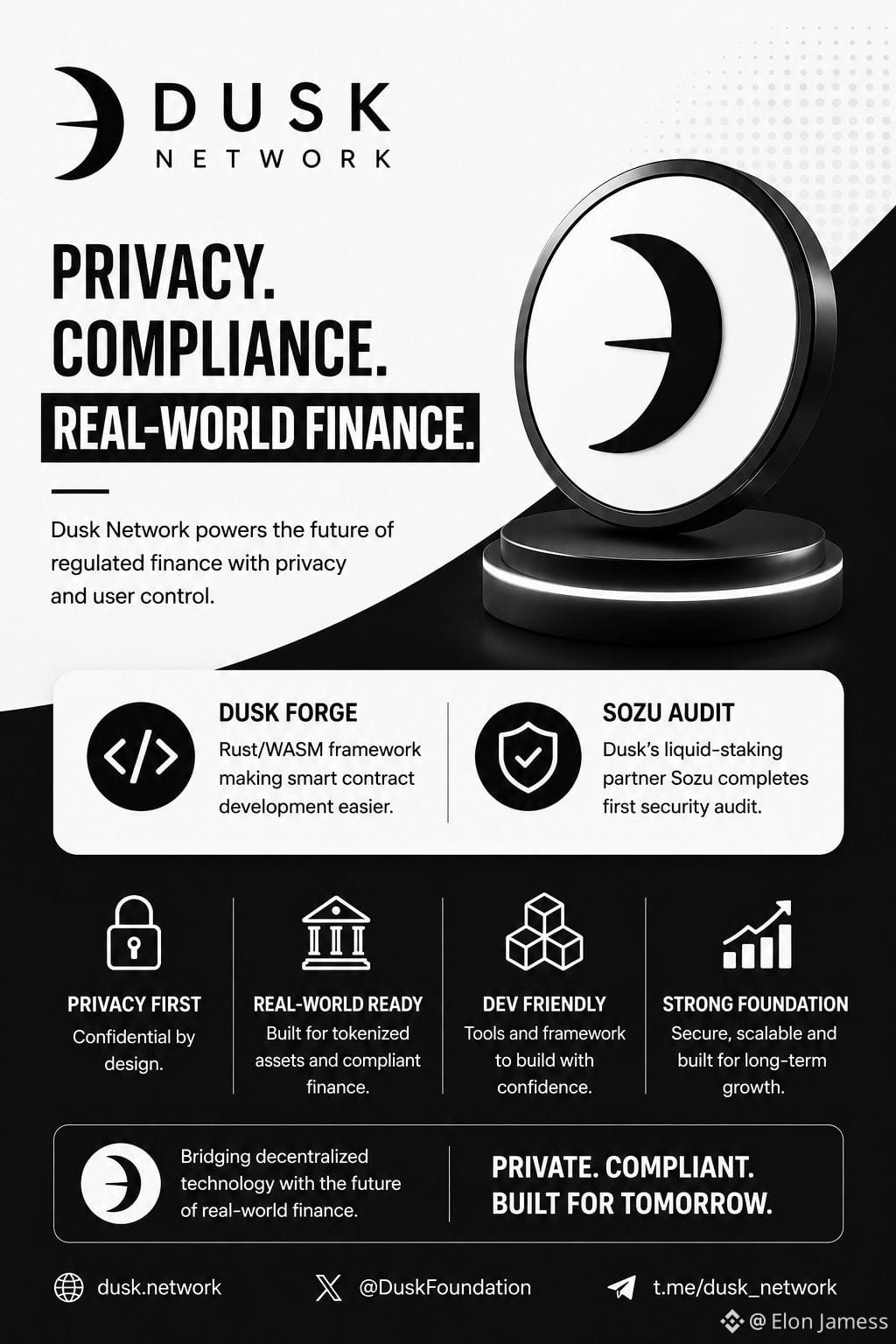
One update that caught my eye is Dusk Forge, a Rust/WASM framework designed to make native smart-contract development much simpler by handling exports, schemas and data drivers from a single module.
That combination matters.
A blockchain built for regulated finance needs more than a strong narrative. It needs developers who can actually build on it, plus infrastructure that can support capital securely.
Dusk is starting to show progress on both sides.
Now the bigger question is how quickly these pieces turn into real applications, liquidity and financial activity on the network.
That’s the part I’ll be watching next.
@Dusk #dusk
$DUSK
One update that caught my eye is Dusk Forge, a Rust/WASM framework designed to make native smart-contract development much simpler by handling exports, schemas and data drivers from a single module.
That combination matters.
A blockchain built for regulated finance needs more than a strong narrative. It needs developers who can actually build on it, plus infrastructure that can support capital securely.
Dusk is starting to show progress on both sides.
Now the bigger question is how quickly these pieces turn into real applications, liquidity and financial activity on the network.
That’s the part I’ll be watching next.
@Dusk #dusk
$DUSK
$BTW is showing solid momentum 👀
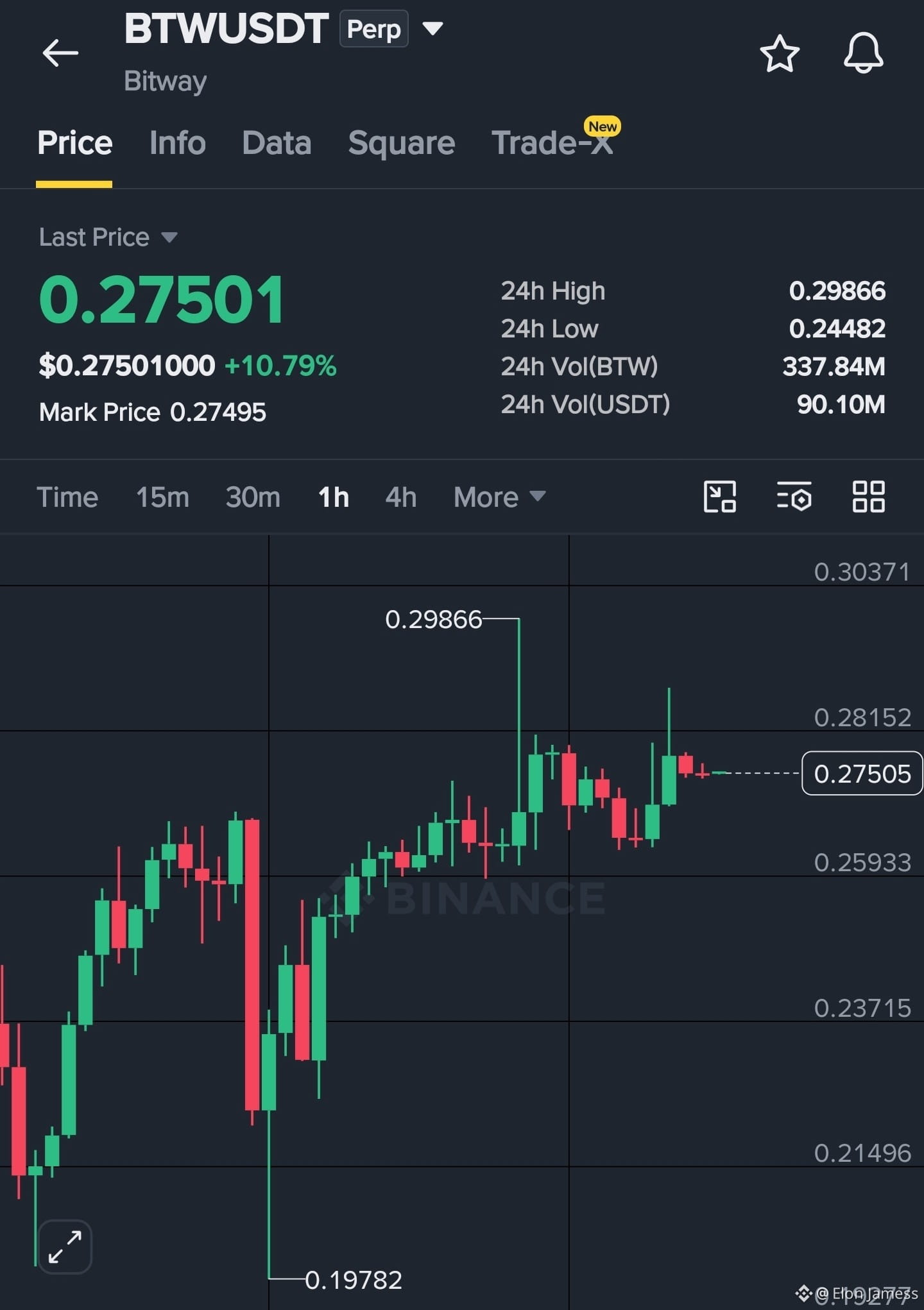
Price is around $0.275, up nearly 11% on the 1H chart.
After bouncing from the $0.198 area, buyers pushed price back toward the $0.30 zone.
Key levels I’m watching:
→ Resistance: $0.282 – $0.299
→ Support: $0.259
→ Stronger support: $0.237
If $BTW breaks and holds above $0.282, the recent high around $0.299 could come back into focus.
Momentum looks bullish, but volatility is still high.
Price is around $0.275, up nearly 11% on the 1H chart.
After bouncing from the $0.198 area, buyers pushed price back toward the $0.30 zone.
Key levels I’m watching:
→ Resistance: $0.282 – $0.299
→ Support: $0.259
→ Stronger support: $0.237
If $BTW breaks and holds above $0.282, the recent high around $0.299 could come back into focus.
Momentum looks bullish, but volatility is still high.
$BR is showing some strength on the 1H chart 👀
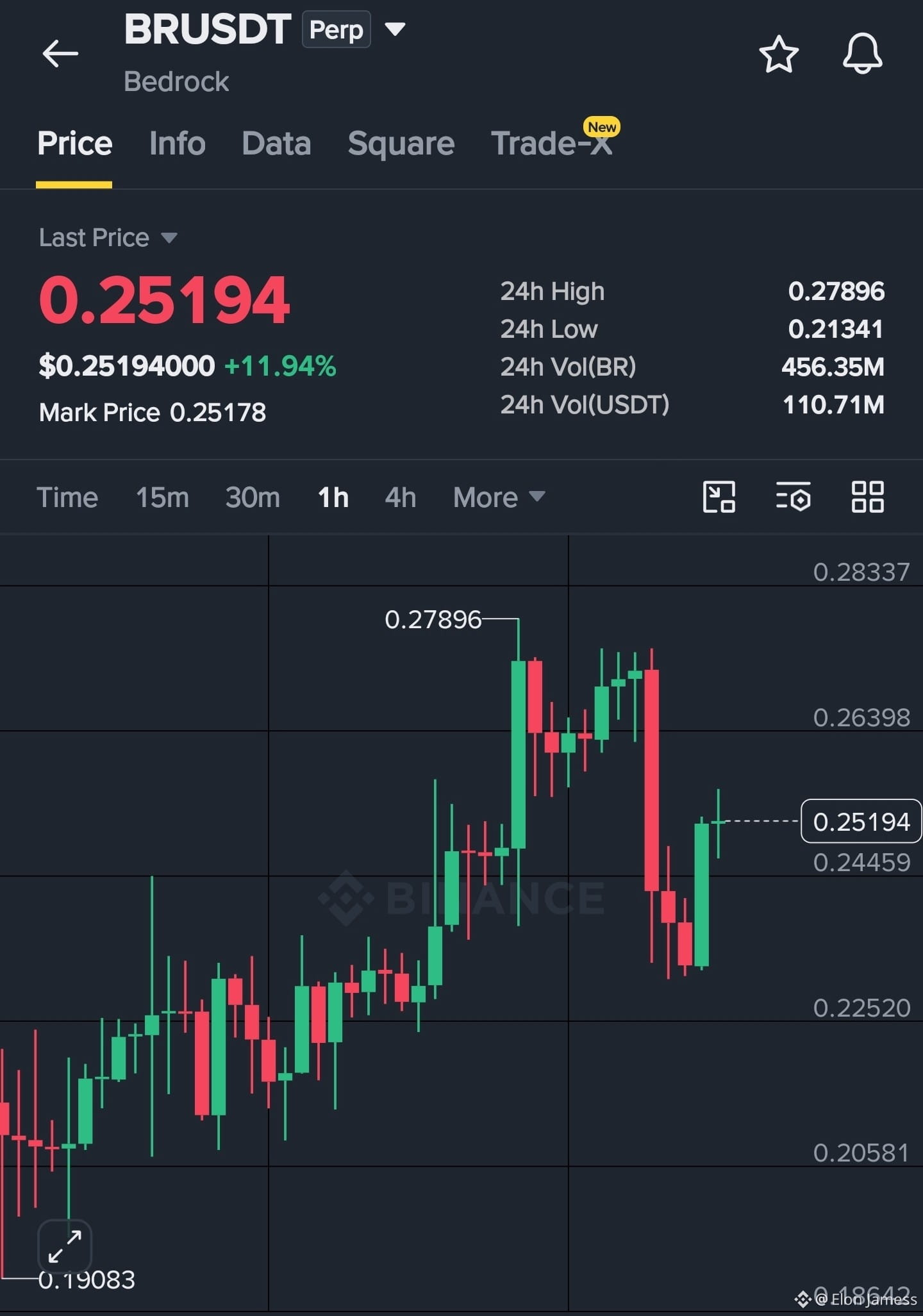
Price is around $0.252, up nearly 12% today.
After dropping from the $0.279 high, buyers stepped back in around the $0.225–$0.23 zone.
Now I’m watching these levels:
→ Resistance: $0.264 – $0.279
→ Support: $0.244
→ Stronger support: $0.225
If $BR can reclaim $0.264 with volume, the previous high could come back into focus.
For now, momentum is improving, but confirmation matters.
Price is around $0.252, up nearly 12% today.
After dropping from the $0.279 high, buyers stepped back in around the $0.225–$0.23 zone.
Now I’m watching these levels:
→ Resistance: $0.264 – $0.279
→ Support: $0.244
→ Stronger support: $0.225
If $BR can reclaim $0.264 with volume, the previous high could come back into focus.
For now, momentum is improving, but confirmation matters.
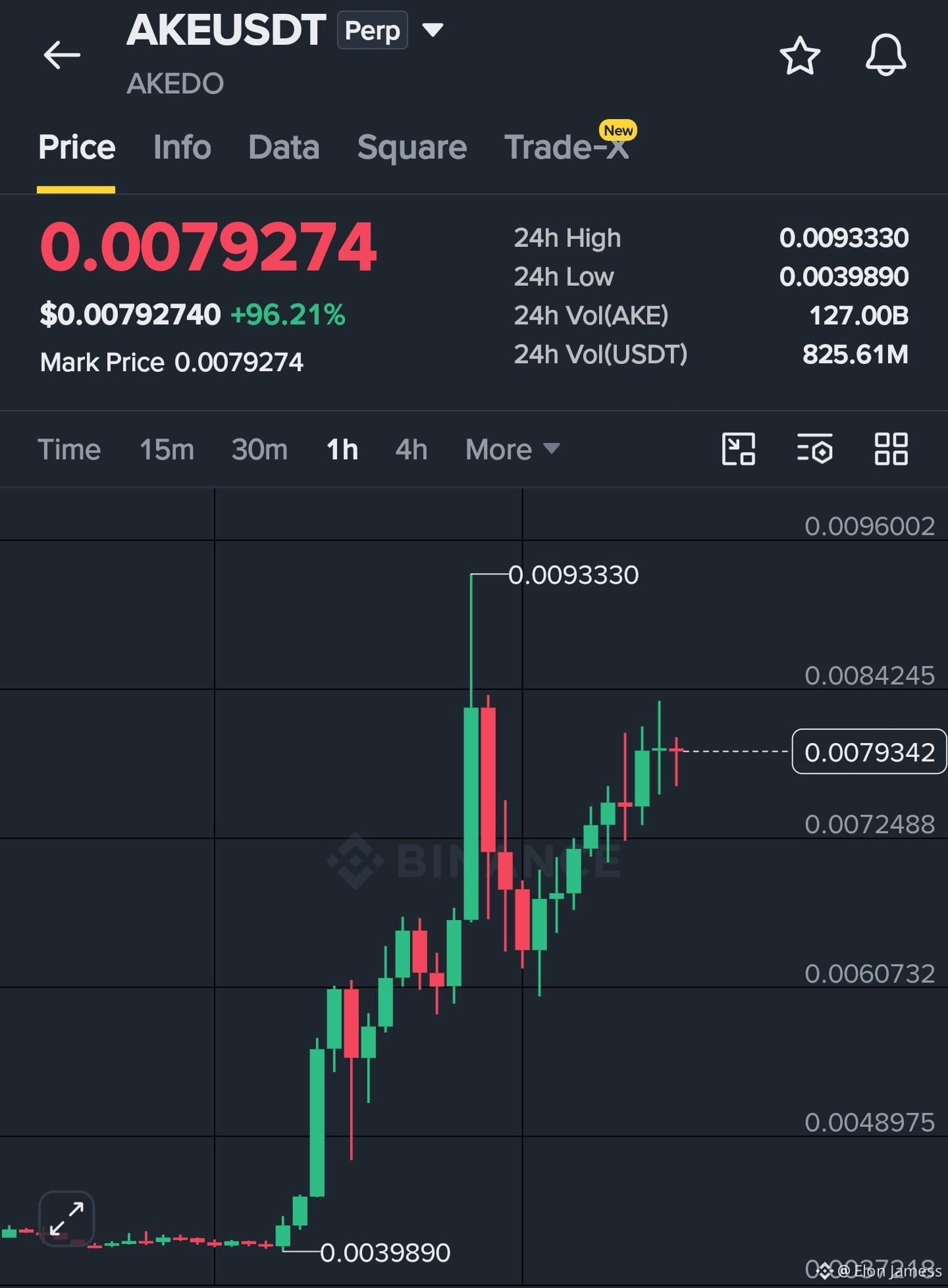
$AKE is making a serious move 👀
Up nearly 96% on the 1H chart.
From around $0.00399 → high of $0.00933.
But here’s what I’m watching now 👇
The price is currently around $0.0079, holding above the $0.0072 area.
Key levels:
→ Resistance: $0.0084 – $0.0093
→ Support: $0.0072
→ Next support: $0.0061
The momentum is strong, but after a move like this, volatility can get crazy.
I wouldn’t blindly chase the pump.
Let the price show the next move.
Up nearly 96% on the 1H chart.
From around $0.00399 → high of $0.00933.
But here’s what I’m watching now 👇
The price is currently around $0.0079, holding above the $0.0072 area.
Key levels:
→ Resistance: $0.0084 – $0.0093
→ Support: $0.0072
→ Next support: $0.0061
The momentum is strong, but after a move like this, volatility can get crazy.
I wouldn’t blindly chase the pump.
Let the price show the next move.
تمّ التحقق
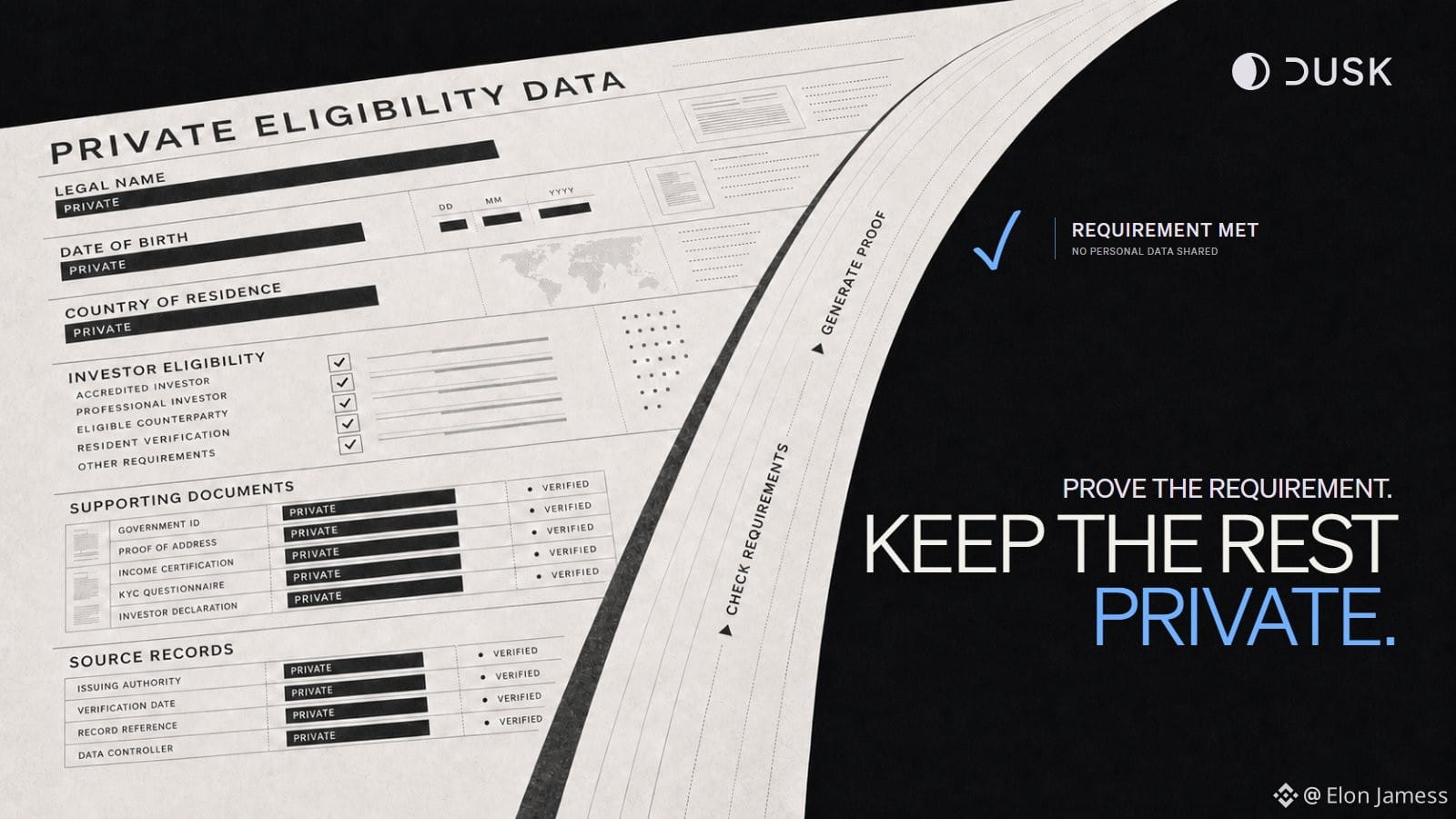
Privacy is becoming a big part of how on-chain finance needs to work.
You shouldn’t have to expose your full personal information just to prove you’re eligible to invest.
With @Dusk selective disclosure, apps can verify things like residency or investor eligibility without revealing the sensitive data behind it.
That balance between compliance and privacy could be a big step forward for on-chain finance.
#dusk $DUSK
You shouldn’t have to expose your full personal information just to prove you’re eligible to invest.
With @Dusk selective disclosure, apps can verify things like residency or investor eligibility without revealing the sensitive data behind it.
That balance between compliance and privacy could be a big step forward for on-chain finance.
#dusk $DUSK
Binance Alpha Watchlist 👀
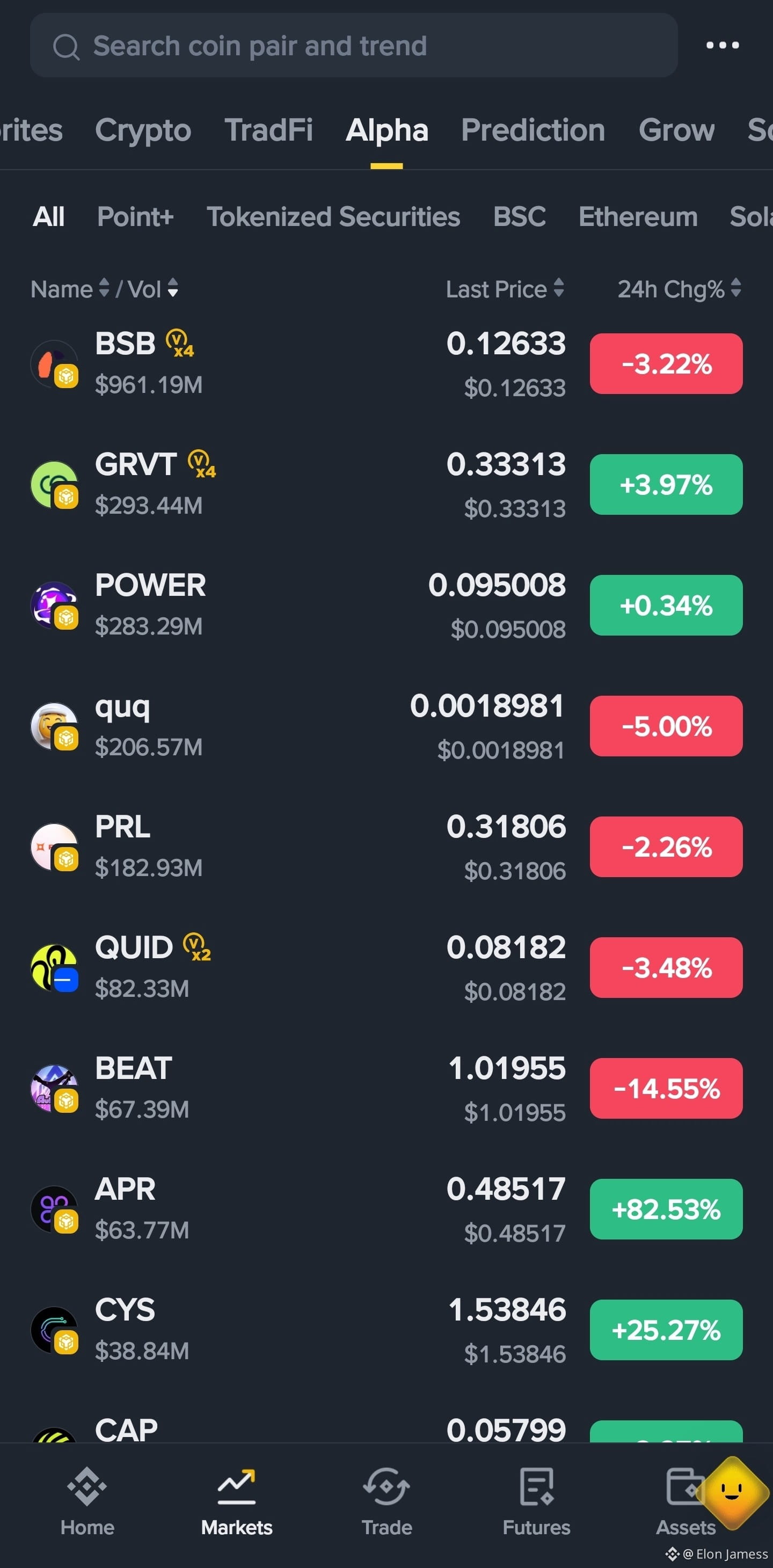
Here’s what’s catching my attention from the board:
🔴 $BSB — $961M volume, down 3.22%
🟢 $GRVT — +3.97% with $293M volume
🟢 $POWER — +0.34% with $283M volume
🔴 $quq — -5.00% with $206M volume
🔴 $PRL — -2.26% with $183M volume
🔴 $QUID — -3.48% with $82M volume
🔴 $BEAT — -14.55% with $67M volume
🟢 $APR — Biggest gainer here at +82.53%
🟢 $CYS — Strong +25.27% move
Alpha is moving fast.
High volume + big price moves can bring opportunity, but they also come with higher volatility.
Keep these on the radar and DYOR. 👀
#ALPHA🔥
Here’s what’s catching my attention from the board:
🔴 $BSB — $961M volume, down 3.22%
🟢 $GRVT — +3.97% with $293M volume
🟢 $POWER — +0.34% with $283M volume
🔴 $quq — -5.00% with $206M volume
🔴 $PRL — -2.26% with $183M volume
🔴 $QUID — -3.48% with $82M volume
🔴 $BEAT — -14.55% with $67M volume
🟢 $APR — Biggest gainer here at +82.53%
🟢 $CYS — Strong +25.27% move
Alpha is moving fast.
High volume + big price moves can bring opportunity, but they also come with higher volatility.
Keep these on the radar and DYOR. 👀
#ALPHA🔥
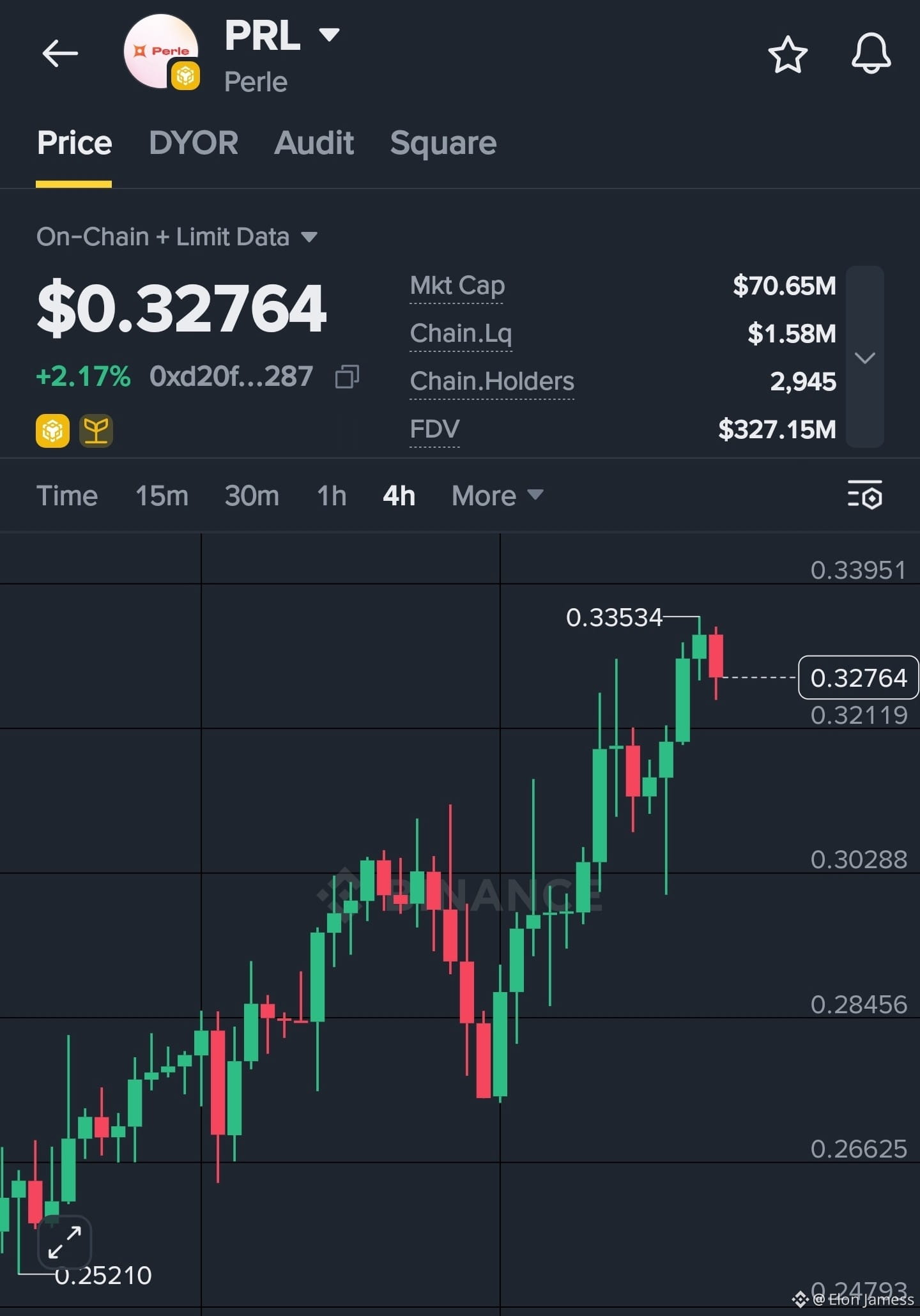
$PRL is showing a strong bullish structure on the 4H chart 👀
Price has climbed from around $0.252 → $0.3353, forming a clear series of higher highs and higher lows.
Currently trading near $0.3276 after a small pullback.
Key levels I’m watching:
→ $0.3212 — immediate support
→ $0.3029 — stronger support
→ $0.3353 — recent high / resistance
→ $0.3395 — next resistance
If $PRL holds above $0.3212 and buyers push back through $0.3353, the bullish structure remains interesting.
But after this strong move, a retest or short consolidation wouldn’t be surprising.
For now, $0.3212 is the level I’m watching closely. 👀
#ALPHA🔥
Price has climbed from around $0.252 → $0.3353, forming a clear series of higher highs and higher lows.
Currently trading near $0.3276 after a small pullback.
Key levels I’m watching:
→ $0.3212 — immediate support
→ $0.3029 — stronger support
→ $0.3353 — recent high / resistance
→ $0.3395 — next resistance
If $PRL holds above $0.3212 and buyers push back through $0.3353, the bullish structure remains interesting.
But after this strong move, a retest or short consolidation wouldn’t be surprising.
For now, $0.3212 is the level I’m watching closely. 👀
#ALPHA🔥
سجّل الدخول لاستكشاف المزيد من المُحتوى