
Jinnnnn_
35 منشورات

Jinnnnn_
50 تتابع
760 المتابعون
33 إعجاب
منشورات
#dusk $DUSK @Dusk
there is a Core Values page in the Dusk docs and I skipped past it for weeks assuming it was filler.
it is not filler exactly. it is the page that tells you what the project will refuse to do.
privacy where it is needed. transparency where it is useful. selective disclosure for authorised review. deterministic settlement.
read that as a set of constraints rather than a set of features and it gets more interesting. each one rules something out.
deterministic settlement rules out probabilistic finality. selective disclosure rules out both total opacity and total exposure.
my caveat is that values pages are the easiest thing in the world to write and the hardest to hold to. nobody publishes a values page saying we will compromise under pressure.
still. knowing what a project claims to refuse gives you something to check it against later.
do you read values pages or skip them like I did
@Dusk #dusk $DUSK
there is a Core Values page in the Dusk docs and I skipped past it for weeks assuming it was filler.
it is not filler exactly. it is the page that tells you what the project will refuse to do.
privacy where it is needed. transparency where it is useful. selective disclosure for authorised review. deterministic settlement.
read that as a set of constraints rather than a set of features and it gets more interesting. each one rules something out.
deterministic settlement rules out probabilistic finality. selective disclosure rules out both total opacity and total exposure.
my caveat is that values pages are the easiest thing in the world to write and the hardest to hold to. nobody publishes a values page saying we will compromise under pressure.
still. knowing what a project claims to refuse gives you something to check it against later.
do you read values pages or skip them like I did
@Dusk #dusk $DUSK
AGREE
100%
NO I DON'T
0%
3 الأصوات • تمّ إغلاق التصويت
#dusk $DUSK @Dusk
found something odd in the Dusk news index this week. a piece from March 2025 about spec drift detection.
that is internal engineering tooling. it catches the gap between what a specification says and what the code actually does.
I had to sit with why a blockchain project would publish about that.
and I think the answer is that spec drift is exactly the failure mode that matters for regulated settlement. a compliance rule written in a document. a contract that implements it slightly differently. nobody notices until a supervisor asks. $TUT
on a normal chain that is a bug. on a chain carrying regulated securities it is a legal problem.
my caveat is that publishing about tooling proves you built the tool. it does not prove the tool works.
still. it is a strange thing to write about publicly and I read that as a decent sign.
does internal engineering culture factor into how you judge a project
@Dusk #dusk $DUSK
found something odd in the Dusk news index this week. a piece from March 2025 about spec drift detection.
that is internal engineering tooling. it catches the gap between what a specification says and what the code actually does.
I had to sit with why a blockchain project would publish about that.
and I think the answer is that spec drift is exactly the failure mode that matters for regulated settlement. a compliance rule written in a document. a contract that implements it slightly differently. nobody notices until a supervisor asks. $TUT
on a normal chain that is a bug. on a chain carrying regulated securities it is a legal problem.
my caveat is that publishing about tooling proves you built the tool. it does not prove the tool works.
still. it is a strange thing to write about publicly and I read that as a decent sign.
does internal engineering culture factor into how you judge a project
@Dusk #dusk $DUSK
AGREE
0%
NO I DON'T
0%
0 الأصوات • تمّ إغلاق التصويت
#dusk $DUSK @Dusk
found the Path to Mainnet article this week and nearly wrote about it as if it were current.
it is not. it is a roadmap from years ago. it lays out the mission around privacy and compliance and real world assets. useful for understanding intent. useless as a delivery schedule. $TRUMP
I think a lot of confusion about projects comes from this. old roadmaps stay online and stay indexed and they read like promises rather than history.
the honest version is that you have to check status separately from vision. the vision article tells you what they were trying to build. it does not tell you what exists today.
worth saying I would rather a project leave old roadmaps up than quietly delete them. the record being visible is better than the record being tidy.
but read the date first.
do you check when something was published before forming a view on it
@Dusk #dusk $DUSK
found the Path to Mainnet article this week and nearly wrote about it as if it were current.
it is not. it is a roadmap from years ago. it lays out the mission around privacy and compliance and real world assets. useful for understanding intent. useless as a delivery schedule. $TRUMP
I think a lot of confusion about projects comes from this. old roadmaps stay online and stay indexed and they read like promises rather than history.
the honest version is that you have to check status separately from vision. the vision article tells you what they were trying to build. it does not tell you what exists today.
worth saying I would rather a project leave old roadmaps up than quietly delete them. the record being visible is better than the record being tidy.
but read the date first.
do you check when something was published before forming a view on it
@Dusk #dusk $DUSK
#dusk $DUSK @Dusk
I spent some time looking at Dusk’s Citadel layer, and this is one of those details that makes more sense the longer I think about it.
The idea isn't simply hiding identity data. Citadel is designed around selective disclosure: a user can prove a required attribute without exposing every piece of personal information behind it.
Technically, that creates a cleaner separation between verification and data exposure.
For a regulated financial workflow, that could matter a lot. An application may need to know that an investor satisfies a condition, but it doesn't necessarily need the investor's entire identity record sitting in every transaction flow.
What I like here is the specificity of the problem Dusk is trying to solve.
The real test is whether applications can make this verification process simple enough for actual users.
What you do if you have Dusk? Sell or buy more?
.
I spent some time looking at Dusk’s Citadel layer, and this is one of those details that makes more sense the longer I think about it.
The idea isn't simply hiding identity data. Citadel is designed around selective disclosure: a user can prove a required attribute without exposing every piece of personal information behind it.
Technically, that creates a cleaner separation between verification and data exposure.
For a regulated financial workflow, that could matter a lot. An application may need to know that an investor satisfies a condition, but it doesn't necessarily need the investor's entire identity record sitting in every transaction flow.
What I like here is the specificity of the problem Dusk is trying to solve.
The real test is whether applications can make this verification process simple enough for actual users.
What you do if you have Dusk? Sell or buy more?
.
Agree
100%
Disagree
0%
2 الأصوات • تمّ إغلاق التصويت
#dusk $DUSK @Dusk
went back to the Phoenix section this morning and read it properly instead of skimming.
funds live as encrypted notes,not balances sitting in a table with your name next to them.
what a transaction proves is narrow. no double spend, enough funds. what it never reveals is the amount, the sender except to the receiver, or which notes were involved
so the verifier confirms the settlement is valid without learning a single figure in it
thats a strange sentence and its the whole point of confidential settlement. the verifier cant be tricked by data it never receives
Moonlight sits next to it for flows that should be observable. two models one chain, you pick per transaction
whats your take
@Dusk #dusk $DUSK
went back to the Phoenix section this morning and read it properly instead of skimming.
funds live as encrypted notes,not balances sitting in a table with your name next to them.
what a transaction proves is narrow. no double spend, enough funds. what it never reveals is the amount, the sender except to the receiver, or which notes were involved
so the verifier confirms the settlement is valid without learning a single figure in it
thats a strange sentence and its the whole point of confidential settlement. the verifier cant be tricked by data it never receives
Moonlight sits next to it for flows that should be observable. two models one chain, you pick per transaction
whats your take
@Dusk #dusk $DUSK
its amazing
0%
settlement is valid
0%
0 الأصوات • تمّ إغلاق التصويت
One thing I noticed while studying @TermMax is how much the protocol relies on the pricing curve to communicate preferences.
A single APR can't really explain everything a market maker wants.
Maybe I want to provide the first part of my capital at 5%.
For the next part, I might require 6%.
Beyond that, perhaps I don't want to provide anything.
A range order can represent that structure.
I was writing this down in my notes and realised it is basically a way of putting a supply schedule on-chain.
That's pretty interesting. like SOL have ben for me
The market isn't just asking what rate exists.
It's showing how much liquidity exists at each rate.
That makes price discovery more granular.
Of course, it also means the person setting the curve has to think carefully about market conditions.
Bad pricing can sit there doing nothing.
Or it can get filled at a time when the market has already moved.
That's the TRADE-OFF.
#TermMax
A single APR can't really explain everything a market maker wants.
Maybe I want to provide the first part of my capital at 5%.
For the next part, I might require 6%.
Beyond that, perhaps I don't want to provide anything.
A range order can represent that structure.
I was writing this down in my notes and realised it is basically a way of putting a supply schedule on-chain.
That's pretty interesting. like SOL have ben for me
The market isn't just asking what rate exists.
It's showing how much liquidity exists at each rate.
That makes price discovery more granular.
Of course, it also means the person setting the curve has to think carefully about market conditions.
Bad pricing can sit there doing nothing.
Or it can get filled at a time when the market has already moved.
That's the TRADE-OFF.
#TermMax
Agree
100%
Disagree
0%
2 الأصوات • تمّ إغلاق التصويت
#termmax @TermMax
was going through the repayment mechanics of TermMax today and found one detail pretty interesting.
A borrower can potentially acquire FT from the market and use it toward settling the debt.
At first I thought repayment would simply mean returning the borrowed asset.
But the FT structure creates another route.
I had to go back through the section twice because the relationship between the fixed claim and repayment isn't immediately obvious.
The important part is that FT has a market value before maturity.
So the economics of repayment can depend on what those claims are trading for at the time.
That creates another connection between the primary borrowing market and the secondary FT market.
It also means liquidity isn't just useful for lenders.
It can matter to borrowers looking for an efficient way to close positions.
Small mechanism, but a GOOD one to understand.
$ACE $BTW
was going through the repayment mechanics of TermMax today and found one detail pretty interesting.
A borrower can potentially acquire FT from the market and use it toward settling the debt.
At first I thought repayment would simply mean returning the borrowed asset.
But the FT structure creates another route.
I had to go back through the section twice because the relationship between the fixed claim and repayment isn't immediately obvious.
The important part is that FT has a market value before maturity.
So the economics of repayment can depend on what those claims are trading for at the time.
That creates another connection between the primary borrowing market and the secondary FT market.
It also means liquidity isn't just useful for lenders.
It can matter to borrowers looking for an efficient way to close positions.
Small mechanism, but a GOOD one to understand.
$ACE $BTW
SMALL MECHANISM
0%
GOOD TO UNDERSTAND
0%
0 الأصوات • تمّ إغلاق التصويت
been i have to be sitting with the settlement side of Dusk today rather than the privacy side.
everyone reads Dusk as a privacy chain. its a settlement chain that happens to have privacy.
DuskEVM settles through DuskDS, and DuskDS is where the deterministic finality lives. so a confidential transaction on the EVM layer still lands on a settlement layer that gives you a final answer.
thats the combination that matters for regulated assets. privacy alone is not enough.compliance alone is not enough. settlement that's confidential AND final is the thing institutions actually need
hmm.
privacy without settlement is a demo. settlement without privacy is every chain we already have
whats your take
@Dusk #dusk $DUSK
everyone reads Dusk as a privacy chain. its a settlement chain that happens to have privacy.
DuskEVM settles through DuskDS, and DuskDS is where the deterministic finality lives. so a confidential transaction on the EVM layer still lands on a settlement layer that gives you a final answer.
thats the combination that matters for regulated assets. privacy alone is not enough.compliance alone is not enough. settlement that's confidential AND final is the thing institutions actually need
hmm.
privacy without settlement is a demo. settlement without privacy is every chain we already have
whats your take
@Dusk #dusk $DUSK
AGREE
0%
No I Don't Agree
0%
0 الأصوات • تمّ إغلاق التصويت
i was sitting on my couch when i thought about termmex and i was flabbergasted.... so here is what i thought.
There is a small detail in @TermMax that changes how I think about repayment.
A borrower doesn't necessarily have to repay the position only by handing back the original debt token.
The documentation describes another route: buying FTs from the market and using them to settle the debt.
Why does that matter?
Because FT can trade before maturity.
So the market price of that fixed claim can influence the economics of repayment.
Imagine a borrower has a debt obligation represented by FTs, but those FTs are available in the market at a discount. $TUT
Buying them could potentially be cheaper than simply sourcing the debt token elsewhere. $BTW
Of course, that depends entirely on the actual market price and liquidity at the time.
Nothing is guaranteed. $ACE
But I like that the repayment mechanism isn't completely rigid.
It creates another layer between the original borrowing transaction and final settlement.
That's the kind of DETAIL I usually look for when studying DeFi protocols.
#TermMax
There is a small detail in @TermMax that changes how I think about repayment.
A borrower doesn't necessarily have to repay the position only by handing back the original debt token.
The documentation describes another route: buying FTs from the market and using them to settle the debt.
Why does that matter?
Because FT can trade before maturity.
So the market price of that fixed claim can influence the economics of repayment.
Imagine a borrower has a debt obligation represented by FTs, but those FTs are available in the market at a discount. $TUT
Buying them could potentially be cheaper than simply sourcing the debt token elsewhere. $BTW
Of course, that depends entirely on the actual market price and liquidity at the time.
Nothing is guaranteed. $ACE
But I like that the repayment mechanism isn't completely rigid.
It creates another layer between the original borrowing transaction and final settlement.
That's the kind of DETAIL I usually look for when studying DeFi protocols.
#TermMax
AGREE
40%
NO
60%
10 الأصوات • تمّ إغلاق التصويت
Had this sitting unresolved for a couple weeks and it came together on the walk back from the shop.
A translated book has two versions in the world. Someone has to keep checking they still say the same thing when the author revises a chapter.
Tokenization works like that.Dusk describe it as creating a synthetic asset representing an underlying one, and the underlying asset stays wherever it already lived, in a registry or a custody arrangement. so there are two records now. the token and the thing it stands for
every corporate action every transfer restriction every servicing event has to land correctly in both. that reconciliation isnt a bug in tokenization, its the defining feature of it
native issuance removes the second copy. the asset is created and managed onchain, so issuance transfers servicing and settlement happen around the ledger instead of around a wrapper. Dusk describe it as assets created directly onchain without needing an underlying asset at all
Where the translation comparison stops working is intent. a translator is preserving a work that already exists and shouldnt change. a registry isnt a work of art, its an operational burden nobody chose
nobody set out to run two sets of books. they ran two because they HAD two, then built an industry around keeping them agreed
whats your take
@Dusk #dusk $DUSK
A translated book has two versions in the world. Someone has to keep checking they still say the same thing when the author revises a chapter.
Tokenization works like that.Dusk describe it as creating a synthetic asset representing an underlying one, and the underlying asset stays wherever it already lived, in a registry or a custody arrangement. so there are two records now. the token and the thing it stands for
every corporate action every transfer restriction every servicing event has to land correctly in both. that reconciliation isnt a bug in tokenization, its the defining feature of it
native issuance removes the second copy. the asset is created and managed onchain, so issuance transfers servicing and settlement happen around the ledger instead of around a wrapper. Dusk describe it as assets created directly onchain without needing an underlying asset at all
Where the translation comparison stops working is intent. a translator is preserving a work that already exists and shouldnt change. a registry isnt a work of art, its an operational burden nobody chose
nobody set out to run two sets of books. they ran two because they HAD two, then built an industry around keeping them agreed
whats your take
@Dusk #dusk $DUSK
YES I AGREE
0%
NO I DON'T AGREE
0%
0 الأصوات • تمّ إغلاق التصويت
تداول لمدة 30 يومًا $ACE 694.2 USDT
#termmax @TermMax
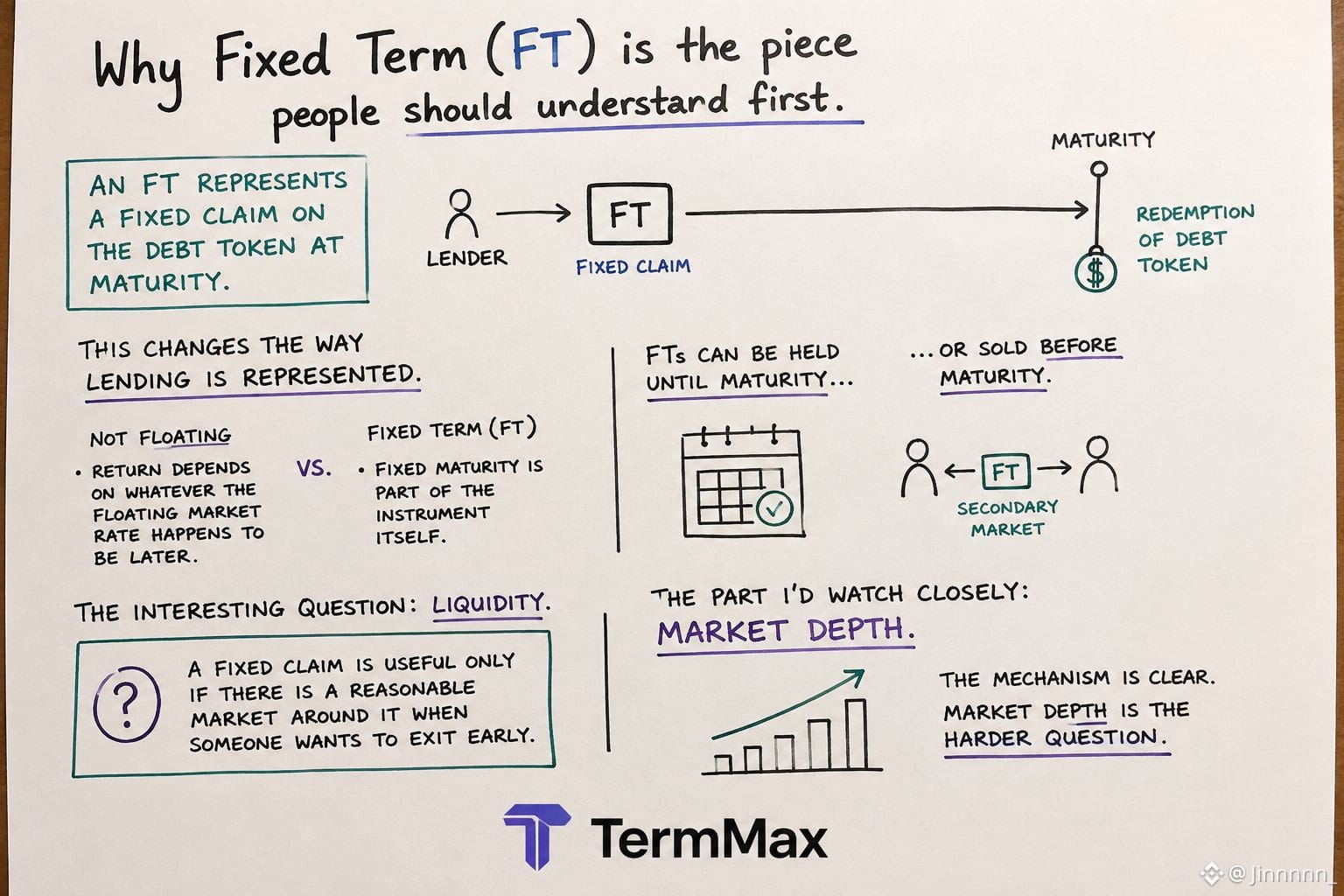
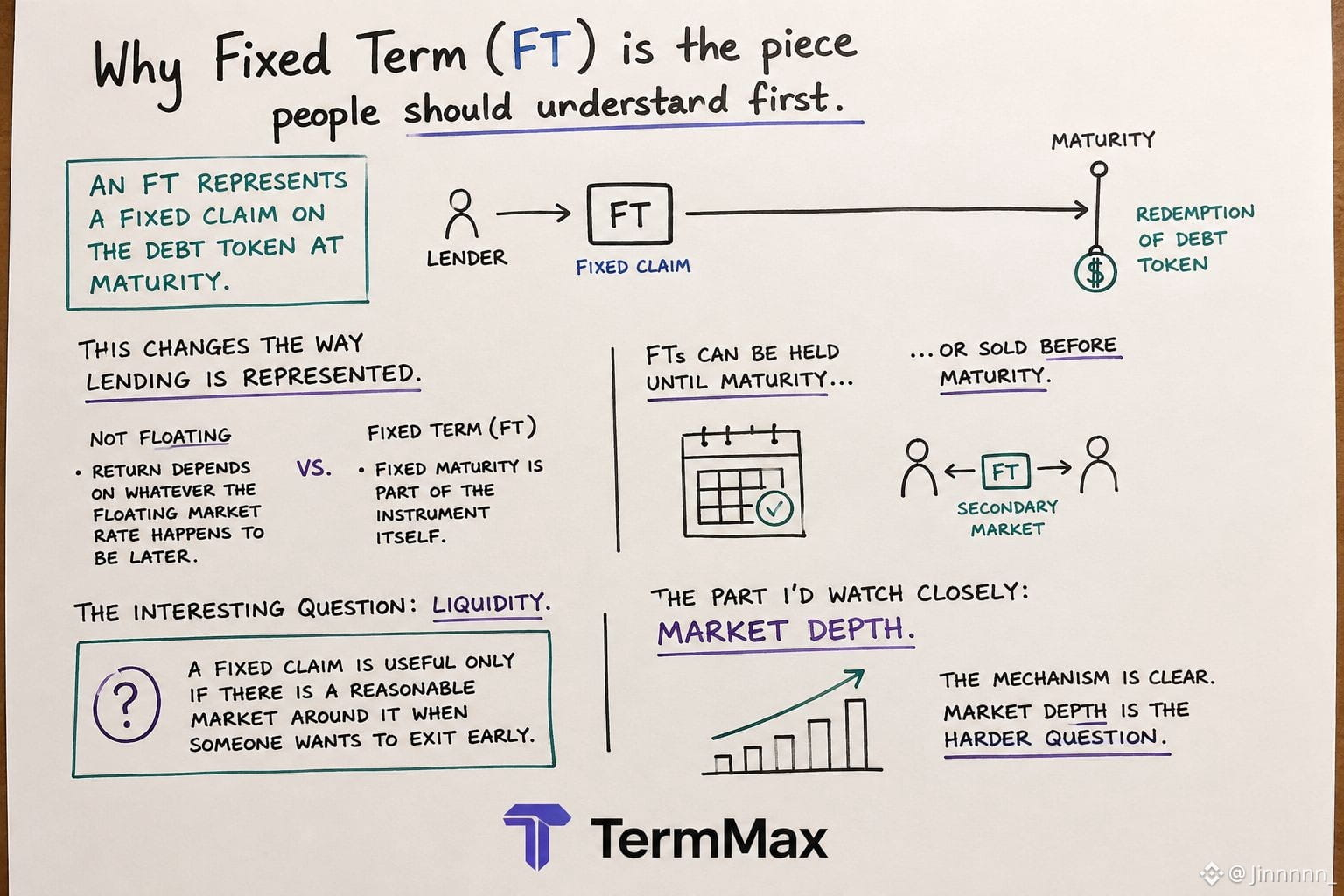
The more I read about @TermMax, the more I think FT is the piece people should understand first.
An FT represents a fixed claim on the debt token at maturity.
That sounds simple, but it changes the way lending can be represented. $TUT
A lender isn't just holding a position whose return depends on whatever the floating market rate happens to be later. The fixed maturity is part of the instrument itself. $HEMI
There is another useful detail here.
FTs can be held until maturity, but they can also be sold before maturity. So the fixed-term position doesn't necessarily mean the capital is locked with no secondary-market option. $ACE
The interesting question is then liquidity.
A fixed claim is useful only if there is a reasonable market around it when someone wants to exit early.
That's the part I'd watch closely.
The MECHANISM is clear. Market depth is the harder question.
The more I read about @TermMax, the more I think FT is the piece people should understand first.
An FT represents a fixed claim on the debt token at maturity.
That sounds simple, but it changes the way lending can be represented. $TUT
A lender isn't just holding a position whose return depends on whatever the floating market rate happens to be later. The fixed maturity is part of the instrument itself. $HEMI
There is another useful detail here.
FTs can be held until maturity, but they can also be sold before maturity. So the fixed-term position doesn't necessarily mean the capital is locked with no secondary-market option. $ACE
The interesting question is then liquidity.
A fixed claim is useful only if there is a reasonable market around it when someone wants to exit early.
That's the part I'd watch closely.
The MECHANISM is clear. Market depth is the harder question.
تداول لمدة 30 يومًا $DUSK 109.4 USDT
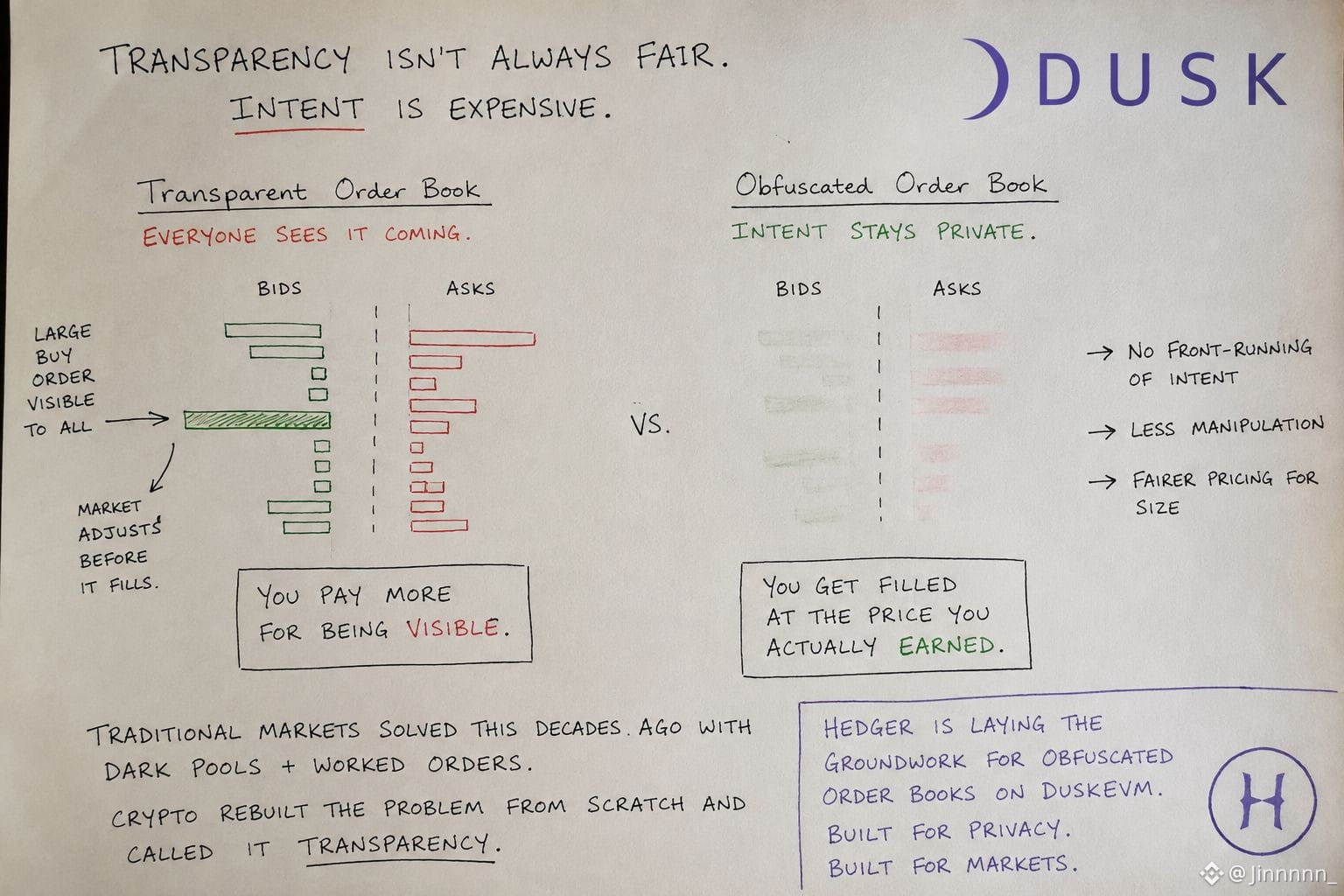
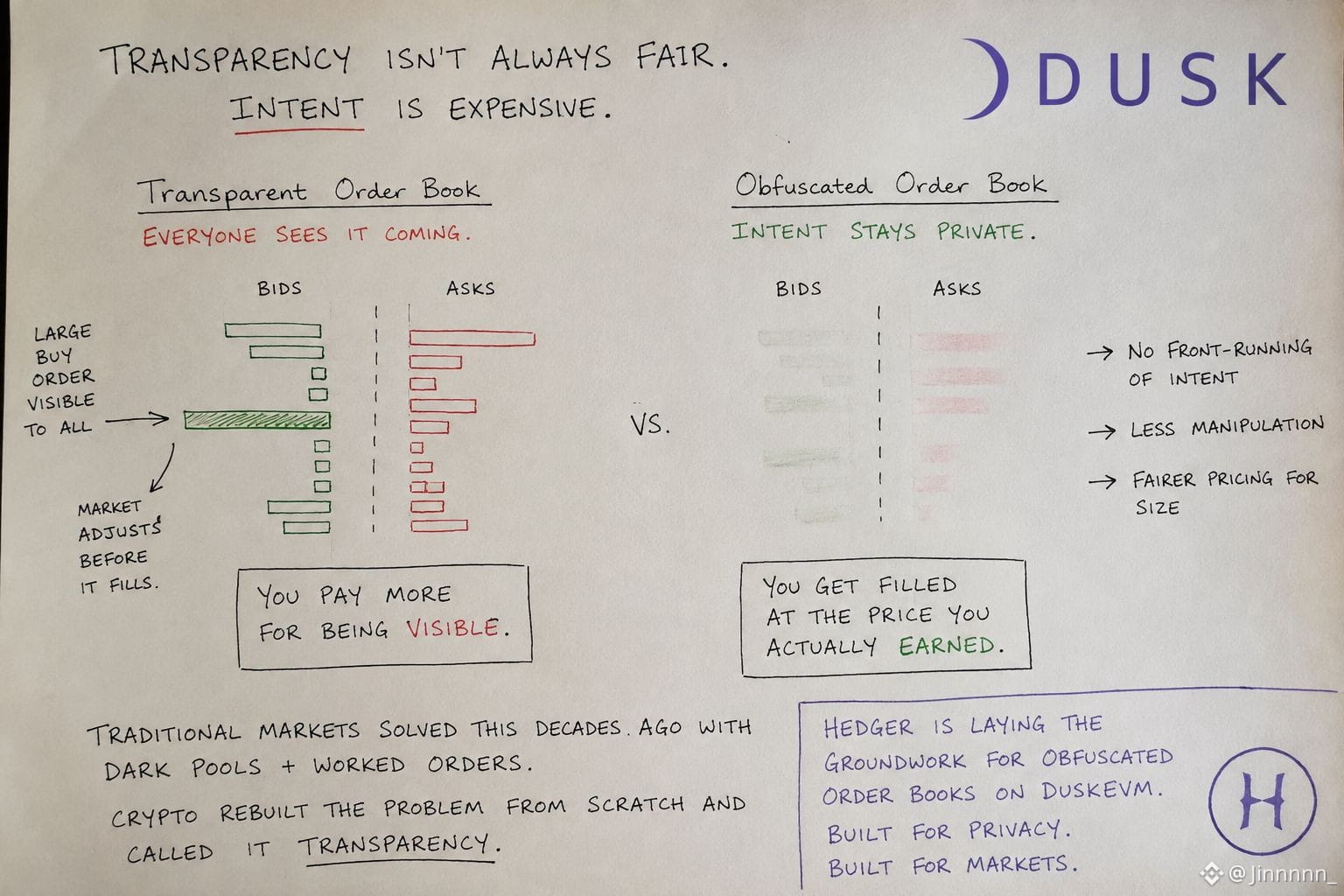
read about obfuscated order books last night and couldnt stop thinking about it on the walk this morning.
Hedger is described as laying the ground for them on DuskEVM. reason given: preventing market manipulation, and stopping participants revealing intent or exposure. $HEMI
intent is the word I keep circling.
on a transparent chain a large order announces itself before it fills. everyone sees it coming and prices accordingly, and the person who wanted to buy pays more for having been VISIBLE. $ACE
thats not a privacy nicety. thats a direct cost, measurable, paid by whoever moved size.
traditional venues solved this decades ago with dark pools and worked orders. crypto rebuilt the problem from scratch and called it transparency.
#dusk @Dusk $DUSK
Hedger is described as laying the ground for them on DuskEVM. reason given: preventing market manipulation, and stopping participants revealing intent or exposure. $HEMI
intent is the word I keep circling.
on a transparent chain a large order announces itself before it fills. everyone sees it coming and prices accordingly, and the person who wanted to buy pays more for having been VISIBLE. $ACE
thats not a privacy nicety. thats a direct cost, measurable, paid by whoever moved size.
traditional venues solved this decades ago with dark pools and worked orders. crypto rebuilt the problem from scratch and called it transparency.
#dusk @Dusk $DUSK
Citadel lets you prove an attribute without showing whats behind it. residency. an age bracket. accreditation status.
the venue learns youre eligible. it doesnt learn your birthday, or your address, or how much you have.
i think about how many forms ask for a full document when they only need one line off it. every one of those is a copy of your identity sitting in someone elses system for no reason anyone could defend if you asked them.
anyway. thats the idea.
#dusk @Dusk $DUSK
the venue learns youre eligible. it doesnt learn your birthday, or your address, or how much you have.
i think about how many forms ask for a full document when they only need one line off it. every one of those is a copy of your identity sitting in someone elses system for no reason anyone could defend if you asked them.
anyway. thats the idea.
#dusk @Dusk $DUSK
GOOD IDEA
100%
BAD IDEA
0%
1 الأصوات • تمّ إغلاق التصويت
تداول لمدة 30 يومًا $DUSK 21.8 USDT
#dusk $DUSK @Dusk
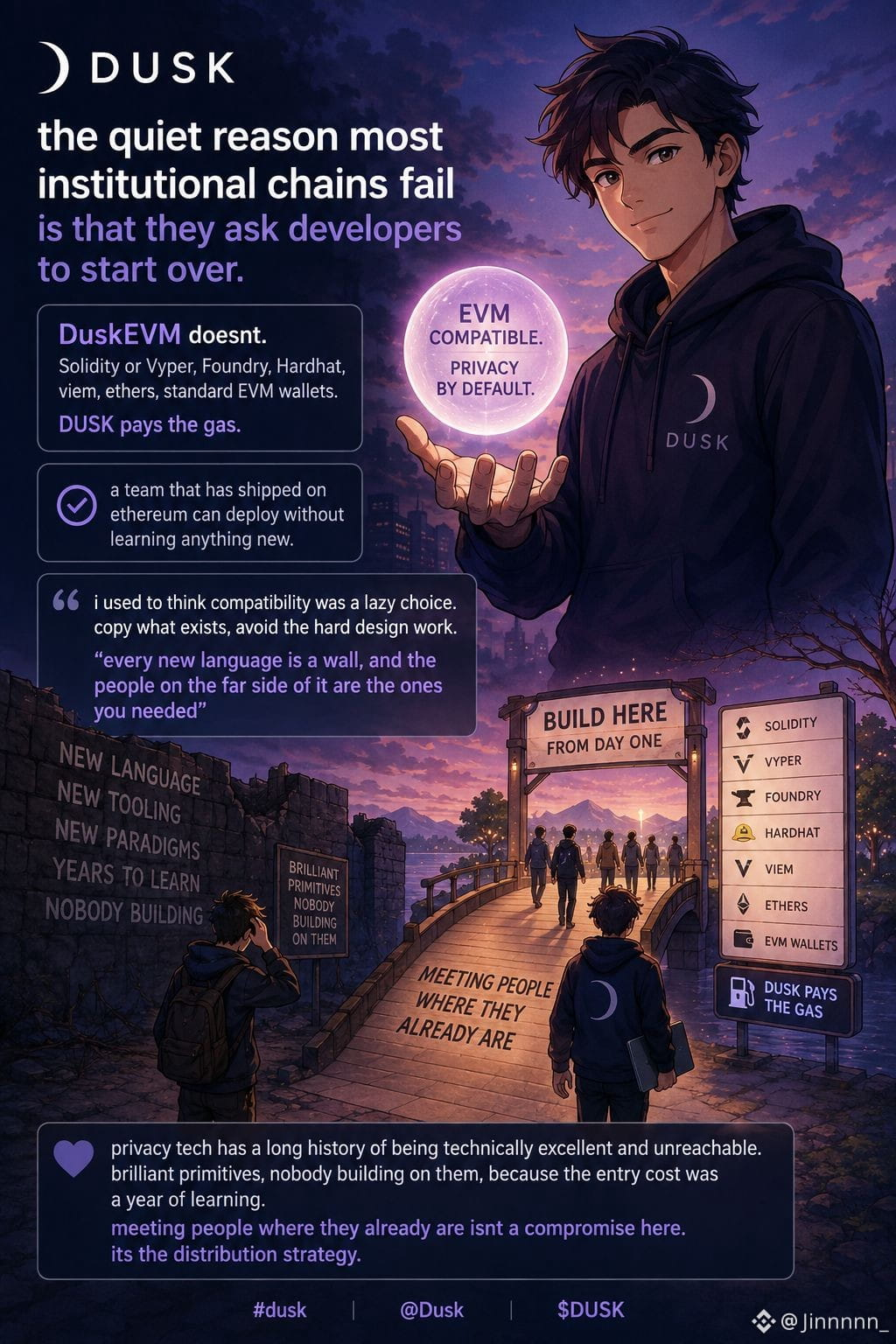
the quiet reason most institutional chains fail is that they ask developers to start over.
DuskEVM doesnt. Solidity or Vyper, Foundry, Hardhat, viem, ethers, standard EVM wallets. DUSK pays the gas.
a team that has shipped on ethereum can deploy without learning anything new.
i used to think compatibility was a lazy choice. copy what exists, avoid the hard design work.
"every new language is a wall, and the people on the far side of it are the ones you needed"
privacy tech has a long history of being technically excellent and unreachable. brilliant primitives, nobody building on them, becuse the entry cost was a year of learning.
meeting people where they already are isnt a compromise here. its the distribution strategy.
the quiet reason most institutional chains fail is that they ask developers to start over.
DuskEVM doesnt. Solidity or Vyper, Foundry, Hardhat, viem, ethers, standard EVM wallets. DUSK pays the gas.
a team that has shipped on ethereum can deploy without learning anything new.
i used to think compatibility was a lazy choice. copy what exists, avoid the hard design work.
"every new language is a wall, and the people on the far side of it are the ones you needed"
privacy tech has a long history of being technically excellent and unreachable. brilliant primitives, nobody building on them, becuse the entry cost was a year of learning.
meeting people where they already are isnt a compromise here. its the distribution strategy.
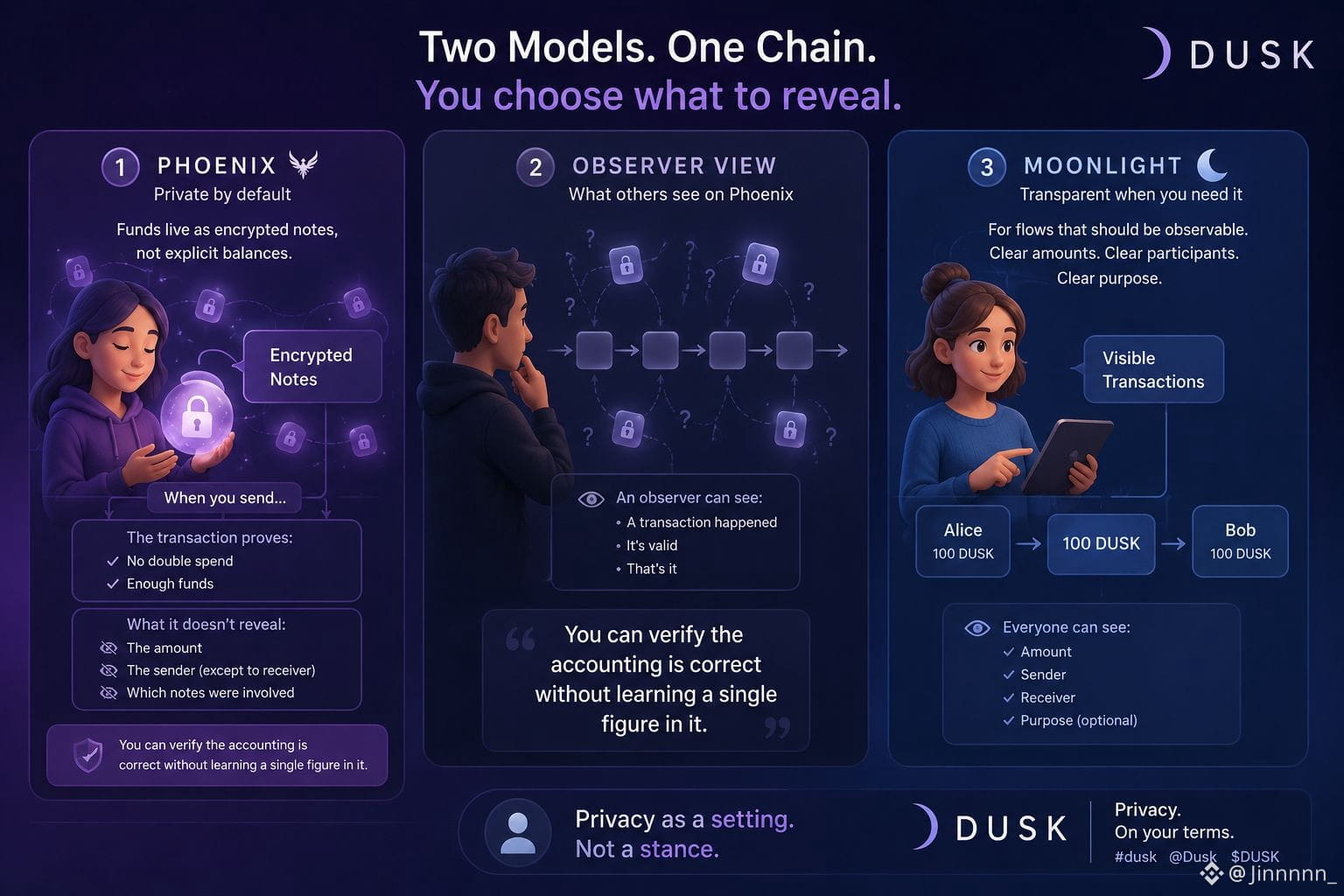
on most chains your balance is a number sitting in a table with your name next to it.
Phoenix doesnt work that way. funds live as encrypted notes instead of explicit balances.
what a transaction proves is narrow and specific. no double spend, enough funds. what it doesnt reveal is the amount, the sender except to the receiver, and wich notes were involved.
i keep coming back to how little that leaves an observer.
"you can verify the accounting is correct without learning a single figure in it"
thats a strange sentence and its the whole point.
Moonlight sits next to it for flows that should be observable. two models, same chain, the user picks based on what the situation needs.
not privacy as a stance. privacy as a setting.
#dusk @Dusk $DUSK
Phoenix doesnt work that way. funds live as encrypted notes instead of explicit balances.
what a transaction proves is narrow and specific. no double spend, enough funds. what it doesnt reveal is the amount, the sender except to the receiver, and wich notes were involved.
i keep coming back to how little that leaves an observer.
"you can verify the accounting is correct without learning a single figure in it"
thats a strange sentence and its the whole point.
Moonlight sits next to it for flows that should be observable. two models, same chain, the user picks based on what the situation needs.
not privacy as a stance. privacy as a setting.
#dusk @Dusk $DUSK
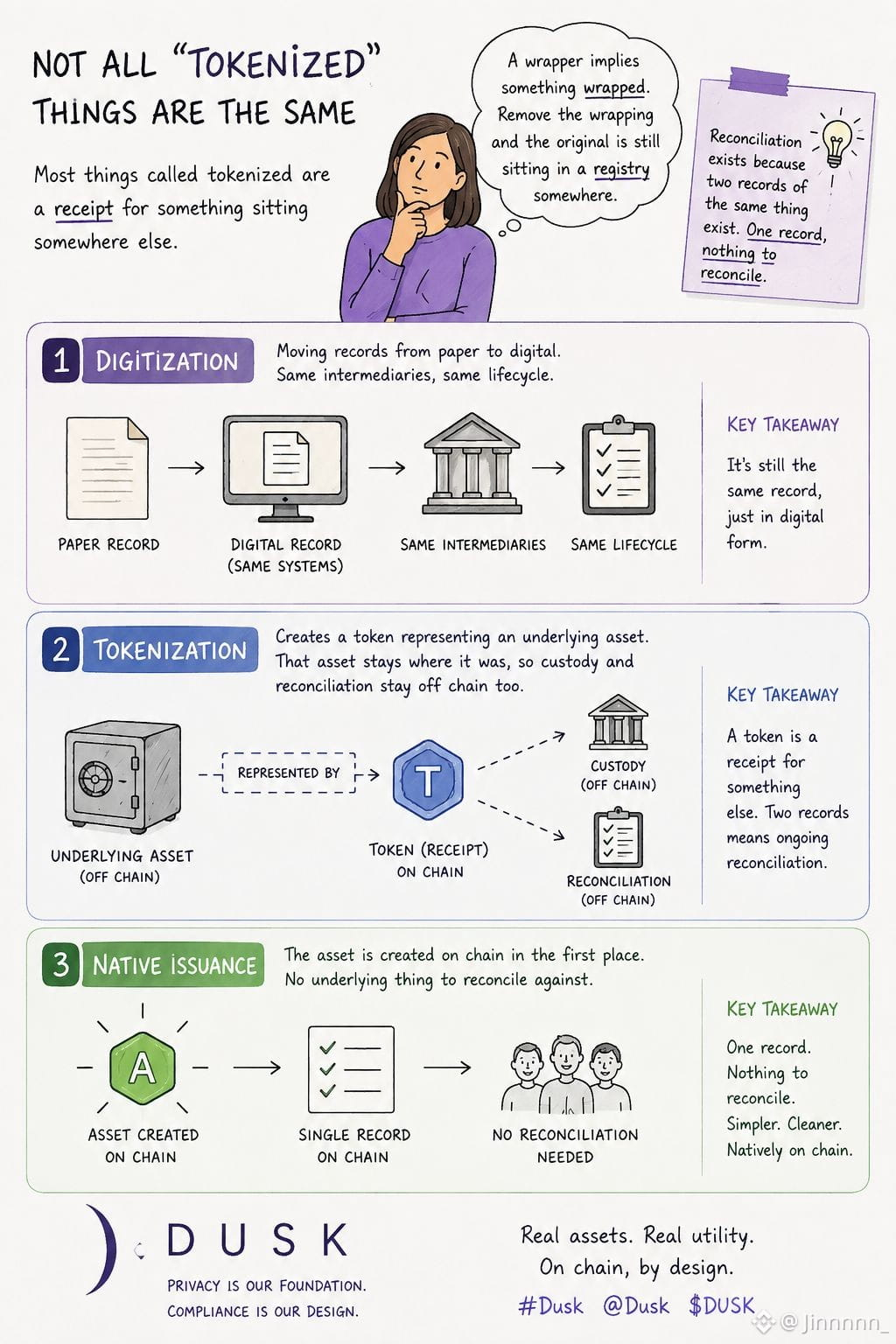
most things called tokenized are a receipt for something sitting somewhere else.
the docs seperate three words that usually get used interchangably. digitization is moving records from paper to digital, same intermediaries, same lifecycle. tokenization creates a token representing an underlying asset, and that asset stays where it was, so custody and reconcilation stay off chain too.
native issuance is the asset created on chain in the first place. no underlying thing to reconcile against.
i had to read the comparison table twice before the diference landed.
"a wrapper implies something wrapped. remove the wrapping and the original is still sitting in a registry somewhere"
reconciliation exists becuse two records of the same thing exist. one record, nothing to reconcile.
#dusk @Dusk $DUSK
the docs seperate three words that usually get used interchangably. digitization is moving records from paper to digital, same intermediaries, same lifecycle. tokenization creates a token representing an underlying asset, and that asset stays where it was, so custody and reconcilation stay off chain too.
native issuance is the asset created on chain in the first place. no underlying thing to reconcile against.
i had to read the comparison table twice before the diference landed.
"a wrapper implies something wrapped. remove the wrapping and the original is still sitting in a registry somewhere"
reconciliation exists becuse two records of the same thing exist. one record, nothing to reconcile.
#dusk @Dusk $DUSK
Today's Trending Coins....
Have you took any trade in them till now????
$ACE
$HEI
$TAKE
Have you took any trade in them till now????
$ACE
$HEI
$TAKE
ACE
12%
HEI
69%
TAKE
19%
68 الأصوات • تمّ إغلاق التصويت
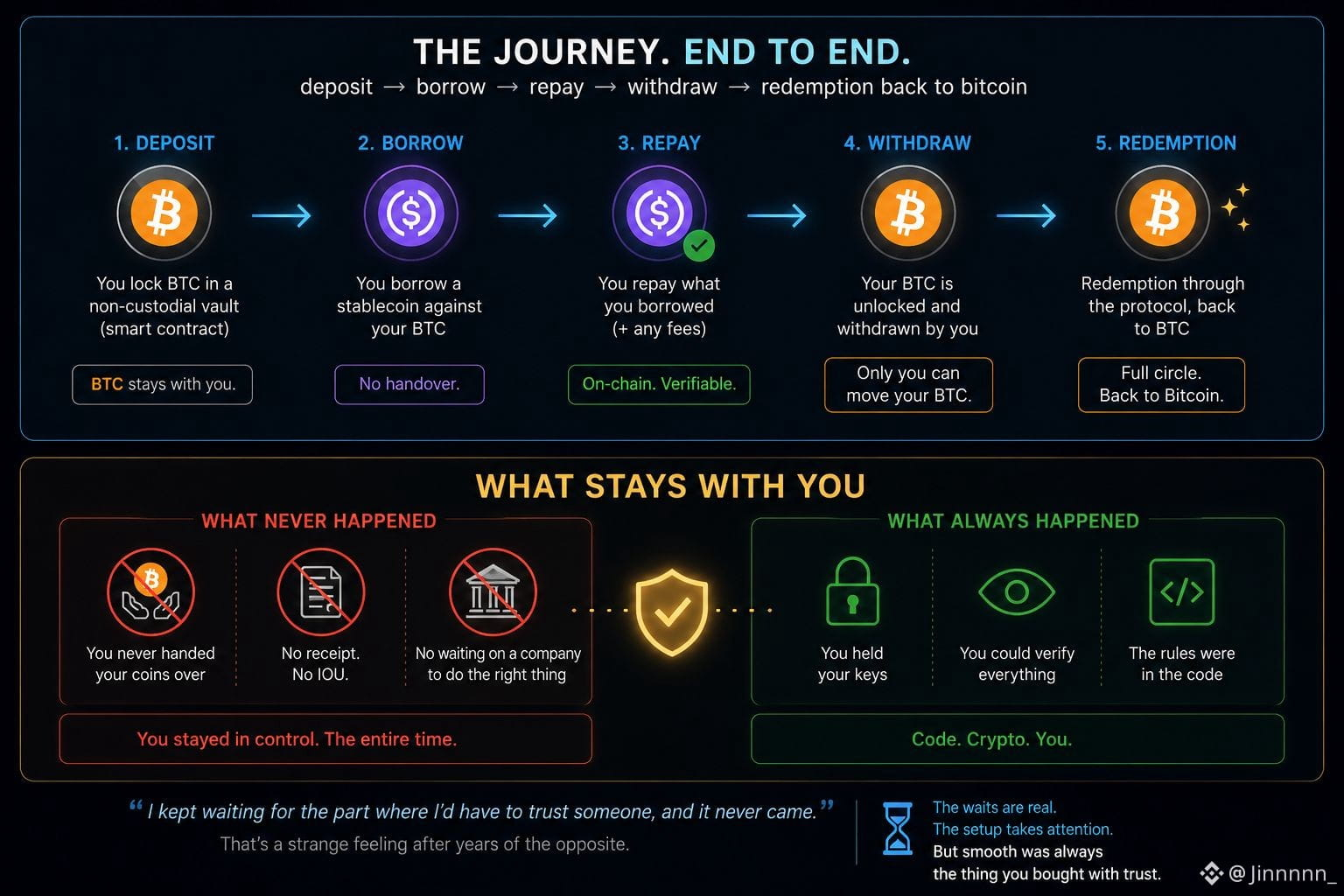
ran the whole thing end to end. deposit, borrow, repay, withdraw, redemption back to bitcoin.
what stays with me isnt any single step. its that nothing ever asked me to hand something over.
there was no moment where my coins left and a receipt arrived. no point where i was waiting on a company to do the right thing.
"i kept waiting for the part where i'd have to trust someone, and it never came"
thats a strange feeling after years of the opposite.
the waits are real. the setup takes attention. its not smooth in the way a custodial app is smooth, and it probably never will be. $CYS
but smooth was always the thing you bought with trust.
#baby @BabylonLabs_io $BABY
what stays with me isnt any single step. its that nothing ever asked me to hand something over.
there was no moment where my coins left and a receipt arrived. no point where i was waiting on a company to do the right thing.
"i kept waiting for the part where i'd have to trust someone, and it never came"
thats a strange feeling after years of the opposite.
the waits are real. the setup takes attention. its not smooth in the way a custodial app is smooth, and it probably never will be. $CYS
but smooth was always the thing you bought with trust.
#baby @BabylonLabs_io $BABY
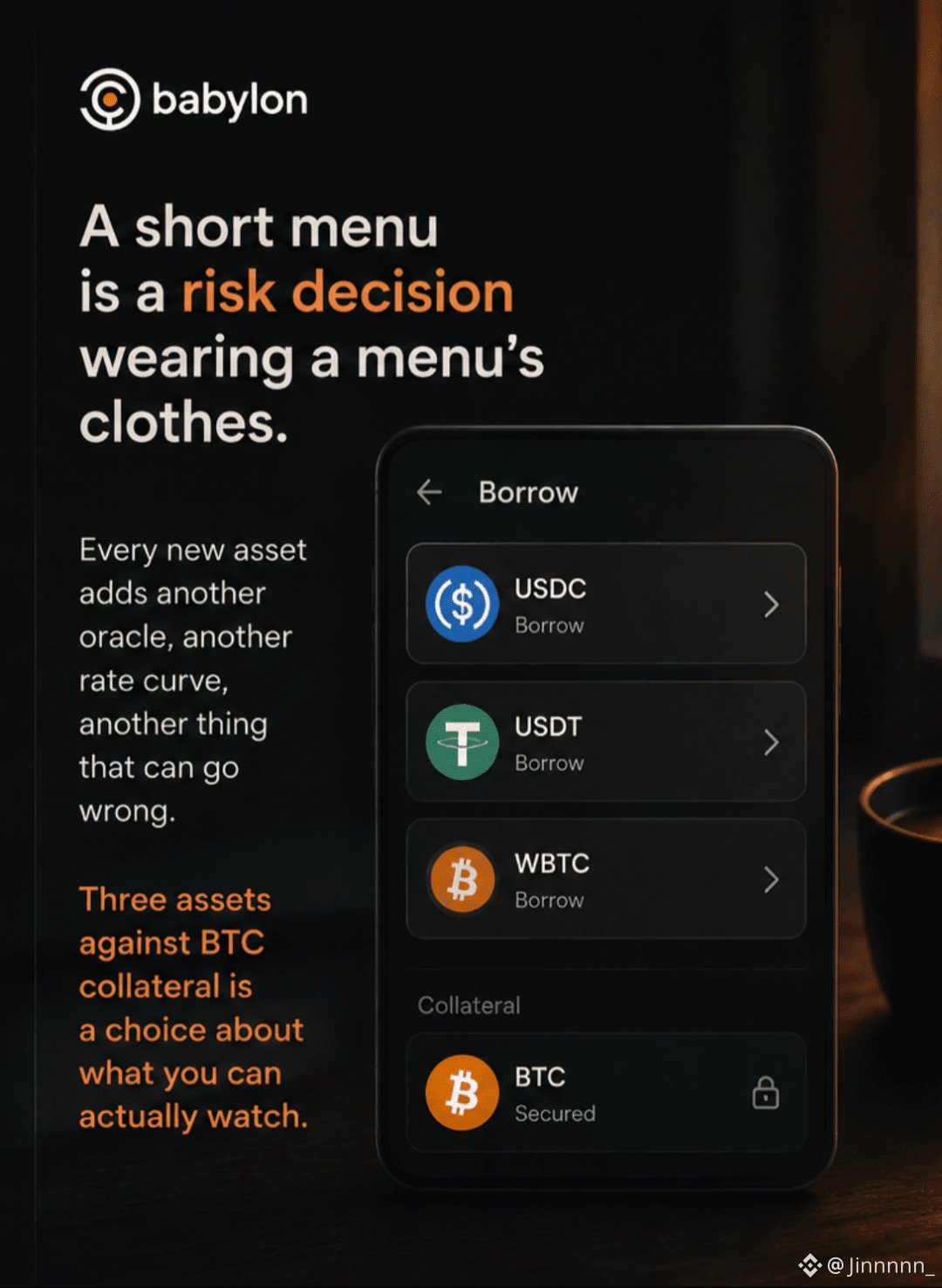
the borrow menu on the testnet is three assets. USDC, USDT, WBTC. thats it.
i noticed the shortness before i noticed anything else.
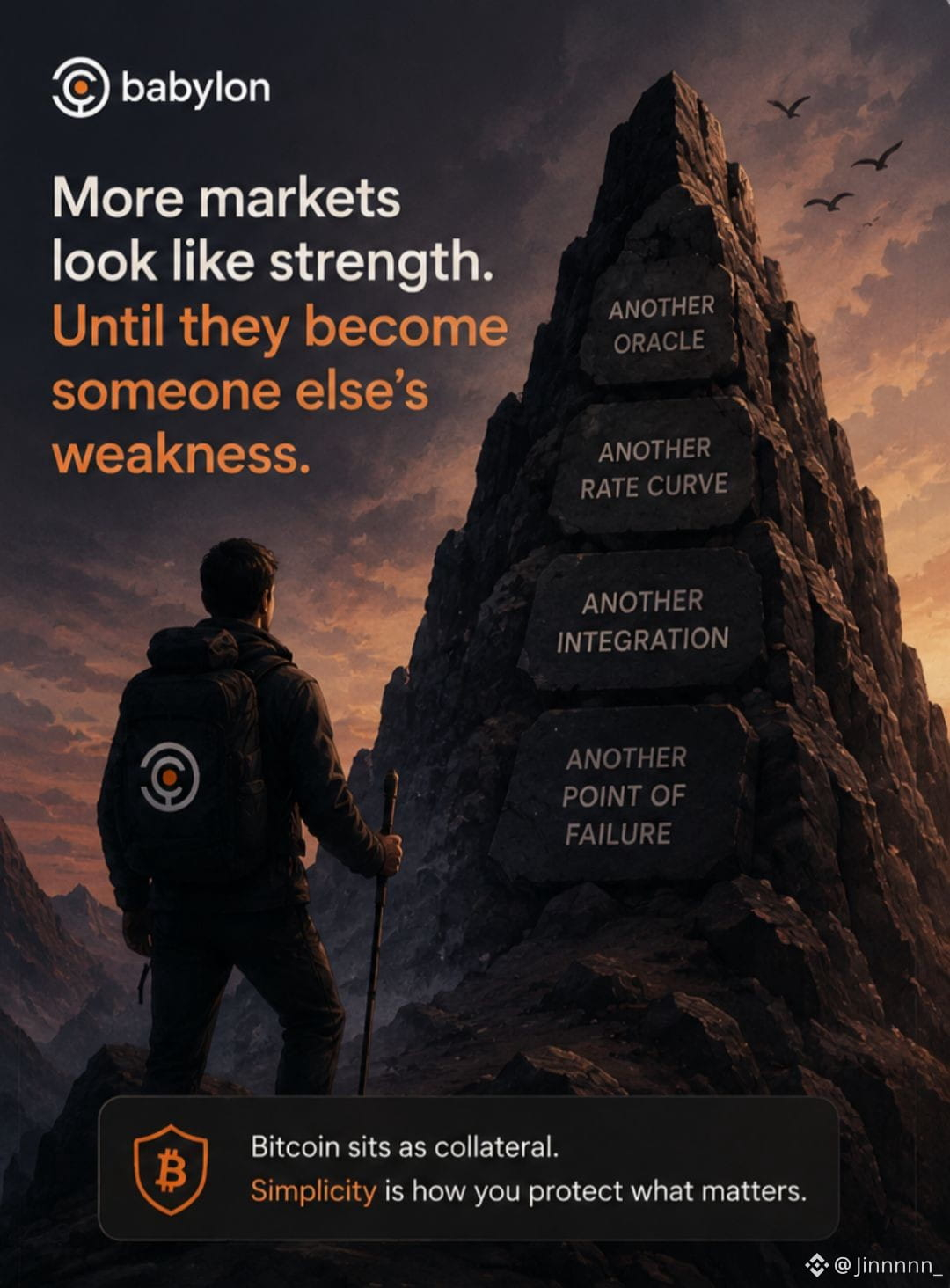
my first reaction was that it felt unfinished. then i thought about what each extra asset would add underneath. another oracle. another rate curve. another thing that can go wrong while bitcoin sits as collateral behind it.
"a short menu is a risk decision wearing a menu's clothes"
every lending platform i've used competed on how many assets it listed. more markets, more pairs, more everything. and the ones that broke, broke on something obscure that nobody was watching.
three assets against BTC collateral is a choice about what you can actually watch.
it looks like less. it reads like less. i think its the opposite.
#baby @BabylonLabs_io $BABY
i noticed the shortness before i noticed anything else.
my first reaction was that it felt unfinished. then i thought about what each extra asset would add underneath. another oracle. another rate curve. another thing that can go wrong while bitcoin sits as collateral behind it.
"a short menu is a risk decision wearing a menu's clothes"
every lending platform i've used competed on how many assets it listed. more markets, more pairs, more everything. and the ones that broke, broke on something obscure that nobody was watching.
three assets against BTC collateral is a choice about what you can actually watch.
it looks like less. it reads like less. i think its the opposite.
#baby @BabylonLabs_io $BABY
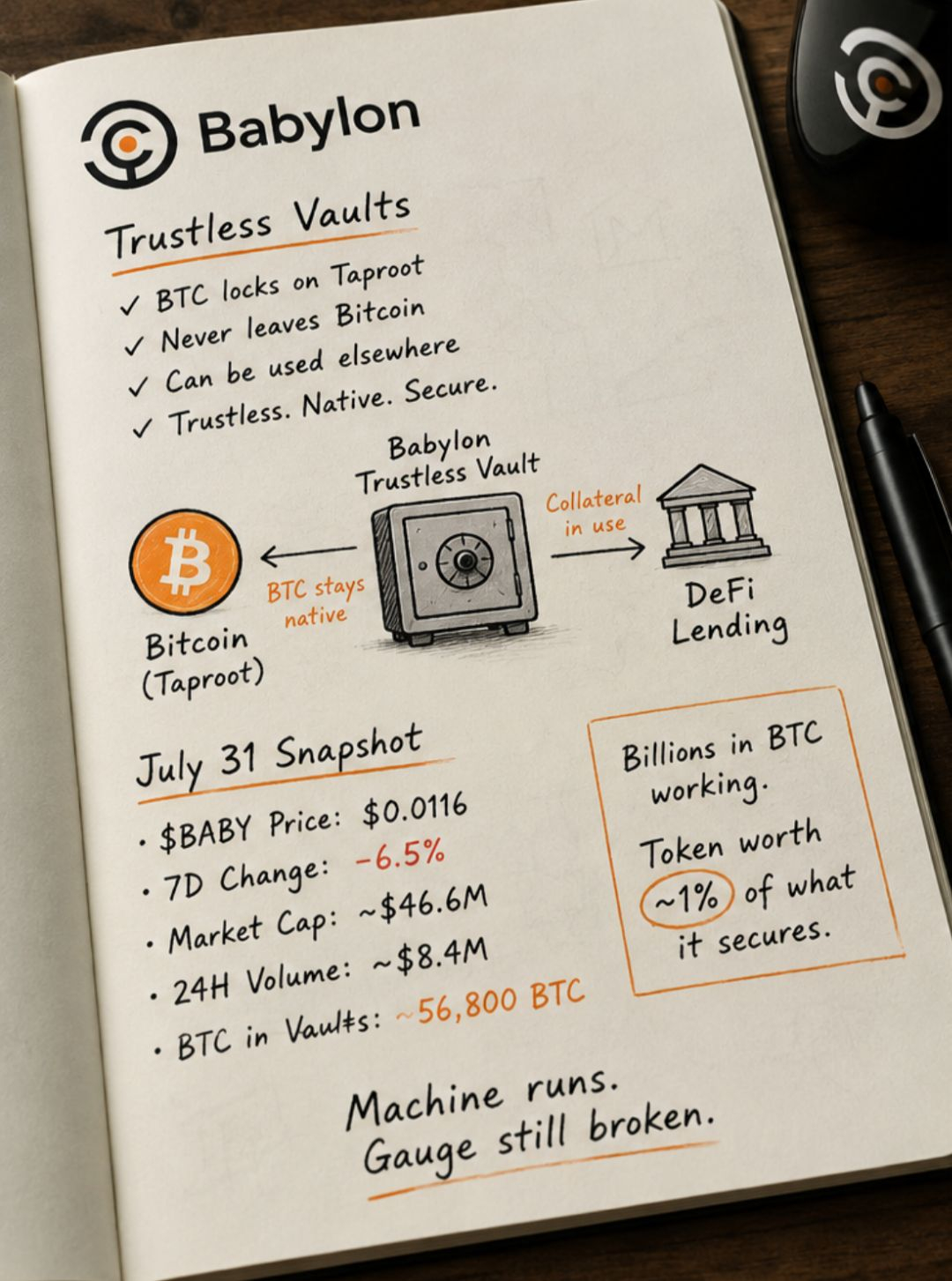
Spent part of the afternoon digging into @BabylonLabs_io 's Trustless Vault docs. The most interesting takeaway wasn't even the mechanics. Bitcoin stays locked on native Taproot, never leaves the Bitcoin network, yet can still be used as productive collateral elsewhere. That's a pretty elegant design.
Then I checked the charts.
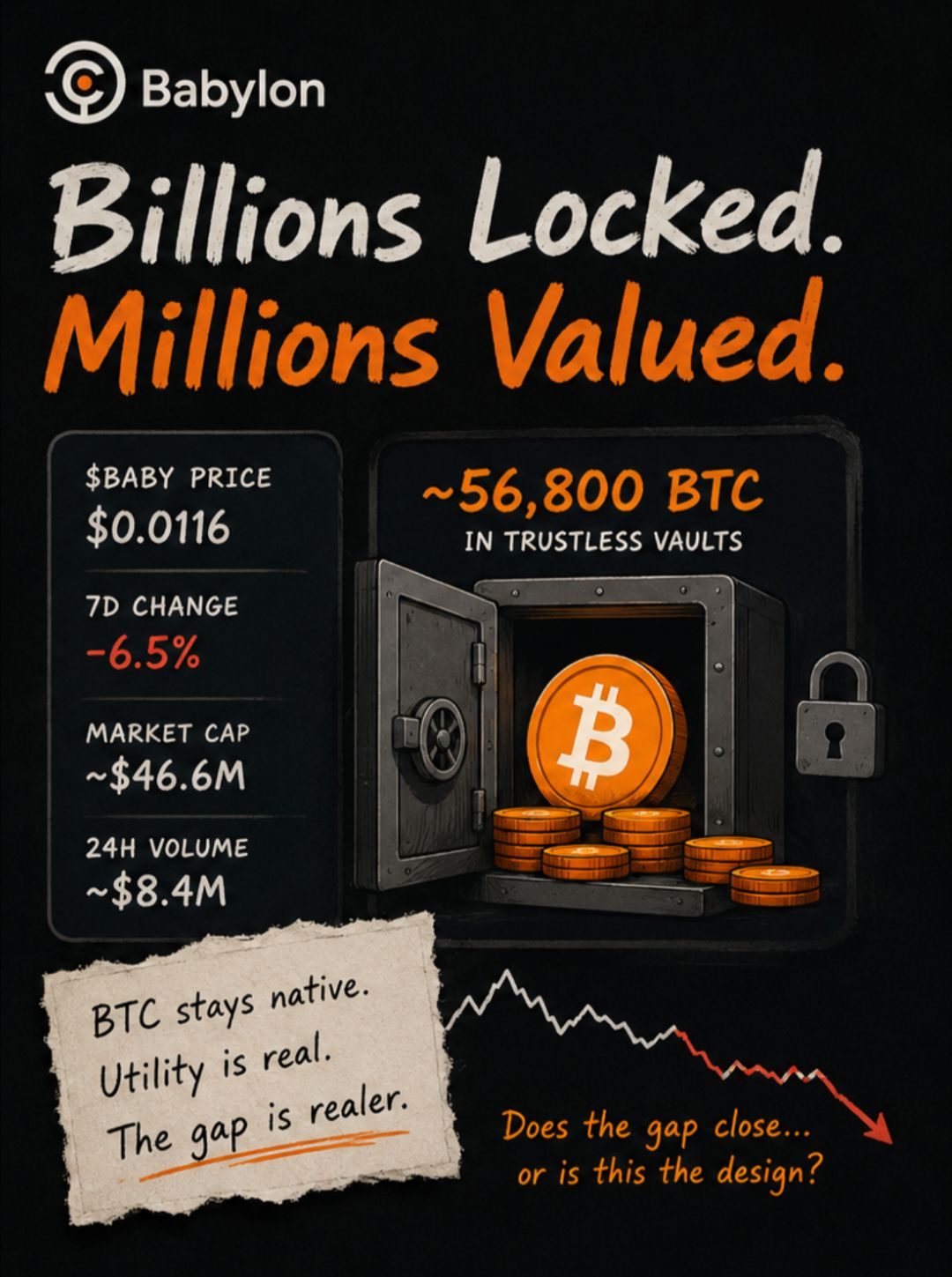
As of the August 02 snapshot, $BABY was sitting around $0.0107, down roughly 5.5% over the week, with a market cap near $46M and about $1M in 24-hour volume. At the same time, the vaults it's meant to govern were securing roughly 56,800 BTC. That's billions of dollars in Bitcoin actively at work.
That's the part I couldn't stop thinking about.
The protocol appears to be doing exactly what it's built to do. Bitcoin remains native. Lending protocols receive real collateral. Users gain access to liquidity. The infrastructure is functioning.
Yet the governance token tied to that ecosystem is valued at only a tiny fraction of the assets it helps coordinate.
It feels like watching a powerful engine run flawlessly while the dashboard barely registers that it's on.
Maybe that disconnect narrows over time through higher borrow demand, additional BSNs, token burns, or stronger value accrual. Or maybe this separation between protocol utility and token value is simply how the system is designed.
Curious to see which direction it takes.
#BABY #BabylonLabs
Then I checked the charts.
As of the August 02 snapshot, $BABY was sitting around $0.0107, down roughly 5.5% over the week, with a market cap near $46M and about $1M in 24-hour volume. At the same time, the vaults it's meant to govern were securing roughly 56,800 BTC. That's billions of dollars in Bitcoin actively at work.
That's the part I couldn't stop thinking about.
The protocol appears to be doing exactly what it's built to do. Bitcoin remains native. Lending protocols receive real collateral. Users gain access to liquidity. The infrastructure is functioning.
Yet the governance token tied to that ecosystem is valued at only a tiny fraction of the assets it helps coordinate.
It feels like watching a powerful engine run flawlessly while the dashboard barely registers that it's on.
Maybe that disconnect narrows over time through higher borrow demand, additional BSNs, token burns, or stronger value accrual. Or maybe this separation between protocol utility and token value is simply how the system is designed.
Curious to see which direction it takes.
#BABY #BabylonLabs
سجّل الدخول لاستكشاف المزيد من المُحتوى