
Kim Jon sun
420 منشورات

Kim Jon sun
فتح تداول
مُتداول مُتكرر
5.9 أشهر
76 تتابع
5.0K+ المتابعون
722 إعجاب
منشورات
الحافظة الاستثمارية
تمّ التحقق
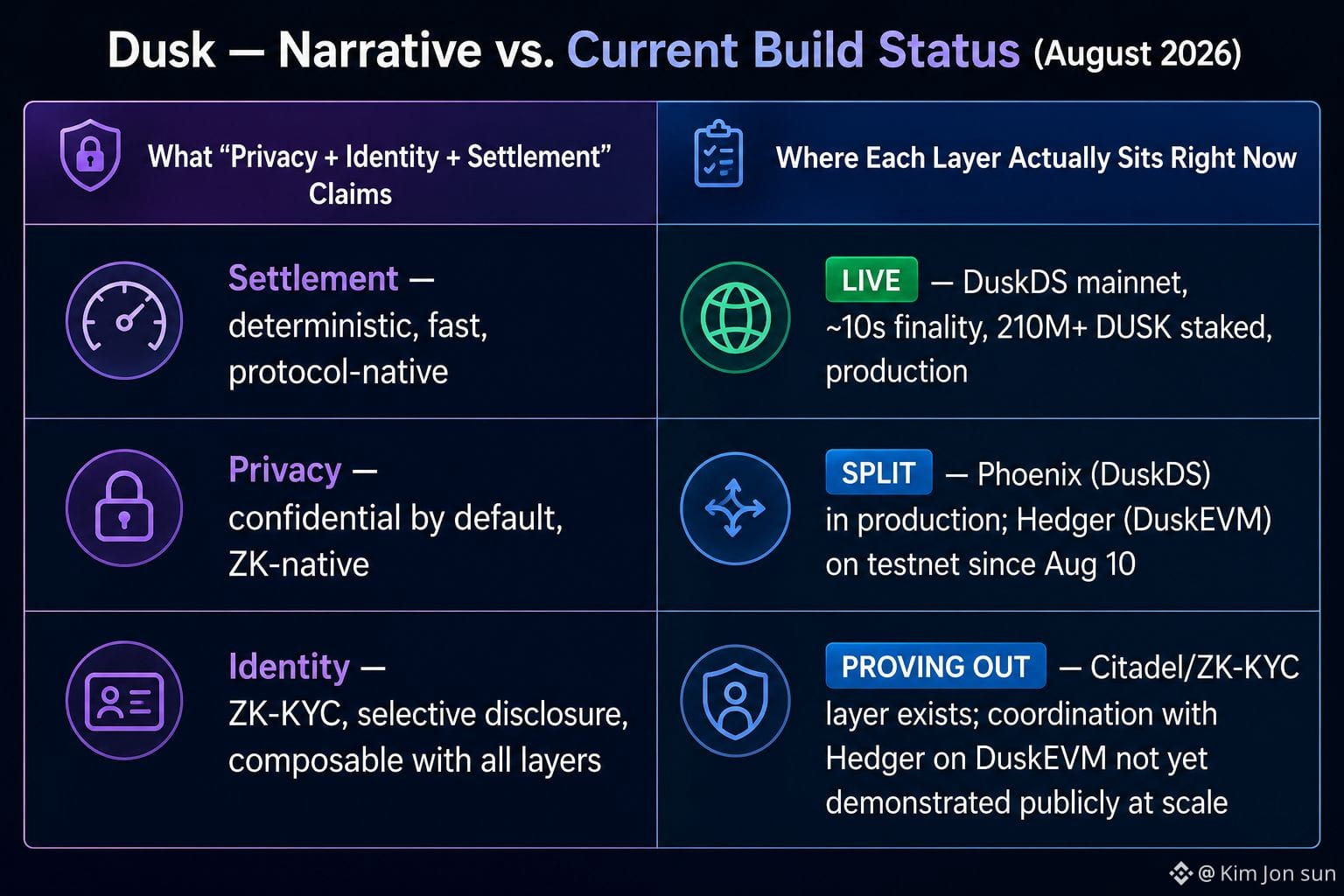
The thing that kept pulling at me during this Dusk Network task wasn't any single feature — it was the gap between how the stack is framed and where it actually sits right now.
$DUSK , #dusk , @Dusk frames privacy, identity, and settlement as working together. Architecturally, yes. But they don't all live in the same phase. Settlement is the most solid: DuskDS mainnet, ~10 seconds to finality, 210M+ DUSK staked and securing the network. Live, production. DuskEVM testnet came up August 10 — Solidity deployment, Hardhat support, settling back to DuskDS. Hedger, the confidential EVM layer meant to make privacy and financial contracts composable, is testnet too.
So here's the honest read: native privacy on DuskDS runs in production. Settlement runs in production. But the part where identity proofs actually meet confidential EVM execution — the bit that makes regulated onchain finance feel genuinely different from anything else — is still proving out. Citadel's ZK-KYC and selective disclosure feeds into the stack, but its coordination with Hedger on DuskEVM hasn't been demonstrated publicly at scale yet. That's not a knock. It's just where the build is.
What I keep turning over: does "privacy, identity, and settlement working together" require all three layers live at once, or is the claim already true at different levels of the stack...
$DUSK , #dusk , @Dusk frames privacy, identity, and settlement as working together. Architecturally, yes. But they don't all live in the same phase. Settlement is the most solid: DuskDS mainnet, ~10 seconds to finality, 210M+ DUSK staked and securing the network. Live, production. DuskEVM testnet came up August 10 — Solidity deployment, Hardhat support, settling back to DuskDS. Hedger, the confidential EVM layer meant to make privacy and financial contracts composable, is testnet too.
So here's the honest read: native privacy on DuskDS runs in production. Settlement runs in production. But the part where identity proofs actually meet confidential EVM execution — the bit that makes regulated onchain finance feel genuinely different from anything else — is still proving out. Citadel's ZK-KYC and selective disclosure feeds into the stack, but its coordination with Hedger on DuskEVM hasn't been demonstrated publicly at scale yet. That's not a knock. It's just where the build is.
What I keep turning over: does "privacy, identity, and settlement working together" require all three layers live at once, or is the claim already true at different levels of the stack...
تمّ التحقق
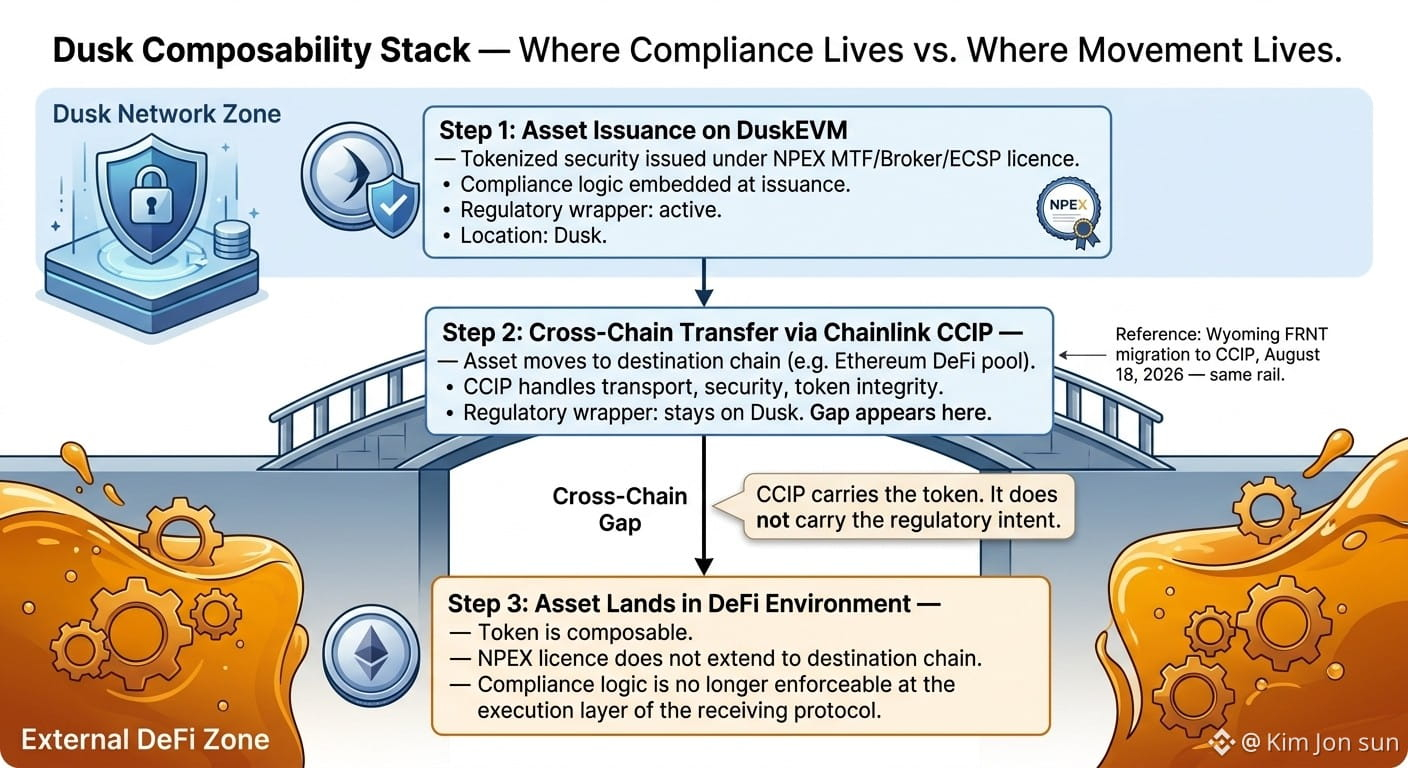
Spent time mapping Dusk Network's composability architecture today — specifically how $DUSK -settled RWAs are supposed to reach DeFi protocols beyond Dusk's own layer. The answer is Chainlink CCIP, chosen as the canonical cross-chain rail for tokenized assets issued via NPEX on DuskEVM. #dusk @Dusk Clean infrastructure choice, honestly.
Then this dropped into my feed from August 18: Wyoming's Stable Token Commission migrated its FRNT stablecoin from LayerZero to CCIP, citing it as "the only infrastructure that met its stringent security and reliability requirements." Government-level validation of the exact transport layer Dusk's composability story depends on. The timing just sits there.
Here's the thing though — "composable regulated assets" sounds like a single primitive, but working through the actual stack it's two separate dependency chains. Compliance lives on Dusk, backed by NPEX's MTF, Broker, and ECSP licences. Cross-chain movement lives on CCIP. These don't share a single trust boundary. When a tokenized NPEX equity hops via CCIP to settle inside a DeFi pool on Ethereum, the compliance logic governing its issuance on Dusk doesn't travel with it. The asset moves. The regulatory wrapper stays home.
I kept pulling at this during the task. CCIP carries tokens, carries data, carries messages. The question I can't cleanly answer is whether it can carry regulatory intent the way it carries the asset itself...
Then this dropped into my feed from August 18: Wyoming's Stable Token Commission migrated its FRNT stablecoin from LayerZero to CCIP, citing it as "the only infrastructure that met its stringent security and reliability requirements." Government-level validation of the exact transport layer Dusk's composability story depends on. The timing just sits there.
Here's the thing though — "composable regulated assets" sounds like a single primitive, but working through the actual stack it's two separate dependency chains. Compliance lives on Dusk, backed by NPEX's MTF, Broker, and ECSP licences. Cross-chain movement lives on CCIP. These don't share a single trust boundary. When a tokenized NPEX equity hops via CCIP to settle inside a DeFi pool on Ethereum, the compliance logic governing its issuance on Dusk doesn't travel with it. The asset moves. The regulatory wrapper stays home.
I kept pulling at this during the task. CCIP carries tokens, carries data, carries messages. The question I can't cleanly answer is whether it can carry regulatory intent the way it carries the asset itself...
تمّ التحقق
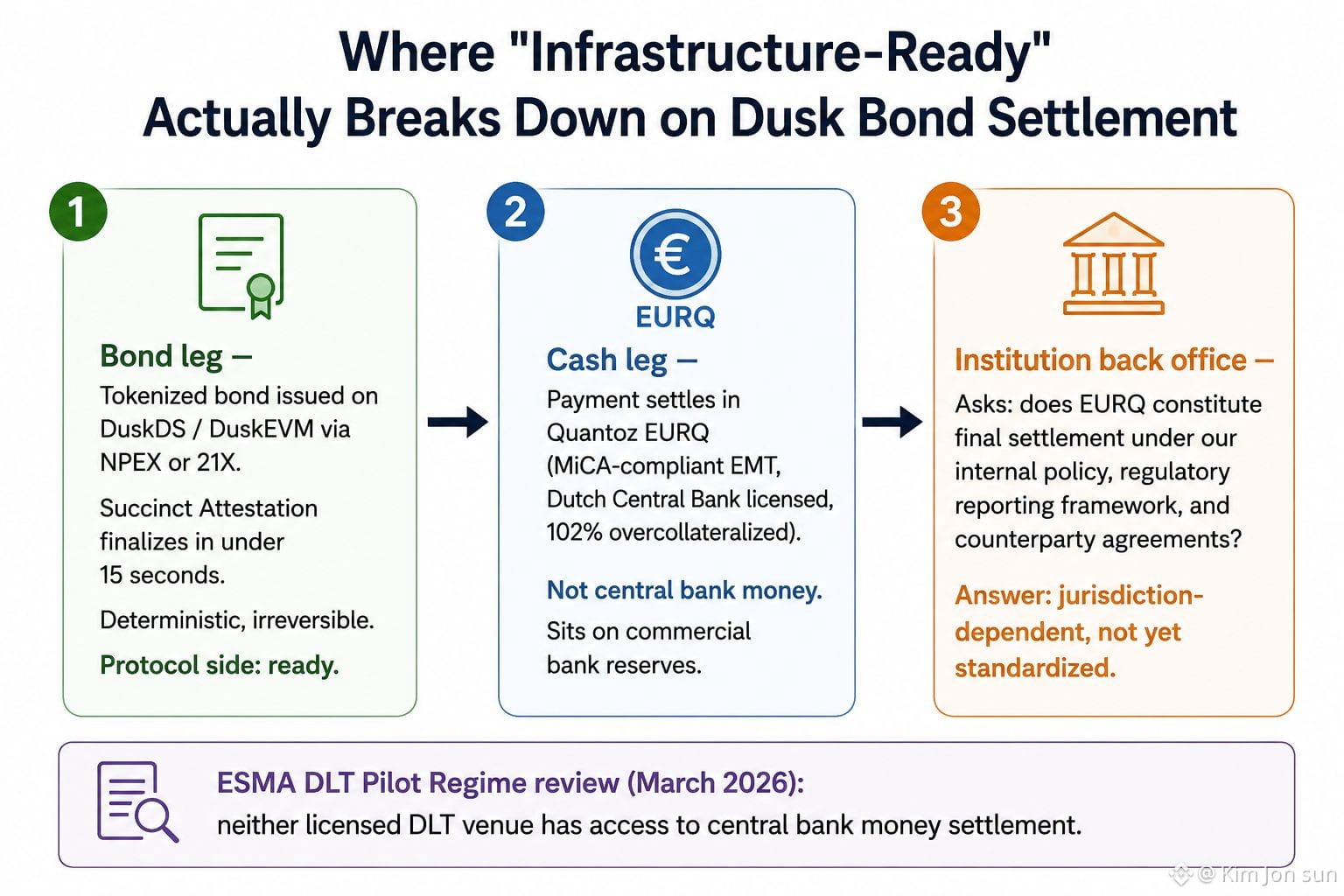
Something clicked reading the August 15 Dusk Network #dusk @Dusk piece on SME tokenization — specifically the part about bonds and settlement. Not the privacy architecture. Not the ZK proofs. The cash leg.
Here's what actually stood out. Dusk's protocol does the hard part well — Succinct Attestation finalizes in under 15 seconds, deterministic and done. $DUSK stakers secure a settlement layer that can handle a bond trade atomically: delivery and payment in the same transaction, no CSD intermediary sitting between them. That's real. 21X has the DLT-TSS license to prove the model isn't theoretical.
But hold up — the ESMA review of the DLT Pilot Regime made a point that keeps sitting with me. Cash settlement across both licensed DLT infrastructures currently runs on commercial bank EMTs, not central bank money. Dusk's cash leg pairs with Quantoz EURQ — a MiCA-compliant stablecoin, well-structured, 102% overcollateralized — but still commercial bank money. The bond settles in 15 seconds on Dusk. The question an institutional back office actually asks is whether EURQ constitutes final settlement for regulatory reporting purposes. That answer varies by jurisdiction and counterparty agreement. With the bridge still closed post-August 16 and DuskEVM launch pending, the settlement stack isn't fully stress-tested in live conditions yet either.
So the bond infrastructure is ready. The money behind it is still in a gray zone most institutions haven't resolved internally. Does the infrastructure-readiness label belong to the chain, or to the cash instrument it settles against?
Here's what actually stood out. Dusk's protocol does the hard part well — Succinct Attestation finalizes in under 15 seconds, deterministic and done. $DUSK stakers secure a settlement layer that can handle a bond trade atomically: delivery and payment in the same transaction, no CSD intermediary sitting between them. That's real. 21X has the DLT-TSS license to prove the model isn't theoretical.
But hold up — the ESMA review of the DLT Pilot Regime made a point that keeps sitting with me. Cash settlement across both licensed DLT infrastructures currently runs on commercial bank EMTs, not central bank money. Dusk's cash leg pairs with Quantoz EURQ — a MiCA-compliant stablecoin, well-structured, 102% overcollateralized — but still commercial bank money. The bond settles in 15 seconds on Dusk. The question an institutional back office actually asks is whether EURQ constitutes final settlement for regulatory reporting purposes. That answer varies by jurisdiction and counterparty agreement. With the bridge still closed post-August 16 and DuskEVM launch pending, the settlement stack isn't fully stress-tested in live conditions yet either.
So the bond infrastructure is ready. The money behind it is still in a gray zone most institutions haven't resolved internally. Does the infrastructure-readiness label belong to the chain, or to the cash instrument it settles against?
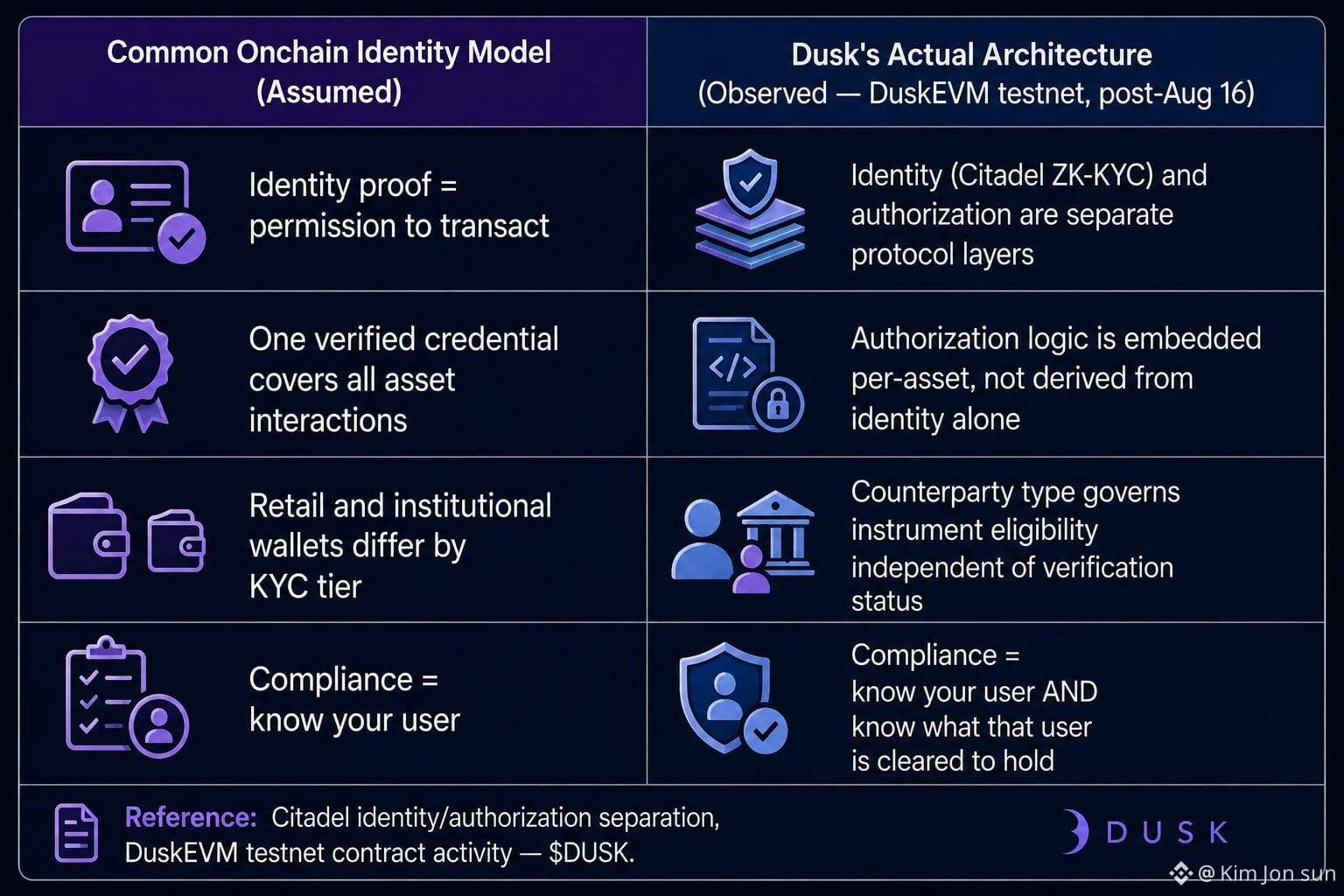
Something I kept circling back to while working through the DuskEVM testnet activity this past week — specifically around the contract interactions that went live after the August 16 bridge situation settled — is how differently Dusk Network ($DUSK ) treats identity versus authorization. #dusk @Dusk
Most onchain identity projects conflate the two. You prove who you are, and that proof becomes your permission. Done. But in Dusk's architecture, identity and authorization are separate layers. Citadel handles the identity attestation through ZK-KYC — you prove attributes without exposing them. But what you're actually authorized to do with a given asset is a different question, governed separately. The regulated asset itself carries the authorization logic, not the identity credential.
Hmm. That split matters more than it sounds. In TradFi, knowing who you are doesn't automatically clear you for every instrument. A verified institutional wallet and a verified retail wallet aren't fungible counterparties for a bond issuance. Dusk seems to be modeling that distinction at protocol level rather than pushing it up to the application layer.
I'll be honest, I almost glossed over it. Spent most of the session focused on the ZK proof structure before the authorization separation clicked.
Still not clear how granular that authorization logic can actually get before it becomes too expensive or too brittle to maintain across asset types though.
Most onchain identity projects conflate the two. You prove who you are, and that proof becomes your permission. Done. But in Dusk's architecture, identity and authorization are separate layers. Citadel handles the identity attestation through ZK-KYC — you prove attributes without exposing them. But what you're actually authorized to do with a given asset is a different question, governed separately. The regulated asset itself carries the authorization logic, not the identity credential.
Hmm. That split matters more than it sounds. In TradFi, knowing who you are doesn't automatically clear you for every instrument. A verified institutional wallet and a verified retail wallet aren't fungible counterparties for a bond issuance. Dusk seems to be modeling that distinction at protocol level rather than pushing it up to the application layer.
I'll be honest, I almost glossed over it. Spent most of the session focused on the ZK proof structure before the authorization separation clicked.
Still not clear how granular that authorization logic can actually get before it becomes too expensive or too brittle to maintain across asset types though.
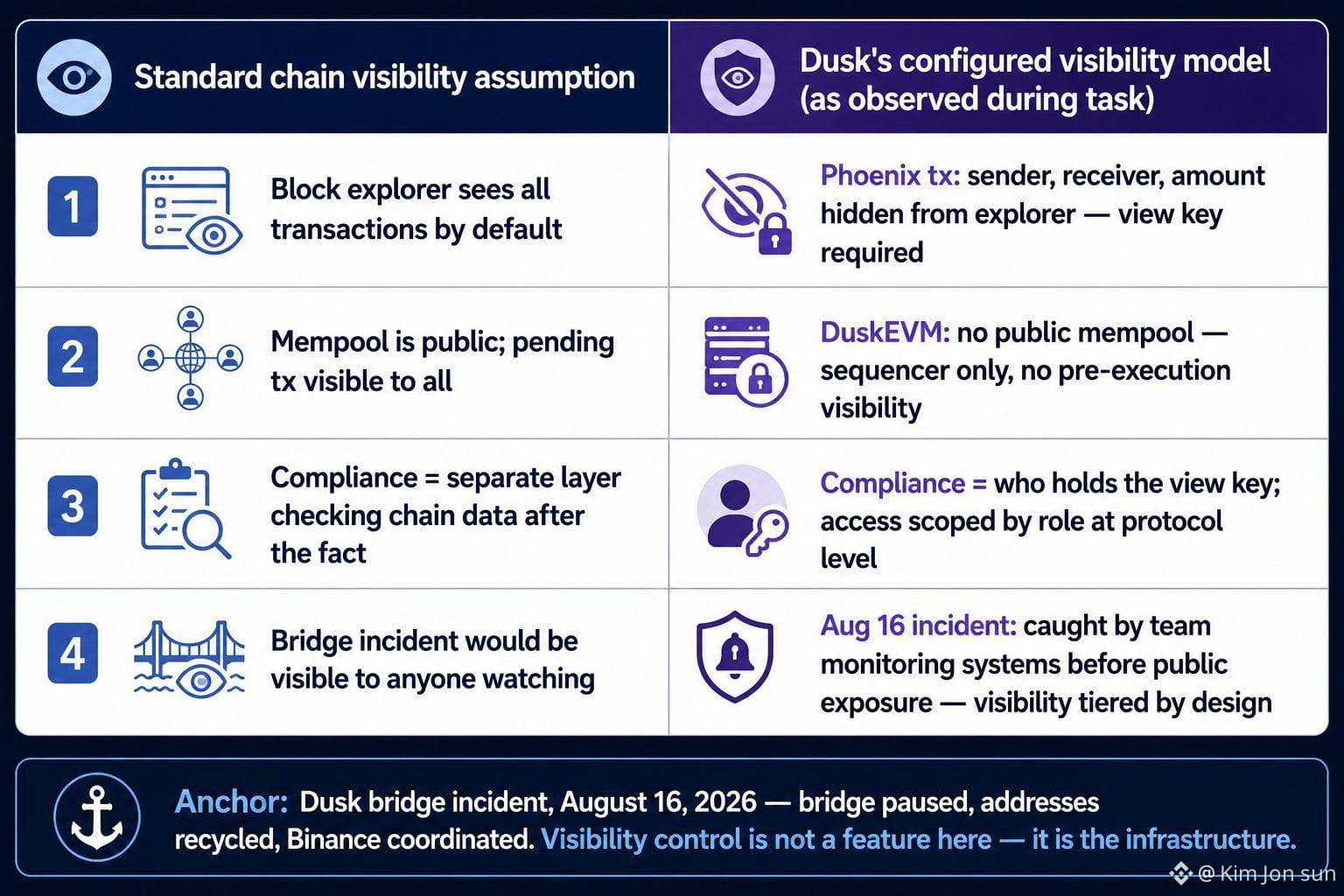
Pulled up the Dusk Network ($DUSK ) bridge incident notice from August 16 while working through this task. #Dusk @Dusk . The team flagged suspicious activity on a team-managed bridge wallet, disabled and recycled the related addresses, paused bridge services, and coordinated with Binance — all apparently before any user funds moved. No protocol-level issue on DuskDS. Standard incident response. But I kept re-reading it for a different reason.
The part that stuck: their monitoring systems caught this. Meaning the team had visibility into specific wallet behavior that external observers, including anyone watching the block explorer, probably didn't. That's not an accident. It's the architecture. Phoenix transactions on DuskDS don't expose sender, receiver, or amount to anyone without a view key. DuskEVM runs with no public mempool — sequencer only. Visibility on Dusk is assigned, not assumed.
And that's actually the institutional pitch. Not privacy as a feature bolted on. Visibility as a configurable permission. Regulators get a view key scoped to what they need. Counterparties see what the contract allows. Operators see what their role grants. Everyone else sees... not much.
I kept thinking about how different that is from standard chain design, where the block explorer sees everything by default and access controls are afterthoughts. Here the default is opacity. Institutions apparently prefer that. Which is understandable — until you start asking who controls the view key distribution, and whether that control ever drifts toward fewer hands than the design implies.
The part that stuck: their monitoring systems caught this. Meaning the team had visibility into specific wallet behavior that external observers, including anyone watching the block explorer, probably didn't. That's not an accident. It's the architecture. Phoenix transactions on DuskDS don't expose sender, receiver, or amount to anyone without a view key. DuskEVM runs with no public mempool — sequencer only. Visibility on Dusk is assigned, not assumed.
And that's actually the institutional pitch. Not privacy as a feature bolted on. Visibility as a configurable permission. Regulators get a view key scoped to what they need. Counterparties see what the contract allows. Operators see what their role grants. Everyone else sees... not much.
I kept thinking about how different that is from standard chain design, where the block explorer sees everything by default and access controls are afterthoughts. Here the default is opacity. Institutions apparently prefer that. Which is understandable — until you start asking who controls the view key distribution, and whether that control ever drifts toward fewer hands than the design implies.
Spent some time this week digging into how Dusk ($DUSK ) actually handles the "reviewable" side of its privacy claim. #dusk @Dusk
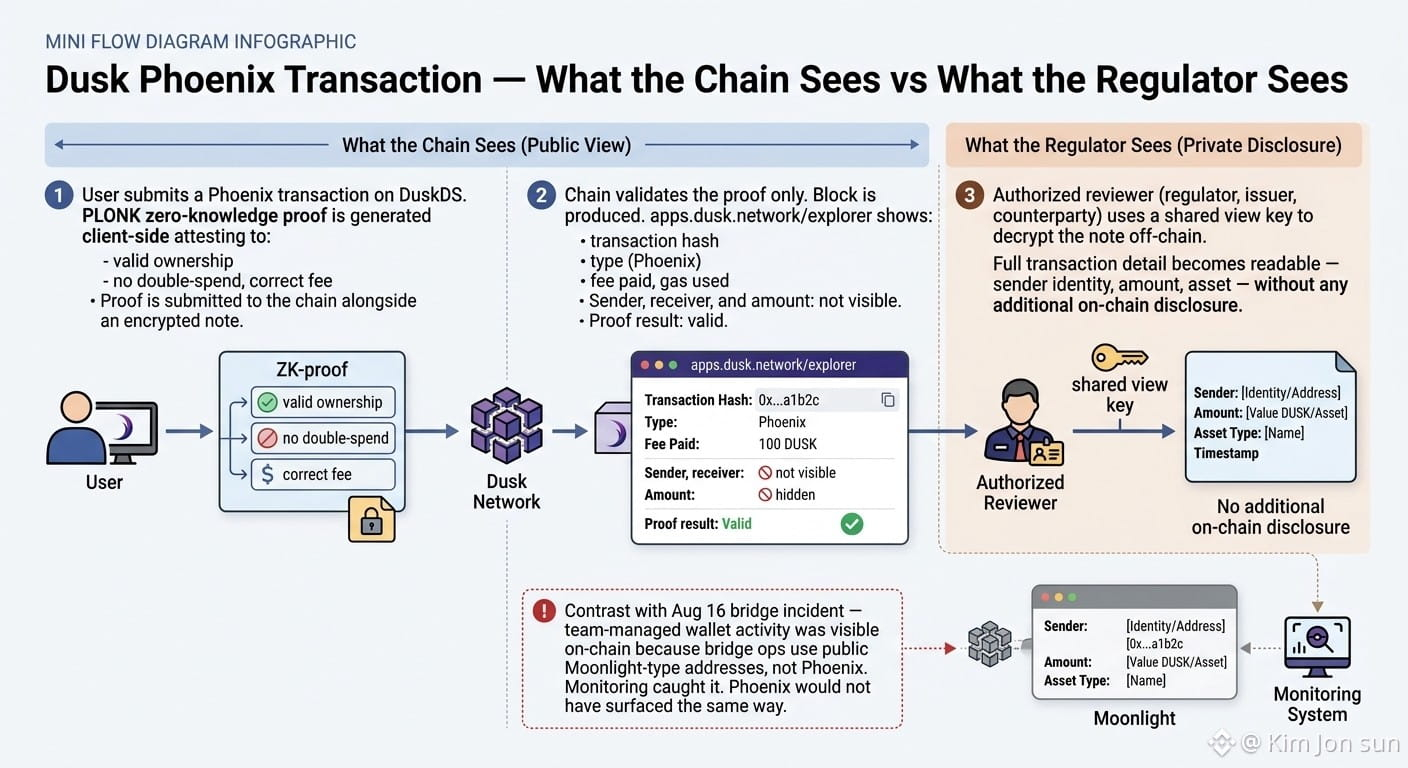
The thing that stopped me: pull up a Phoenix transaction on apps.dusk.network/explorer and what you see is basically just... fee and gas used. The proof is there, marked valid. But sender, receiver, amount — nothing. The ZK proof tells the network the transaction is correct without telling the network what it contains. That's the actual mechanism. Reviewability doesn't live on the public chain; it lives with whoever holds the view key. Two completely different surfaces.
Hold up — this actually reframes the Aug 16 bridge incident in an odd way. The suspicious activity on that team wallet was catchable by monitoring precisely because bridge operations run through a publicly visible address, not Phoenix shielded flow. It surfaced. A Phoenix-routed operation with the same behavior would've been invisible on-chain without the view key. So "private" and "reviewable" aren't in conflict here; they're just scoped to different layers by design. The proof attests to validity. The key controls disclosure.
I went in expecting the insight to be about proof generation overhead. Ended up sitting with something quieter — that in a regulated context, "auditable" means controlled access to a view key, not on-chain transparency. Which holds up architecturally... until you start asking who manages key custody and whether that access itself ever gets logged anywhere.
The thing that stopped me: pull up a Phoenix transaction on apps.dusk.network/explorer and what you see is basically just... fee and gas used. The proof is there, marked valid. But sender, receiver, amount — nothing. The ZK proof tells the network the transaction is correct without telling the network what it contains. That's the actual mechanism. Reviewability doesn't live on the public chain; it lives with whoever holds the view key. Two completely different surfaces.
Hold up — this actually reframes the Aug 16 bridge incident in an odd way. The suspicious activity on that team wallet was catchable by monitoring precisely because bridge operations run through a publicly visible address, not Phoenix shielded flow. It surfaced. A Phoenix-routed operation with the same behavior would've been invisible on-chain without the view key. So "private" and "reviewable" aren't in conflict here; they're just scoped to different layers by design. The proof attests to validity. The key controls disclosure.
I went in expecting the insight to be about proof generation overhead. Ended up sitting with something quieter — that in a regulated context, "auditable" means controlled access to a view key, not on-chain transparency. Which holds up architecturally... until you start asking who manages key custody and whether that access itself ever gets logged anywhere.
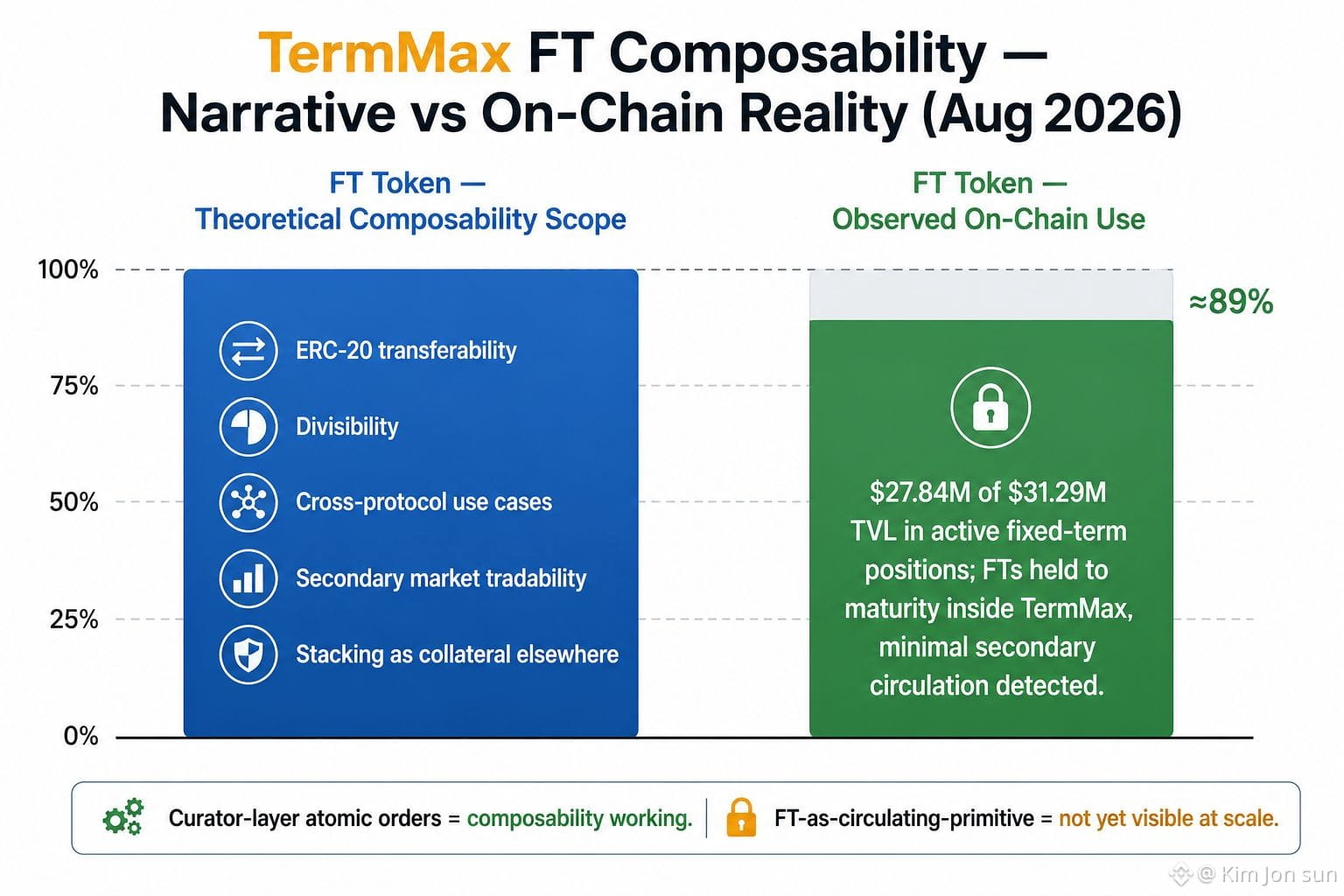
Something clicked mid-task when I pulled up TermMax on DeFiLlama this week. #TermMax , @TermMax — current TVL sitting around $31.29M, active loans at $27.84M. That's roughly 89 cents of every deposited dollar already out as live credit.
The composability narrative here is that FT tokens — ERC-20 zero-coupon bonds minted when a lender enters a position — are the "primitive." Transferable, divisible, theoretically stackable into anything else in DeFi. Which sounds right. And structurally it is right.
But 89% utilization means those FTs are mostly not circulating. They're sitting inside live fixed-term positions waiting for their maturity date, not bouncing around as collateral elsewhere or routing through other protocols. The composable primitive exists on paper as an ERC-20. In practice, it's locked up being the yield instrument it was issued to be. The real composability activity — atomic orders across multiple markets — is happening at the curator layer: MEV Capital, Keyrock, the others. One pool, many markets, simultaneously. That's composability working. But it's working for the capital allocators, not for the FT token as a freely circulating building block.
I kept flipping between the docs and the DeFiLlama breakdown trying to find where the FT secondary market actually shows up. Didn't find much.
So who's actually using FT composability outside of TermMax's own markets, and does that usage emerge naturally or does it need another protocol to explicitly integrate it?
The composability narrative here is that FT tokens — ERC-20 zero-coupon bonds minted when a lender enters a position — are the "primitive." Transferable, divisible, theoretically stackable into anything else in DeFi. Which sounds right. And structurally it is right.
But 89% utilization means those FTs are mostly not circulating. They're sitting inside live fixed-term positions waiting for their maturity date, not bouncing around as collateral elsewhere or routing through other protocols. The composable primitive exists on paper as an ERC-20. In practice, it's locked up being the yield instrument it was issued to be. The real composability activity — atomic orders across multiple markets — is happening at the curator layer: MEV Capital, Keyrock, the others. One pool, many markets, simultaneously. That's composability working. But it's working for the capital allocators, not for the FT token as a freely circulating building block.
I kept flipping between the docs and the DeFiLlama breakdown trying to find where the FT secondary market actually shows up. Didn't find much.
So who's actually using FT composability outside of TermMax's own markets, and does that usage emerge naturally or does it need another protocol to explicitly integrate it?
تمّ التحقق
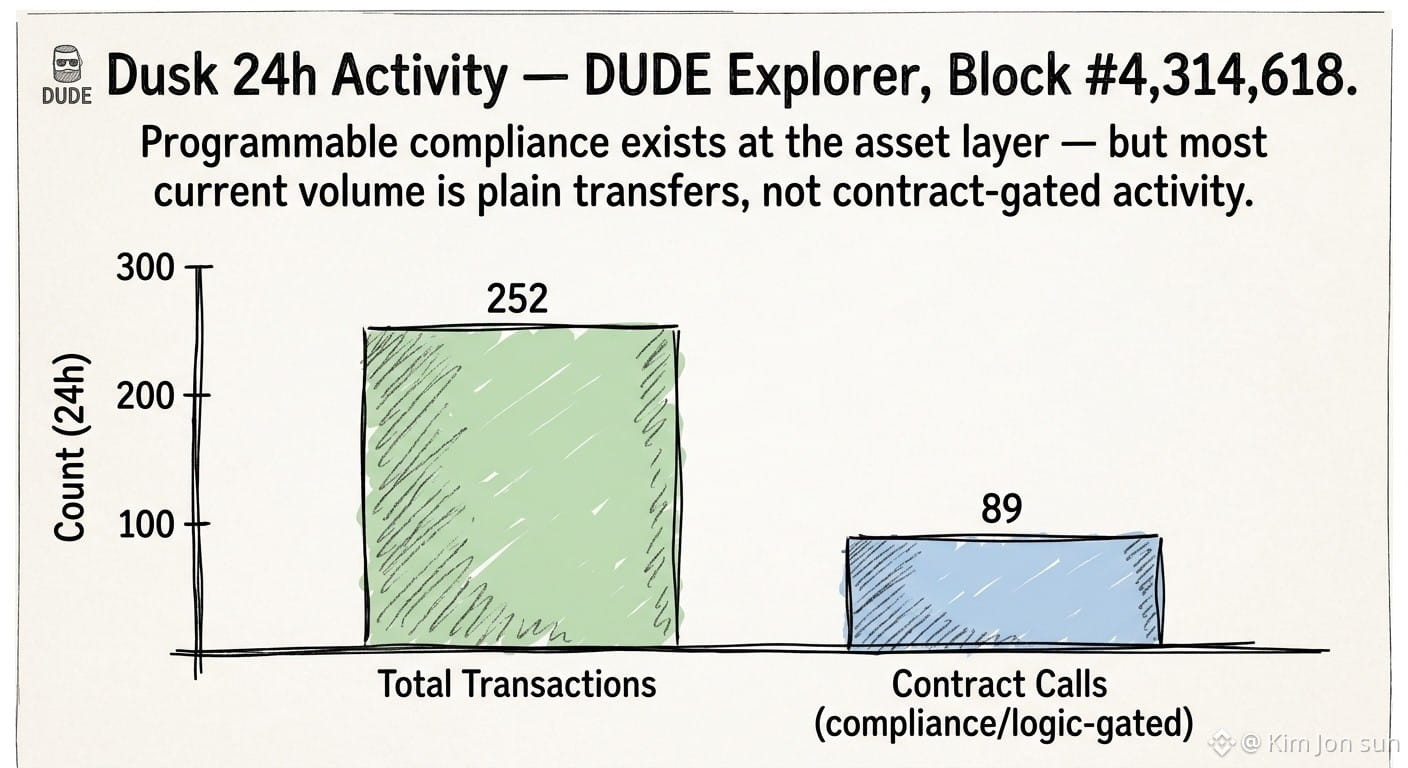
Sat with the DUDE explorer open for a while after wrapping this task... block #4,314,618, 24h window: 252 total transactions, only 89 of them contract calls. Everything else is just plain value moving — Moonlight or Phoenix, no logic attached.
Dusk ($DUSK ) #dusk @Dusk architecture is genuinely different here. The Transfer Contract can gate a transaction on a license or eligibility claim natively — compliance checks live at the asset layer, not bolted on after the fact through a freeze function or an off-chain KYC gate that only matters if someone gets caught. That's the pitch, and structurally it's real. Citadel-style claims get verified in the same breath as the transfer itself.
But hold up — watching the actual 24h split, the majority of chain activity still isn't routing through contract logic at all. It's just transfers. Which means the "compliance is programmable at settlement" story is mostly proven in design, not yet in volume. NPEX flows and similar institutional rails are presumably where this gets tested for real, and that's a smaller slice than total throughput right now.
Caught myself wanting to write "compliance-native by default" as a settled fact, then reread the contract-call ratio and had to walk it back a notch.
Wondering what that call ratio looks like once regulated asset transfers actually make up a meaningful share of daily volume instead of a fraction of it.
Dusk ($DUSK ) #dusk @Dusk architecture is genuinely different here. The Transfer Contract can gate a transaction on a license or eligibility claim natively — compliance checks live at the asset layer, not bolted on after the fact through a freeze function or an off-chain KYC gate that only matters if someone gets caught. That's the pitch, and structurally it's real. Citadel-style claims get verified in the same breath as the transfer itself.
But hold up — watching the actual 24h split, the majority of chain activity still isn't routing through contract logic at all. It's just transfers. Which means the "compliance is programmable at settlement" story is mostly proven in design, not yet in volume. NPEX flows and similar institutional rails are presumably where this gets tested for real, and that's a smaller slice than total throughput right now.
Caught myself wanting to write "compliance-native by default" as a settled fact, then reread the contract-call ratio and had to walk it back a notch.
Wondering what that call ratio looks like once regulated asset transfers actually make up a meaningful share of daily volume instead of a fraction of it.
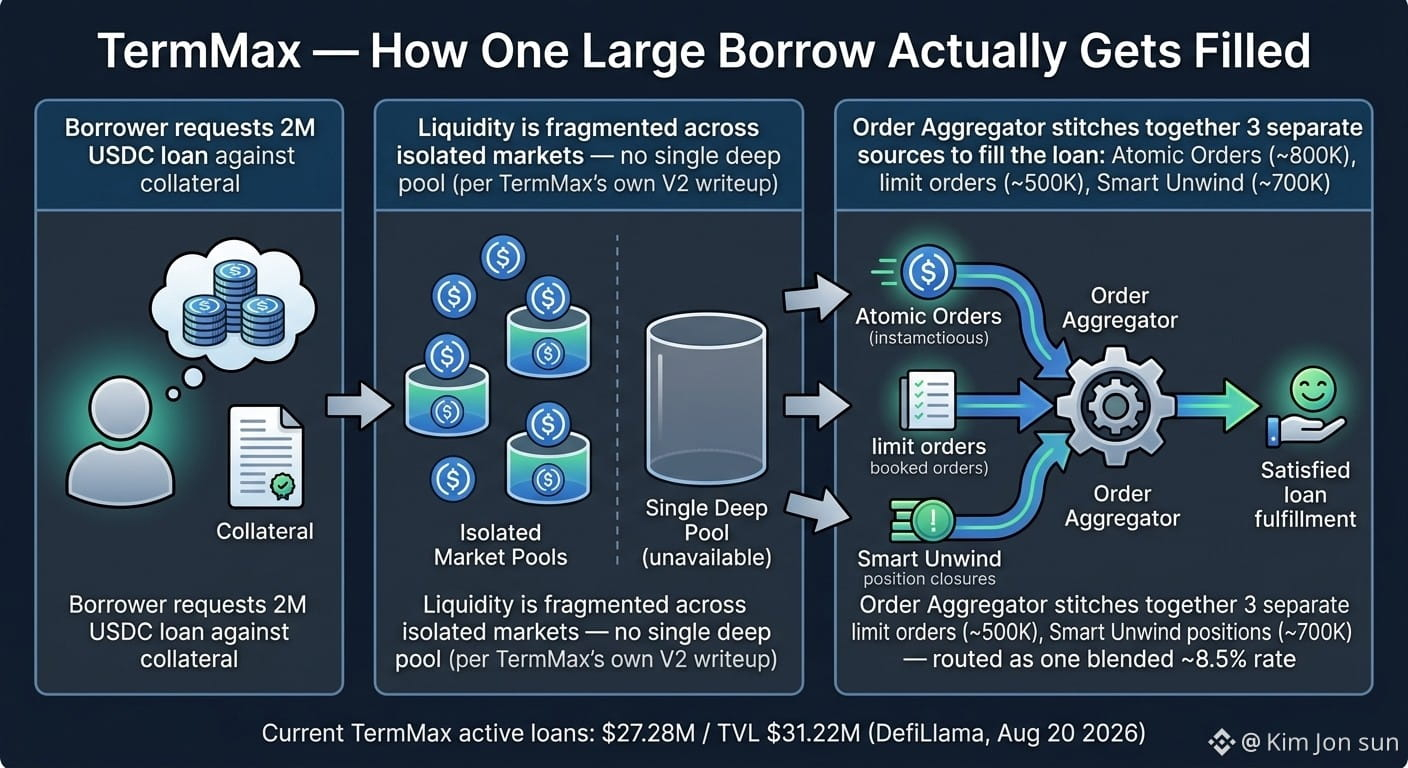
Grabbed a snack and went down a rabbit hole in TermMax's (#TermMax , @TermMax ) own V2 writeup, and hold up — they straight up admit the thing most people assume works fine by default. Isolated markets mean liquidity sits siloed per maturity. Their own example: 1.1M USDC in a vault has to get split across markets, and that "makes it impossible to take huge orders." Not spin. Their words.
Checked DefiLlama same session — TermMax currently sitting at $27.28M in active loans, TVL $31.22M. So the actual capital footprint is still modest, and even at that size the protocol needed to build an Order Aggregator just to fake single-pool depth — stitching together Atomic Orders, limit orders, and Smart Unwind positions behind the scenes so a borrower doesn't have to manually piece together three separate liquidity sources for one loan.
That's the part that sat with me. "Decentralized fixed-rate markets powering the next cycle" assumes deep, unified liquidity showing up on demand. What's actually happening is fragmentation by design, patched over with routing logic — which works, but it's not the same as organic depth.
Makes me wonder whether fixed-rate DeFi scales by attracting more capital into these isolated markets, or by getting better at hiding the fact that it's still fragmented underneath.
Checked DefiLlama same session — TermMax currently sitting at $27.28M in active loans, TVL $31.22M. So the actual capital footprint is still modest, and even at that size the protocol needed to build an Order Aggregator just to fake single-pool depth — stitching together Atomic Orders, limit orders, and Smart Unwind positions behind the scenes so a borrower doesn't have to manually piece together three separate liquidity sources for one loan.
That's the part that sat with me. "Decentralized fixed-rate markets powering the next cycle" assumes deep, unified liquidity showing up on demand. What's actually happening is fragmentation by design, patched over with routing logic — which works, but it's not the same as organic depth.
Makes me wonder whether fixed-rate DeFi scales by attracting more capital into these isolated markets, or by getting better at hiding the fact that it's still fragmented underneath.
صحيح جزئيًا
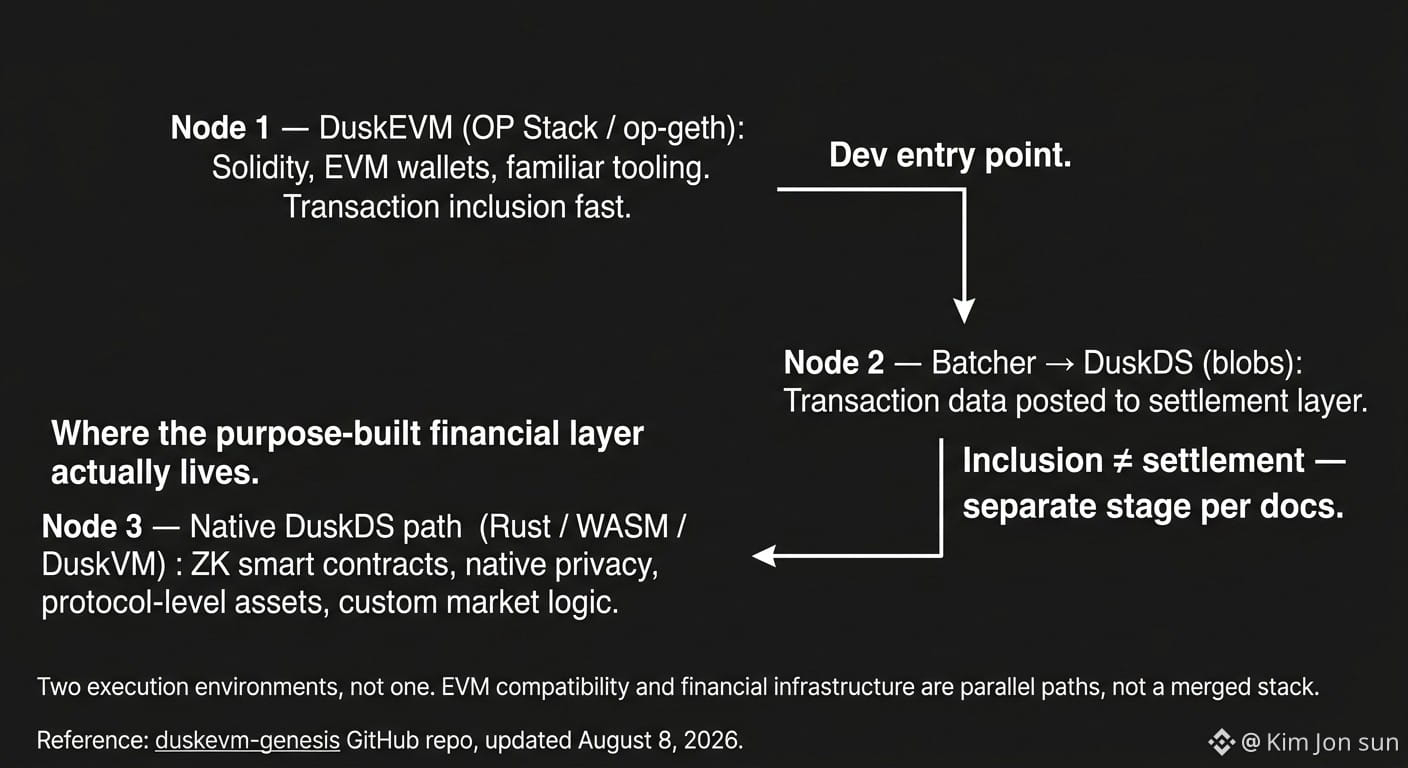
Spent a while in the Dusk docs this week and the thing that actually made me stop was the architecture diagram for what they're calling the full financial lifecycle onchain. Not the privacy pitch — that part I already knew. The part I kept coming back to was how deliberately the stack is sequenced.
Issuance on DuskDS. Secondary trading through NPEX, a Dutch MTF-regulated exchange with 17,500+ active investors and over €200M raised through its platform. Settlement back to the base layer — deterministic, not probabilistic. That's not a DeFi protocol duct-taped into compliance. That's an actual market structure argument.
And then DuskEVM testnet dropped August 13. Solidity deployments, Hardhat support, OP Stack compatibility — settling back to DuskDS. So developers can build with familiar tooling but the settlement guarantee stays on the native layer. @Dusk , $DUSK , #dusk . The composability story only works if that settlement anchoring holds under real transaction volume, not testnet conditions.
Hmm… what I'm still not sure about is who actually initiates on this infrastructure first. NPEX brings the regulated deal flow. Dusk brings the rails. But the bridge between those two things — the moment a real institution books an actual trade onchain — hasn't happened yet in any publicly documented way. Still a compelling stack. Still waiting to see where the first live deal lands.
Issuance on DuskDS. Secondary trading through NPEX, a Dutch MTF-regulated exchange with 17,500+ active investors and over €200M raised through its platform. Settlement back to the base layer — deterministic, not probabilistic. That's not a DeFi protocol duct-taped into compliance. That's an actual market structure argument.
And then DuskEVM testnet dropped August 13. Solidity deployments, Hardhat support, OP Stack compatibility — settling back to DuskDS. So developers can build with familiar tooling but the settlement guarantee stays on the native layer. @Dusk , $DUSK , #dusk . The composability story only works if that settlement anchoring holds under real transaction volume, not testnet conditions.
Hmm… what I'm still not sure about is who actually initiates on this infrastructure first. NPEX brings the regulated deal flow. Dusk brings the rails. But the bridge between those two things — the moment a real institution books an actual trade onchain — hasn't happened yet in any publicly documented way. Still a compelling stack. Still waiting to see where the first live deal lands.
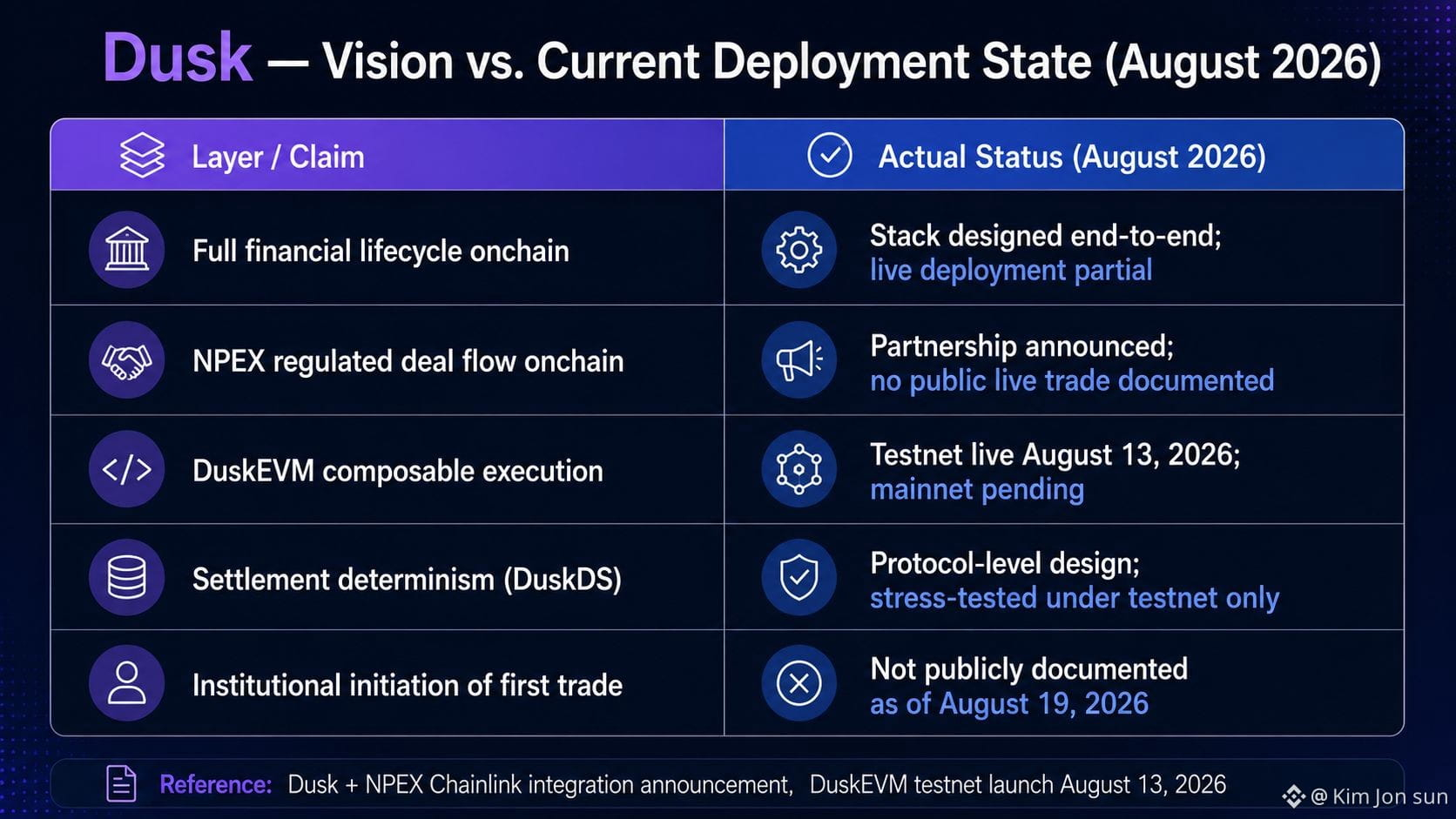
Was going through the capital efficiency framing inside TermMax —, #TermMax , @TermMax . The pitch is layered: fixed-rate lending keeps costs predictable, and idle capital auto-routes to Aave or Morpho while it waits to be matched. Options on top. All of it supposed to mean your capital never sleeps.
Hold up. DefiLlama is showing $31.22M TVL against $27.28M in active loans right now. That's roughly 87% utilisation across 77 markets on 8 chains. So the "earn while you wait" routing to Morpho Vault V2 — the baseline variable rate that supposedly keeps unmatched lender capital working — is only touching maybe 13% of deposited funds at this point. That mechanic is real, but it's doing less lifting than the framing implies.
The part that actually generates efficiency independently — without outsourcing to Aave or Morpho — is the options layer. Dual Investment Vault premium income on BNB Chain doesn't need a third-party baseline rate. The yield is endogenous: traders pay premiums to take leveraged positions, vault depositors collect it. That's a closed loop. The fixed-rate side's idle routing borrows its efficiency from protocols TermMax doesn't control. The options side builds it internally.
I kept thinking about which of the two actually expands capital efficiency versus just routing it somewhere else...
Still not sure the pitch separates those clearly enough for most users walking in.
Hold up. DefiLlama is showing $31.22M TVL against $27.28M in active loans right now. That's roughly 87% utilisation across 77 markets on 8 chains. So the "earn while you wait" routing to Morpho Vault V2 — the baseline variable rate that supposedly keeps unmatched lender capital working — is only touching maybe 13% of deposited funds at this point. That mechanic is real, but it's doing less lifting than the framing implies.
The part that actually generates efficiency independently — without outsourcing to Aave or Morpho — is the options layer. Dual Investment Vault premium income on BNB Chain doesn't need a third-party baseline rate. The yield is endogenous: traders pay premiums to take leveraged positions, vault depositors collect it. That's a closed loop. The fixed-rate side's idle routing borrows its efficiency from protocols TermMax doesn't control. The options side builds it internally.
I kept thinking about which of the two actually expands capital efficiency versus just routing it somewhere else...
Still not sure the pitch separates those clearly enough for most users walking in.
تمّ التحقق
Something in the docs stopped me mid-scroll today.
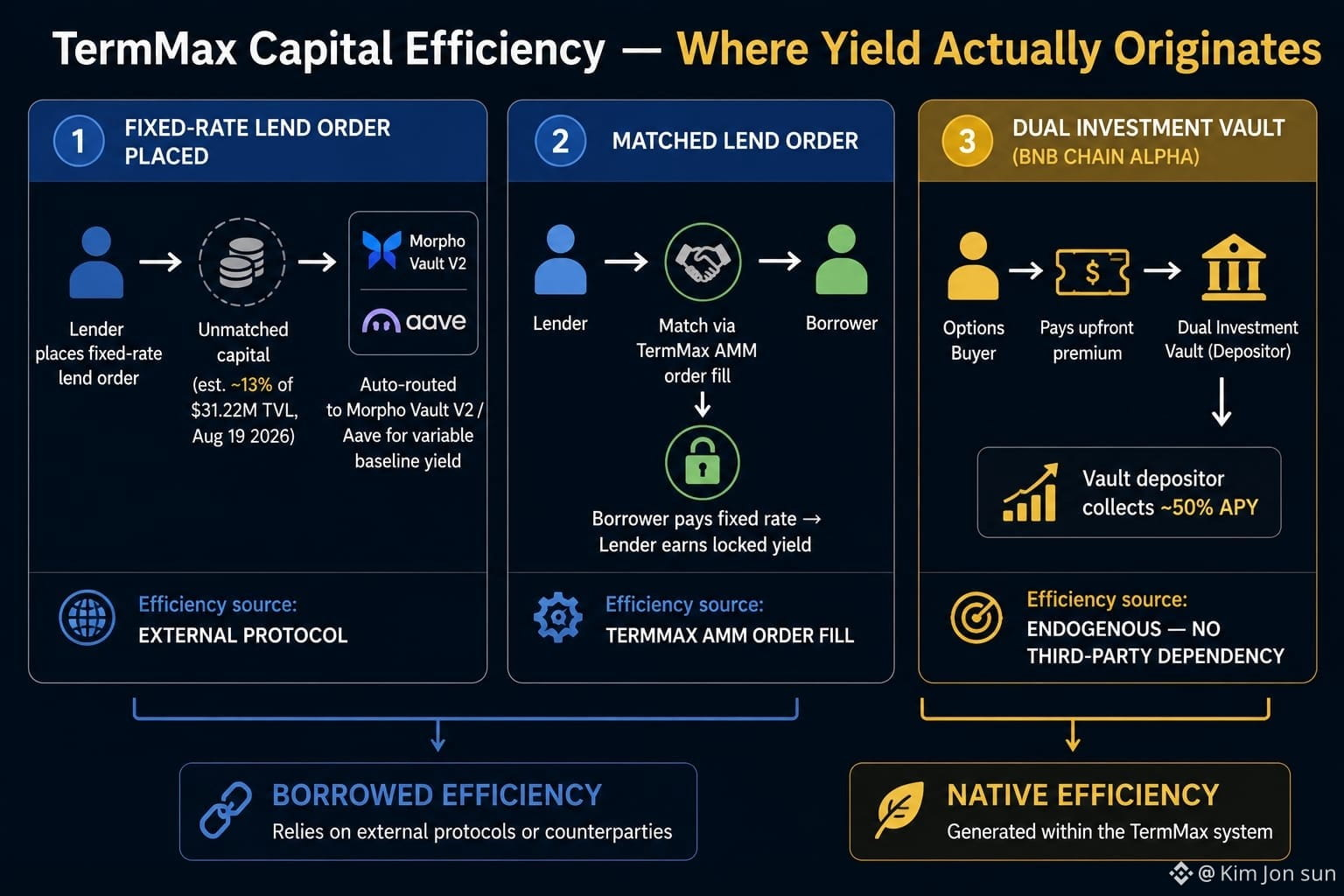
Dusk Network, $DUSK , #dusk , @Dusk — the EVM compatibility angle is how most people find this project. Port your Solidity contracts, use familiar tooling, existing EVM wallets. The duskevm-genesis repo on GitHub was last updated August 8, showing active rollup config work. So the machinery is running. But the deeper thing I couldn't shake is in the architecture docs themselves, tucked under a single line: "Transaction inclusion is fast, but inclusion and settlement are different stages."
That's the tell. DuskEVM runs on OP Stack — essentially op-geth as the sequencer, batching transaction data back to DuskDS as blobs. Standard rollup behaviour. But DuskDS, the actual purpose-built layer underneath — deterministic settlement, ZK smart contracts, native privacy — is a separate execution environment entirely. The docs are explicit about it: build on DuskEVM for Solidity and familiar tooling, or build natively on DuskDS with Rust and WASM for real protocol-level privacy and custom market logic. Two paths. Not one unified thing.
hmm… I spent a bit too long assuming EVM compatibility here meant Solidity code would automatically inherit Dusk's financial infrastructure. It doesn't. The bridge between those two layers is deliberate and optional, not automatic.
Which makes me wonder — how many developers porting to DuskEVM will actually go back and re-architect for DuskDS once they realize what they left on the table?
Dusk Network, $DUSK , #dusk , @Dusk — the EVM compatibility angle is how most people find this project. Port your Solidity contracts, use familiar tooling, existing EVM wallets. The duskevm-genesis repo on GitHub was last updated August 8, showing active rollup config work. So the machinery is running. But the deeper thing I couldn't shake is in the architecture docs themselves, tucked under a single line: "Transaction inclusion is fast, but inclusion and settlement are different stages."
That's the tell. DuskEVM runs on OP Stack — essentially op-geth as the sequencer, batching transaction data back to DuskDS as blobs. Standard rollup behaviour. But DuskDS, the actual purpose-built layer underneath — deterministic settlement, ZK smart contracts, native privacy — is a separate execution environment entirely. The docs are explicit about it: build on DuskEVM for Solidity and familiar tooling, or build natively on DuskDS with Rust and WASM for real protocol-level privacy and custom market logic. Two paths. Not one unified thing.
hmm… I spent a bit too long assuming EVM compatibility here meant Solidity code would automatically inherit Dusk's financial infrastructure. It doesn't. The bridge between those two layers is deliberate and optional, not automatic.
Which makes me wonder — how many developers porting to DuskEVM will actually go back and re-architect for DuskDS once they realize what they left on the table?
Pulled up TermMax @TermMax this week, right after the pre-mine window shut August 11. Hard close, XP system queued for September 12. Good moment to look at what's actually sitting on-chain before TGE noise takes over.
#TermMax
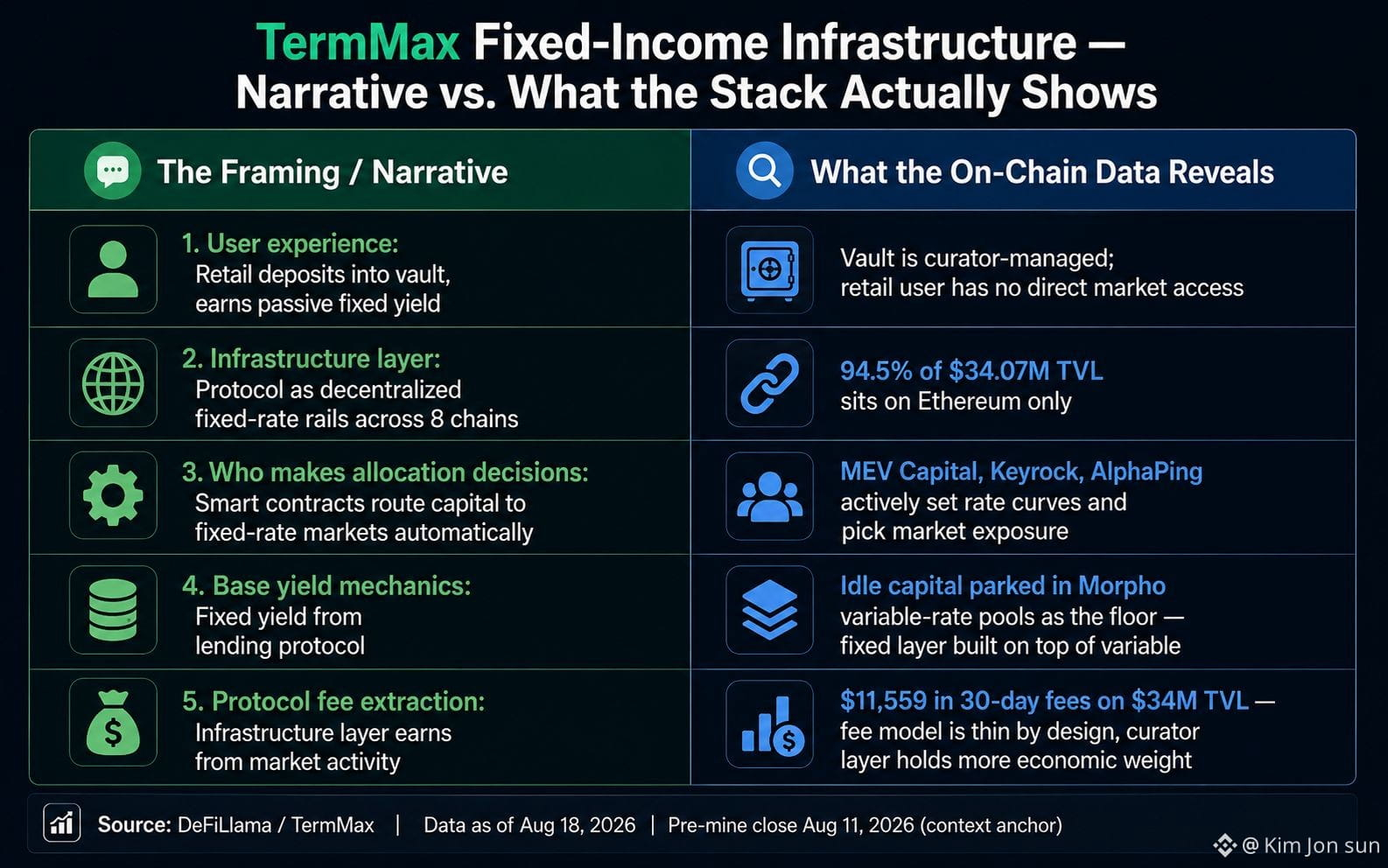
$34.07M TVL on DeFiLlama right now, 12.7% growth over 30 days. Seven institutional curators — MEV Capital, Keyrock, AlphaPing among them — managing the actual capital allocation across 100+ markets. And 94.5% of that TVL is on Ethereum. Eight-chain deployment is technically live. The distribution tells a quieter story.
Here's the thing that stayed with me. Retail deposits into a vault, earns fixed yield passively — sounds like a bond product. But underneath, curators are actively managing: picking markets, setting rate curves, deciding when to park idle capital in Morpho versus deploying into a fixed-rate position. That's not passive infrastructure. That's active asset management with a fixed-rate interface sitting on top.
hmm… the "fixed-income infrastructure" framing is accurate but it lands differently when you trace it. The protocol is the rails. The curators are the fund managers. Without MEV Capital and Keyrock making allocation decisions, most retail depositors have no clean path into the actual markets — just a vault abstraction they can't fully inspect.
Whether that curator dependency is a thoughtful design or a quiet centralization point the protocol will eventually need to address — I'm genuinely not sure yet.
#TermMax
$34.07M TVL on DeFiLlama right now, 12.7% growth over 30 days. Seven institutional curators — MEV Capital, Keyrock, AlphaPing among them — managing the actual capital allocation across 100+ markets. And 94.5% of that TVL is on Ethereum. Eight-chain deployment is technically live. The distribution tells a quieter story.
Here's the thing that stayed with me. Retail deposits into a vault, earns fixed yield passively — sounds like a bond product. But underneath, curators are actively managing: picking markets, setting rate curves, deciding when to park idle capital in Morpho versus deploying into a fixed-rate position. That's not passive infrastructure. That's active asset management with a fixed-rate interface sitting on top.
hmm… the "fixed-income infrastructure" framing is accurate but it lands differently when you trace it. The protocol is the rails. The curators are the fund managers. Without MEV Capital and Keyrock making allocation decisions, most retail depositors have no clean path into the actual markets — just a vault abstraction they can't fully inspect.
Whether that curator dependency is a thoughtful design or a quiet centralization point the protocol will eventually need to address — I'm genuinely not sure yet.
صحيح جزئيًا
Something clicked while checking the dusk-network/web-wallet repo — updated Aug 7, quiet commit, easy to skim past — and I realized I'd been reading the Dusk lifecycle in the wrong order.
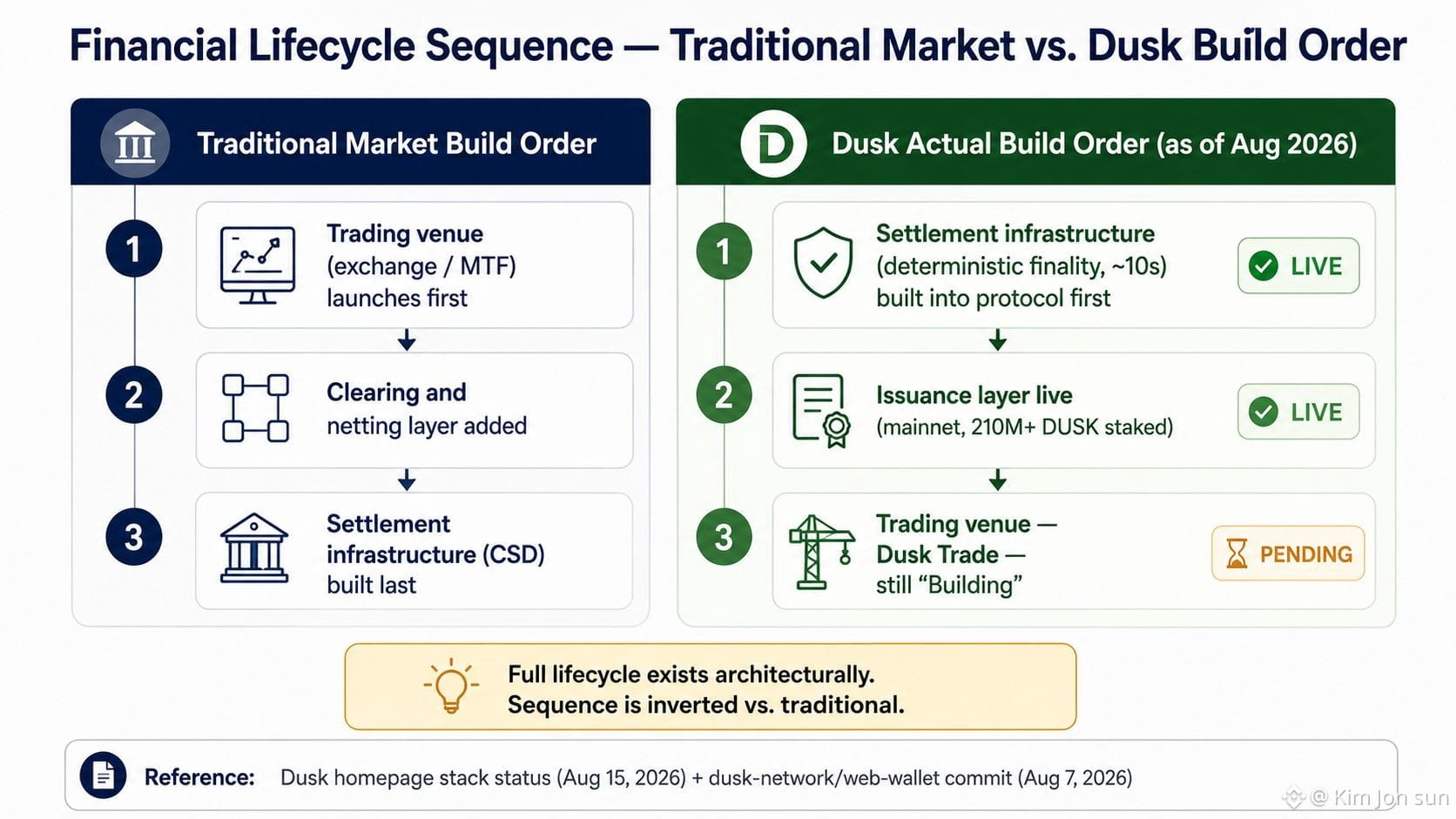
The framing around Dusk Network ($DUSK ) is issuance, then trading, then settlement. One clean chain, end to end. #dusk @Dusk . That's how traditional markets narrate themselves too — list the asset, trade it, settle it after.
But Dusk built this backwards. Settlement infrastructure came first — deterministic finality, roughly ten seconds, embedded at the protocol level before anything else existed. Then issuance capability. Mainnet live, 210M+ $DUSK staked securing the base layer this week. Trading — Dusk Trade, the actual application layer where investors onboard, bind wallets, buy and sell — still listed as "Building."
So the lifecycle as it exists right now: an extremely capable settlement engine with no institutional flow to settle yet, a live issuance layer with assets staged but not moving at scale, and the trading venue still coming. The full lifecycle is real in architecture. Just not yet in sequence.
Hold on — that might actually be the smarter way to build. Plumbing before pipes. Every previous exchange-first, settlement-later model created decades of clearing fragmentation.
Still… I keep wondering what the first real securities settlement transaction on Dusk actually looks like when Dusk Trade finally opens.
The framing around Dusk Network ($DUSK ) is issuance, then trading, then settlement. One clean chain, end to end. #dusk @Dusk . That's how traditional markets narrate themselves too — list the asset, trade it, settle it after.
But Dusk built this backwards. Settlement infrastructure came first — deterministic finality, roughly ten seconds, embedded at the protocol level before anything else existed. Then issuance capability. Mainnet live, 210M+ $DUSK staked securing the base layer this week. Trading — Dusk Trade, the actual application layer where investors onboard, bind wallets, buy and sell — still listed as "Building."
So the lifecycle as it exists right now: an extremely capable settlement engine with no institutional flow to settle yet, a live issuance layer with assets staged but not moving at scale, and the trading venue still coming. The full lifecycle is real in architecture. Just not yet in sequence.
Hold on — that might actually be the smarter way to build. Plumbing before pipes. Every previous exchange-first, settlement-later model created decades of clearing fragmentation.
Still… I keep wondering what the first real securities settlement transaction on Dusk actually looks like when Dusk Trade finally opens.
تمّ التحقق
The framing that hooked me going into this session — TermMax, #TermMax , fixed-rate markets without banks — sounds clean. Almost obvious. Banks set rates. Remove banks, rates get set by code. Except when you actually trace how rate-setting works inside the protocol, it's not code all the way down.
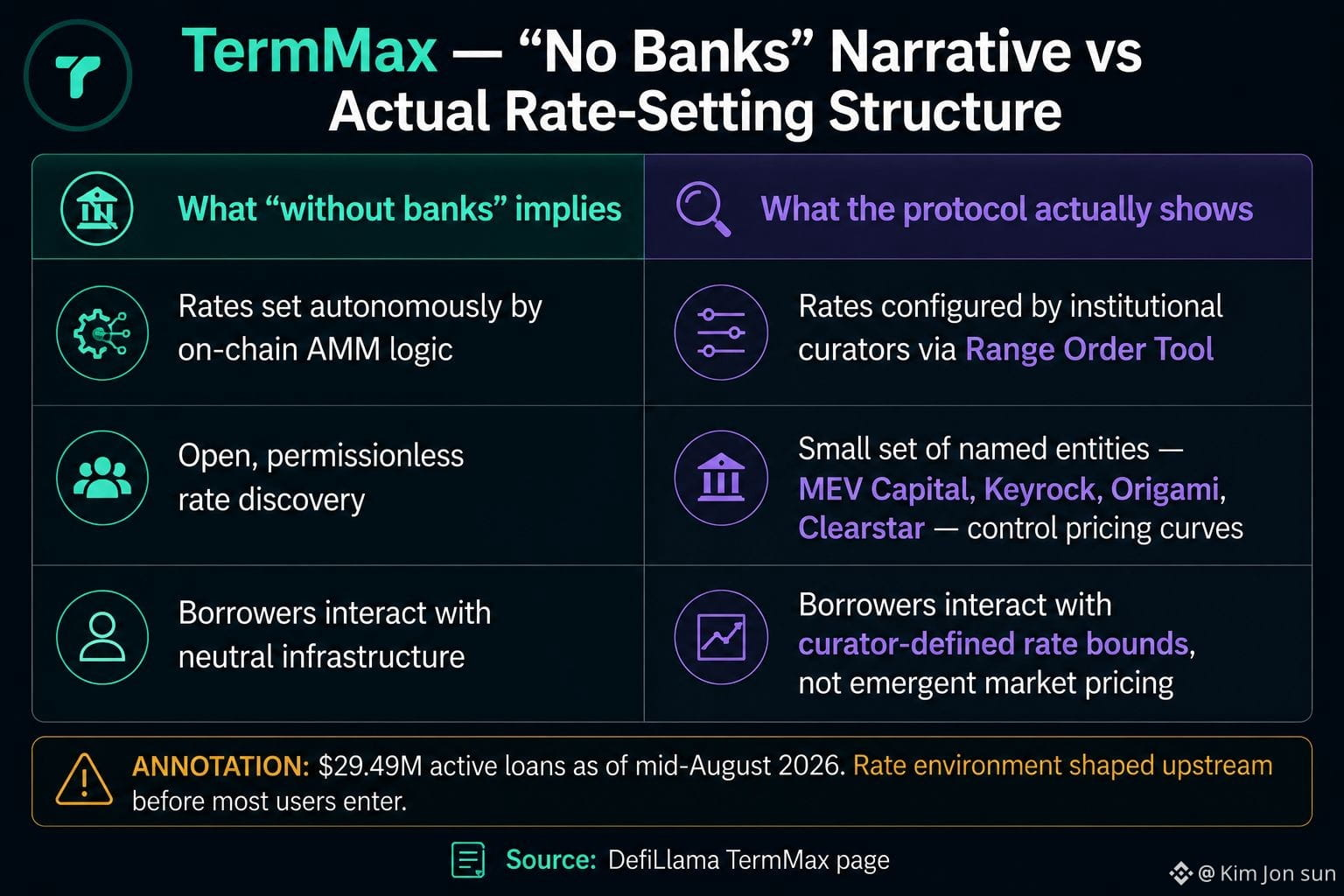
Curators do it. MEV Capital, Keyrock, Origami, Clearstar Labs. These are the entities configuring the Range Order Tool, deciding pricing curves, setting rate bounds across markets. The TGE announcement landed August 15 — token live August 25 — and across that period the protocol held $29.49M in active loans on ~$34M TVL. That loan book didn't price itself. Someone upstream made those decisions, and it wasn't a smart contract acting autonomously.
Which is the thing that quietly reframed the whole topic for me. The "no banks" part is structurally true — no central institution holds custody, no credit officer approves your borrow. But the rate discovery function? That's still a small set of sophisticated actors with outsized influence over what borrowers actually pay. Curators are, in a narrow but real sense, the rate desk.
Hmm. Maybe that's fine. Maybe that's just how fixed-rate markets have to work until order flow deepens enough for the AMM to price itself more organically. But the gap between "decentralized fixed-rate markets" and "curator-managed fixed-rate markets" is worth sitting with a little longer.
@TermMax
Curators do it. MEV Capital, Keyrock, Origami, Clearstar Labs. These are the entities configuring the Range Order Tool, deciding pricing curves, setting rate bounds across markets. The TGE announcement landed August 15 — token live August 25 — and across that period the protocol held $29.49M in active loans on ~$34M TVL. That loan book didn't price itself. Someone upstream made those decisions, and it wasn't a smart contract acting autonomously.
Which is the thing that quietly reframed the whole topic for me. The "no banks" part is structurally true — no central institution holds custody, no credit officer approves your borrow. But the rate discovery function? That's still a small set of sophisticated actors with outsized influence over what borrowers actually pay. Curators are, in a narrow but real sense, the rate desk.
Hmm. Maybe that's fine. Maybe that's just how fixed-rate markets have to work until order flow deepens enough for the AMM to price itself more organically. But the gap between "decentralized fixed-rate markets" and "curator-managed fixed-rate markets" is worth sitting with a little longer.
@TermMax
تمّ التحقق
Was deep in the Chainlink CCIP integration on Dusk Network $DUSK when one technical detail stopped me cold. Not the bridge part — every RWA project has a bridge narrative now. Something quieter. #dusk @Dusk
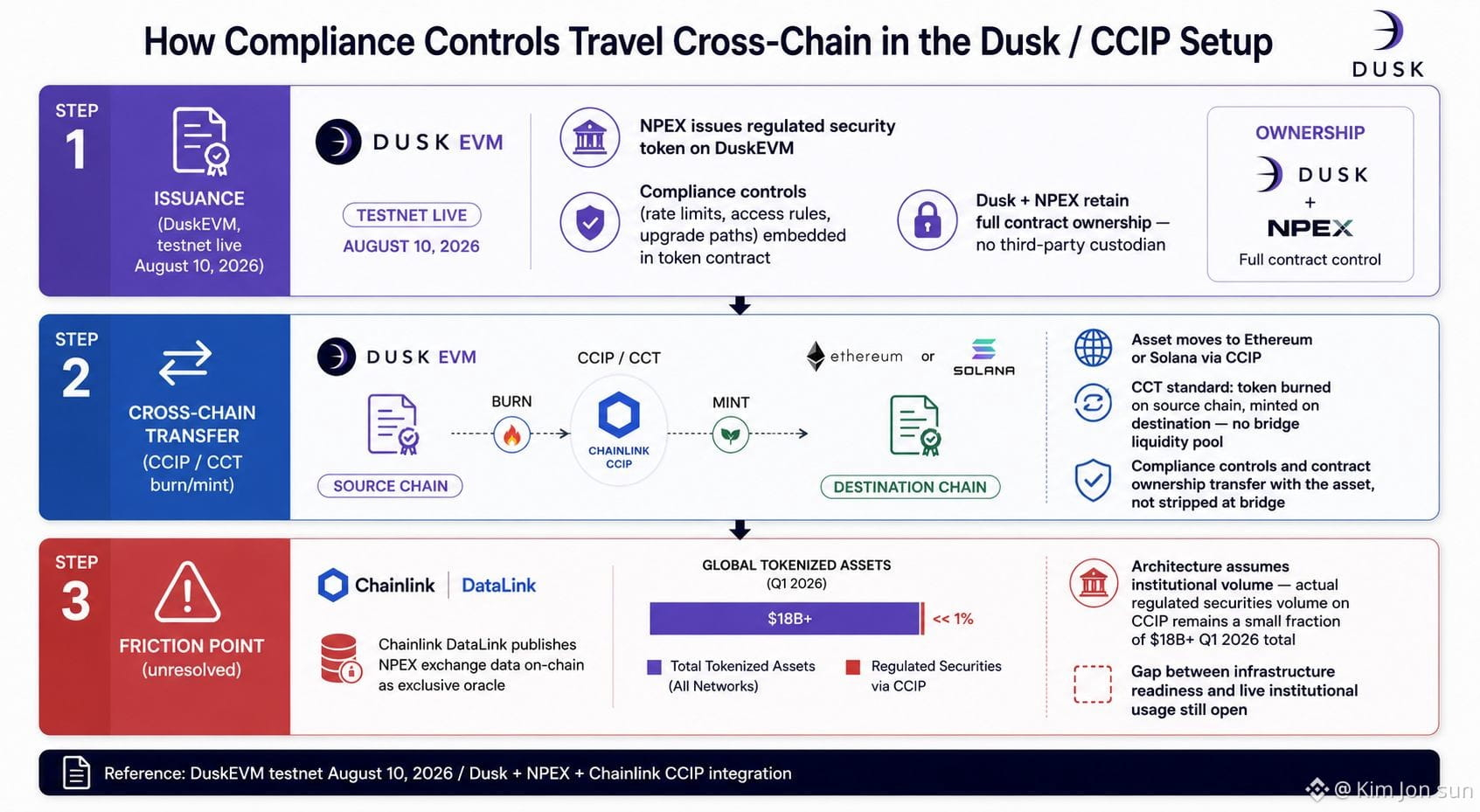
DuskEVM testnet went live August 10th. That's the environment where NPEX-issued securities will actually deploy. And under the CCIP integration, when those assets move cross-chain, Dusk and NPEX retain full ownership of the token contracts — programmatic rate limits, upgrade paths, all of it. The CCT burn/mint model cuts out third-party liquidity pools entirely. No slippage dependency. No external custodian holding the underlying at a bridge.
That's the thing most of the coverage glosses over. CCIP here isn't just interoperability plumbing. It's what lets a regulated issuer keep compliance controls intact even after an asset leaves Dusk and lands on Ethereum or Solana. Normally cross-chain movement is where compliance frameworks break down — the asset hits a bridge, wraps, and loses context. Here the controls travel with it.
Chainlink DataLink also becomes the exclusive on-chain oracle for NPEX exchange data. So regulatory-grade market data, not just the asset itself, gets published on-chain. I spent a while sitting with that combination — compliant asset movement plus verified institutional data feeds. It's a lot of infrastructure pointing at the same gap.
Still… CCIP processed $18B+ in Q1 2026 volume, mostly DeFi. The regulated securities slice of that is presumably tiny. Whether this architecture gets tested at real institutional volume before the next cycle, I genuinely don't know
DuskEVM testnet went live August 10th. That's the environment where NPEX-issued securities will actually deploy. And under the CCIP integration, when those assets move cross-chain, Dusk and NPEX retain full ownership of the token contracts — programmatic rate limits, upgrade paths, all of it. The CCT burn/mint model cuts out third-party liquidity pools entirely. No slippage dependency. No external custodian holding the underlying at a bridge.
That's the thing most of the coverage glosses over. CCIP here isn't just interoperability plumbing. It's what lets a regulated issuer keep compliance controls intact even after an asset leaves Dusk and lands on Ethereum or Solana. Normally cross-chain movement is where compliance frameworks break down — the asset hits a bridge, wraps, and loses context. Here the controls travel with it.
Chainlink DataLink also becomes the exclusive on-chain oracle for NPEX exchange data. So regulatory-grade market data, not just the asset itself, gets published on-chain. I spent a while sitting with that combination — compliant asset movement plus verified institutional data feeds. It's a lot of infrastructure pointing at the same gap.
Still… CCIP processed $18B+ in Q1 2026 volume, mostly DeFi. The regulated securities slice of that is presumably tiny. Whether this architecture gets tested at real institutional volume before the next cycle, I genuinely don't know
تمّ التحقق
Spent some time this week tracing DuskEVM testnet contract interactions — explorer activity from around August 10–13 shows early settlement logic being tested, transfer finality executing without rollback windows. Small stuff. But it pointed at something I hadn't thought about cleanly before.
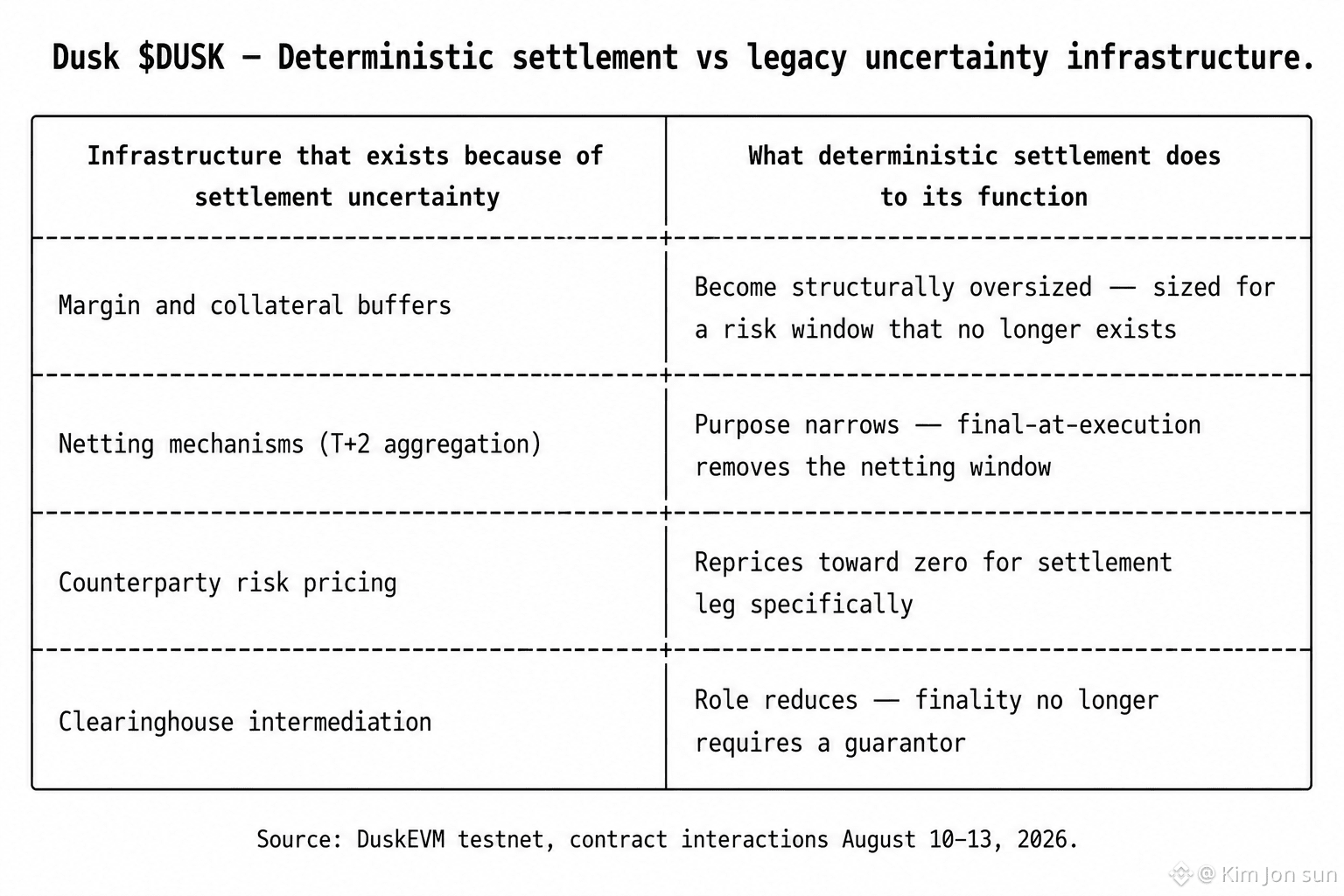
Deterministic settlement isn't just a speed improvement. It's an architectural constraint that changes what you can build on top. In traditional capital markets, settlement uncertainty — the gap between trade execution and finality — is load-bearing. Margin systems, netting mechanisms, counterparty risk buffers, collateral haircuts — a lot of that infrastructure exists precisely because you can't be certain the trade actually closed until T+2. Or later.
Dusk, $DUSK , #dusk @Dusk is building toward settlement that is final at execution. No ambiguity window. And if that holds in practice — not just in testnet conditions but under real asset load — it doesn't just make existing capital market rails faster. It potentially makes several of them unnecessary. The infrastructure built to manage settlement uncertainty starts looking like overhead.
I found myself pausing on that longer than expected. Because removing overhead sounds clean in theory but the entities who operate that overhead don't disappear. They adapt, or they push back.
What I still don't have a read on is whether Dusk has thought through the institutional friction that deterministic finality actually creates — not the technical part, the political part.
Deterministic settlement isn't just a speed improvement. It's an architectural constraint that changes what you can build on top. In traditional capital markets, settlement uncertainty — the gap between trade execution and finality — is load-bearing. Margin systems, netting mechanisms, counterparty risk buffers, collateral haircuts — a lot of that infrastructure exists precisely because you can't be certain the trade actually closed until T+2. Or later.
Dusk, $DUSK , #dusk @Dusk is building toward settlement that is final at execution. No ambiguity window. And if that holds in practice — not just in testnet conditions but under real asset load — it doesn't just make existing capital market rails faster. It potentially makes several of them unnecessary. The infrastructure built to manage settlement uncertainty starts looking like overhead.
I found myself pausing on that longer than expected. Because removing overhead sounds clean in theory but the entities who operate that overhead don't disappear. They adapt, or they push back.
What I still don't have a read on is whether Dusk has thought through the institutional friction that deterministic finality actually creates — not the technical part, the political part.
تمّ التحقق
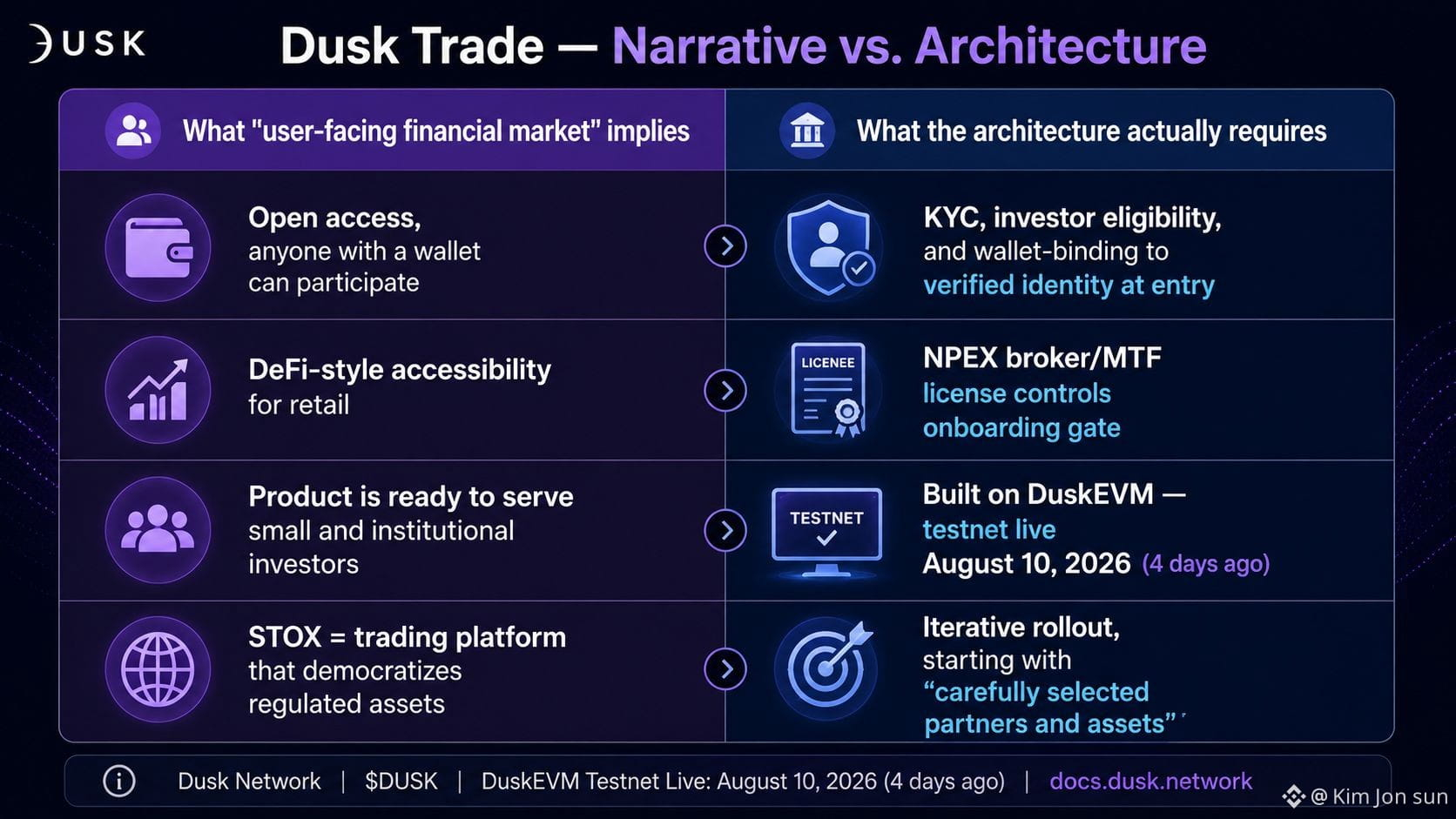
Something stopped me mid-task on Dusk Network. The docs for Dusk Trade describe it as a product layer that turns "infrastructure primitives into user-facing workflows." Investor onboarding. Wallet binding. Payment coordination. Controlled transfers. $DUSK , #dusk , @Dusk . The language is deliberate — and so is what it doesn't say.
Dusk Trade runs on DuskEVM, which got its testnet four days ago — August 10. That's the layer beneath the user-facing product. Which means the trading platform being pitched as the interface between blockchain infrastructure and real regulated securities markets is sitting on infrastructure that entered testnet less than a week ago. Not a criticism necessarily. Just a sequence worth noting.
Here's what actually caught me though. "User-facing" in Dusk Trade's context means something different than in DeFi. Investor eligibility, KYC, controlled transfers, wallet-binding to verified identities — these aren't optional flows. They're the front door. NPEX's broker and MTF licenses run the gate. So what looks like an accessible consumer product is closer to a licensed brokerage interface with simplified UX. The "small investor" access framing from STOX's original pitch is real, but only after clearing a compliance funnel that most retail participants won't find trivial.
Waitlist opened January 2026. DuskEVM testnet August 10. Wondering what the onboarding actually looks like when it goes live — and who gets through first.
Dusk Trade runs on DuskEVM, which got its testnet four days ago — August 10. That's the layer beneath the user-facing product. Which means the trading platform being pitched as the interface between blockchain infrastructure and real regulated securities markets is sitting on infrastructure that entered testnet less than a week ago. Not a criticism necessarily. Just a sequence worth noting.
Here's what actually caught me though. "User-facing" in Dusk Trade's context means something different than in DeFi. Investor eligibility, KYC, controlled transfers, wallet-binding to verified identities — these aren't optional flows. They're the front door. NPEX's broker and MTF licenses run the gate. So what looks like an accessible consumer product is closer to a licensed brokerage interface with simplified UX. The "small investor" access framing from STOX's original pitch is real, but only after clearing a compliance funnel that most retail participants won't find trivial.
Waitlist opened January 2026. DuskEVM testnet August 10. Wondering what the onboarding actually looks like when it goes live — and who gets through first.
تمّ التحقق
Was reading through Dusk Network's Citadel protocol during the task. The citadel repo on GitHub picked up commits on August 8 — active work, not a static spec — and I ended up stuck on the three-party model longer than intended.
The phrase "selective disclosure" gets used a lot in the $DUSK @Dusk #dusk materials. It's accurate. But there's a structural thing the architecture reveals that the pitch doesn't foreground.
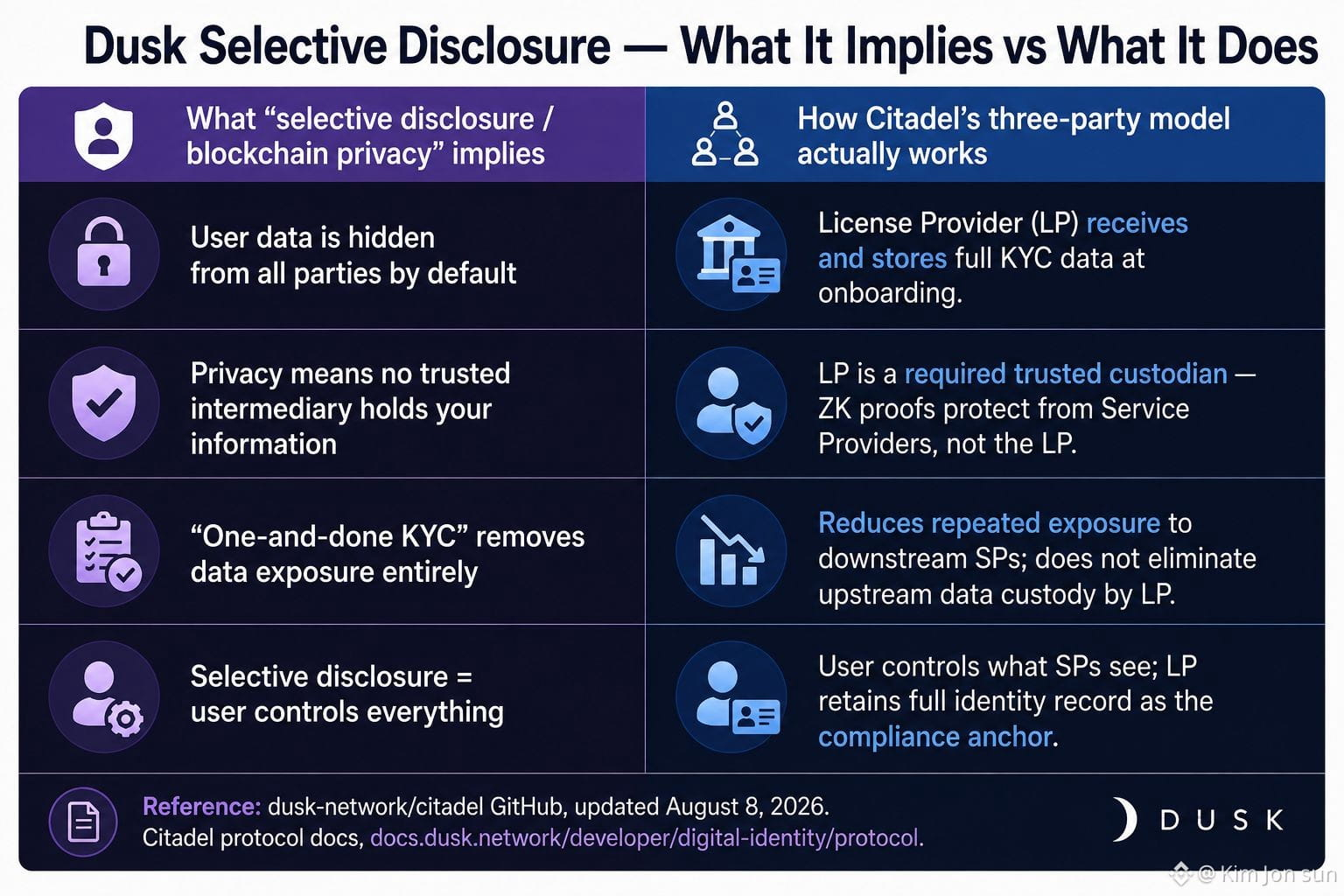
Citadel has three parties: User, License Provider (LP), Service Provider (SP). The ZK proofs protect you from the SP — they verify you meet a compliance threshold without seeing your actual data. That part works as described. But the LP does full KYC. They hold your data. They issue the on-chain license. Every subsequent service provider only gets a proof, which is elegant. The friction is earlier, at onboarding, not at every gate.
So Dusk's privacy model isn't "hidden from authority." It's "hidden from counterparties, visible to your chosen authority." The LP knows everything. The SPs know nothing. For regulated finance that's probably the correct design — someone has to be the responsible data custodian for regulators. But it reads differently from how most people interpret "blockchain privacy," which tends to mean hidden from everyone by default.
Hmm… the interesting open question is who actually plays LP in practice. If it's a regulated custodian or a licensed KYC provider, that's outsourced identity infrastructure with better UX, not decentralized identity. I'm not sure those two framings ever fully resolve into each other.
The phrase "selective disclosure" gets used a lot in the $DUSK @Dusk #dusk materials. It's accurate. But there's a structural thing the architecture reveals that the pitch doesn't foreground.
Citadel has three parties: User, License Provider (LP), Service Provider (SP). The ZK proofs protect you from the SP — they verify you meet a compliance threshold without seeing your actual data. That part works as described. But the LP does full KYC. They hold your data. They issue the on-chain license. Every subsequent service provider only gets a proof, which is elegant. The friction is earlier, at onboarding, not at every gate.
So Dusk's privacy model isn't "hidden from authority." It's "hidden from counterparties, visible to your chosen authority." The LP knows everything. The SPs know nothing. For regulated finance that's probably the correct design — someone has to be the responsible data custodian for regulators. But it reads differently from how most people interpret "blockchain privacy," which tends to mean hidden from everyone by default.
Hmm… the interesting open question is who actually plays LP in practice. If it's a regulated custodian or a licensed KYC provider, that's outsourced identity infrastructure with better UX, not decentralized identity. I'm not sure those two framings ever fully resolve into each other.
صحيح جزئيًا
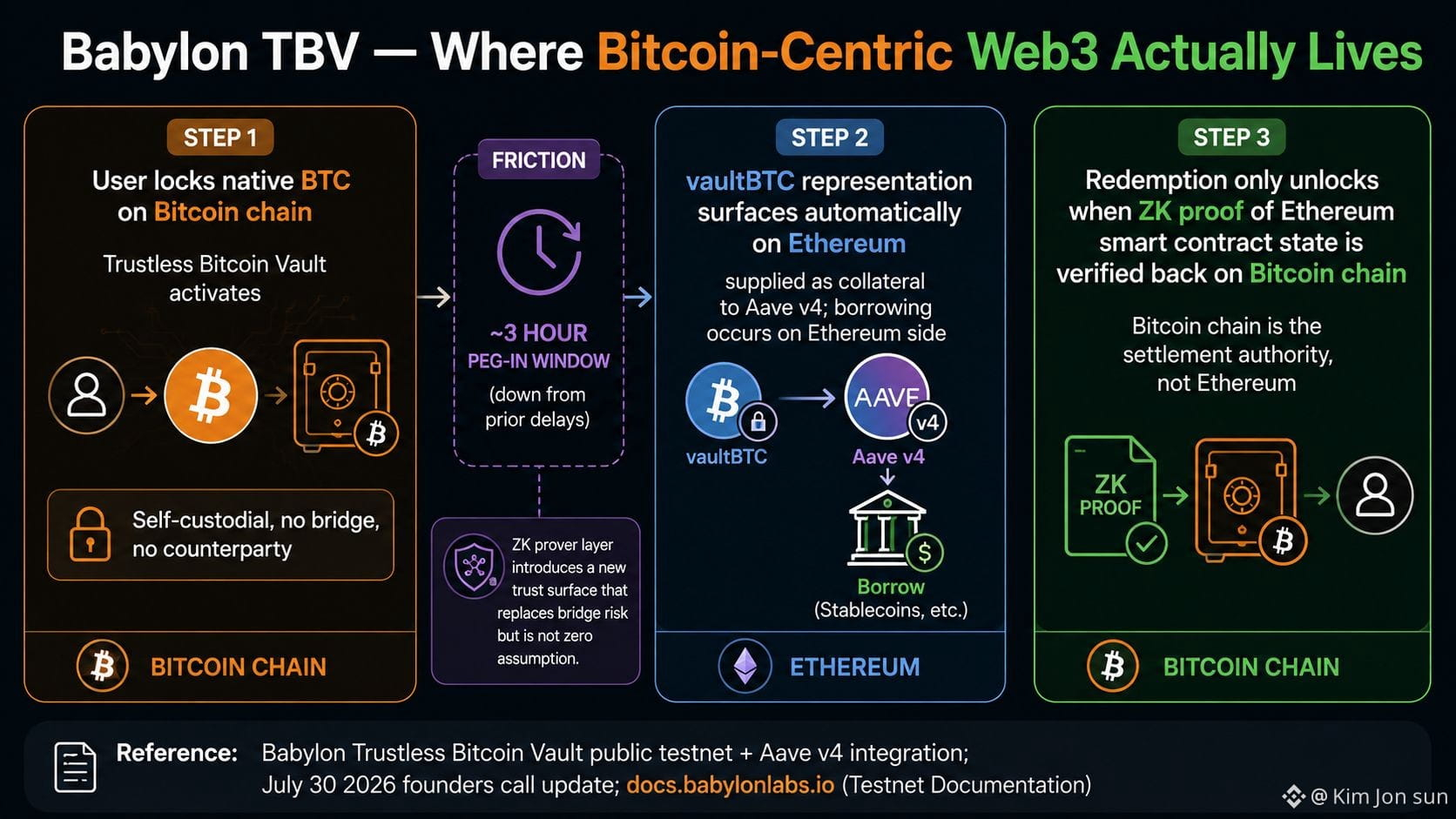
Spent some time this week walking through Babylon's testnet docs — the Trustless Bitcoin Vault flow with Aave v4. Lock signet BTC on Bitcoin, vault activates, vaultBTC surfaces automatically as collateral on Ethereum. Tried to follow the peg-in end to end. Came up for air a little unsettled.
Not because it's broken. Because the architecture is almost backwards from what "Bitcoin-centric Web3" usually implies. Babylon $BABY @BabylonLabs_io isn't pulling Bitcoin into Web3. It's restructuring how Ethereum-side DeFi operates around Bitcoin's native constraints. The BTC never crosses. Withdrawals only unlock when a zero-knowledge proof of smart contract state gets verified back on the Bitcoin chain. Ethereum comes to Bitcoin's terms. That's the actual design. #baby
The July 30 founders call confirmed native BTC-backed borrowing is live on public testnet with Aave v4, peg-in times now down to roughly three hours. That reduction matters — it's the gap between a protocol that's architecturally interesting and one people might actually use. Three hours is still three hours for a DeFi interaction, but it's a very different number than a bridge confirmation queue.
Here's what I keep sitting with though. Less than 1% of all BTC has ever touched a smart contract platform. The vault model removes the bridge risk that kept most of that BTC out. But does it remove the friction? Peg-in flows, ZK provers, separate reward addresses — the trust model is cleaner, the UX path is not.
Which matters more for actual adoption?
Not because it's broken. Because the architecture is almost backwards from what "Bitcoin-centric Web3" usually implies. Babylon $BABY @BabylonLabs_io isn't pulling Bitcoin into Web3. It's restructuring how Ethereum-side DeFi operates around Bitcoin's native constraints. The BTC never crosses. Withdrawals only unlock when a zero-knowledge proof of smart contract state gets verified back on the Bitcoin chain. Ethereum comes to Bitcoin's terms. That's the actual design. #baby
The July 30 founders call confirmed native BTC-backed borrowing is live on public testnet with Aave v4, peg-in times now down to roughly three hours. That reduction matters — it's the gap between a protocol that's architecturally interesting and one people might actually use. Three hours is still three hours for a DeFi interaction, but it's a very different number than a bridge confirmation queue.
Here's what I keep sitting with though. Less than 1% of all BTC has ever touched a smart contract platform. The vault model removes the bridge risk that kept most of that BTC out. But does it remove the friction? Peg-in flows, ZK provers, separate reward addresses — the trust model is cleaner, the UX path is not.
Which matters more for actual adoption?
سجّل الدخول لاستكشاف المزيد من المُحتوى