
Kri
6.4k منشورات

Kri
 تحقُّق Binance Square الإضافي
إبلاغ
حظر المُستخدم
Top Crypto Content Creator Since 2014 Year! For Partnership X: Sh_Mach

Top Voices

Level 1 Creator
6 تتابع
143.4K+ المتابعون
138.9K+ إعجاب
2 الشارات
منشورات
الحافظة الاستثمارية
الكل
اقتباسات
مقاطع فيديو
·
--
تمّ التحقق
BREAKING : 🇺🇸 BlackRock and other ETFs have bought $232.2 million worth of Bitcoin and $192.4 million worth of Ethereum.
#BlackRock $ETH $BTC
{future}(BTCUSDT)
{future}(ETHUSDT)
BREAKING : 🇺🇸 BlackRock and other ETFs have bought $232.2 million worth of Bitcoin and $192.4 million worth of Ethereum.
#BlackRock $ETH $BTC
#BlackRock $ETH $BTC
2
4
574
·
--
🚨BREAKING:
BINANCE FOUNDER CZ SAYS AI AGENTS WILL MAKE 1,000X MORE TRANSACTIONS THAN HUMANS
"AI WILL USE CRYPTO," HE SAYS
CZ EXPECTS AI TO DRIVE THE NEXT WAVE OF ADOPTION
#CZ $BNB
{future}(BNBUSDT)
🚨BREAKING:
BINANCE FOUNDER CZ SAYS AI AGENTS WILL MAKE 1,000X MORE TRANSACTIONS THAN HUMANS
"AI WILL USE CRYPTO," HE SAYS
CZ EXPECTS AI TO DRIVE THE NEXT WAVE OF ADOPTION
#CZ $BNB
BINANCE FOUNDER CZ SAYS AI AGENTS WILL MAKE 1,000X MORE TRANSACTIONS THAN HUMANS
"AI WILL USE CRYPTO," HE SAYS
CZ EXPECTS AI TO DRIVE THE NEXT WAVE OF ADOPTION
#CZ $BNB
2
352
·
--
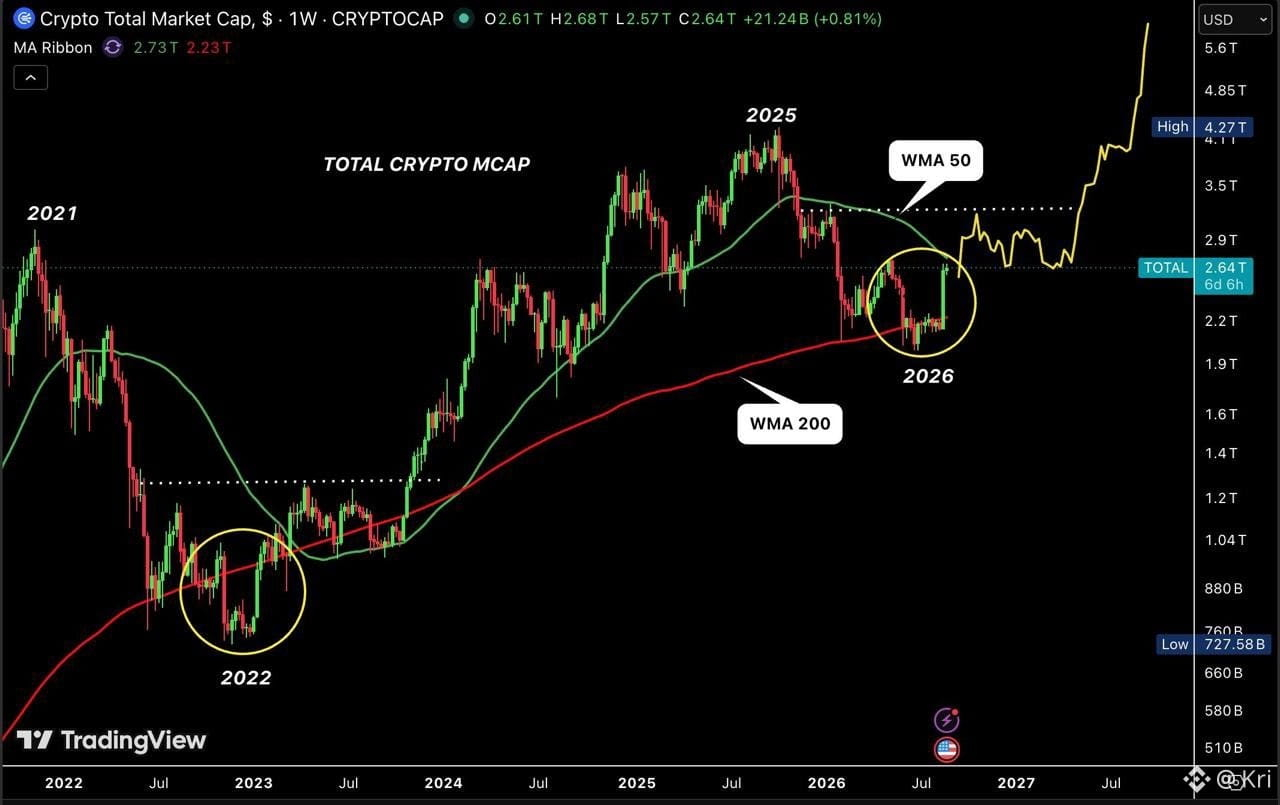
Crypto market cap added $474 Billion in a single week, the largest ever in crypto history.
That’s a 22% pump and the largest weekly candle since February 2021, coming after nearly 3 months of sideways consolidation.
The setup now looks similar to the 2022 bottom, where the market built a base before starting a multi-year rally.
Next resistance is WMA 50 at $2.73 Trillion. A clean breakout above this level could open the path toward $3.25 Trillion.
In 2022, a similar base eventually led to a major multi-year rally.
#BitcoinRises23.6%Weekly $BTC
{future}(BTCUSDT)
Crypto market cap added $474 Billion in a single week, the largest ever in crypto history.
That’s a 22% pump and the largest weekly candle since February 2021, coming after nearly 3 months of sideways consolidation.
The setup now looks similar to the 2022 bottom, where the market built a base before starting a multi-year rally.
Next resistance is WMA 50 at $2.73 Trillion. A clean breakout above this level could open the path toward $3.25 Trillion.
In 2022, a similar base eventually led to a major multi-year rally.
#BitcoinRises23.6%Weekly $BTC
That’s a 22% pump and the largest weekly candle since February 2021, coming after nearly 3 months of sideways consolidation.
The setup now looks similar to the 2022 bottom, where the market built a base before starting a multi-year rally.
Next resistance is WMA 50 at $2.73 Trillion. A clean breakout above this level could open the path toward $3.25 Trillion.
In 2022, a similar base eventually led to a major multi-year rally.
#BitcoinRises23.6%Weekly $BTC
515
·
--
BREAKING: #bitcoin JUST OFFICIALLY RECORDED ITS HIGHEST WEEKLY PRICE GAIN IN OVER 3 YEARS
💥 BTC ENDS THE WEEK UP OVER 22%
💥 THAT'S $14,000 IN JUST 7 DAYS
NEW HIGHS ARE COMING. BUCKLE UP 🚀
$BTC
{future}(BTCUSDT)
BREAKING: #bitcoin JUST OFFICIALLY RECORDED ITS HIGHEST WEEKLY PRICE GAIN IN OVER 3 YEARS
💥 BTC ENDS THE WEEK UP OVER 22%
💥 THAT'S $14,000 IN JUST 7 DAYS
NEW HIGHS ARE COMING. BUCKLE UP 🚀
$BTC
💥 BTC ENDS THE WEEK UP OVER 22%
💥 THAT'S $14,000 IN JUST 7 DAYS
NEW HIGHS ARE COMING. BUCKLE UP 🚀
$BTC
1
878
·
--
حيازة $SOL 2.3K USDT
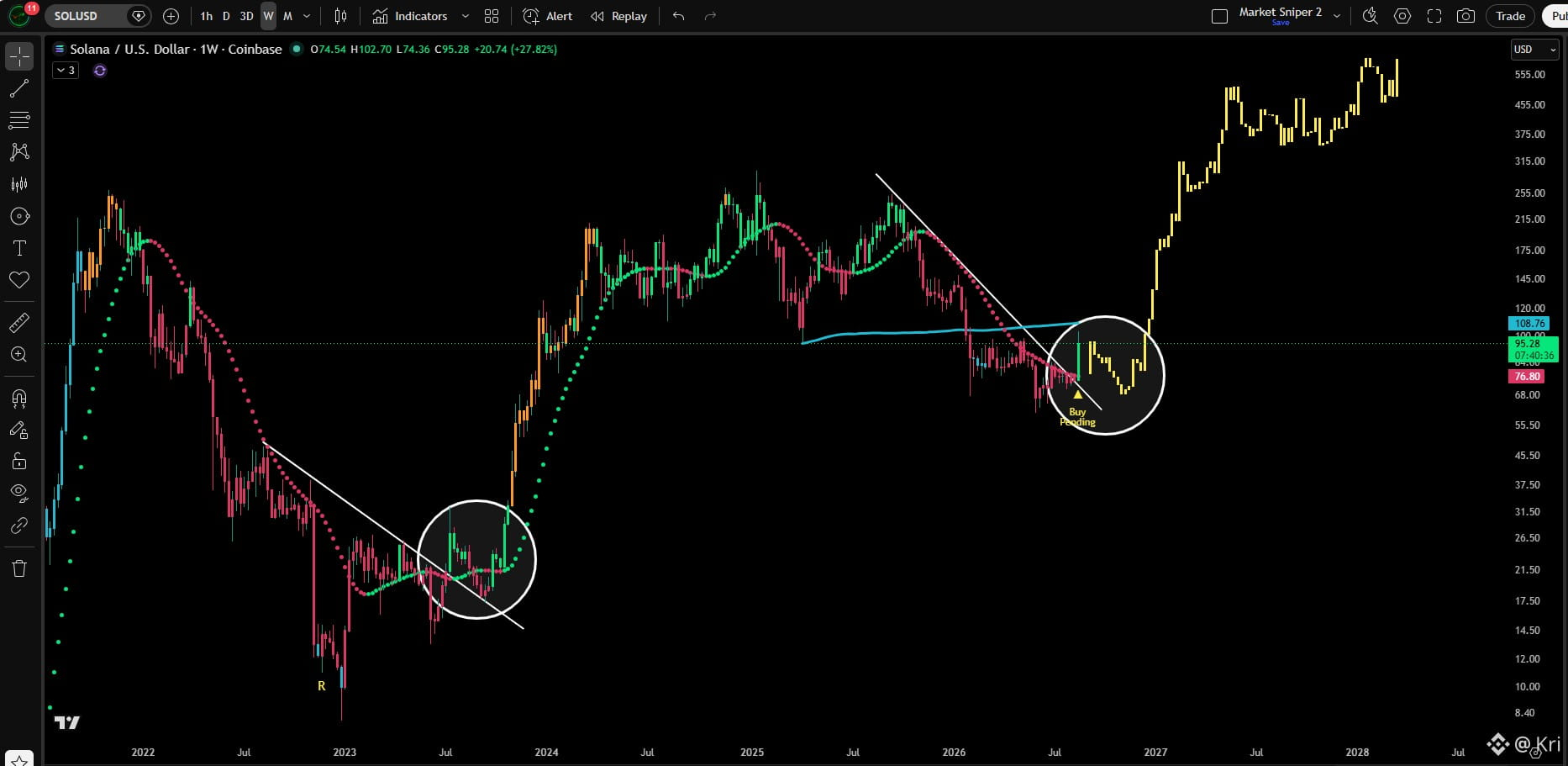
IF $SOL macro bottom is in, THEN we are still early.
Last weekly buy signal price dropped -35% but then price increased 991%.
Today we will see a weekly candle print a buy signal.
{future}(SOLUSDT)
IF $SOL macro bottom is in, THEN we are still early.
Last weekly buy signal price dropped -35% but then price increased 991%.
Today we will see a weekly candle print a buy signal.
Last weekly buy signal price dropped -35% but then price increased 991%.
Today we will see a weekly candle print a buy signal.
4
679
·
--
🚨 PRESIDENT TRUMP: “You should be buying right now.”
Over $30 TRILLION could soon be unleashed into the crypto market!
GET READY. 🚀
🚨 PRESIDENT TRUMP: “You should be buying right now.”
Over $30 TRILLION could soon be unleashed into the crypto market!
GET READY. 🚀
Over $30 TRILLION could soon be unleashed into the crypto market!
GET READY. 🚀
1
350
·
--
The crypto market is looking better again! 👀
Bitcoin had a strong move, going from around $62K to $77K, while Ethereum climbed from around $1.8K to $2.4K.
The good news? Money is coming back into crypto. More investors are buying again and the market is getting more active.
Another sector we really like right now is RWA (Real World Assets). RWA is growing fast as more real-world assets like stocks, bonds and real estate are moving on-chain.
We believe RWA can be one of the strongest crypto sectors going forward and we are very bullish on it!
#BTC #RWA $BTC
The crypto market is looking better again! 👀
Bitcoin had a strong move, going from around $62K to $77K, while Ethereum climbed from around $1.8K to $2.4K.
The good news? Money is coming back into crypto. More investors are buying again and the market is getting more active.
Another sector we really like right now is RWA (Real World Assets). RWA is growing fast as more real-world assets like stocks, bonds and real estate are moving on-chain.
We believe RWA can be one of the strongest crypto sectors going forward and we are very bullish on it!
#BTC #RWA $BTC
Bitcoin had a strong move, going from around $62K to $77K, while Ethereum climbed from around $1.8K to $2.4K.
The good news? Money is coming back into crypto. More investors are buying again and the market is getting more active.
Another sector we really like right now is RWA (Real World Assets). RWA is growing fast as more real-world assets like stocks, bonds and real estate are moving on-chain.
We believe RWA can be one of the strongest crypto sectors going forward and we are very bullish on it!
#BTC #RWA $BTC
1
1.6k
·
--
مقالة
MANTRA token plunges 18% to record low as blockchain halts after exploitThe token of MANTRA, a blockchain focused on putting traditional financial assets such as funds and bonds onchain, plunged 18.5% to a record low shortly before the network stopped producing blocks and was halted following a software exploit.
MANTRA fell from $0.005060 to an all-time low of $0.004126 around 11:10 p.m. UTC Thursday, according to CoinGecko. It later recovered to about $0.0044 but remained down roughly 10% over 24 hours, while trading volume jumped nearly 600% to $24 million.
The network produced its last recorded block at about 11:13 p.m. UTC, minutes after the token touched its low. MANTRA announced the halt roughly half an hour later in an X post.
The project has not said whether the price drop was connected to the attack, though security incidents can trigger outsized moves as traders rapidly reassess the risk of holding the affected token.
We're aware of an incident affecting MANTRA Chain and have halted the chain as a precaution while we investigate. All endpoints and transactions are currently frozen.
This means deposits and withdrawals to/from MANTRA Chain are temporarily affected. If you're unsure how this…— MANTRA | The EVM L1 for RWAs (@MANTRA_Chain) August 21, 2026
MANTRA initially said it had frozen all transactions and network endpoints as a precaution while investigating an incident. Deposits and withdrawals were also paused on affected exchanges.
A later update said an attacker had exploited a vulnerability in an “upstream dependency,” meaning software used by MANTRA Chain but developed outside the network itself.
“We have identified the vulnerability and are proceeding to prepare a patched release,” the team said.
MANTRA’s network operators, known as validators, remain offline while developers prepare and test the fix. Restarting the blockchain will require coordination with the wider group of operators that verify transactions and keep the network running.
The project is also tracing fund movements and working with exchanges while it assesses the damage. It has not disclosed which software was exploited, how the attack worked or whether any assets were lost.
“Our assessment of the full impact is ongoing and we are not yet in a position to confirm the complete scope,” MANTRA said.
The outage affects the chain’s public endpoints, validators, bridge operations and MANTRA-managed links used to communicate with other blockchains.
The incident follows a difficult period for the project. MANTRA’s former OM token collapsed more than 90% in April 2025 in a bizarre sell-off, wiping out more than $5 billion in market value.
Inveniam Capital Partners, which invested $20 million in MANTRA last year, said in June it planned to acquire the project. The deal is expected to close in the third quarter.
$MANTRA #mantra
{future}(MANTRAUSDT)
MANTRA token plunges 18% to record low as blockchain halts after exploit
The token of MANTRA, a blockchain focused on putting traditional financial assets such as funds and bonds onchain, plunged 18.5% to a record low shortly before the network stopped producing blocks and was halted following a software exploit.
MANTRA fell from $0.005060 to an all-time low of $0.004126 around 11:10 p.m. UTC Thursday, according to CoinGecko. It later recovered to about $0.0044 but remained down roughly 10% over 24 hours, while trading volume jumped nearly 600% to $24 million.
The network produced its last recorded block at about 11:13 p.m. UTC, minutes after the token touched its low. MANTRA announced the halt roughly half an hour later in an X post.
The project has not said whether the price drop was connected to the attack, though security incidents can trigger outsized moves as traders rapidly reassess the risk of holding the affected token.
We're aware of an incident affecting MANTRA Chain and have halted the chain as a precaution while we investigate. All endpoints and transactions are currently frozen.
This means deposits and withdrawals to/from MANTRA Chain are temporarily affected. If you're unsure how this…— MANTRA | The EVM L1 for RWAs (@MANTRA_Chain) August 21, 2026
MANTRA initially said it had frozen all transactions and network endpoints as a precaution while investigating an incident. Deposits and withdrawals were also paused on affected exchanges.
A later update said an attacker had exploited a vulnerability in an “upstream dependency,” meaning software used by MANTRA Chain but developed outside the network itself.
“We have identified the vulnerability and are proceeding to prepare a patched release,” the team said.
MANTRA’s network operators, known as validators, remain offline while developers prepare and test the fix. Restarting the blockchain will require coordination with the wider group of operators that verify transactions and keep the network running.
The project is also tracing fund movements and working with exchanges while it assesses the damage. It has not disclosed which software was exploited, how the attack worked or whether any assets were lost.
“Our assessment of the full impact is ongoing and we are not yet in a position to confirm the complete scope,” MANTRA said.
The outage affects the chain’s public endpoints, validators, bridge operations and MANTRA-managed links used to communicate with other blockchains.
The incident follows a difficult period for the project. MANTRA’s former OM token collapsed more than 90% in April 2025 in a bizarre sell-off, wiping out more than $5 billion in market value.
Inveniam Capital Partners, which invested $20 million in MANTRA last year, said in June it planned to acquire the project. The deal is expected to close in the third quarter.
$MANTRA #mantra
MANTRA fell from $0.005060 to an all-time low of $0.004126 around 11:10 p.m. UTC Thursday, according to CoinGecko. It later recovered to about $0.0044 but remained down roughly 10% over 24 hours, while trading volume jumped nearly 600% to $24 million.
The network produced its last recorded block at about 11:13 p.m. UTC, minutes after the token touched its low. MANTRA announced the halt roughly half an hour later in an X post.
The project has not said whether the price drop was connected to the attack, though security incidents can trigger outsized moves as traders rapidly reassess the risk of holding the affected token.
We're aware of an incident affecting MANTRA Chain and have halted the chain as a precaution while we investigate. All endpoints and transactions are currently frozen.
This means deposits and withdrawals to/from MANTRA Chain are temporarily affected. If you're unsure how this…— MANTRA | The EVM L1 for RWAs (@MANTRA_Chain) August 21, 2026
MANTRA initially said it had frozen all transactions and network endpoints as a precaution while investigating an incident. Deposits and withdrawals were also paused on affected exchanges.
A later update said an attacker had exploited a vulnerability in an “upstream dependency,” meaning software used by MANTRA Chain but developed outside the network itself.
“We have identified the vulnerability and are proceeding to prepare a patched release,” the team said.
MANTRA’s network operators, known as validators, remain offline while developers prepare and test the fix. Restarting the blockchain will require coordination with the wider group of operators that verify transactions and keep the network running.
The project is also tracing fund movements and working with exchanges while it assesses the damage. It has not disclosed which software was exploited, how the attack worked or whether any assets were lost.
“Our assessment of the full impact is ongoing and we are not yet in a position to confirm the complete scope,” MANTRA said.
The outage affects the chain’s public endpoints, validators, bridge operations and MANTRA-managed links used to communicate with other blockchains.
The incident follows a difficult period for the project. MANTRA’s former OM token collapsed more than 90% in April 2025 in a bizarre sell-off, wiping out more than $5 billion in market value.
Inveniam Capital Partners, which invested $20 million in MANTRA last year, said in June it planned to acquire the project. The deal is expected to close in the third quarter.
$MANTRA #mantra
640
·
--
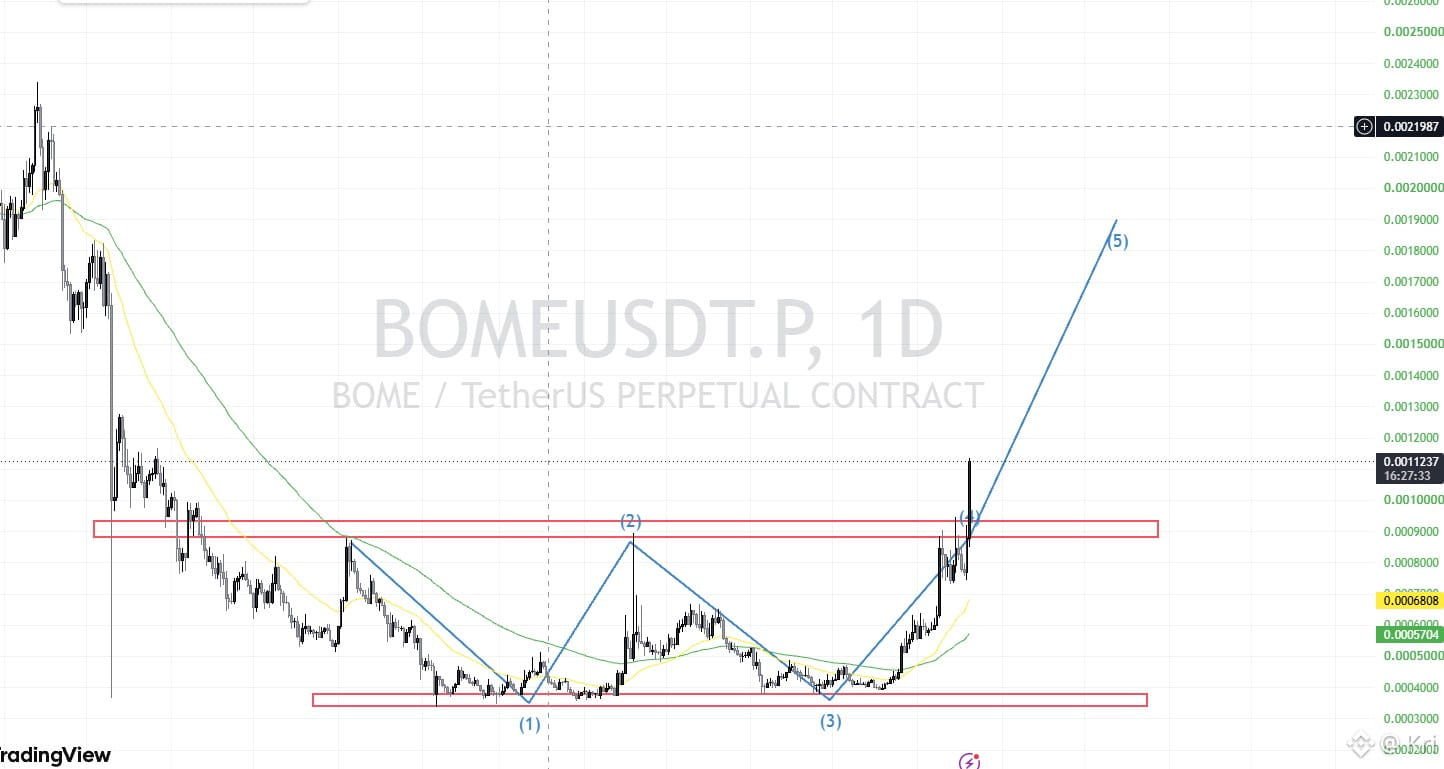
$BOME just broke out of the resistance zone that capped price since the wave 1 top, reclaiming $0.0009 to $0.0011 after basing for weeks between $0.0004 and $0.0006.
The count on this chart reads as a completed 1 through 4 impact structure, with wave 3 bottoming lower than wave 1 before the recent push back above range. If wave 5 plays out with similar proportions to the prior legs, the move projects well above $0.0018, back toward the same zone BOME rejected from at the start of this whole sequence.
Wave counts are subjective and this one still needs the breakout to hold as new support rather than get rejected back into range.
$BOME #Solana #Memecoin
{future}(BOMEUSDT)
This is just my personal opinion, not financial advice.
$BOME just broke out of the resistance zone that capped price since the wave 1 top, reclaiming $0.0009 to $0.0011 after basing for weeks between $0.0004 and $0.0006.
The count on this chart reads as a completed 1 through 4 impact structure, with wave 3 bottoming lower than wave 1 before the recent push back above range. If wave 5 plays out with similar proportions to the prior legs, the move projects well above $0.0018, back toward the same zone BOME rejected from at the start of this whole sequence.
Wave counts are subjective and this one still needs the breakout to hold as new support rather than get rejected back into range.
$BOME #Solana #Memecoin
This is just my personal opinion, not financial advice.
The count on this chart reads as a completed 1 through 4 impact structure, with wave 3 bottoming lower than wave 1 before the recent push back above range. If wave 5 plays out with similar proportions to the prior legs, the move projects well above $0.0018, back toward the same zone BOME rejected from at the start of this whole sequence.
Wave counts are subjective and this one still needs the breakout to hold as new support rather than get rejected back into range.
$BOME #Solana #Memecoin
This is just my personal opinion, not financial advice.
616
·
--
The next 6 to 12 months will be life-changing.
$BTC
will reach $200,000.
$ETH
will break past $10,000.
$SOL
will reach $1,000.
{future}(SOLUSDT)
The next 6 to 12 months will be life-changing.
$BTC
will reach $200,000.
$ETH
will break past $10,000.
$SOL
will reach $1,000.
$BTC
will reach $200,000.
$ETH
will break past $10,000.
$SOL
will reach $1,000.
1
772
·
--
💥 BOOOOOOOOlOOOOOOOOM! 💥
As the White House event ended, Brad Garlinghouse opened the door for President Trump.
Years ago, Ripple was fighting the U.S. government.
Today, Brad is holding the White House door open.
WHAT A PICTURE. 🇺🇸 $XRP $SOL
{future}(SOLUSDT)
{future}(XRPUSDT)
💥 BOOOOOOOOlOOOOOOOOM! 💥
As the White House event ended, Brad Garlinghouse opened the door for President Trump.
Years ago, Ripple was fighting the U.S. government.
Today, Brad is holding the White House door open.
WHAT A PICTURE. 🇺🇸 $XRP $SOL
As the White House event ended, Brad Garlinghouse opened the door for President Trump.
Years ago, Ripple was fighting the U.S. government.
Today, Brad is holding the White House door open.
WHAT A PICTURE. 🇺🇸 $XRP $SOL
1.4k
·
--
Why Choose TermPrime
Full lifecycle on-chain
From order matching to atomic settlement, all on one venue with finality.
Approved counterparties
Trades happen only between KYB’d institutions that have existing trading relationships.
Fixed or floating rate
Borrowing and lending at a fixed or floating rate, with or without collateral, over a fixed term.
#termmax @termmax
Why Choose TermPrime
Full lifecycle on-chain
From order matching to atomic settlement, all on one venue with finality.
Approved counterparties
Trades happen only between KYB’d institutions that have existing trading relationships.
Fixed or floating rate
Borrowing and lending at a fixed or floating rate, with or without collateral, over a fixed term.
#termmax @TermMax
Full lifecycle on-chain
From order matching to atomic settlement, all on one venue with finality.
Approved counterparties
Trades happen only between KYB’d institutions that have existing trading relationships.
Fixed or floating rate
Borrowing and lending at a fixed or floating rate, with or without collateral, over a fixed term.
#termmax @TermMax

2
447
·
--
In 2010, BTC crashed to $0.10
In 2011, BTC crashed to $1
In 2013, BTC crashed to $50
In 2015, BTC crashed to $200
In 2018, BTC crashed to $3,000
In 2022, BTC crashed to $15,000
In 2024, BTC crashed to $39,000
In 2026, BTC crashed to $60,000
Notice anything?
#BTC $BTC
{future}(BTCUSDT)
In 2010, BTC crashed to $0.10
In 2011, BTC crashed to $1
In 2013, BTC crashed to $50
In 2015, BTC crashed to $200
In 2018, BTC crashed to $3,000
In 2022, BTC crashed to $15,000
In 2024, BTC crashed to $39,000
In 2026, BTC crashed to $60,000
Notice anything?
#BTC $BTC
In 2011, BTC crashed to $1
In 2013, BTC crashed to $50
In 2015, BTC crashed to $200
In 2018, BTC crashed to $3,000
In 2022, BTC crashed to $15,000
In 2024, BTC crashed to $39,000
In 2026, BTC crashed to $60,000
Notice anything?
#BTC $BTC
525
·
--
مقالة
PEPECOIN: A Community Takeover Taking Shape on Robinhood ChainFrom Abandoned Token to Community Project
PEPECOIN is entering a new chapter on Robinhood Chain following a community takeover, or CTO. With the original team no longer involved, the project has effectively been handed over to its holders, who are now responsible for its direction, branding, social presence, and future development.
The concept is straightforward: instead of relying on a centralized team to define the project, the community becomes the driving force behind it.
PEPECOIN operates under the same contract, while its new community has built a fresh identity around the token. The project has launched new social channels, a dedicated website, and a renewed push to establish PEPECOIN as one of the recognizable meme communities on Robinhood Chain.
The token contract address is:
0x0b9606FB048A14d8381e9B97d00a78b4F4C66241
A Different Kind of Meme Coin Story
Community takeovers have become an increasingly interesting part of the memecoin ecosystem. When a project loses its original team, the token does not necessarily have to disappear. In some cases, holders decide to take responsibility themselves and attempt to build something new around an existing community and contract.
That is the story behind PEPECOIN.
The project is not presenting itself as a conventional startup with venture capital backing, corporate management, or a traditional development roadmap. Instead, it is positioning itself as a community-led memecoin where participation, creativity, social activity, and collective momentum are the primary drivers.
This approach also fits naturally with the culture of meme coins, where strong communities can often become more important than formal organizational structures.
35% of the Supply Has Been Burned
One of the most notable aspects of PEPECOIN's current token structure is its supply burn.
According to the project's on-chain information, 351,837,132 tokens have been burned, representing approximately 35% of the original 1 billion token supply.
Those tokens have been sent to a dead address and are no longer part of the circulating supply available to the market.
The remaining supply structure is therefore significantly different from the original one, while the burn can be independently verified on-chain.
Rather than simply being a marketing claim, the burn provides a transparent blockchain-based record that holders and observers can inspect themselves.
No Dev Allocation and No Team Wallet
PEPECOIN's community takeover model also focuses heavily on ownership distribution.
The project states that there is no developer or team allocation, meaning there is no dedicated team wallet holding a reserved portion of the supply for future selling.
This is particularly relevant in the memecoin market, where large insider allocations can create substantial selling pressure when tokens become active.
With the project now being community-driven, the emphasis is instead placed on holders, traders, creators, and community members participating directly in the ecosystem.
Of course, wallet distribution and holder activity can change over time, so investors should always verify the current on-chain data rather than relying solely on project statements.
Permanently Locked Liquidity
Another central part of the PEPECOIN narrative is its liquidity.
The project states that its liquidity is locked permanently, removing the traditional possibility of the project team simply withdrawing liquidity from the market.
For a community takeover, this is an important foundation. The community is attempting to build on an existing token rather than repeatedly creating new contracts or moving between different versions of the project.
Combined with the absence of a team allocation, the locked-liquidity structure gives PEPECOIN a relatively simple framework: an existing token, a reduced supply, and a community responsible for creating the next stage of the project.
Built on Robinhood Chain
PEPECOIN is deployed on Robinhood Chain, using Chain ID 4663.
The choice of network gives the project access to an emerging ecosystem while allowing it to position itself alongside other meme-focused communities developing on the chain.
For a memecoin, network selection can have a meaningful impact. Trading infrastructure, liquidity, accessibility, transaction costs, and the size of the surrounding community can all influence how easily a token can attract and retain users.
PEPECOIN is therefore not only building around its meme identity but also around the broader opportunity presented by Robinhood Chain.
The PEPE Brand and Meme Culture
There is another obvious element behind the project: the name PEPE.
PEPE has become one of the most recognizable characters in cryptocurrency culture, and meme-based tokens have repeatedly demonstrated how powerful recognizable internet culture can become when combined with active communities.
PEPECOIN is attempting to build its own identity within that broader culture rather than positioning itself as a traditional utility protocol.
The project's value proposition is therefore primarily community and culture-driven. Memes, social content, participation, trading activity, and community growth are central to the way the project presents itself.
That also means its success will ultimately depend on whether the community can maintain momentum and continue attracting attention over time.
Community Is the New Team
The defining phrase behind the project is simple:
The team is gone. We are the team.
This captures the CTO structure in a single idea.
Instead of waiting for a centralized development team to deliver announcements or updates, community members can contribute through content creation, social media, marketing, discussions, memes, partnerships, and other initiatives.
This creates a more open-ended structure. There is no guarantee that the community will succeed, but there is also no single team controlling the entire direction of the project.
For PEPECOIN, the community takeover is therefore not just a change in management. It is the foundation of the project's identity.
Tokenomics at a Glance
Token: PEPECOIN
Chain: Robinhood Chain
Chain ID: 4663
Original Supply: 1,000,000,000
Burned: 351,837,132
Tax: 0%
Liquidity: Permanently locked
Team Allocation: None stated by the project
Contract: 0x0b9606FB048A14d8381e9B97d00a78b4F4C66241
The combination of a 35% supply burn, 0% tax, locked liquidity, and community ownership forms the core of PEPECOIN's current token structure.
How to Find PEPECOIN
PEPECOIN is available for trading through the project's linked trading infrastructure on Robinhood Chain.
Users looking to participate should first ensure they have ETH available on Robinhood Chain, connect a compatible wallet, and verify the contract address before making any transaction.
The official contract is:
0x0b9606FB048A14d8381e9B97d00a78b4F4C66241
Always verify the contract independently before trading, particularly when dealing with meme coins where copycat tokens can appear.
What Comes Next?
The most interesting part of a community takeover is that the story is not finished when the takeover happens. That is where the real work begins.
PEPECOIN now needs to demonstrate whether a community can turn an abandoned or inactive token into an active, recognizable ecosystem.
That means maintaining consistent social activity, growing its holder base, creating original content, increasing visibility across Robinhood Chain, and giving people a reason to remain involved beyond short-term speculation.
There is no traditional roadmap promising a fixed series of developments. Instead, the project is deliberately leaving its direction in the hands of the community.
That makes PEPECOIN an experiment in decentralized meme culture as much as it is a cryptocurrency.
The Bigger Picture
PEPECOIN represents a familiar but increasingly relevant phenomenon in crypto: a token can outlive its original creators when a community decides to take ownership of its future.
The ingredients are already in place — an established contract, a significant supply burn, locked liquidity, zero stated tax, a recognizable meme identity, and a community willing to continue building.
Whether that is enough to create a major memecoin remains to be seen. Markets ultimately decide which communities survive, and attention in the memecoin sector can change quickly.
But the PEPECOIN community has made its position clear.
The original team may be gone.
The community has taken over.
And on Robinhood Chain, the next chapter of PEPECOIN is now being written by the people holding the frog.
PEPECOIN: A Community Takeover Taking Shape on Robinhood Chain
From Abandoned Token to Community Project
PEPECOIN is entering a new chapter on Robinhood Chain following a community takeover, or CTO. With the original team no longer involved, the project has effectively been handed over to its holders, who are now responsible for its direction, branding, social presence, and future development.
The concept is straightforward: instead of relying on a centralized team to define the project, the community becomes the driving force behind it.
PEPECOIN operates under the same contract, while its new community has built a fresh identity around the token. The project has launched new social channels, a dedicated website, and a renewed push to establish PEPECOIN as one of the recognizable meme communities on Robinhood Chain.
The token contract address is:
0x0b9606FB048A14d8381e9B97d00a78b4F4C66241
A Different Kind of Meme Coin Story
Community takeovers have become an increasingly interesting part of the memecoin ecosystem. When a project loses its original team, the token does not necessarily have to disappear. In some cases, holders decide to take responsibility themselves and attempt to build something new around an existing community and contract.
That is the story behind PEPECOIN.
The project is not presenting itself as a conventional startup with venture capital backing, corporate management, or a traditional development roadmap. Instead, it is positioning itself as a community-led memecoin where participation, creativity, social activity, and collective momentum are the primary drivers.
This approach also fits naturally with the culture of meme coins, where strong communities can often become more important than formal organizational structures.
35% of the Supply Has Been Burned
One of the most notable aspects of PEPECOIN's current token structure is its supply burn.
According to the project's on-chain information, 351,837,132 tokens have been burned, representing approximately 35% of the original 1 billion token supply.
Those tokens have been sent to a dead address and are no longer part of the circulating supply available to the market.
The remaining supply structure is therefore significantly different from the original one, while the burn can be independently verified on-chain.
Rather than simply being a marketing claim, the burn provides a transparent blockchain-based record that holders and observers can inspect themselves.
No Dev Allocation and No Team Wallet
PEPECOIN's community takeover model also focuses heavily on ownership distribution.
The project states that there is no developer or team allocation, meaning there is no dedicated team wallet holding a reserved portion of the supply for future selling.
This is particularly relevant in the memecoin market, where large insider allocations can create substantial selling pressure when tokens become active.
With the project now being community-driven, the emphasis is instead placed on holders, traders, creators, and community members participating directly in the ecosystem.
Of course, wallet distribution and holder activity can change over time, so investors should always verify the current on-chain data rather than relying solely on project statements.
Permanently Locked Liquidity
Another central part of the PEPECOIN narrative is its liquidity.
The project states that its liquidity is locked permanently, removing the traditional possibility of the project team simply withdrawing liquidity from the market.
For a community takeover, this is an important foundation. The community is attempting to build on an existing token rather than repeatedly creating new contracts or moving between different versions of the project.
Combined with the absence of a team allocation, the locked-liquidity structure gives PEPECOIN a relatively simple framework: an existing token, a reduced supply, and a community responsible for creating the next stage of the project.
Built on Robinhood Chain
PEPECOIN is deployed on Robinhood Chain, using Chain ID 4663.
The choice of network gives the project access to an emerging ecosystem while allowing it to position itself alongside other meme-focused communities developing on the chain.
For a memecoin, network selection can have a meaningful impact. Trading infrastructure, liquidity, accessibility, transaction costs, and the size of the surrounding community can all influence how easily a token can attract and retain users.
PEPECOIN is therefore not only building around its meme identity but also around the broader opportunity presented by Robinhood Chain.
The PEPE Brand and Meme Culture
There is another obvious element behind the project: the name PEPE.
PEPE has become one of the most recognizable characters in cryptocurrency culture, and meme-based tokens have repeatedly demonstrated how powerful recognizable internet culture can become when combined with active communities.
PEPECOIN is attempting to build its own identity within that broader culture rather than positioning itself as a traditional utility protocol.
The project's value proposition is therefore primarily community and culture-driven. Memes, social content, participation, trading activity, and community growth are central to the way the project presents itself.
That also means its success will ultimately depend on whether the community can maintain momentum and continue attracting attention over time.
Community Is the New Team
The defining phrase behind the project is simple:
The team is gone. We are the team.
This captures the CTO structure in a single idea.
Instead of waiting for a centralized development team to deliver announcements or updates, community members can contribute through content creation, social media, marketing, discussions, memes, partnerships, and other initiatives.
This creates a more open-ended structure. There is no guarantee that the community will succeed, but there is also no single team controlling the entire direction of the project.
For PEPECOIN, the community takeover is therefore not just a change in management. It is the foundation of the project's identity.
Tokenomics at a Glance
Token: PEPECOIN
Chain: Robinhood Chain
Chain ID: 4663
Original Supply: 1,000,000,000
Burned: 351,837,132
Tax: 0%
Liquidity: Permanently locked
Team Allocation: None stated by the project
Contract: 0x0b9606FB048A14d8381e9B97d00a78b4F4C66241
The combination of a 35% supply burn, 0% tax, locked liquidity, and community ownership forms the core of PEPECOIN's current token structure.
How to Find PEPECOIN
PEPECOIN is available for trading through the project's linked trading infrastructure on Robinhood Chain.
Users looking to participate should first ensure they have ETH available on Robinhood Chain, connect a compatible wallet, and verify the contract address before making any transaction.
The official contract is:
0x0b9606FB048A14d8381e9B97d00a78b4F4C66241
Always verify the contract independently before trading, particularly when dealing with meme coins where copycat tokens can appear.
What Comes Next?
The most interesting part of a community takeover is that the story is not finished when the takeover happens. That is where the real work begins.
PEPECOIN now needs to demonstrate whether a community can turn an abandoned or inactive token into an active, recognizable ecosystem.
That means maintaining consistent social activity, growing its holder base, creating original content, increasing visibility across Robinhood Chain, and giving people a reason to remain involved beyond short-term speculation.
There is no traditional roadmap promising a fixed series of developments. Instead, the project is deliberately leaving its direction in the hands of the community.
That makes PEPECOIN an experiment in decentralized meme culture as much as it is a cryptocurrency.
The Bigger Picture
PEPECOIN represents a familiar but increasingly relevant phenomenon in crypto: a token can outlive its original creators when a community decides to take ownership of its future.
The ingredients are already in place — an established contract, a significant supply burn, locked liquidity, zero stated tax, a recognizable meme identity, and a community willing to continue building.
Whether that is enough to create a major memecoin remains to be seen. Markets ultimately decide which communities survive, and attention in the memecoin sector can change quickly.
But the PEPECOIN community has made its position clear.
The original team may be gone.
The community has taken over.
And on Robinhood Chain, the next chapter of PEPECOIN is now being written by the people holding the frog.
PEPECOIN is entering a new chapter on Robinhood Chain following a community takeover, or CTO. With the original team no longer involved, the project has effectively been handed over to its holders, who are now responsible for its direction, branding, social presence, and future development.
The concept is straightforward: instead of relying on a centralized team to define the project, the community becomes the driving force behind it.
PEPECOIN operates under the same contract, while its new community has built a fresh identity around the token. The project has launched new social channels, a dedicated website, and a renewed push to establish PEPECOIN as one of the recognizable meme communities on Robinhood Chain.
The token contract address is:
0x0b9606FB048A14d8381e9B97d00a78b4F4C66241
A Different Kind of Meme Coin Story
Community takeovers have become an increasingly interesting part of the memecoin ecosystem. When a project loses its original team, the token does not necessarily have to disappear. In some cases, holders decide to take responsibility themselves and attempt to build something new around an existing community and contract.
That is the story behind PEPECOIN.
The project is not presenting itself as a conventional startup with venture capital backing, corporate management, or a traditional development roadmap. Instead, it is positioning itself as a community-led memecoin where participation, creativity, social activity, and collective momentum are the primary drivers.
This approach also fits naturally with the culture of meme coins, where strong communities can often become more important than formal organizational structures.
35% of the Supply Has Been Burned
One of the most notable aspects of PEPECOIN's current token structure is its supply burn.
According to the project's on-chain information, 351,837,132 tokens have been burned, representing approximately 35% of the original 1 billion token supply.
Those tokens have been sent to a dead address and are no longer part of the circulating supply available to the market.
The remaining supply structure is therefore significantly different from the original one, while the burn can be independently verified on-chain.
Rather than simply being a marketing claim, the burn provides a transparent blockchain-based record that holders and observers can inspect themselves.
No Dev Allocation and No Team Wallet
PEPECOIN's community takeover model also focuses heavily on ownership distribution.
The project states that there is no developer or team allocation, meaning there is no dedicated team wallet holding a reserved portion of the supply for future selling.
This is particularly relevant in the memecoin market, where large insider allocations can create substantial selling pressure when tokens become active.
With the project now being community-driven, the emphasis is instead placed on holders, traders, creators, and community members participating directly in the ecosystem.
Of course, wallet distribution and holder activity can change over time, so investors should always verify the current on-chain data rather than relying solely on project statements.
Permanently Locked Liquidity
Another central part of the PEPECOIN narrative is its liquidity.
The project states that its liquidity is locked permanently, removing the traditional possibility of the project team simply withdrawing liquidity from the market.
For a community takeover, this is an important foundation. The community is attempting to build on an existing token rather than repeatedly creating new contracts or moving between different versions of the project.
Combined with the absence of a team allocation, the locked-liquidity structure gives PEPECOIN a relatively simple framework: an existing token, a reduced supply, and a community responsible for creating the next stage of the project.
Built on Robinhood Chain
PEPECOIN is deployed on Robinhood Chain, using Chain ID 4663.
The choice of network gives the project access to an emerging ecosystem while allowing it to position itself alongside other meme-focused communities developing on the chain.
For a memecoin, network selection can have a meaningful impact. Trading infrastructure, liquidity, accessibility, transaction costs, and the size of the surrounding community can all influence how easily a token can attract and retain users.
PEPECOIN is therefore not only building around its meme identity but also around the broader opportunity presented by Robinhood Chain.
The PEPE Brand and Meme Culture
There is another obvious element behind the project: the name PEPE.
PEPE has become one of the most recognizable characters in cryptocurrency culture, and meme-based tokens have repeatedly demonstrated how powerful recognizable internet culture can become when combined with active communities.
PEPECOIN is attempting to build its own identity within that broader culture rather than positioning itself as a traditional utility protocol.
The project's value proposition is therefore primarily community and culture-driven. Memes, social content, participation, trading activity, and community growth are central to the way the project presents itself.
That also means its success will ultimately depend on whether the community can maintain momentum and continue attracting attention over time.
Community Is the New Team
The defining phrase behind the project is simple:
The team is gone. We are the team.
This captures the CTO structure in a single idea.
Instead of waiting for a centralized development team to deliver announcements or updates, community members can contribute through content creation, social media, marketing, discussions, memes, partnerships, and other initiatives.
This creates a more open-ended structure. There is no guarantee that the community will succeed, but there is also no single team controlling the entire direction of the project.
For PEPECOIN, the community takeover is therefore not just a change in management. It is the foundation of the project's identity.
Tokenomics at a Glance
Token: PEPECOIN
Chain: Robinhood Chain
Chain ID: 4663
Original Supply: 1,000,000,000
Burned: 351,837,132
Tax: 0%
Liquidity: Permanently locked
Team Allocation: None stated by the project
Contract: 0x0b9606FB048A14d8381e9B97d00a78b4F4C66241
The combination of a 35% supply burn, 0% tax, locked liquidity, and community ownership forms the core of PEPECOIN's current token structure.
How to Find PEPECOIN
PEPECOIN is available for trading through the project's linked trading infrastructure on Robinhood Chain.
Users looking to participate should first ensure they have ETH available on Robinhood Chain, connect a compatible wallet, and verify the contract address before making any transaction.
The official contract is:
0x0b9606FB048A14d8381e9B97d00a78b4F4C66241
Always verify the contract independently before trading, particularly when dealing with meme coins where copycat tokens can appear.
What Comes Next?
The most interesting part of a community takeover is that the story is not finished when the takeover happens. That is where the real work begins.
PEPECOIN now needs to demonstrate whether a community can turn an abandoned or inactive token into an active, recognizable ecosystem.
That means maintaining consistent social activity, growing its holder base, creating original content, increasing visibility across Robinhood Chain, and giving people a reason to remain involved beyond short-term speculation.
There is no traditional roadmap promising a fixed series of developments. Instead, the project is deliberately leaving its direction in the hands of the community.
That makes PEPECOIN an experiment in decentralized meme culture as much as it is a cryptocurrency.
The Bigger Picture
PEPECOIN represents a familiar but increasingly relevant phenomenon in crypto: a token can outlive its original creators when a community decides to take ownership of its future.
The ingredients are already in place — an established contract, a significant supply burn, locked liquidity, zero stated tax, a recognizable meme identity, and a community willing to continue building.
Whether that is enough to create a major memecoin remains to be seen. Markets ultimately decide which communities survive, and attention in the memecoin sector can change quickly.
But the PEPECOIN community has made its position clear.
The original team may be gone.
The community has taken over.
And on Robinhood Chain, the next chapter of PEPECOIN is now being written by the people holding the frog.
1
2
331
·
--
مقالة
When a Whale Drops the Market, My Order Is Already ThereWe've all watched the same thing happen. A large player pushes size into thin liquidity, price gaps down for a fraction of a second, then snaps right back. No news, no reason. Just a whale moving too much size through a book that couldn't absorb it. By the time you register the wick, price is already back where it started.
That snap-back is one of the cleanest inefficiencies in this market, and one of the hardest to trade, because it lives and dies in milliseconds. You can't click fast enough. Nobody can.
That is exactly what Moonbot's flagship strategy, MoonShot, was built for. A limit order sits in the book below the market at a set distance and follows the price. When a whale drops the market with a market order, that order catches the flush and takes profit on the instant bounce. It isn't buying a dip, and it isn't waiting for a reversal. It sits in ambush for one specific mechanical event and fires in a fraction of a second, around the clock. The same order doubles as a market-making tool, holding liquidity in the book at the level you set.
I've traded through Moonbot for a while now, and MoonShot is only one reason. Here is the honest breakdown of the rest: what it does, why it fits the way I trade, and where it doesn't.
Watching whales, live
Start with the part that matters to this feed.
Moonbot has a tool called Watcher. It tracks large traders on Hyperliquid and drops their trades straight onto your chart in real time. The size steps in, you see it right next to the price you're working. No delay, no explorer.
That's the whole gap I keep talking about. On-chain I show you the whale after the fact. Watcher shows you the whale while there's still a trade left to take.
Watcher is Hyperliquid only, and it's free if you register through a Moonbot referral link, otherwise it's built into PRO.
But Hyperliquid is just one venue here. Watcher is the on-chain piece, while the terminal itself runs exactly the same across Binance, Bybit, HTX, Gate, OKX and Bitget, spot and futures alike, with the same tick charts, the same Detects and the same strategies on every one of them. Plenty of traders keep it on Binance and Bybit day to day and treat Hyperliquid as the extra on-chain edge on top, so it all lives in one terminal with every book in the same place.
Why the tick chart
A one-minute candle is a summary. It already swallowed the wick, the flush, the reaction to a $70M market sell.
Moonbot's tick chart doesn't summarize anything. Every trade plotted as it happens, updating at millisecond speed. You watch the flush while it's flushing. For scalping that's the whole game.
The latest update added a full candlestick view and a hybrid mode. Flip between ticks and candles in one click, or run both in the same window. Ticks for the entry, candles for the map. Your call.
Right beside it sits a graphical order book. Liquidity is shown as shapes, not columns of numbers, so you can read where the size is parked and which wall is real at a glance. There's also an Arbitrage Prices module that plots the same coin across exchanges and refreshes every 250ms, so a dislocation lights up before you've alt-tabbed to a second tab.
Detects: a radar, not an alert log
You set the conditions. A volume spike, a sharp move, a volatility shift, a fat order landing in the book. When one trips, Moonbot pops a live chart of that coin, or in auto mode it fires a full strategy on its own.
Indicators read the closed candle. The past. Detects react while it's still happening. That difference is the whole edge when a coin is in and out inside a minute.
Manual speed
When it's hands-on, everything is wired for speed.
Take-profits dropped with one click and fanned across the chart with the mouse. Order grids you grab and drag the second the plan changes. Hooks that trail your order and only pull the trigger on a sharp wick. A "View Markets" button to scan coins by volatility and volume, and set margin and leverage across all of them at once.
Not one bot. An army.
This is where it gets serious on the algo side.
20+ built-in strategies with names like Moonshot, MoonHook, Delta, Pump and TopMarket, each with 300+ parameters. And they talk to each other through triggers. Pump catches a spike, fires Moonshot on that coin, Moonshot runs its own setup. You're not running one bot, you're building a system.
Feed it external signals too. TradingView webhooks and Telegram calls, all screened through your own Detects before an order ever goes out. Test any of it in the emulator on live data, or backtest it on history before you risk a dollar.
Your keys stay yours
I care about this one a lot. Moonbot doesn't hold your funds and doesn't hold your API keys. The connection runs straight off your own machine or VPS. Keys, settings, trade history, all local. No middleman server sitting there waiting to get drained the way we've watched other platforms get drained.
Want your execution as close to the exchange as the big wallets get it? Moon Kernel runs the engine on a VPS right next to the matching engine while your laptop just draws the interface.
And one for the "copy his moves" crowd: trust management over UDP lets traders mirror each other with almost no lag. Everyone on their own keys, their own account, only the trade commands crossing the wire. Copy trading without handing anyone the keys to the kingdom.
There's even an open-source SDK (MoonProto, Apache-2.0) if you'd rather build your own terminal or dashboard on top of the core.
Run it from your phone
Alerts, trade reports, chart screenshots and remote commands straight from a Telegram chat. Away from the desk doesn't mean out of the trade.
Does it actually win
Fair question.
In Bybit's multi-broker Grand Arena, ranked purely on volume no matter which app you used, seven of the top ten finishers traded through Moonbot. On CoinMarketMan's Hyperliquid builder board it's been sitting near 9th out of 638.
That's the traders, not the software. No tick chart prints money on its own. But the same terminal keeps turning up in the winners' circle, and I don't ignore patterns like that.
What it costs
No subscription. You buy the license once.
Demo is the emulator on real data, no live orders. Free is a real version now: real spot and futures on USD and stable pairs, MultiOrders up to 30 at a time, and the Delta, Pump, Moonshot and TopMarket strategies.
That's already enough to feel it out on a live market. PRO is the full kit: unlimited strategies, every exchange, deep analytics, Moon Kernel, trust management, VPS mode. Register on a partner exchange through a referral and MoonBonus adds fee cashback (up to 30%, exchange dependent), a PRO discount and a month of MoonAcademy.
Who it's for
If you buy and hold, skip it. Not your tool, and that's fine.
But if you're the type who watches these wallets all day and quietly thinks I could do that, this is the terminal a lot of them are actually doing it with.
Pull the Free version and test it on the live market with no size cap. Sit in the emulator first if you want to learn the buttons risk-free. Docs and an active scalper community are there if you get stuck. Then go take your own six-figure hour.
NFA. DYOR.
🤖 https://moonbot.pro/
$BTC $ETH #Hyperliquid #Scalping #Moonbot
When a Whale Drops the Market, My Order Is Already There
We've all watched the same thing happen. A large player pushes size into thin liquidity, price gaps down for a fraction of a second, then snaps right back. No news, no reason. Just a whale moving too much size through a book that couldn't absorb it. By the time you register the wick, price is already back where it started.
That snap-back is one of the cleanest inefficiencies in this market, and one of the hardest to trade, because it lives and dies in milliseconds. You can't click fast enough. Nobody can.
That is exactly what Moonbot's flagship strategy, MoonShot, was built for. A limit order sits in the book below the market at a set distance and follows the price. When a whale drops the market with a market order, that order catches the flush and takes profit on the instant bounce. It isn't buying a dip, and it isn't waiting for a reversal. It sits in ambush for one specific mechanical event and fires in a fraction of a second, around the clock. The same order doubles as a market-making tool, holding liquidity in the book at the level you set.
I've traded through Moonbot for a while now, and MoonShot is only one reason. Here is the honest breakdown of the rest: what it does, why it fits the way I trade, and where it doesn't.
Watching whales, live
Start with the part that matters to this feed.
Moonbot has a tool called Watcher. It tracks large traders on Hyperliquid and drops their trades straight onto your chart in real time. The size steps in, you see it right next to the price you're working. No delay, no explorer.
That's the whole gap I keep talking about. On-chain I show you the whale after the fact. Watcher shows you the whale while there's still a trade left to take.
Watcher is Hyperliquid only, and it's free if you register through a Moonbot referral link, otherwise it's built into PRO.
But Hyperliquid is just one venue here. Watcher is the on-chain piece, while the terminal itself runs exactly the same across Binance, Bybit, HTX, Gate, OKX and Bitget, spot and futures alike, with the same tick charts, the same Detects and the same strategies on every one of them. Plenty of traders keep it on Binance and Bybit day to day and treat Hyperliquid as the extra on-chain edge on top, so it all lives in one terminal with every book in the same place.
Why the tick chart
A one-minute candle is a summary. It already swallowed the wick, the flush, the reaction to a $70M market sell.
Moonbot's tick chart doesn't summarize anything. Every trade plotted as it happens, updating at millisecond speed. You watch the flush while it's flushing. For scalping that's the whole game.
The latest update added a full candlestick view and a hybrid mode. Flip between ticks and candles in one click, or run both in the same window. Ticks for the entry, candles for the map. Your call.
Right beside it sits a graphical order book. Liquidity is shown as shapes, not columns of numbers, so you can read where the size is parked and which wall is real at a glance. There's also an Arbitrage Prices module that plots the same coin across exchanges and refreshes every 250ms, so a dislocation lights up before you've alt-tabbed to a second tab.
Detects: a radar, not an alert log
You set the conditions. A volume spike, a sharp move, a volatility shift, a fat order landing in the book. When one trips, Moonbot pops a live chart of that coin, or in auto mode it fires a full strategy on its own.
Indicators read the closed candle. The past. Detects react while it's still happening. That difference is the whole edge when a coin is in and out inside a minute.
Manual speed
When it's hands-on, everything is wired for speed.
Take-profits dropped with one click and fanned across the chart with the mouse. Order grids you grab and drag the second the plan changes. Hooks that trail your order and only pull the trigger on a sharp wick. A "View Markets" button to scan coins by volatility and volume, and set margin and leverage across all of them at once.
Not one bot. An army.
This is where it gets serious on the algo side.
20+ built-in strategies with names like Moonshot, MoonHook, Delta, Pump and TopMarket, each with 300+ parameters. And they talk to each other through triggers. Pump catches a spike, fires Moonshot on that coin, Moonshot runs its own setup. You're not running one bot, you're building a system.
Feed it external signals too. TradingView webhooks and Telegram calls, all screened through your own Detects before an order ever goes out. Test any of it in the emulator on live data, or backtest it on history before you risk a dollar.
Your keys stay yours
I care about this one a lot. Moonbot doesn't hold your funds and doesn't hold your API keys. The connection runs straight off your own machine or VPS. Keys, settings, trade history, all local. No middleman server sitting there waiting to get drained the way we've watched other platforms get drained.
Want your execution as close to the exchange as the big wallets get it? Moon Kernel runs the engine on a VPS right next to the matching engine while your laptop just draws the interface.
And one for the "copy his moves" crowd: trust management over UDP lets traders mirror each other with almost no lag. Everyone on their own keys, their own account, only the trade commands crossing the wire. Copy trading without handing anyone the keys to the kingdom.
There's even an open-source SDK (MoonProto, Apache-2.0) if you'd rather build your own terminal or dashboard on top of the core.
Run it from your phone
Alerts, trade reports, chart screenshots and remote commands straight from a Telegram chat. Away from the desk doesn't mean out of the trade.
Does it actually win
Fair question.
In Bybit's multi-broker Grand Arena, ranked purely on volume no matter which app you used, seven of the top ten finishers traded through Moonbot. On CoinMarketMan's Hyperliquid builder board it's been sitting near 9th out of 638.
That's the traders, not the software. No tick chart prints money on its own. But the same terminal keeps turning up in the winners' circle, and I don't ignore patterns like that.
What it costs
No subscription. You buy the license once.
Demo is the emulator on real data, no live orders. Free is a real version now: real spot and futures on USD and stable pairs, MultiOrders up to 30 at a time, and the Delta, Pump, Moonshot and TopMarket strategies.
That's already enough to feel it out on a live market. PRO is the full kit: unlimited strategies, every exchange, deep analytics, Moon Kernel, trust management, VPS mode. Register on a partner exchange through a referral and MoonBonus adds fee cashback (up to 30%, exchange dependent), a PRO discount and a month of MoonAcademy.
Who it's for
If you buy and hold, skip it. Not your tool, and that's fine.
But if you're the type who watches these wallets all day and quietly thinks I could do that, this is the terminal a lot of them are actually doing it with.
Pull the Free version and test it on the live market with no size cap. Sit in the emulator first if you want to learn the buttons risk-free. Docs and an active scalper community are there if you get stuck. Then go take your own six-figure hour.
NFA. DYOR.
🤖 https://moonbot.pro/
$BTC $ETH #Hyperliquid #Scalping #Moonbot
That snap-back is one of the cleanest inefficiencies in this market, and one of the hardest to trade, because it lives and dies in milliseconds. You can't click fast enough. Nobody can.
That is exactly what Moonbot's flagship strategy, MoonShot, was built for. A limit order sits in the book below the market at a set distance and follows the price. When a whale drops the market with a market order, that order catches the flush and takes profit on the instant bounce. It isn't buying a dip, and it isn't waiting for a reversal. It sits in ambush for one specific mechanical event and fires in a fraction of a second, around the clock. The same order doubles as a market-making tool, holding liquidity in the book at the level you set.
I've traded through Moonbot for a while now, and MoonShot is only one reason. Here is the honest breakdown of the rest: what it does, why it fits the way I trade, and where it doesn't.
Watching whales, live
Start with the part that matters to this feed.
Moonbot has a tool called Watcher. It tracks large traders on Hyperliquid and drops their trades straight onto your chart in real time. The size steps in, you see it right next to the price you're working. No delay, no explorer.
That's the whole gap I keep talking about. On-chain I show you the whale after the fact. Watcher shows you the whale while there's still a trade left to take.
Watcher is Hyperliquid only, and it's free if you register through a Moonbot referral link, otherwise it's built into PRO.
But Hyperliquid is just one venue here. Watcher is the on-chain piece, while the terminal itself runs exactly the same across Binance, Bybit, HTX, Gate, OKX and Bitget, spot and futures alike, with the same tick charts, the same Detects and the same strategies on every one of them. Plenty of traders keep it on Binance and Bybit day to day and treat Hyperliquid as the extra on-chain edge on top, so it all lives in one terminal with every book in the same place.
Why the tick chart
A one-minute candle is a summary. It already swallowed the wick, the flush, the reaction to a $70M market sell.
Moonbot's tick chart doesn't summarize anything. Every trade plotted as it happens, updating at millisecond speed. You watch the flush while it's flushing. For scalping that's the whole game.
The latest update added a full candlestick view and a hybrid mode. Flip between ticks and candles in one click, or run both in the same window. Ticks for the entry, candles for the map. Your call.
Right beside it sits a graphical order book. Liquidity is shown as shapes, not columns of numbers, so you can read where the size is parked and which wall is real at a glance. There's also an Arbitrage Prices module that plots the same coin across exchanges and refreshes every 250ms, so a dislocation lights up before you've alt-tabbed to a second tab.
Detects: a radar, not an alert log
You set the conditions. A volume spike, a sharp move, a volatility shift, a fat order landing in the book. When one trips, Moonbot pops a live chart of that coin, or in auto mode it fires a full strategy on its own.
Indicators read the closed candle. The past. Detects react while it's still happening. That difference is the whole edge when a coin is in and out inside a minute.
Manual speed
When it's hands-on, everything is wired for speed.
Take-profits dropped with one click and fanned across the chart with the mouse. Order grids you grab and drag the second the plan changes. Hooks that trail your order and only pull the trigger on a sharp wick. A "View Markets" button to scan coins by volatility and volume, and set margin and leverage across all of them at once.
Not one bot. An army.
This is where it gets serious on the algo side.
20+ built-in strategies with names like Moonshot, MoonHook, Delta, Pump and TopMarket, each with 300+ parameters. And they talk to each other through triggers. Pump catches a spike, fires Moonshot on that coin, Moonshot runs its own setup. You're not running one bot, you're building a system.
Feed it external signals too. TradingView webhooks and Telegram calls, all screened through your own Detects before an order ever goes out. Test any of it in the emulator on live data, or backtest it on history before you risk a dollar.
Your keys stay yours
I care about this one a lot. Moonbot doesn't hold your funds and doesn't hold your API keys. The connection runs straight off your own machine or VPS. Keys, settings, trade history, all local. No middleman server sitting there waiting to get drained the way we've watched other platforms get drained.
Want your execution as close to the exchange as the big wallets get it? Moon Kernel runs the engine on a VPS right next to the matching engine while your laptop just draws the interface.
And one for the "copy his moves" crowd: trust management over UDP lets traders mirror each other with almost no lag. Everyone on their own keys, their own account, only the trade commands crossing the wire. Copy trading without handing anyone the keys to the kingdom.
There's even an open-source SDK (MoonProto, Apache-2.0) if you'd rather build your own terminal or dashboard on top of the core.
Run it from your phone
Alerts, trade reports, chart screenshots and remote commands straight from a Telegram chat. Away from the desk doesn't mean out of the trade.
Does it actually win
Fair question.
In Bybit's multi-broker Grand Arena, ranked purely on volume no matter which app you used, seven of the top ten finishers traded through Moonbot. On CoinMarketMan's Hyperliquid builder board it's been sitting near 9th out of 638.
That's the traders, not the software. No tick chart prints money on its own. But the same terminal keeps turning up in the winners' circle, and I don't ignore patterns like that.
What it costs
No subscription. You buy the license once.
Demo is the emulator on real data, no live orders. Free is a real version now: real spot and futures on USD and stable pairs, MultiOrders up to 30 at a time, and the Delta, Pump, Moonshot and TopMarket strategies.
That's already enough to feel it out on a live market. PRO is the full kit: unlimited strategies, every exchange, deep analytics, Moon Kernel, trust management, VPS mode. Register on a partner exchange through a referral and MoonBonus adds fee cashback (up to 30%, exchange dependent), a PRO discount and a month of MoonAcademy.
Who it's for
If you buy and hold, skip it. Not your tool, and that's fine.
But if you're the type who watches these wallets all day and quietly thinks I could do that, this is the terminal a lot of them are actually doing it with.
Pull the Free version and test it on the live market with no size cap. Sit in the emulator first if you want to learn the buttons risk-free. Docs and an active scalper community are there if you get stuck. Then go take your own six-figure hour.
NFA. DYOR.
🤖 https://moonbot.pro/
$BTC $ETH #Hyperliquid #Scalping #Moonbot
1
341
·
--
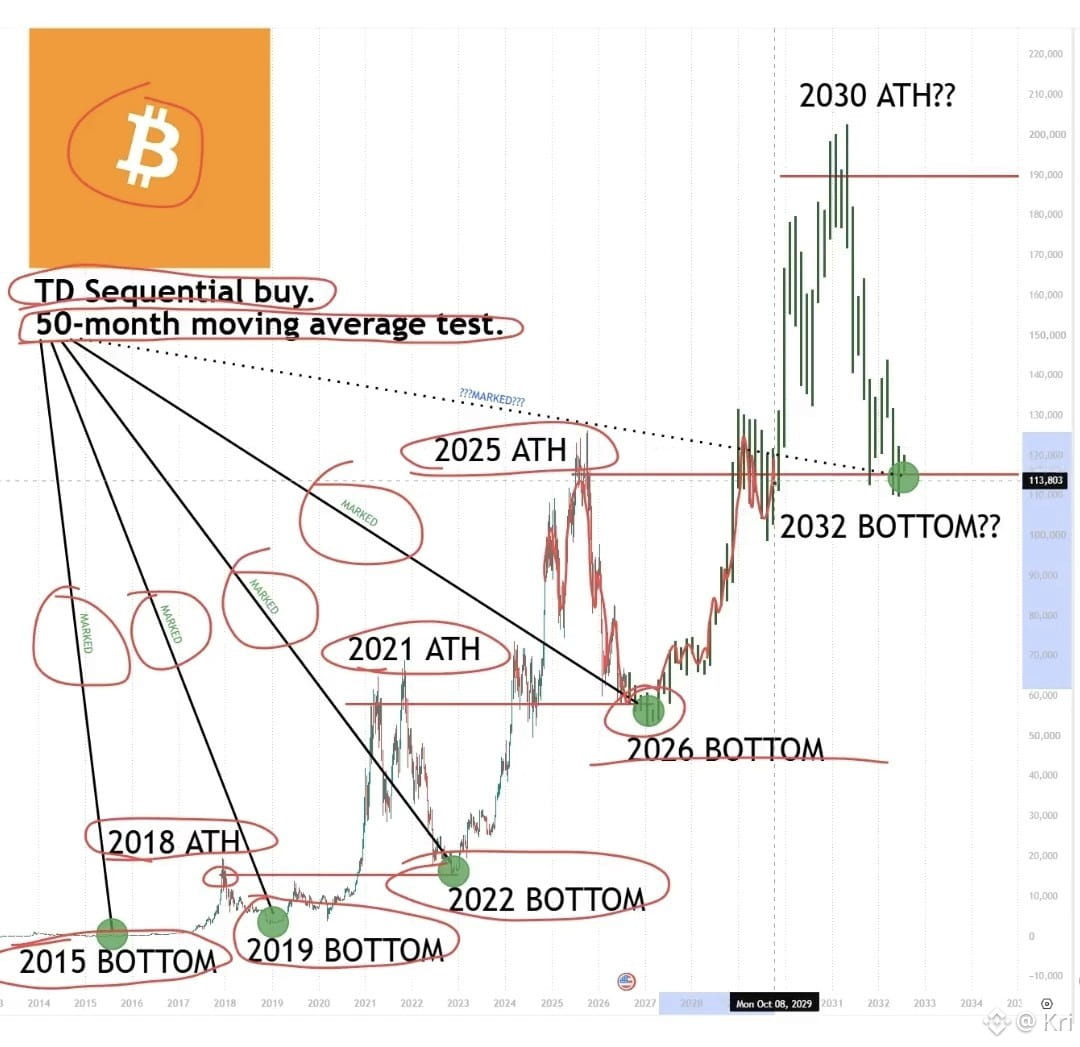
🚨A 4-YEAR BULL RUN HAS BEGUN.
They've gotten you so used to the bad times that…
None of you are ready for this.
#BTC $BTC
{future}(BTCUSDT)
🚨A 4-YEAR BULL RUN HAS BEGUN.
They've gotten you so used to the bad times that…
None of you are ready for this.
#BTC $BTC
They've gotten you so used to the bad times that…
None of you are ready for this.
#BTC $BTC
2
4
958
·
--
2011: $30 → Bitcoin is the future
2012: $5 → Bitcoin is dead
2013: $1,330 → Bitcoin is the future
2015: $200 → Bitcoin is dead
2017: $19,000 → Bitcoin is the future
2018: $3,300 → Bitcoin is dead
2021: $69,000 → Bitcoin is the future
2022: $16,000 → Bitcoin is dead
2025: $126,000 → Bitcoin is the future
2026: $60,000 → Bitcoin is dead
Every cycle, Bitcoin proves everyone wrong
#BTC $BTC
{future}(BTCUSDT)
2011: $30 → Bitcoin is the future
2012: $5 → Bitcoin is dead
2013: $1,330 → Bitcoin is the future
2015: $200 → Bitcoin is dead
2017: $19,000 → Bitcoin is the future
2018: $3,300 → Bitcoin is dead
2021: $69,000 → Bitcoin is the future
2022: $16,000 → Bitcoin is dead
2025: $126,000 → Bitcoin is the future
2026: $60,000 → Bitcoin is dead
Every cycle, Bitcoin proves everyone wrong
#BTC $BTC
2012: $5 → Bitcoin is dead
2013: $1,330 → Bitcoin is the future
2015: $200 → Bitcoin is dead
2017: $19,000 → Bitcoin is the future
2018: $3,300 → Bitcoin is dead
2021: $69,000 → Bitcoin is the future
2022: $16,000 → Bitcoin is dead
2025: $126,000 → Bitcoin is the future
2026: $60,000 → Bitcoin is dead
Every cycle, Bitcoin proves everyone wrong
#BTC $BTC
2
487
·
--
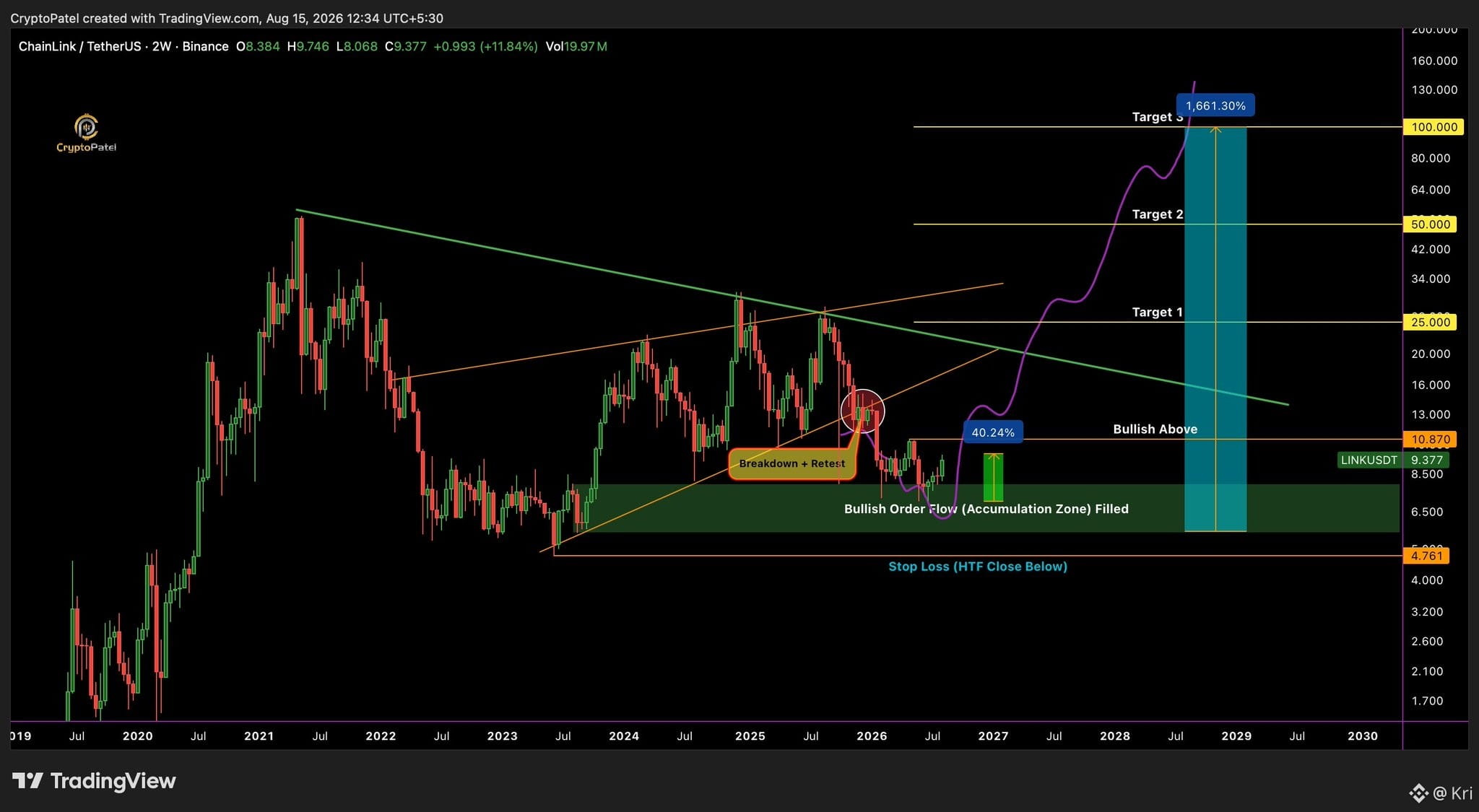
$LINK is Now +40% From our Entry Hope You’re Enjoying the Ride.
And this move is getting even more interesting:
→ #LINK breaks above $9
→ ETF inflows + Token Buybacks Adding Fuel
My Long-Term Targets Remain unchanged: $20 → $50 → $100
We’re still early.
{future}(LINKUSDT)
$LINK is Now +40% From our Entry Hope You’re Enjoying the Ride.
And this move is getting even more interesting:
→ #LINK breaks above $9
→ ETF inflows + Token Buybacks Adding Fuel
My Long-Term Targets Remain unchanged: $20 → $50 → $100
We’re still early.
And this move is getting even more interesting:
→ #LINK breaks above $9
→ ETF inflows + Token Buybacks Adding Fuel
My Long-Term Targets Remain unchanged: $20 → $50 → $100
We’re still early.
1
1
412
سجّل الدخول لاستكشاف المزيد من المُحتوى
انضم إلى مُستخدمي العملات الرقمية حول العالم على Binance Square
⚡️ احصل على أحدث المعلومات المفيدة عن العملات الرقمية.
💬 موثوقة من قبل أكبر منصّة لتداول العملات الرقمية في العالم.
👍 اكتشف الرؤى الحقيقية من صنّاع المُحتوى الموثوقين.
البريد الإلكتروني / رقم الهاتف
المواضيع الرائجة
OktaCrowdStrikeSurgeOnEarningsBeat
4,633 مشاهدات
193 يقومون بالنقاش
#oktacrowdstrikesurgeonearningsbeat Cybersecurity stocks are outrunning the broad market Thursday after twin fiscal Q2 2027 earnings beats from Okta and CrowdStrike reported Wednesday after the close. The First Trust NASDAQ Cybersecurity ETF (NASDDAQ;CIBR) is up 3% to $96.20 in early Thursday trading. The SPDR S&P 500 ETF Trust (NYSEARCA;SPY) is up 0.3% to $768.17, a fraction of the sector's move. $MOVR $MAGMA $VET
Isabella-I
·1 إعجاب
·693 مشاهدات
BitcoinHoldsNear$79400
6,841 مشاهدات
100 يقومون بالنقاش
BitcoinTops$80KThreeMonthHigh
1,877 مشاهدات
73 يقومون بالنقاش