
LAST MOON
2.9k منشورات

LAST MOON
فتح تداول
مُتداول مُتكرر
1.9 سنوات
344 تتابع
92 المتابعون
2.2K+ إعجاب
منشورات
الحافظة الاستثمارية
PINNED
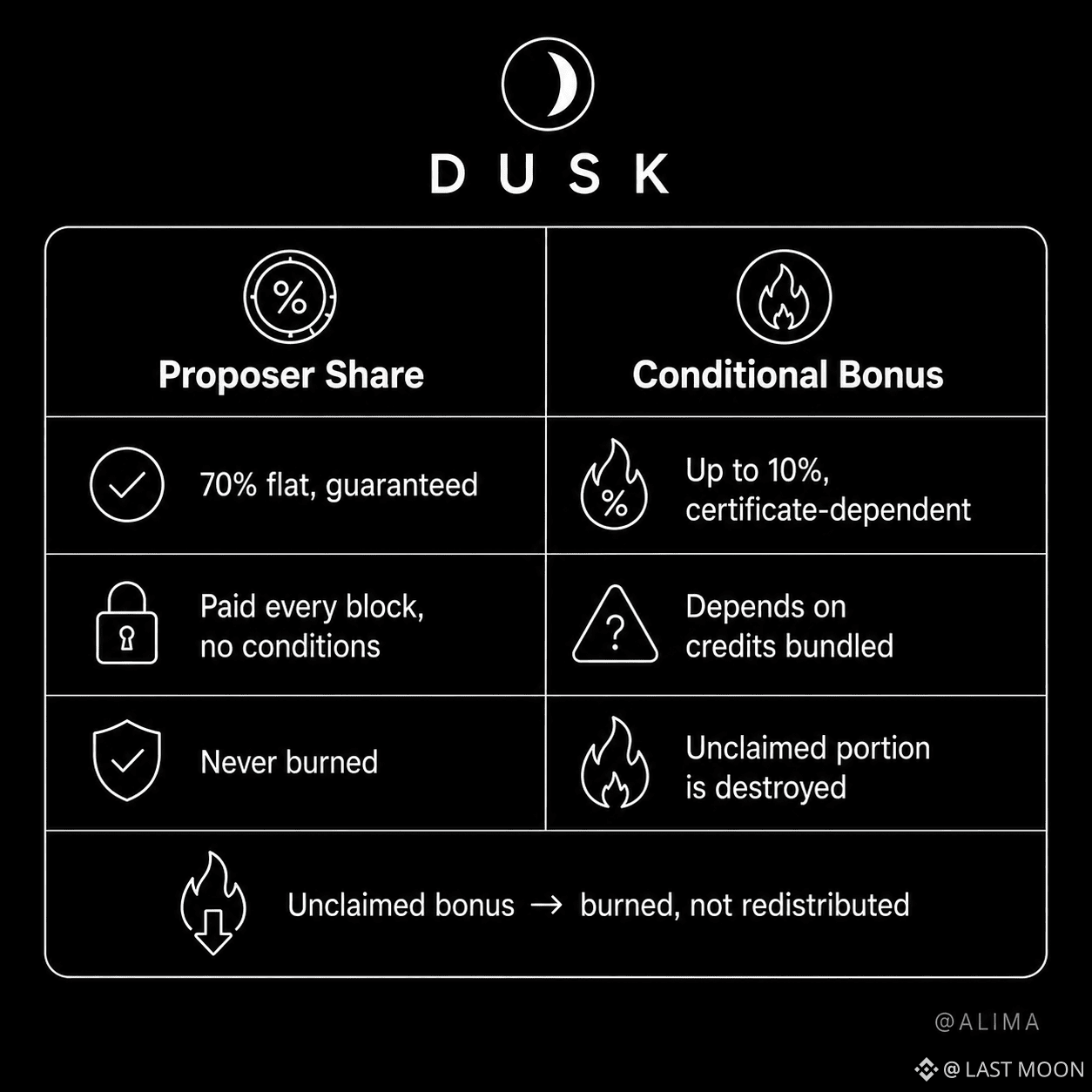
was expecting the block reward split to be a fixed cut for everyone doing consensus work. Proposer gets a share, validators get a share, ratifiers get a share, all accounted for. The actual breakdown has a piece that just disappears sometimes.
Per block, the reward splits as 70% to the proposer, plus up to another 10% bonus, 5% to validation, 5% to ratification, and 10% to the Dusk Dev Fund. That base structure isn't surprising on its own.
The part that stopped me was the bonus. That extra up to 10% isn't guaranteed. It depends on how many credits get bundled into the certificate. And if it goes unclaimed, it doesn't roll over to anyone. It gets burned.
So the actual payout to the person proposing a block isn't a flat 70%, it's 70% plus a variable amount that either gets captured or destroyed depending on certificate composition. Nobody else picks up the difference. It just leaves the system.
That's a strange middle ground. It's not shared with voters, and it's not kept by the proposer if they don't hit the conditions. It's the one part of the reward with a real chance of going to nobody at all, every single block.
Makes me wonder how often that bonus is actually fully claimed versus partially burned in practice, and whether proposers are optimizing certificate composition specifically to capture more of it, or if most just take whatever falls out naturally.
Still don't know how much cumulative DUSK has been burned this way since mainnet versus how much of that 10% window is actually being claimed block by block.
$DUSK #dusk @Dusk
Per block, the reward splits as 70% to the proposer, plus up to another 10% bonus, 5% to validation, 5% to ratification, and 10% to the Dusk Dev Fund. That base structure isn't surprising on its own.
The part that stopped me was the bonus. That extra up to 10% isn't guaranteed. It depends on how many credits get bundled into the certificate. And if it goes unclaimed, it doesn't roll over to anyone. It gets burned.
So the actual payout to the person proposing a block isn't a flat 70%, it's 70% plus a variable amount that either gets captured or destroyed depending on certificate composition. Nobody else picks up the difference. It just leaves the system.
That's a strange middle ground. It's not shared with voters, and it's not kept by the proposer if they don't hit the conditions. It's the one part of the reward with a real chance of going to nobody at all, every single block.
Makes me wonder how often that bonus is actually fully claimed versus partially burned in practice, and whether proposers are optimizing certificate composition specifically to capture more of it, or if most just take whatever falls out naturally.
Still don't know how much cumulative DUSK has been burned this way since mainnet versus how much of that 10% window is actually being claimed block by block.
$DUSK #dusk @Dusk
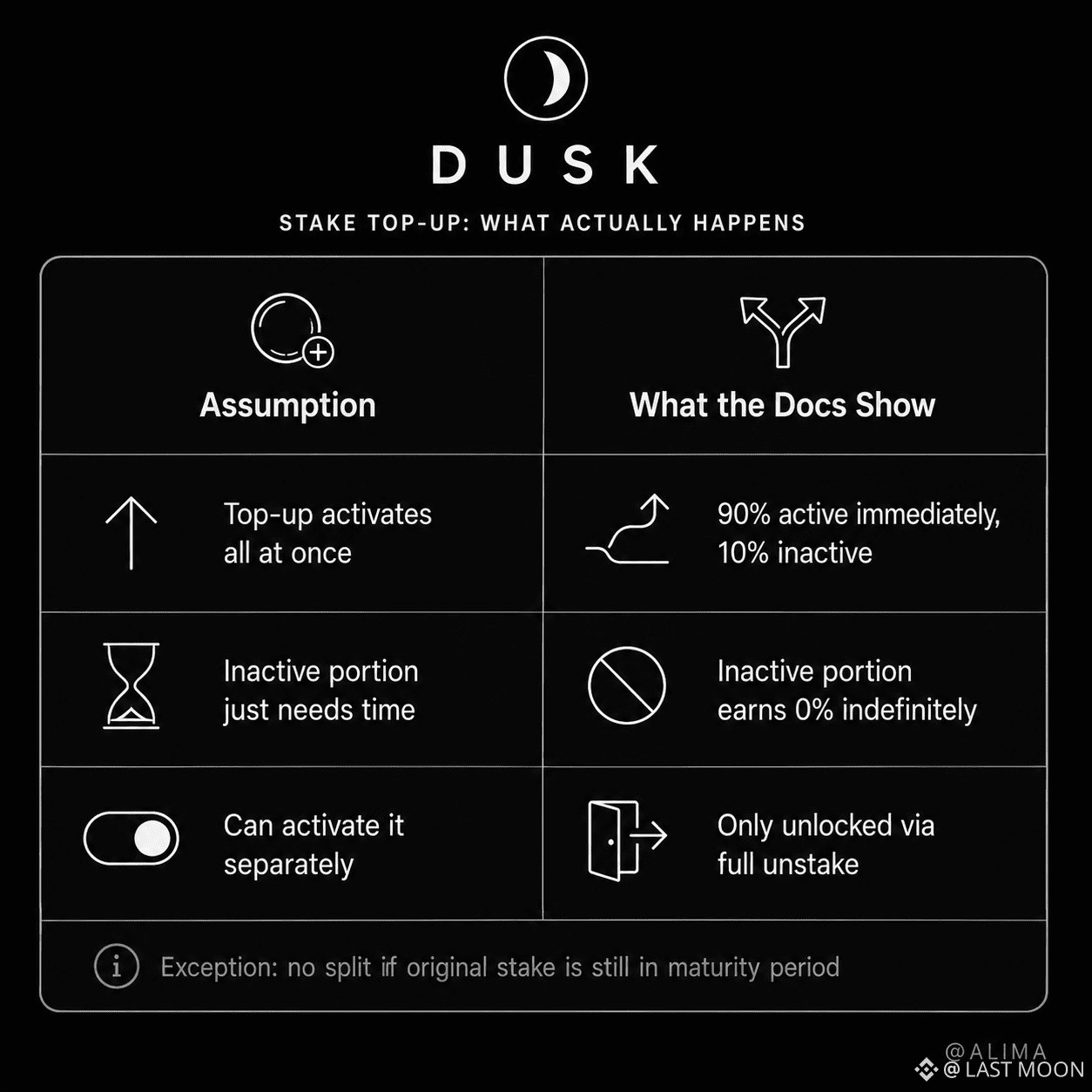
assumed adding to an existing stake worked the same as making a fresh one. Just top up the amount and it all activates together. That's not what the docs actually describe.
If your stake is already active and you add more, 90% of the new amount becomes active immediately and starts earning. The remaining 10% goes in as inactive stake, and that portion earns nothing until you fully unstake and restake it.
I had to reread that twice. It's not a delay on the whole top-up, it's a permanent split. Ninety percent works right away, ten percent just sits there earning zero until you go through a full unstake cycle. There's no separate action to "activate" that leftover 10%, the only way to unlock it is to exit the position entirely.
The one exception: if you add to a stake that's still in its own maturity period, meaning the original hasn't gone active yet, the top-up just follows normal maturity rules. No 90/10 split in that case. So the split only exists specifically when you're adding onto stake that's already earning.
Sat with why that mechanism might exist. My best guess is it discourages people from constantly topping up in small chunks to game timing, since a piece of every addition ends up idle. But that's a guess. The docs state the mechanic clearly and don't explain the reasoning behind the exact 90/10 ratio.
Makes me wonder if provisioners actually account for that stranded 10% in their yield calculations, or if most people miss it entirely and assume their full top-up is earning from day one.
$DUSK #dusk @Dusk
If your stake is already active and you add more, 90% of the new amount becomes active immediately and starts earning. The remaining 10% goes in as inactive stake, and that portion earns nothing until you fully unstake and restake it.
I had to reread that twice. It's not a delay on the whole top-up, it's a permanent split. Ninety percent works right away, ten percent just sits there earning zero until you go through a full unstake cycle. There's no separate action to "activate" that leftover 10%, the only way to unlock it is to exit the position entirely.
The one exception: if you add to a stake that's still in its own maturity period, meaning the original hasn't gone active yet, the top-up just follows normal maturity rules. No 90/10 split in that case. So the split only exists specifically when you're adding onto stake that's already earning.
Sat with why that mechanism might exist. My best guess is it discourages people from constantly topping up in small chunks to game timing, since a piece of every addition ends up idle. But that's a guess. The docs state the mechanic clearly and don't explain the reasoning behind the exact 90/10 ratio.
Makes me wonder if provisioners actually account for that stranded 10% in their yield calculations, or if most people miss it entirely and assume their full top-up is earning from day one.
$DUSK #dusk @Dusk
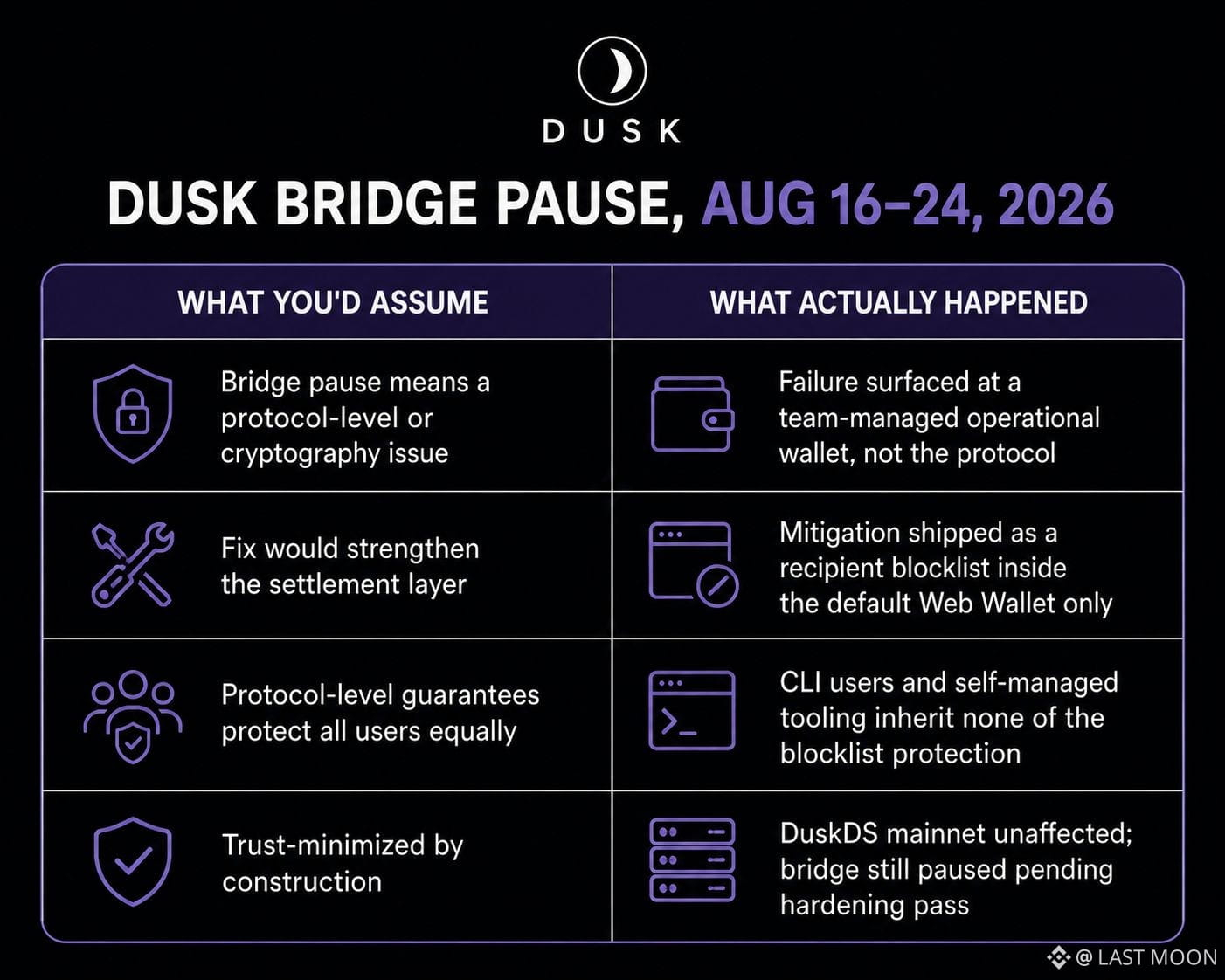
I assumed a bridge pause on a chain built for regulated finance would come with a protocol-level explanation, something about the cryptography or the settlement layer needing a fix. Went and checked what actually happened, and that assumption didn't hold.
bridge services got paused on August 16 after monitoring flagged activity inconsistent with normal bridge operations, tied to a team-managed wallet. still paused as of writing this, while the team finishes what they're calling a hardening pass. DuskDS itself was never affected, the chain kept producing blocks the entire time, this was isolated to the bridge operational layer.
what actually stuck with me was the mitigation itself. it wasn't a protocol-level fix, nothing touching the cryptography stack. it was a recipient blocklist added to the Web Wallet, a warning that pops up before you send to a flagged address. that's a frontend safeguard, not a settlement-layer one.
which raises an obvious gap if you're not using the Web Wallet. anyone on Rusk CLI or their own tooling inherits none of that protection. the actual safety control is sitting in the client most people happen to default to, not in the protocol itself.
I keep going back and forth on this. shipping a fast, pragmatic frontend fix and refining the deeper layer later is a reasonable call. but a chain built specifically for regulated, institutional finance probably shouldn't have its most visible safety response living outside the protocol. when real institutions start moving assets through this, I'm not sure which layer they'll actually assume they're trusting.
@Dusk $DUSK #dusk
bridge services got paused on August 16 after monitoring flagged activity inconsistent with normal bridge operations, tied to a team-managed wallet. still paused as of writing this, while the team finishes what they're calling a hardening pass. DuskDS itself was never affected, the chain kept producing blocks the entire time, this was isolated to the bridge operational layer.
what actually stuck with me was the mitigation itself. it wasn't a protocol-level fix, nothing touching the cryptography stack. it was a recipient blocklist added to the Web Wallet, a warning that pops up before you send to a flagged address. that's a frontend safeguard, not a settlement-layer one.
which raises an obvious gap if you're not using the Web Wallet. anyone on Rusk CLI or their own tooling inherits none of that protection. the actual safety control is sitting in the client most people happen to default to, not in the protocol itself.
I keep going back and forth on this. shipping a fast, pragmatic frontend fix and refining the deeper layer later is a reasonable call. but a chain built specifically for regulated, institutional finance probably shouldn't have its most visible safety response living outside the protocol. when real institutions start moving assets through this, I'm not sure which layer they'll actually assume they're trusting.
@Dusk $DUSK #dusk
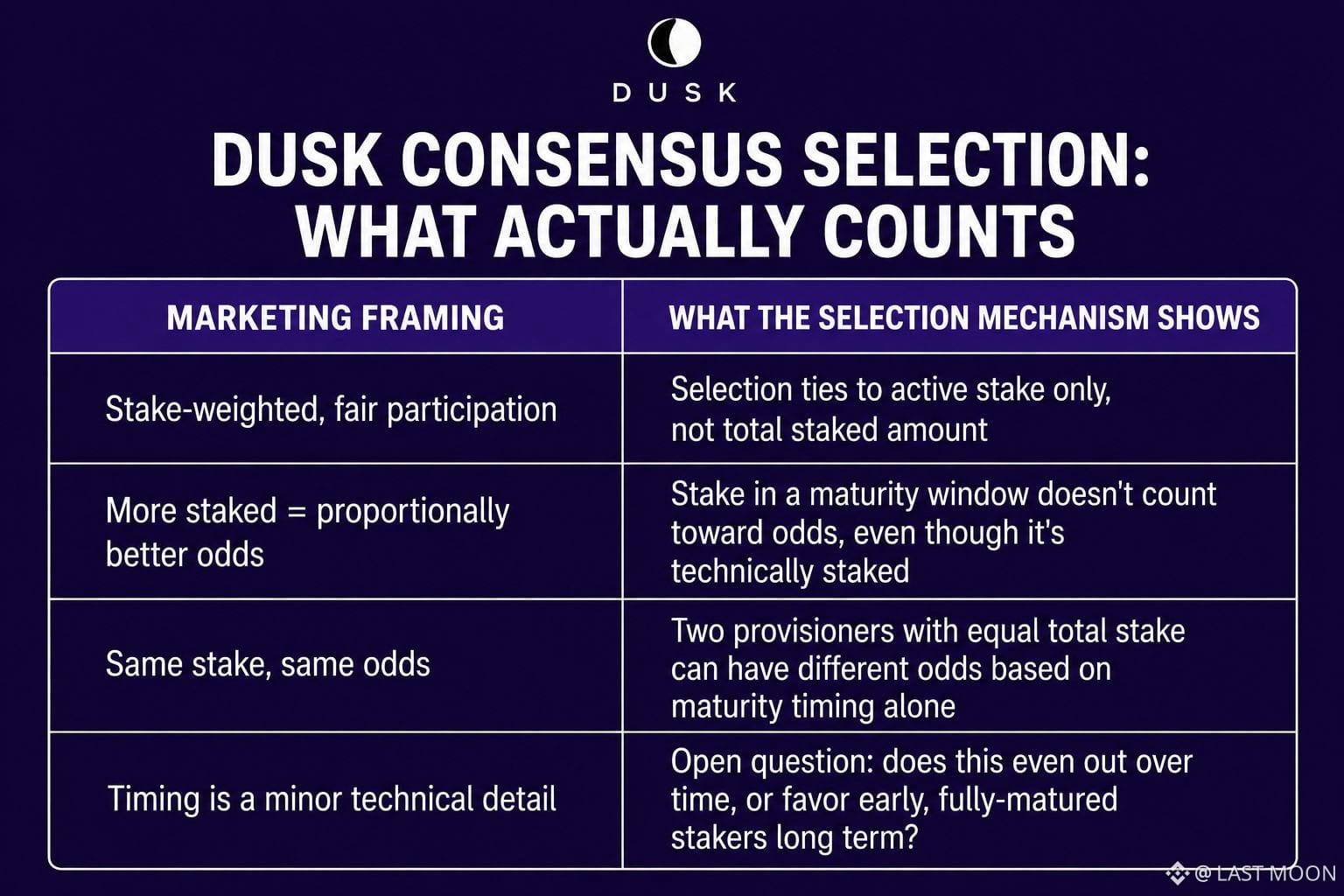
I assumed DuskDS consensus selection was straightforward, stake weighted, fair participation, your odds scale cleanly with how much you've put in.
went through the actual selection mechanism instead of taking that at face value, while trying to understand the settlement layer split from DuskVM/DuskEVM, and it's not that simple. selection ties to active stake specifically, not total stake. any portion still sitting in a maturity window, whether it's a new stake or a top-up to an existing one, doesn't count toward your odds at all, even though it's technically staked.
that means two provisioners with identical total staked amounts can have meaningfully different selection odds right now, purely based on when their stake cleared maturity relative to each other, not how much they've actually committed.
what I keep wondering is whether that timing gap is a small effect that evens out over enough blocks, or a real, sustained advantage for provisioners who staked early and stayed fully matured, versus newer entrants constantly cycling partial stakes through that inactive window.
@Dusk $DUSK #dusk
went through the actual selection mechanism instead of taking that at face value, while trying to understand the settlement layer split from DuskVM/DuskEVM, and it's not that simple. selection ties to active stake specifically, not total stake. any portion still sitting in a maturity window, whether it's a new stake or a top-up to an existing one, doesn't count toward your odds at all, even though it's technically staked.
that means two provisioners with identical total staked amounts can have meaningfully different selection odds right now, purely based on when their stake cleared maturity relative to each other, not how much they've actually committed.
what I keep wondering is whether that timing gap is a small effect that evens out over enough blocks, or a real, sustained advantage for provisioners who staked early and stayed fully matured, versus newer entrants constantly cycling partial stakes through that inactive window.
@Dusk $DUSK #dusk
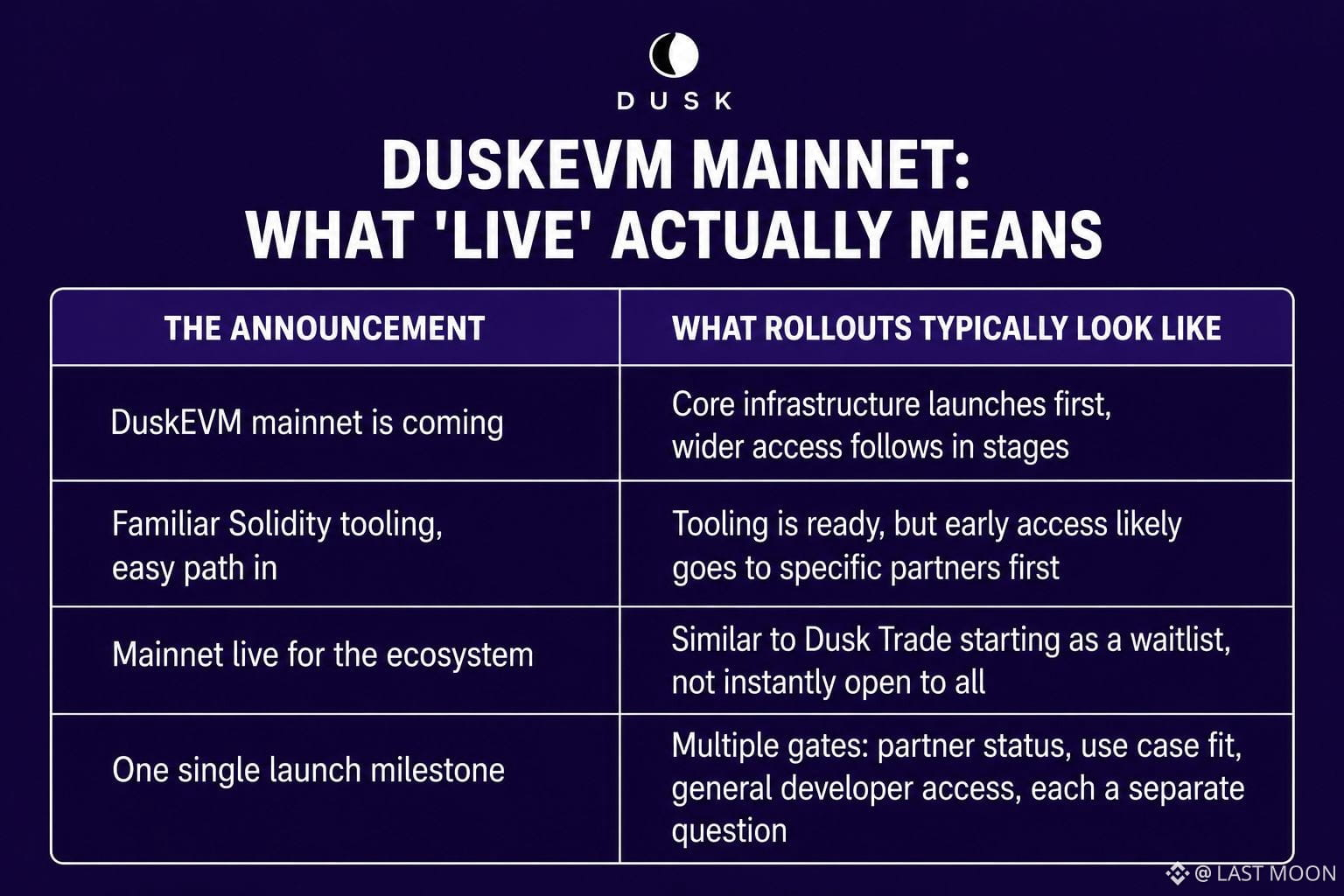
I assumed DuskEVM mainnet is coming meant a single launch event, flip a switch, the whole EVM layer goes live for anyone building on Dusk at once.
digging into how these rollouts usually get described, that's not really how it works. mainnet launches for a new execution layer tend to happen in stages, core infrastructure goes live first, then specific applications and partners get onboarded before the door opens wider to general developers. "mainnet is live" and "anyone can permissionlessly deploy and expect the same support as an early partner" aren't the same milestone, even though they get talked about like they are.
so the EVM compatibility pitch, familiar Solidity tooling, an easy path in, is real at the tooling level. but tooling being familiar doesn't mean the rollout itself is open to everyone from day one. early access likely goes to specific partners and use cases first, the same way Dusk Trade started as a waitlist rather than an instantly open platform, while the broader developer ecosystem catches up afterward.
what I actually want to know is who gets access in that first wave once DuskEVM mainnet goes live, and on what basis. is it based on being an existing Dusk partner, an application that fits the regulated-finance use case specifically, or is general developer access genuinely open from the first day. that's a very different rollout than "mainnet is coming" implies on its own.
@Dusk $DUSK #dusk
digging into how these rollouts usually get described, that's not really how it works. mainnet launches for a new execution layer tend to happen in stages, core infrastructure goes live first, then specific applications and partners get onboarded before the door opens wider to general developers. "mainnet is live" and "anyone can permissionlessly deploy and expect the same support as an early partner" aren't the same milestone, even though they get talked about like they are.
so the EVM compatibility pitch, familiar Solidity tooling, an easy path in, is real at the tooling level. but tooling being familiar doesn't mean the rollout itself is open to everyone from day one. early access likely goes to specific partners and use cases first, the same way Dusk Trade started as a waitlist rather than an instantly open platform, while the broader developer ecosystem catches up afterward.
what I actually want to know is who gets access in that first wave once DuskEVM mainnet goes live, and on what basis. is it based on being an existing Dusk partner, an application that fits the regulated-finance use case specifically, or is general developer access genuinely open from the first day. that's a very different rollout than "mainnet is coming" implies on its own.
@Dusk $DUSK #dusk
spent this morning going through @TermMax lending market maker setup because market makers configure range orders sounded like standard liquidity provision, and I think the risk underneath it is different from what people assume
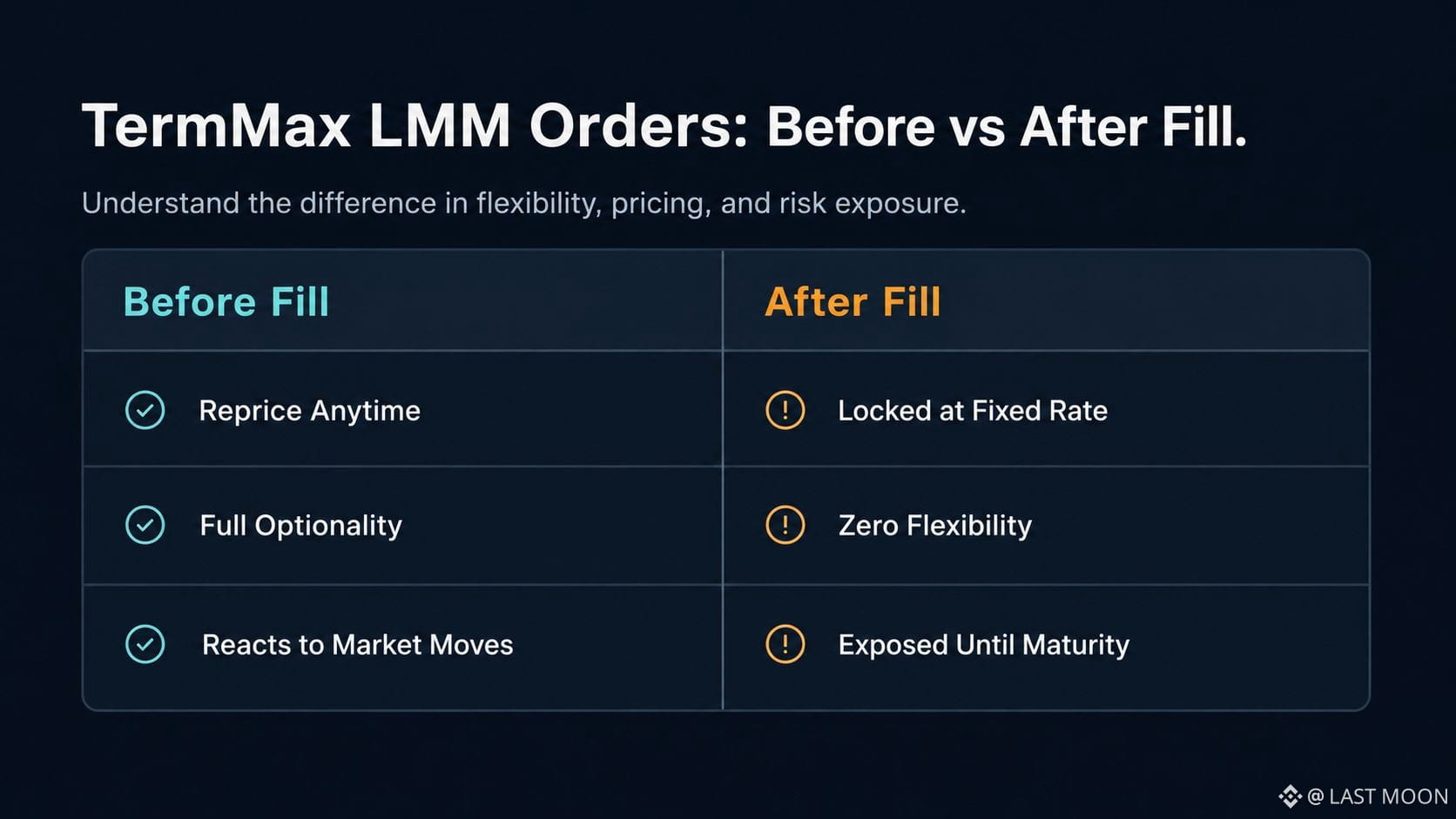
the pitch: LMMs place range orders across markets, borrowers fill them for fixed rate loans, more LMMs means tighter rates. standard liquidity story
but a range order here quotes a fixed rate for a fixed term, not a spot price. once filled, the LMM is locked until maturity, no repricing as conditions shift the way an AMM LP can rebalance. the "range" only describes flexibility before the fill, not after
so the real question isn't "how tight are the rates," it's "what happens to an LMM's capital the second their order gets filled." before the fill: full optionality. after: a fixed-term position with zero ability to react if rates move against them
then there's aggregation on top. V2 routes takers across multiple LMMs' orders in one transaction, so a borrower might fill several LMMs at once without knowing which just got locked into a now-stale rate
takers get smoothness, LMMs absorb single-sided lock-in risk the moment liquidity gets touched, and that asymmetry never shows up in the "more liquidity, better rates" pitch
not sure if experienced LMMs already price this in, or if newer ones are walking into an underpriced risk
anyone placed a range order as an LMM and tracked it after a fill vs before?
@TermMax #TermMax
the pitch: LMMs place range orders across markets, borrowers fill them for fixed rate loans, more LMMs means tighter rates. standard liquidity story
but a range order here quotes a fixed rate for a fixed term, not a spot price. once filled, the LMM is locked until maturity, no repricing as conditions shift the way an AMM LP can rebalance. the "range" only describes flexibility before the fill, not after
so the real question isn't "how tight are the rates," it's "what happens to an LMM's capital the second their order gets filled." before the fill: full optionality. after: a fixed-term position with zero ability to react if rates move against them
then there's aggregation on top. V2 routes takers across multiple LMMs' orders in one transaction, so a borrower might fill several LMMs at once without knowing which just got locked into a now-stale rate
takers get smoothness, LMMs absorb single-sided lock-in risk the moment liquidity gets touched, and that asymmetry never shows up in the "more liquidity, better rates" pitch
not sure if experienced LMMs already price this in, or if newer ones are walking into an underpriced risk
anyone placed a range order as an LMM and tracked it after a fill vs before?
@TermMax #TermMax
was looking into whether staking on Dusk actually requires running your own node. Assumed the only two options were "run a validator" or "don't stake." Found a third thing I wasn't expecting.
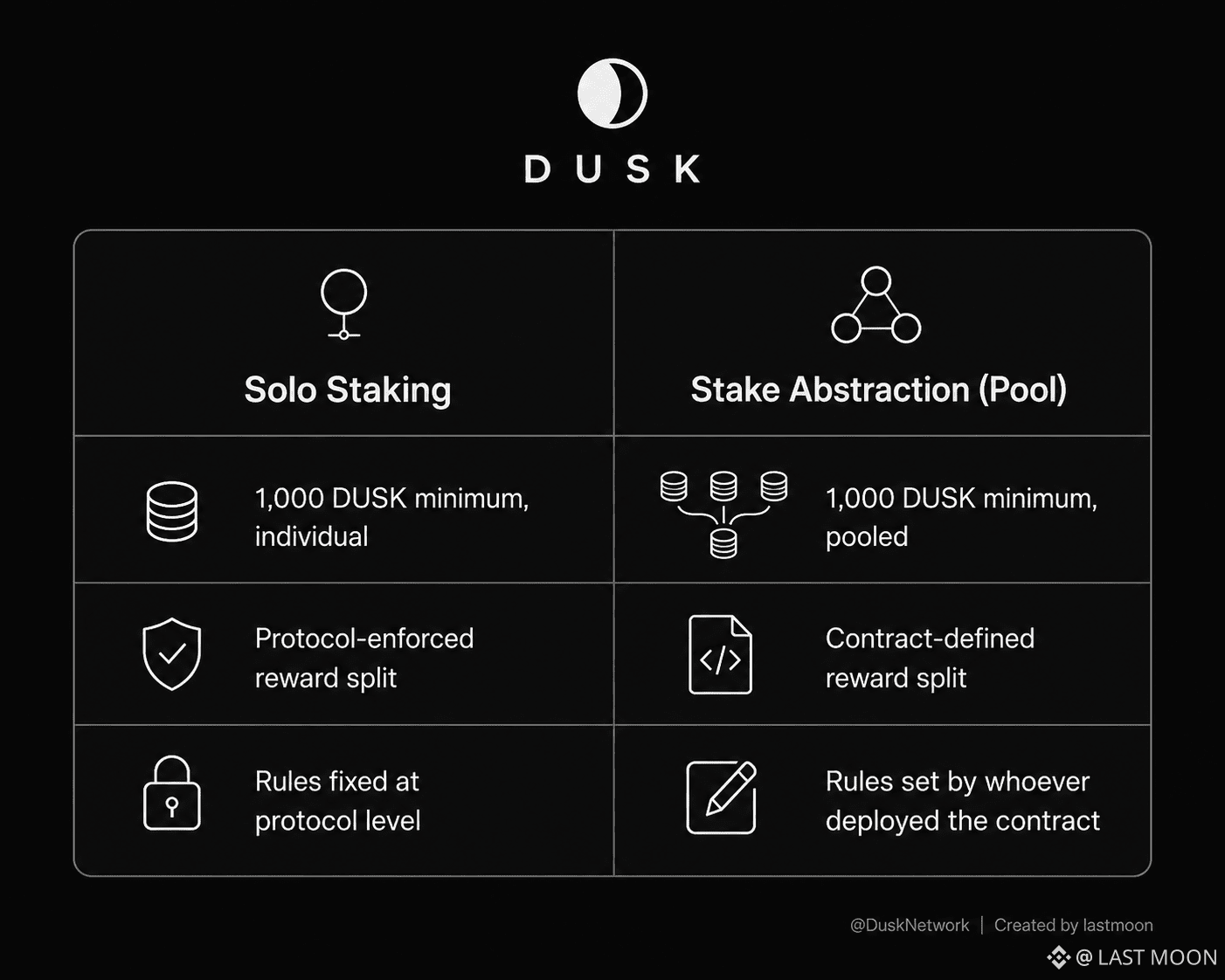
It's called Stake Abstraction, internally referred to as Hyperstaking. It lets a smart contract stake on your behalf instead of you touching a provisioner node directly. The contract can accept deposits, stake them, then distribute or reinvest the rewards according to whatever logic it's written with.
That part didn't surprise me much, pooled staking exists everywhere. What did surprise me is the minimum stake requirement still applies to contracts. 1,000 DUSK minimum, same as an individual. So a pool isn't bypassing the floor, it's just aggregating deposits until the pool itself clears it.
The other detail that stuck: reward-splitting is fully arbitrary at the contract level. A pool can route a cut to referrers, affiliates, operators, whatever it's coded to do. Nothing in the base protocol dictates a fair or standard split. The contract is the rulebook.
That's the part I keep turning over. Individual staking has one set of rules, transparent, protocol-enforced. The moment you go through a contract, the actual terms depend entirely on whoever wrote it. The chain doesn't audit whether a pool's split is reasonable, it just executes whatever logic is deployed.
Not saying that's a flaw, most chains with delegated staking work the same way. But it does mean "staking on Dusk" through a pool and staking on Dusk directly are two different trust models wearing the same name.
Wondering how many people using a staking pool actually check the contract's reward split versus just assuming it mirrors solo staking.
$DUSK #dusk @Dusk
It's called Stake Abstraction, internally referred to as Hyperstaking. It lets a smart contract stake on your behalf instead of you touching a provisioner node directly. The contract can accept deposits, stake them, then distribute or reinvest the rewards according to whatever logic it's written with.
That part didn't surprise me much, pooled staking exists everywhere. What did surprise me is the minimum stake requirement still applies to contracts. 1,000 DUSK minimum, same as an individual. So a pool isn't bypassing the floor, it's just aggregating deposits until the pool itself clears it.
The other detail that stuck: reward-splitting is fully arbitrary at the contract level. A pool can route a cut to referrers, affiliates, operators, whatever it's coded to do. Nothing in the base protocol dictates a fair or standard split. The contract is the rulebook.
That's the part I keep turning over. Individual staking has one set of rules, transparent, protocol-enforced. The moment you go through a contract, the actual terms depend entirely on whoever wrote it. The chain doesn't audit whether a pool's split is reasonable, it just executes whatever logic is deployed.
Not saying that's a flaw, most chains with delegated staking work the same way. But it does mean "staking on Dusk" through a pool and staking on Dusk directly are two different trust models wearing the same name.
Wondering how many people using a staking pool actually check the contract's reward split versus just assuming it mirrors solo staking.
$DUSK #dusk @Dusk
spent this morning going through @TermMax Gearing Token mechanics because over collateralization eliminates liquidation risk uncertainty sounded like a solved problem, and I don't think the uncertainty actually left, it just moved
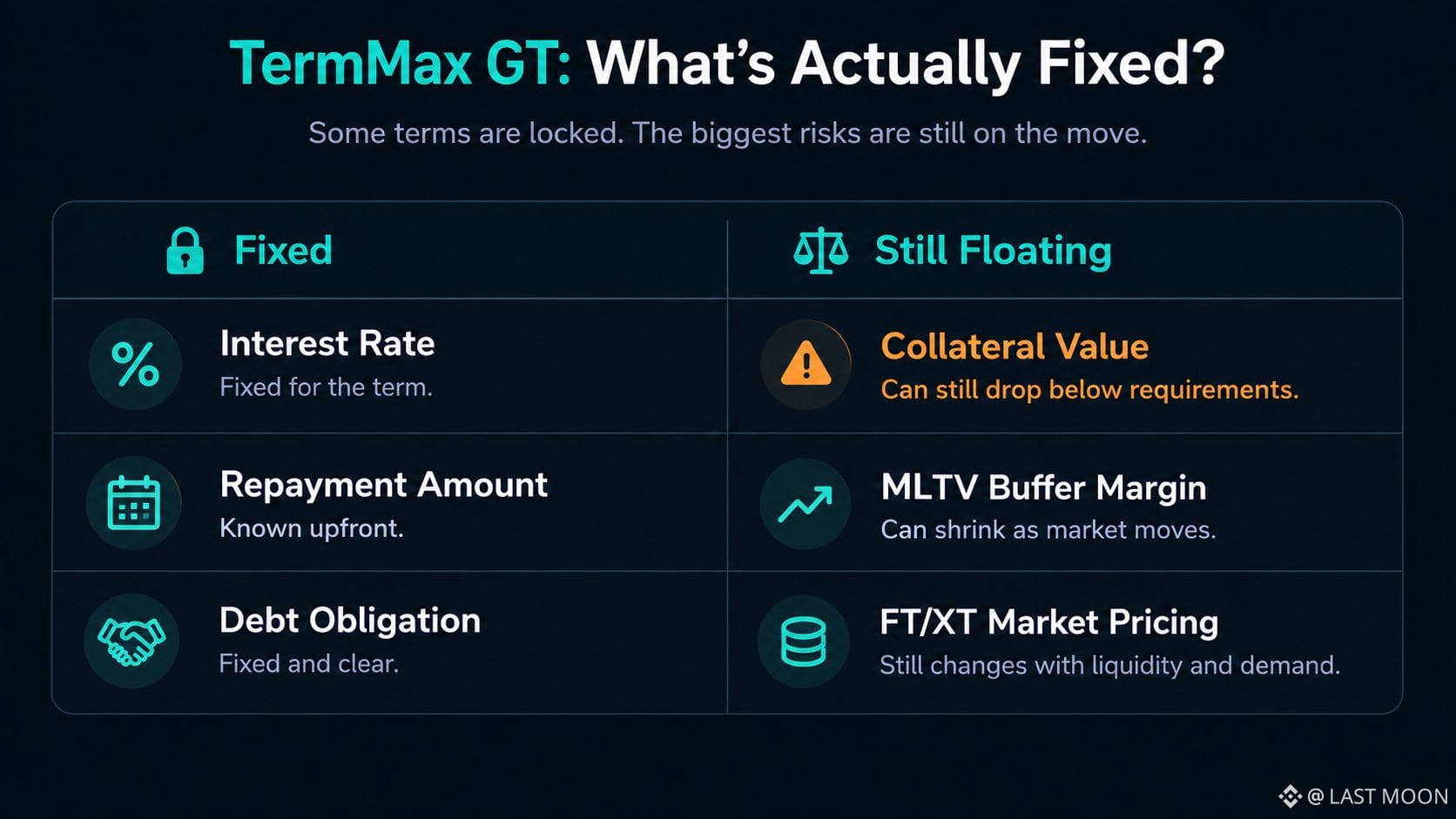
the pitch: lock collateral into a GT, issue FTs against it, MLTV keeps the position over-collateralized. no floating-rate liquidation spirals, no surprise margin calls, the fixed-rate structure means you know your obligation upfront
but the collateral value itself still floats. the debt side of the position is fixed, the interest owed is fixed, the repayment schedule is fixed. the collateral backing it is whatever ETH or the underlying asset is doing that week. MLTV protects the lender by forcing over-collateralization, it doesn't protect the borrower from their collateral getting hit if the market moves against them before maturity
so the real question isn't "is my rate fixed," it's "is my liquidation risk fixed." those got bundled into one pitch when they're actually two separate exposures, one eliminated, one untouched. you know exactly what you owe, you still don't know exactly what your collateral will be worth when you owe it
then there's the FT/XT split sitting on top of this. 1 FT plus 1 XT equals 1 debt token at maturity, which is clean math on paper, but it means your position's actual redemption value depends on both sides trading correctly against each other in the market up until that point, not just on the fixed rate holding
so fixed-rate borrowing removes rate uncertainty completely while leaving collateral value uncertainty exactly where it was on any other lending protocol
not sure if this is just an unavoidable tradeoff of any collateralized lending model, or if the predictable, fixed rate borrowing framing overstates how much risk actually left the table
anyone here run a GT position through a real drawdown and check whether the fixed-rate part actually made the experience feel any safer?
@TermMax #TermMax
the pitch: lock collateral into a GT, issue FTs against it, MLTV keeps the position over-collateralized. no floating-rate liquidation spirals, no surprise margin calls, the fixed-rate structure means you know your obligation upfront
but the collateral value itself still floats. the debt side of the position is fixed, the interest owed is fixed, the repayment schedule is fixed. the collateral backing it is whatever ETH or the underlying asset is doing that week. MLTV protects the lender by forcing over-collateralization, it doesn't protect the borrower from their collateral getting hit if the market moves against them before maturity
so the real question isn't "is my rate fixed," it's "is my liquidation risk fixed." those got bundled into one pitch when they're actually two separate exposures, one eliminated, one untouched. you know exactly what you owe, you still don't know exactly what your collateral will be worth when you owe it
then there's the FT/XT split sitting on top of this. 1 FT plus 1 XT equals 1 debt token at maturity, which is clean math on paper, but it means your position's actual redemption value depends on both sides trading correctly against each other in the market up until that point, not just on the fixed rate holding
so fixed-rate borrowing removes rate uncertainty completely while leaving collateral value uncertainty exactly where it was on any other lending protocol
not sure if this is just an unavoidable tradeoff of any collateralized lending model, or if the predictable, fixed rate borrowing framing overstates how much risk actually left the table
anyone here run a GT position through a real drawdown and check whether the fixed-rate part actually made the experience feel any safer?
@TermMax #TermMax
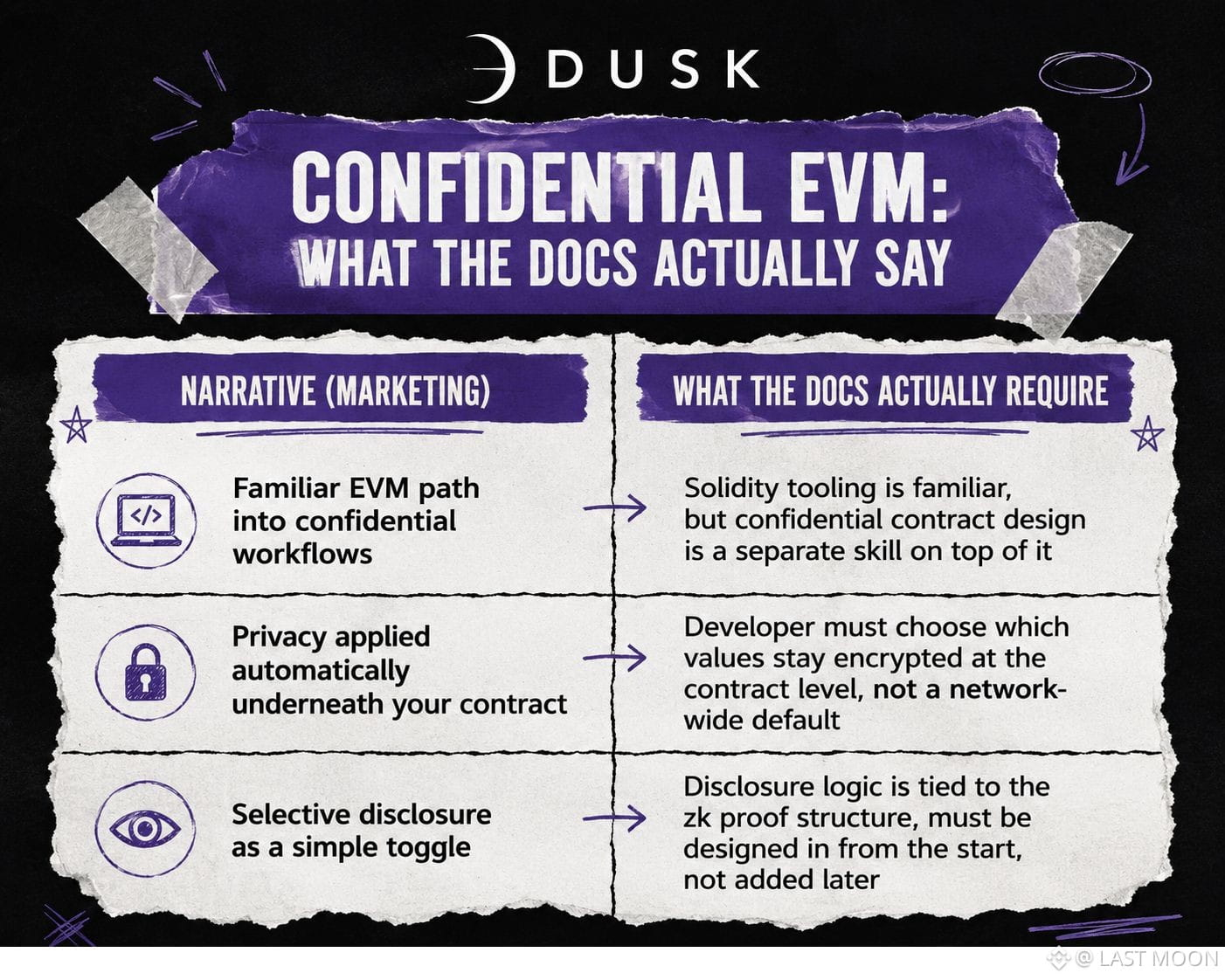
I assumed confidential EVM workflows meant you just deploy a normal Solidity contract and privacy happens automatically underneath it. went through the actual Hedger documentation instead of taking that at face value, and the setup isn't quite that simple.
first thing that stood out: privacy isn't a network-wide default you opt out of, it's something built into how specific data gets handled at the contract level. that means a developer has to actually design which values stay encrypted and which don't, rather than writing normal EVM code and getting confidentiality automatically applied on top. familiar Solidity tooling gets you onto DuskEVM easily, but writing genuinely confidential logic on top of it isn't a zero-effort upgrade from what you'd write elsewhere.
second, selective disclosure isn't a single feature you toggle, it's tied to the zero-knowledge proof structure underneath. authorized review works because the proof itself is built to allow it, which means the disclosure logic has to be considered at the point you're designing the contract, not bolted on afterward if a regulator asks for access later.
so the pitch of "familiar EVM path into confidential workflows" is accurate in the sense that the tooling is familiar, but the actual privacy design work isn't something that just comes for free because you're writing Solidity. it's still a distinct skill from writing a normal EVM contract.
what I haven't been able to tell from the docs alone is how steep that gap actually is in practice, whether most Solidity developers can pick up confidential contract design quickly, or whether this ends up needing specialized expertise that slows adoption regardless of how EVM-compatible the entry point looks.
@Dusk $DUSK #dusk
first thing that stood out: privacy isn't a network-wide default you opt out of, it's something built into how specific data gets handled at the contract level. that means a developer has to actually design which values stay encrypted and which don't, rather than writing normal EVM code and getting confidentiality automatically applied on top. familiar Solidity tooling gets you onto DuskEVM easily, but writing genuinely confidential logic on top of it isn't a zero-effort upgrade from what you'd write elsewhere.
second, selective disclosure isn't a single feature you toggle, it's tied to the zero-knowledge proof structure underneath. authorized review works because the proof itself is built to allow it, which means the disclosure logic has to be considered at the point you're designing the contract, not bolted on afterward if a regulator asks for access later.
so the pitch of "familiar EVM path into confidential workflows" is accurate in the sense that the tooling is familiar, but the actual privacy design work isn't something that just comes for free because you're writing Solidity. it's still a distinct skill from writing a normal EVM contract.
what I haven't been able to tell from the docs alone is how steep that gap actually is in practice, whether most Solidity developers can pick up confidential contract design quickly, or whether this ends up needing specialized expertise that slows adoption regardless of how EVM-compatible the entry point looks.
@Dusk $DUSK #dusk
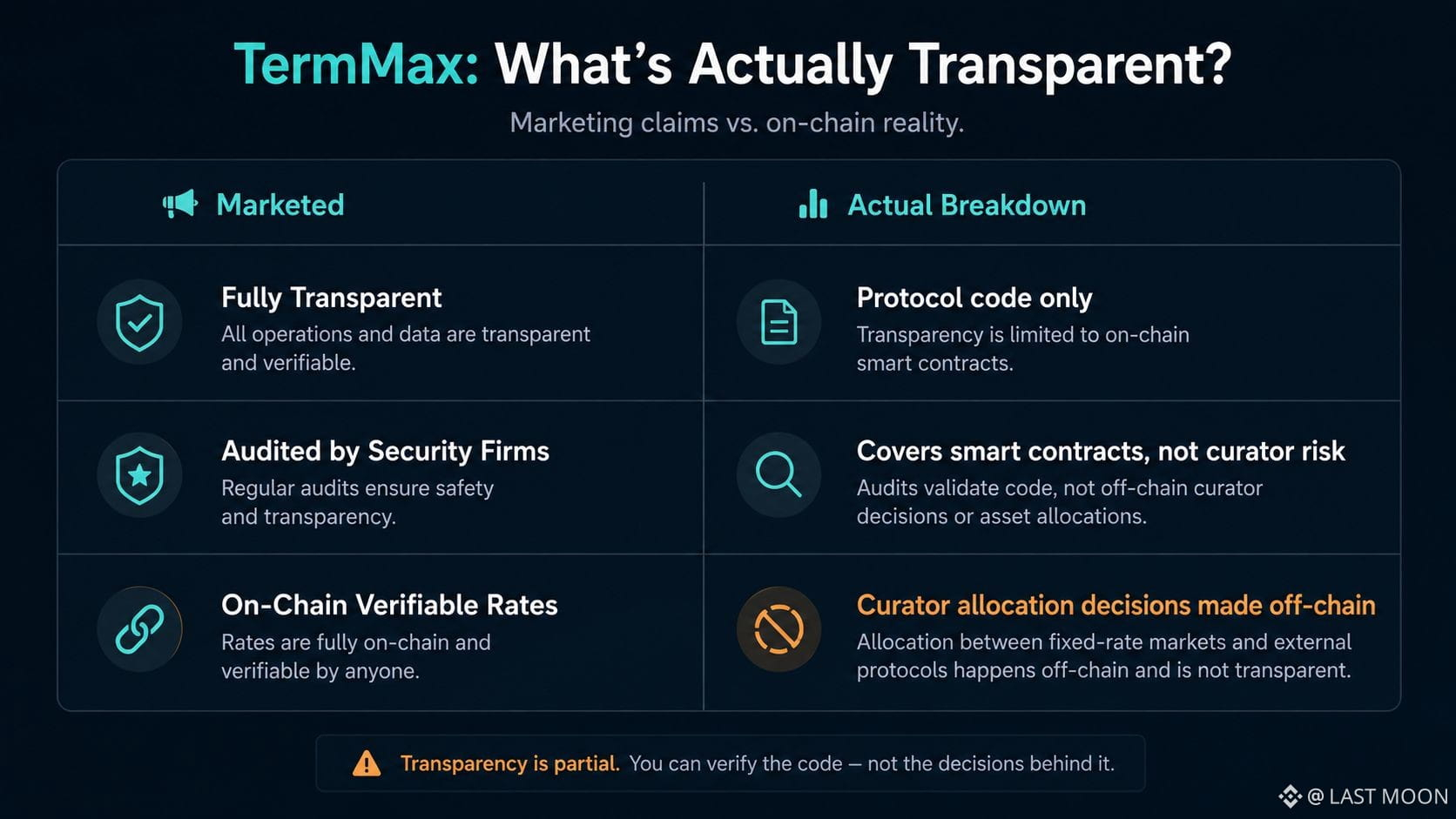
spent this morning going through @TermMax transparency claims because no hidden mechanisms, no opaque fee structures is a strong thing to promise, and I think it's only true for half the stack
the pitch: all rates, fees, and protocol parameters are publicly verifiable on-chain. full transparency, nothing hidden, you can audit exactly what you're earning and paying at any moment
but that transparency applies to the protocol layer, not the curator layer. vaults are run by curators who decide which markets to allocate deposits into, which chains to prioritize, and how aggressively to chase yield versus sit conservative. those allocation decisions happen off-chain, in curator judgment, before anything gets posted as an on-chain rate
so the real question isn't "can I verify the rate," it's "can I verify why the curator put my capital there instead of somewhere else." the rate itself is transparent. the decision-making that produced that specific rate isn't published anywhere, it's just the output you see after the fact
then there's the audit language sitting on top of this. "rigorous auditing by leading security firms" covers smart contract risk, code-level exploits, that kind of thing. it says nothing about curator risk, which is a judgment call, not a code vulnerability, and audits don't touch it
so you get code-level transparency and allocation-level opacity bundled under one "fully transparent" label, and most people reading the marketing don't separate the two
genuinely unclear if this is just how every curated vault model works everywhere, or if TermMax's messaging oversells the transparency piece specifically
anyone here actually dug into a curator's historical allocation choices before depositing, or picked a vault off the APY number alone?
@TermMax #TermMax
the pitch: all rates, fees, and protocol parameters are publicly verifiable on-chain. full transparency, nothing hidden, you can audit exactly what you're earning and paying at any moment
but that transparency applies to the protocol layer, not the curator layer. vaults are run by curators who decide which markets to allocate deposits into, which chains to prioritize, and how aggressively to chase yield versus sit conservative. those allocation decisions happen off-chain, in curator judgment, before anything gets posted as an on-chain rate
so the real question isn't "can I verify the rate," it's "can I verify why the curator put my capital there instead of somewhere else." the rate itself is transparent. the decision-making that produced that specific rate isn't published anywhere, it's just the output you see after the fact
then there's the audit language sitting on top of this. "rigorous auditing by leading security firms" covers smart contract risk, code-level exploits, that kind of thing. it says nothing about curator risk, which is a judgment call, not a code vulnerability, and audits don't touch it
so you get code-level transparency and allocation-level opacity bundled under one "fully transparent" label, and most people reading the marketing don't separate the two
genuinely unclear if this is just how every curated vault model works everywhere, or if TermMax's messaging oversells the transparency piece specifically
anyone here actually dug into a curator's historical allocation choices before depositing, or picked a vault off the APY number alone?
@TermMax #TermMax
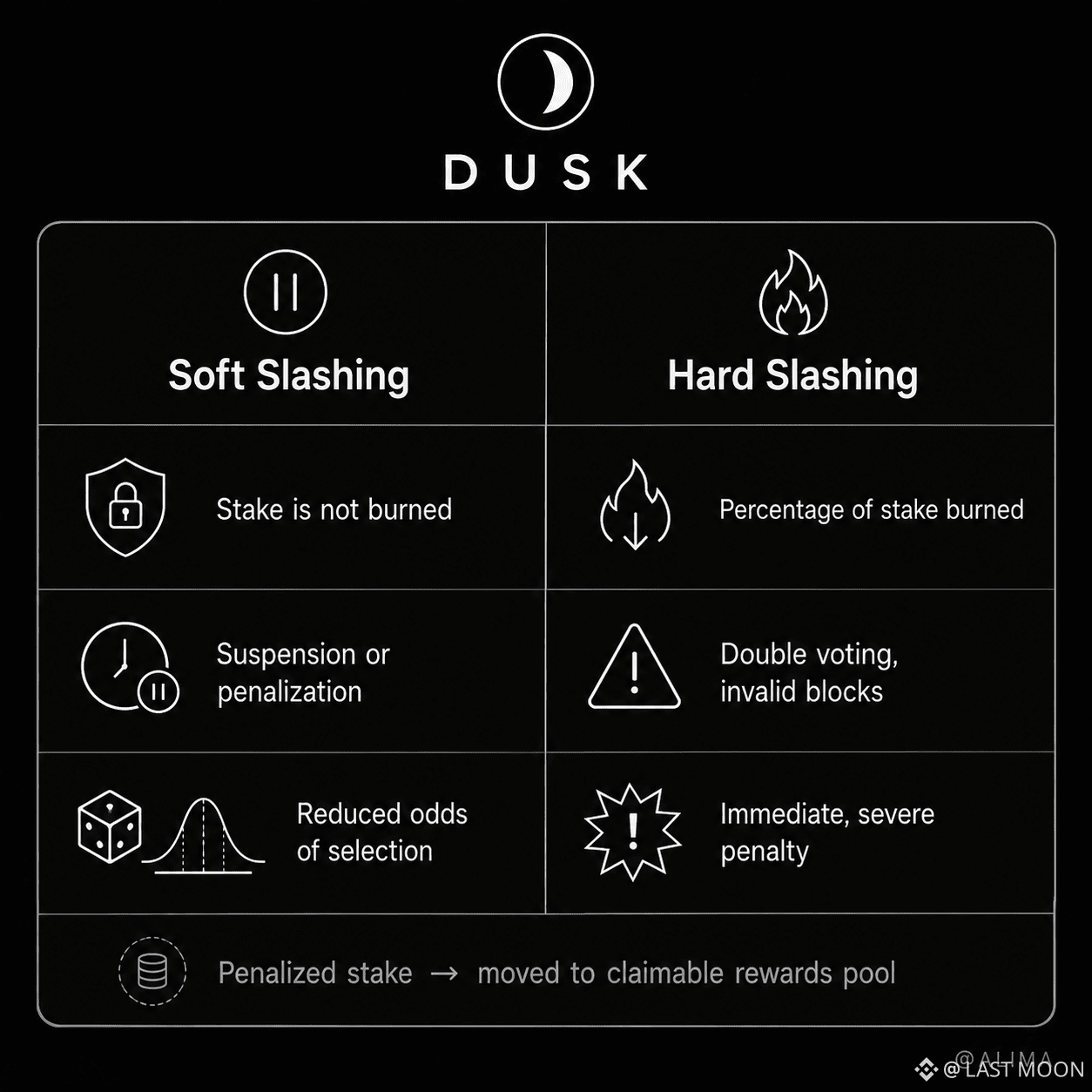
was expecting to find a burn mechanic when I looked into how Dusk punishes bad provisioners. Kept assuming slashing meant losing your stake outright. That's not actually what's happening here.
Dusk runs something called soft slashing, and the entire design avoids burning stake. There are two tools instead: suspension, where a provisioner is temporarily excluded from selection and earns nothing for a stretch of epochs, and penalization, where a portion of the stake gets moved into the claimable rewards pool rather than destroyed.
That second part is what threw me. The "penalty" isn't gone, it's relocated. It reduces the offending provisioner's effective stake used in sortition, which lowers their odds of getting picked again, but the actual DUSK doesn't disappear from the system.
Hard slashing still exists for the serious stuff, double voting, deliberately producing invalid blocks, and that does burn a percentage of stake. But the everyday offense, a node going quiet or missing its duty, gets the soft version. No burn, just reduced probability of being chosen again until it proves it's reliable.
Sat with that for a bit. Most PoS chains I've looked into treat slashing as a deterrent through direct loss. Dusk is betting that reducing your odds of earning is enough of a deterrent on its own, without needing to destroy value to make the point.
Still not sure which model actually produces more honest uptime over time, losing money outright or losing the chance to make money. They're not the same incentive even if they sound similar on paper.
Makes me want to see the actual suspension/penalization numbers on mainnet so far, how often either gets triggered, and whether provisioners are treating penalization as a real cost or just background noise.
$DUSK #dusk @Dusk
Dusk runs something called soft slashing, and the entire design avoids burning stake. There are two tools instead: suspension, where a provisioner is temporarily excluded from selection and earns nothing for a stretch of epochs, and penalization, where a portion of the stake gets moved into the claimable rewards pool rather than destroyed.
That second part is what threw me. The "penalty" isn't gone, it's relocated. It reduces the offending provisioner's effective stake used in sortition, which lowers their odds of getting picked again, but the actual DUSK doesn't disappear from the system.
Hard slashing still exists for the serious stuff, double voting, deliberately producing invalid blocks, and that does burn a percentage of stake. But the everyday offense, a node going quiet or missing its duty, gets the soft version. No burn, just reduced probability of being chosen again until it proves it's reliable.
Sat with that for a bit. Most PoS chains I've looked into treat slashing as a deterrent through direct loss. Dusk is betting that reducing your odds of earning is enough of a deterrent on its own, without needing to destroy value to make the point.
Still not sure which model actually produces more honest uptime over time, losing money outright or losing the chance to make money. They're not the same incentive even if they sound similar on paper.
Makes me want to see the actual suspension/penalization numbers on mainnet so far, how often either gets triggered, and whether provisioners are treating penalization as a real cost or just background noise.
$DUSK #dusk @Dusk
تمّ التحقق
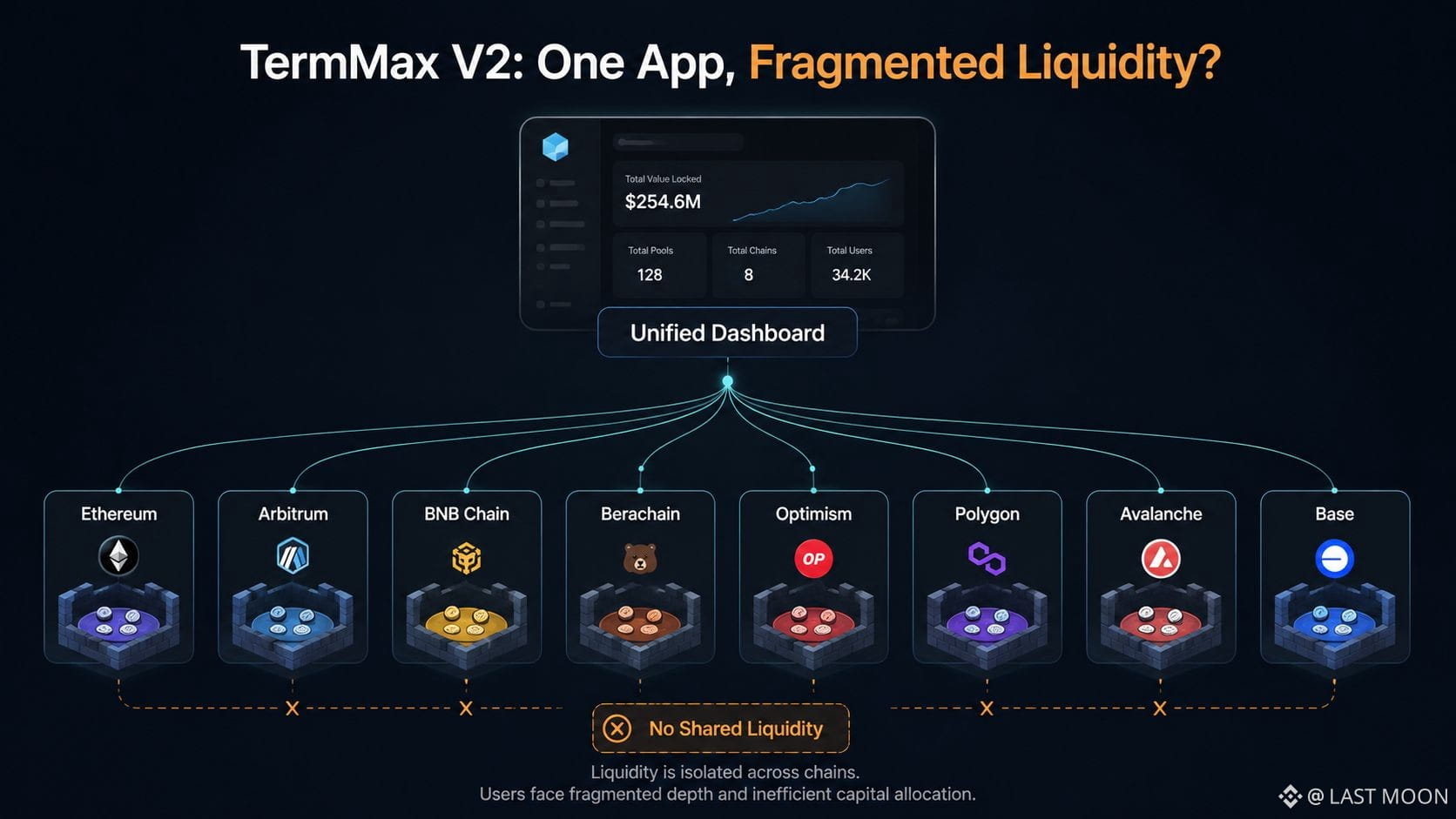
spent this morning going through @TermMax's V2 launch messaging because "one app, every chain, every order" sounded like liquidity finally got unified, and I don't think it did
the pitch: V2 sources from every available order, curator ranges, individual limit orders, across every chain, and routes it into one transaction. one dashboard, one app, everything connected
but the unification is happening at the interface layer, not the liquidity layer. TermMax runs as separate deployments across Ethereum, Arbitrum, BNB Chain, and five other chains, each with its own isolated markets, own range orders, own fixed-rate curves. the app aggregates what's visible to you in one screen, it doesn't pool the actual capital sitting on different chains into one order book
so the real question isn't "can I see every position in one place," it's "is my fixed rate on Arbitrum actually competing against the same liquidity as Ethereum, or am I just getting a nicer view of eight separate, thinner books." a unified dashboard over fragmented liquidity still leaves you exposed to whichever chain's market happens to be thin that week
then there's the curator layer sitting on top of this. curators choose which chains and markets to allocate vault deposits into, which means your "fixed rate" isn't just a function of TermMax's rate curve, it's also a function of which curator picked which chain for you, and how much of that chain's book they're competing against
so you've got interface-level unification masking market-level fragmentation, plus a curator decision layer choosing which fragment you're actually exposed to
not sure if this makes V2 a genuine liquidity improvement or just a much better UI wrapped around the same eight siloed pools
anyone actually compared realized rates for the same asset across two different TermMax chains, or just assuming V2 evened that out automatically?
@TermMax #TermMax
the pitch: V2 sources from every available order, curator ranges, individual limit orders, across every chain, and routes it into one transaction. one dashboard, one app, everything connected
but the unification is happening at the interface layer, not the liquidity layer. TermMax runs as separate deployments across Ethereum, Arbitrum, BNB Chain, and five other chains, each with its own isolated markets, own range orders, own fixed-rate curves. the app aggregates what's visible to you in one screen, it doesn't pool the actual capital sitting on different chains into one order book
so the real question isn't "can I see every position in one place," it's "is my fixed rate on Arbitrum actually competing against the same liquidity as Ethereum, or am I just getting a nicer view of eight separate, thinner books." a unified dashboard over fragmented liquidity still leaves you exposed to whichever chain's market happens to be thin that week
then there's the curator layer sitting on top of this. curators choose which chains and markets to allocate vault deposits into, which means your "fixed rate" isn't just a function of TermMax's rate curve, it's also a function of which curator picked which chain for you, and how much of that chain's book they're competing against
so you've got interface-level unification masking market-level fragmentation, plus a curator decision layer choosing which fragment you're actually exposed to
not sure if this makes V2 a genuine liquidity improvement or just a much better UI wrapped around the same eight siloed pools
anyone actually compared realized rates for the same asset across two different TermMax chains, or just assuming V2 evened that out automatically?
@TermMax #TermMax
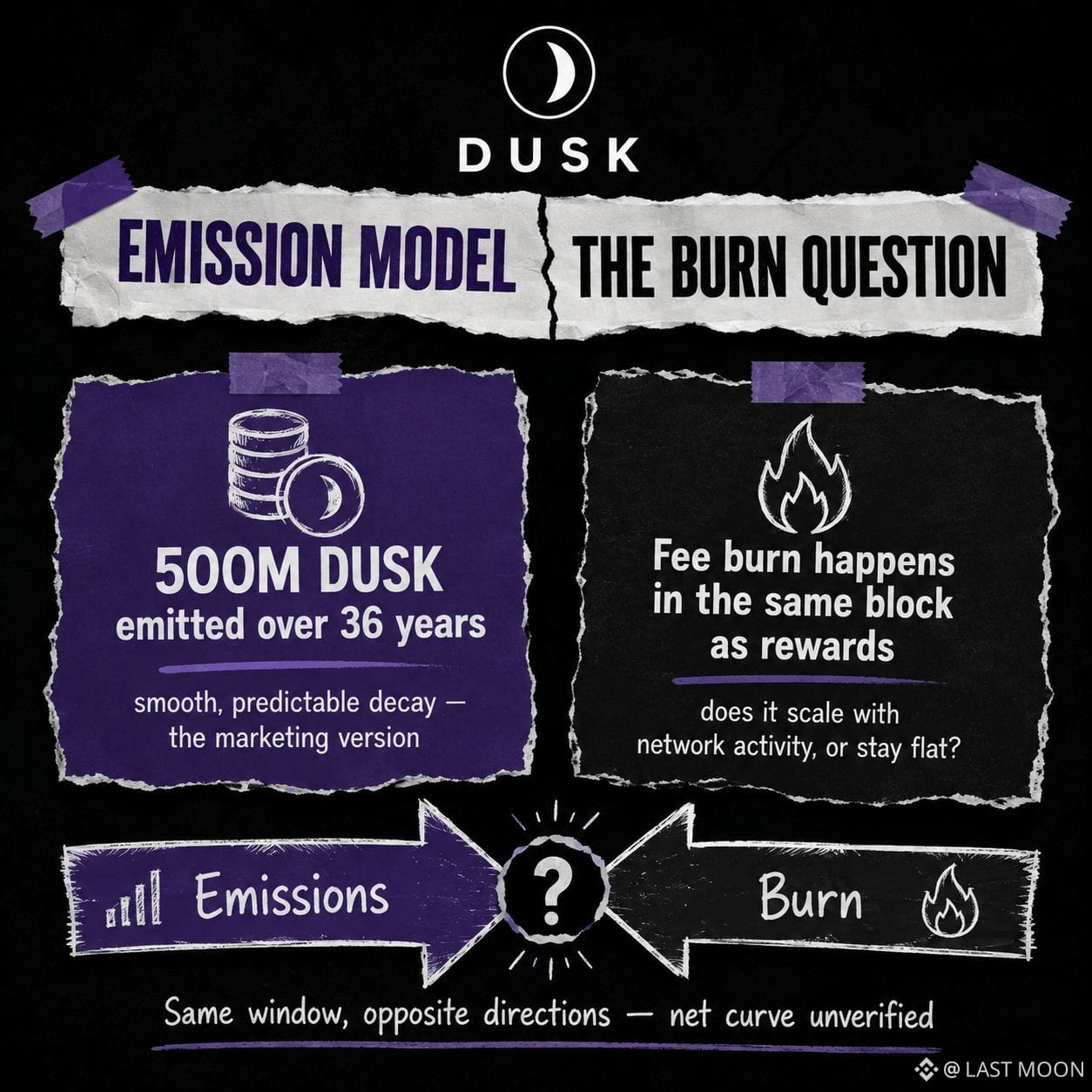
I assumed Dusk's 500M emission schedule over 36 years meant a smooth, predictable curve, rewards go out, that's the whole story. hadn't actually thought about the fee burn side until I looked closer at how it's described.
fee burn gets mentioned almost like a footnote next to emissions, a minor mechanic sitting underneath the bigger supply schedule. but if a real share of rewards paid out each day is also getting burned in the same window, that's not just a footnote, that's an active pull against the smooth curve everyone talks about. emissions going out and supply getting burned aren't separate stories, they're happening in the same block, pulling in opposite directions.
what I can't verify without pulling actual explorer data myself is how large that burn ratio actually is day to day, and whether it holds steady or moves with network activity and staking participation. a fixed 36 year schedule sounds deterministic on paper, but if burn scales with usage, the real net emission curve could look very different from the marketing version depending on how much activity the network sees.
I'd want to actually check this against the explorer myself before treating any specific ratio as settled. has anyone tracked whether that burn/reward relationship stays consistent across epochs, or does it swing noticeably with participation?
@Dusk $DUSK #dusk
fee burn gets mentioned almost like a footnote next to emissions, a minor mechanic sitting underneath the bigger supply schedule. but if a real share of rewards paid out each day is also getting burned in the same window, that's not just a footnote, that's an active pull against the smooth curve everyone talks about. emissions going out and supply getting burned aren't separate stories, they're happening in the same block, pulling in opposite directions.
what I can't verify without pulling actual explorer data myself is how large that burn ratio actually is day to day, and whether it holds steady or moves with network activity and staking participation. a fixed 36 year schedule sounds deterministic on paper, but if burn scales with usage, the real net emission curve could look very different from the marketing version depending on how much activity the network sees.
I'd want to actually check this against the explorer myself before treating any specific ratio as settled. has anyone tracked whether that burn/reward relationship stays consistent across epochs, or does it swing noticeably with participation?
@Dusk $DUSK #dusk
went down a docs rabbit hole trying to understand why Phoenix and Moonlight both exist instead of just picking one. Assumed it was a UX choice. Wasn't.
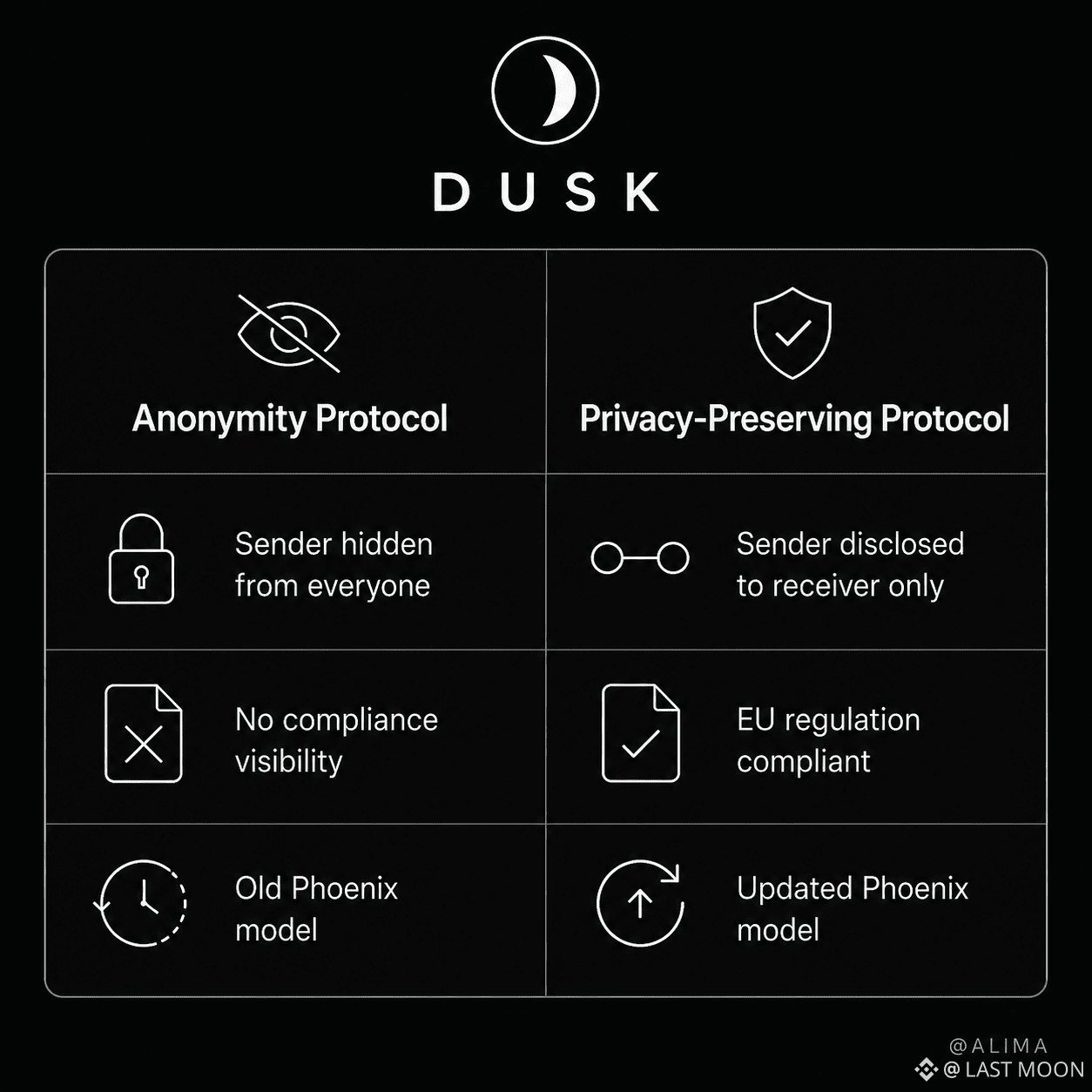
Phoenix is the shielded model, UTXO-based, hides sender, receiver, and amount using nullifiers and commitments. I had it filed away as the anonymous one. Then I hit a line in the updated whitepaper that reframed the whole thing.
Phoenix now includes the ability to identify the sender of a transaction to the receiver. Not to the public, to the receiver. That single addition is what moves Phoenix from an anonymity protocol to something the docs call privacy preserving and EU compliant.
That's a narrower promise than private. Anonymity means nobody knows. Privacy-preserving with sender disclosure to the counterparty means the two parties in the transaction can know each other, but the rest of the chain still can't. Different guarantee entirely.
Moonlight exists alongside it as the fully public, account-based model, closer to how Ethereum works, built so exchanges and other regulated entities have a simple, transparent option without needing to touch shielded logic at all.
So the dual model isn't "pick private or public for vibes." It's Dusk deciding that full anonymity was actually a liability for the use case they're targeting, and building a privacy layer that still lets a receiver know who they're dealing with.
Had a small moment of doubt reading that. Is disclosure-to-receiver actually privacy, or is it just a compliance workaround wearing privacy language? I don't think it's dishonest, but I also don't think private and privacy preserving mean the same thing anymore on this chain.
Makes me wonder how many projects call something "private" when what they actually built is private from everyone except the one party regulators care about.
$DUSK #dusk @Dusk
Phoenix is the shielded model, UTXO-based, hides sender, receiver, and amount using nullifiers and commitments. I had it filed away as the anonymous one. Then I hit a line in the updated whitepaper that reframed the whole thing.
Phoenix now includes the ability to identify the sender of a transaction to the receiver. Not to the public, to the receiver. That single addition is what moves Phoenix from an anonymity protocol to something the docs call privacy preserving and EU compliant.
That's a narrower promise than private. Anonymity means nobody knows. Privacy-preserving with sender disclosure to the counterparty means the two parties in the transaction can know each other, but the rest of the chain still can't. Different guarantee entirely.
Moonlight exists alongside it as the fully public, account-based model, closer to how Ethereum works, built so exchanges and other regulated entities have a simple, transparent option without needing to touch shielded logic at all.
So the dual model isn't "pick private or public for vibes." It's Dusk deciding that full anonymity was actually a liability for the use case they're targeting, and building a privacy layer that still lets a receiver know who they're dealing with.
Had a small moment of doubt reading that. Is disclosure-to-receiver actually privacy, or is it just a compliance workaround wearing privacy language? I don't think it's dishonest, but I also don't think private and privacy preserving mean the same thing anymore on this chain.
Makes me wonder how many projects call something "private" when what they actually built is private from everyone except the one party regulators care about.
$DUSK #dusk @Dusk
spent this morning going through @TermMax vault mechanics because the fixed rate pitch is doing a lot of work, and I think it's only half true
the pitch: deposit into a curator-run vault, earn a fixed rate, no floating-rate chaos, no liquidation surprises. that's the whole value prop, predictability over everything
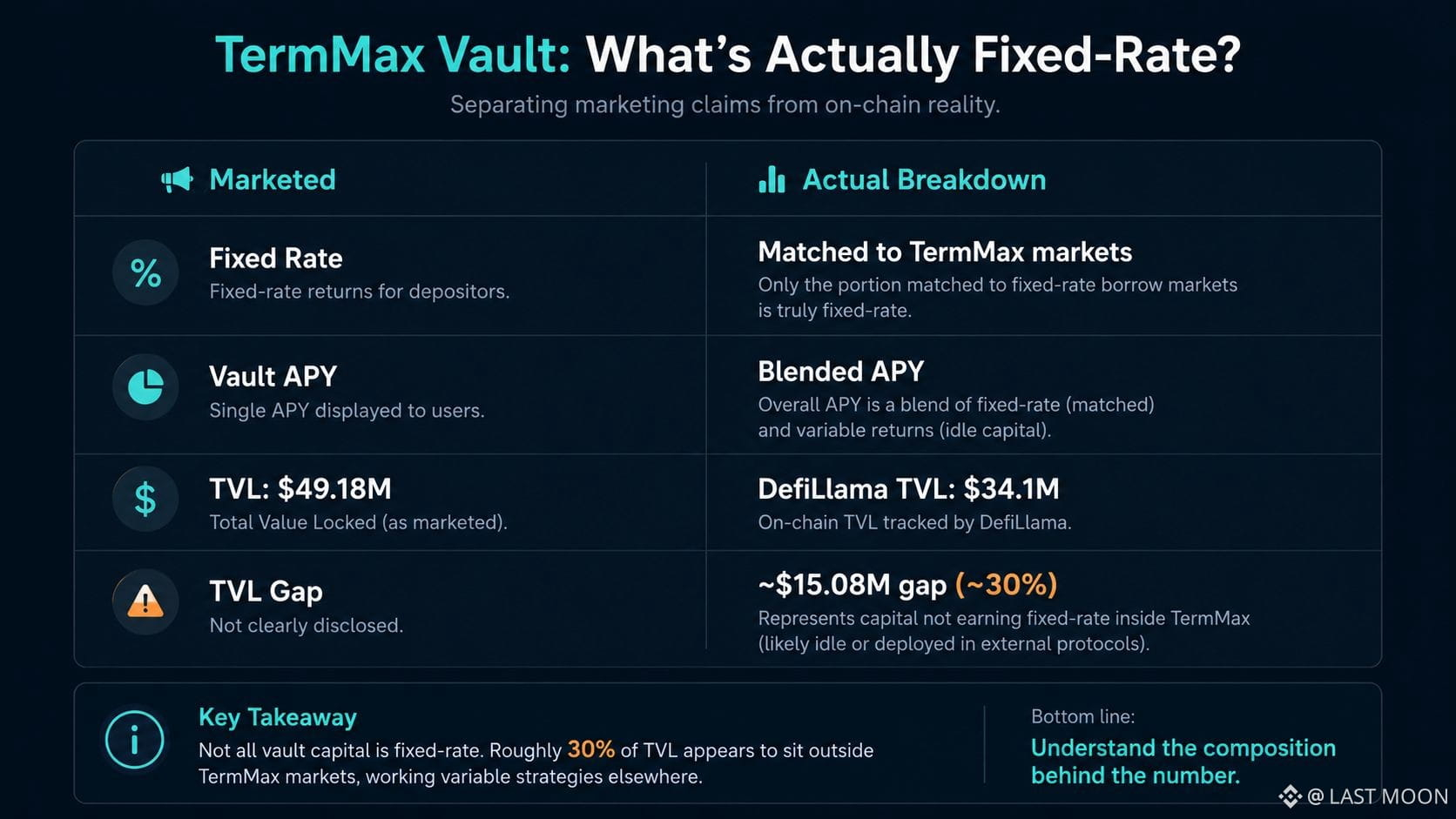
but read the actual flow. curators allocate vault deposits into TermMax's own fixed-rate markets, sure, but idle capital that isn't matched to a borrower gets auto-deployed into other lending platforms to keep it productive. so part of your "fixed" yield is actually coming from floating-rate positions on other protocols, sitting underneath the fixed-rate label
so the real question isn't "is my rate fixed," it's "what percentage of the vault is actually sitting in TermMax's fixed-rate matches versus parked in someone else's floating market waiting for a borrower to show up." those are two very different risk profiles wearing the same UI
then there's the TVL gap sitting on top of this. TermMax's own numbers put TVL around $49M including borrowed value. DefiLlama's tracking has it closer to $34M. that's not a rounding error, that's a ~30% spread depending on whose dashboard you trust and how "unproductive positions" get counted
two separate things get compressed into one clean "fixed rate, $49M TVL" headline, when the underlying picture is messier on both counts
genuinely don't know if the idle-capital rerouting is a smart efficiency play or a quiet dilution of what "fixed rate" is supposed to mean
anyone here actually checked what % of their vault deposit is sitting in a live TermMax match vs parked elsewhere, or just trusting the APY number as shown?
@TermMax #TermMax
the pitch: deposit into a curator-run vault, earn a fixed rate, no floating-rate chaos, no liquidation surprises. that's the whole value prop, predictability over everything
but read the actual flow. curators allocate vault deposits into TermMax's own fixed-rate markets, sure, but idle capital that isn't matched to a borrower gets auto-deployed into other lending platforms to keep it productive. so part of your "fixed" yield is actually coming from floating-rate positions on other protocols, sitting underneath the fixed-rate label
so the real question isn't "is my rate fixed," it's "what percentage of the vault is actually sitting in TermMax's fixed-rate matches versus parked in someone else's floating market waiting for a borrower to show up." those are two very different risk profiles wearing the same UI
then there's the TVL gap sitting on top of this. TermMax's own numbers put TVL around $49M including borrowed value. DefiLlama's tracking has it closer to $34M. that's not a rounding error, that's a ~30% spread depending on whose dashboard you trust and how "unproductive positions" get counted
two separate things get compressed into one clean "fixed rate, $49M TVL" headline, when the underlying picture is messier on both counts
genuinely don't know if the idle-capital rerouting is a smart efficiency play or a quiet dilution of what "fixed rate" is supposed to mean
anyone here actually checked what % of their vault deposit is sitting in a live TermMax match vs parked elsewhere, or just trusting the APY number as shown?
@TermMax #TermMax
I used to think Dusk's core pitch was mainly about what happens at the settlement layer, privacy, compliance, finality. studying the architecture more closely changed that.
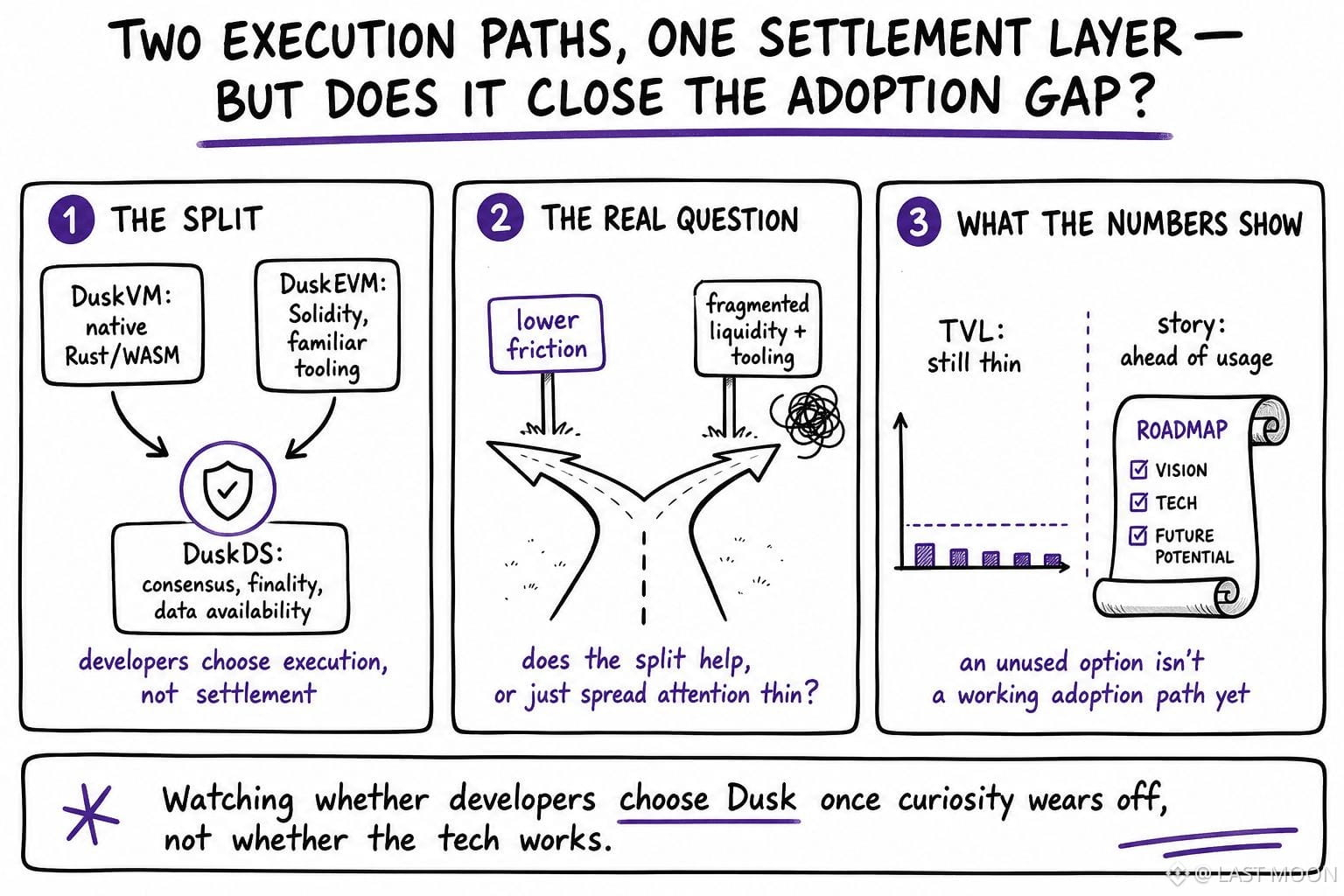
Dusk separates execution from settlement. DuskDS handles consensus, finality, and data availability for the entire network. applications sit on top and can choose either DuskVM for native Rust/WASM execution, or DuskEVM for Solidity and familiar Ethereum tooling. that split means developers aren't choosing between Dusk-native capabilities and EVM compatibility, they're choosing an execution environment while still settling through the same underlying infrastructure either way.
that made me ask a different question than "does the tech work." the more interesting one is: does that separation actually lower the friction developers feel when deciding to build here at all, or does maintaining two execution environments just fragment liquidity and tooling attention instead of solving anything.
right now DUSK is trading around six cents, with market cap sitting a little over thirty million. TVL is still thin and activity metrics stay modest, so the roadmap story is running well ahead of what's showing up in actual usage. the EVM layer exists so developers don't have to start from zero, but an unused option isn't the same as a working adoption path yet.
what I'm actually watching for isn't whether DuskEVM works technically, it clearly can. it's whether developers who could build anywhere else actually choose to build here once the initial curiosity wears off, and whether that choice shows up in numbers instead of announcements.
@Dusk $DUSK #dusk
Dusk separates execution from settlement. DuskDS handles consensus, finality, and data availability for the entire network. applications sit on top and can choose either DuskVM for native Rust/WASM execution, or DuskEVM for Solidity and familiar Ethereum tooling. that split means developers aren't choosing between Dusk-native capabilities and EVM compatibility, they're choosing an execution environment while still settling through the same underlying infrastructure either way.
that made me ask a different question than "does the tech work." the more interesting one is: does that separation actually lower the friction developers feel when deciding to build here at all, or does maintaining two execution environments just fragment liquidity and tooling attention instead of solving anything.
right now DUSK is trading around six cents, with market cap sitting a little over thirty million. TVL is still thin and activity metrics stay modest, so the roadmap story is running well ahead of what's showing up in actual usage. the EVM layer exists so developers don't have to start from zero, but an unused option isn't the same as a working adoption path yet.
what I'm actually watching for isn't whether DuskEVM works technically, it clearly can. it's whether developers who could build anywhere else actually choose to build here once the initial curiosity wears off, and whether that choice shows up in numbers instead of announcements.
@Dusk $DUSK #dusk
I used to assume tokenized assets and regulated brokerage were two separate categories that just happened to overlap sometimes. changed my mind once I looked at how Dusk Trade is actually structured.
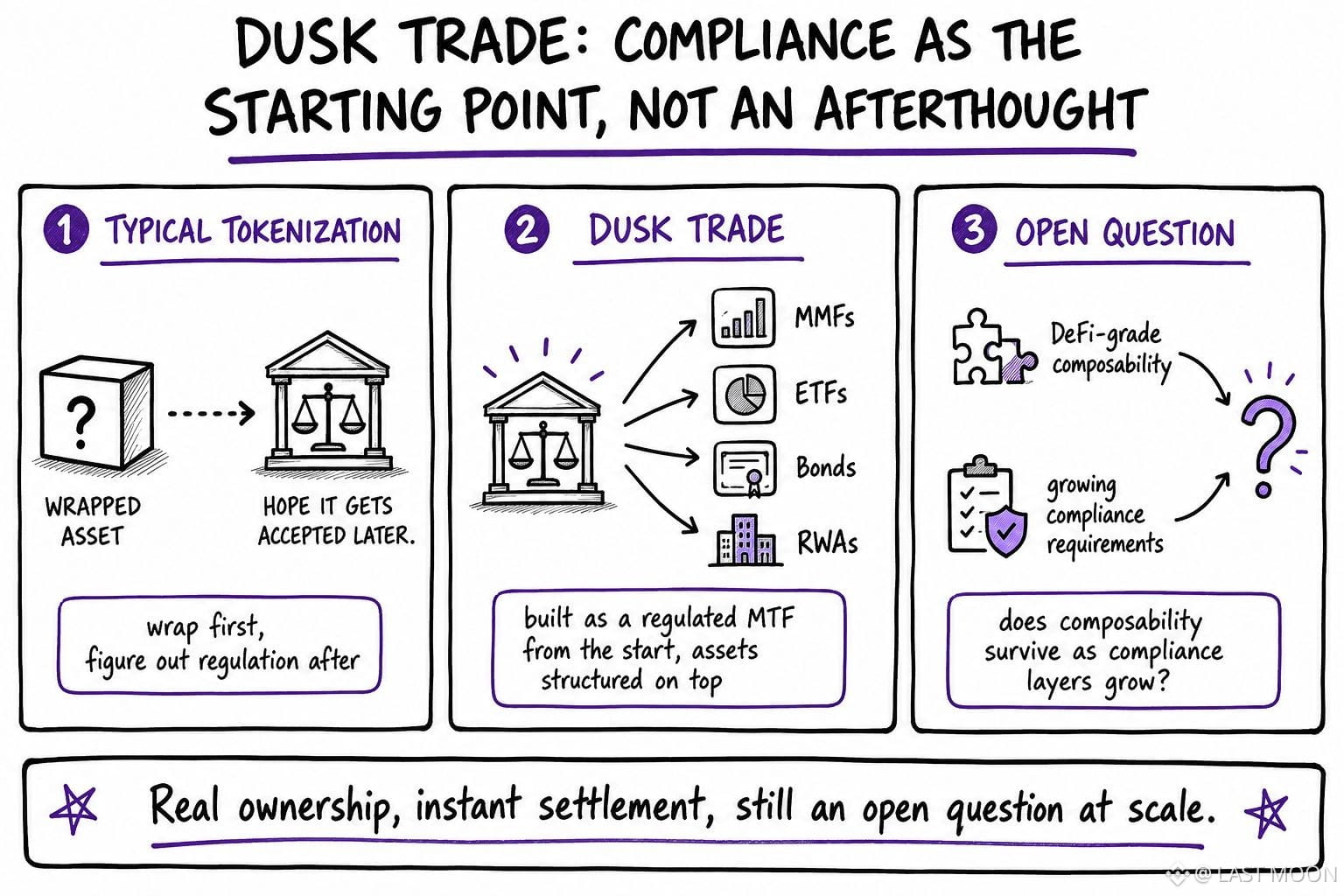
most tokenization platforms wrap an asset and hope the wrapper gets treated seriously by regulators eventually. Dusk Trade goes the other direction, it's built from the start to operate as a regulated MTF and investment platform under EU rules, with MMFs, ETFs, bonds, and RWAs sitting on top of DuskEVM as the actual application layer. the compliance isn't an afterthought bolted onto a DeFi product, it's the starting constraint the whole thing was designed around.
that's a harder path than launching a permissionless app first and figuring out regulation later. but it also means the assets aren't synthetic exposure to something else, they're structured as real ownership with instant settlement, while still keeping DeFi-grade composability instead of getting locked inside a closed institutional system the way most regulated products end up.
what I keep wondering is whether that composability actually survives contact with real regulatory constraints once volume grows, or whether "DeFi-grade" ends up quietly narrowing in practice as more compliance requirements get layered on top over time.
@Dusk $DUSK #dusk
most tokenization platforms wrap an asset and hope the wrapper gets treated seriously by regulators eventually. Dusk Trade goes the other direction, it's built from the start to operate as a regulated MTF and investment platform under EU rules, with MMFs, ETFs, bonds, and RWAs sitting on top of DuskEVM as the actual application layer. the compliance isn't an afterthought bolted onto a DeFi product, it's the starting constraint the whole thing was designed around.
that's a harder path than launching a permissionless app first and figuring out regulation later. but it also means the assets aren't synthetic exposure to something else, they're structured as real ownership with instant settlement, while still keeping DeFi-grade composability instead of getting locked inside a closed institutional system the way most regulated products end up.
what I keep wondering is whether that composability actually survives contact with real regulatory constraints once volume grows, or whether "DeFi-grade" ends up quietly narrowing in practice as more compliance requirements get layered on top over time.
@Dusk $DUSK #dusk
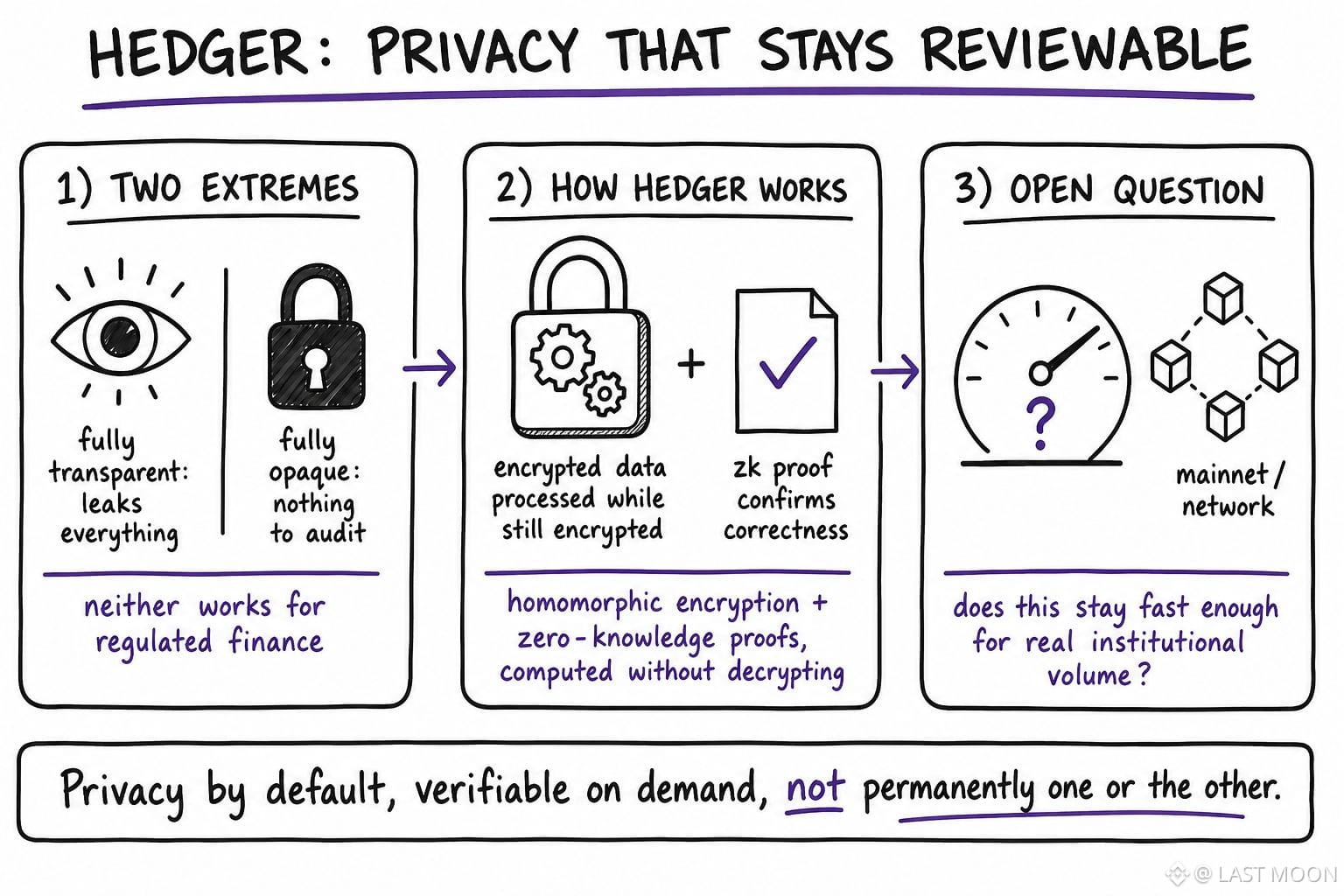
I used to assume privacy on an EVM chain meant picking one of two extremes, either everything's encrypted and unreadable to regulators, or everything's transparent and there's no privacy at all. changed my mind once I looked at how Hedger actually handles this on DuskEVM.
Hedger isn't just encryption bolted onto EVM transactions. it combines homomorphic encryption with zero-knowledge proofs, which means computation can happen on encrypted data without ever decrypting it first, while a separate proof confirms the result is correct. that's what makes selective disclosure possible. the data stays private by default, but an authorized reviewer can still verify what happened without the entire chain being exposed to everyone.
that distinction matters more for regulated finance than it sounds. a fully transparent chain leaks position sizes and counterparty behavior to competitors. a fully opaque chain gives regulators nothing to audit.
Hedger's bet is that neither extreme actually works for institutions, and the harder, more useful problem is building privacy that stays reviewable on demand instead of choosing one side permanently.
what I don't know yet is how this performs once real transaction volume hits DuskEVM mainnet.
homomorphic encryption has historically been computationally expensive. the theory checks out, but whether confidential EVM workflows stay fast enough for actual institutional use is something only mainnet load will answer.
@Dusk $DUSK #dusk
Hedger isn't just encryption bolted onto EVM transactions. it combines homomorphic encryption with zero-knowledge proofs, which means computation can happen on encrypted data without ever decrypting it first, while a separate proof confirms the result is correct. that's what makes selective disclosure possible. the data stays private by default, but an authorized reviewer can still verify what happened without the entire chain being exposed to everyone.
that distinction matters more for regulated finance than it sounds. a fully transparent chain leaks position sizes and counterparty behavior to competitors. a fully opaque chain gives regulators nothing to audit.
Hedger's bet is that neither extreme actually works for institutions, and the harder, more useful problem is building privacy that stays reviewable on demand instead of choosing one side permanently.
what I don't know yet is how this performs once real transaction volume hits DuskEVM mainnet.
homomorphic encryption has historically been computationally expensive. the theory checks out, but whether confidential EVM workflows stay fast enough for actual institutional use is something only mainnet load will answer.
@Dusk $DUSK #dusk
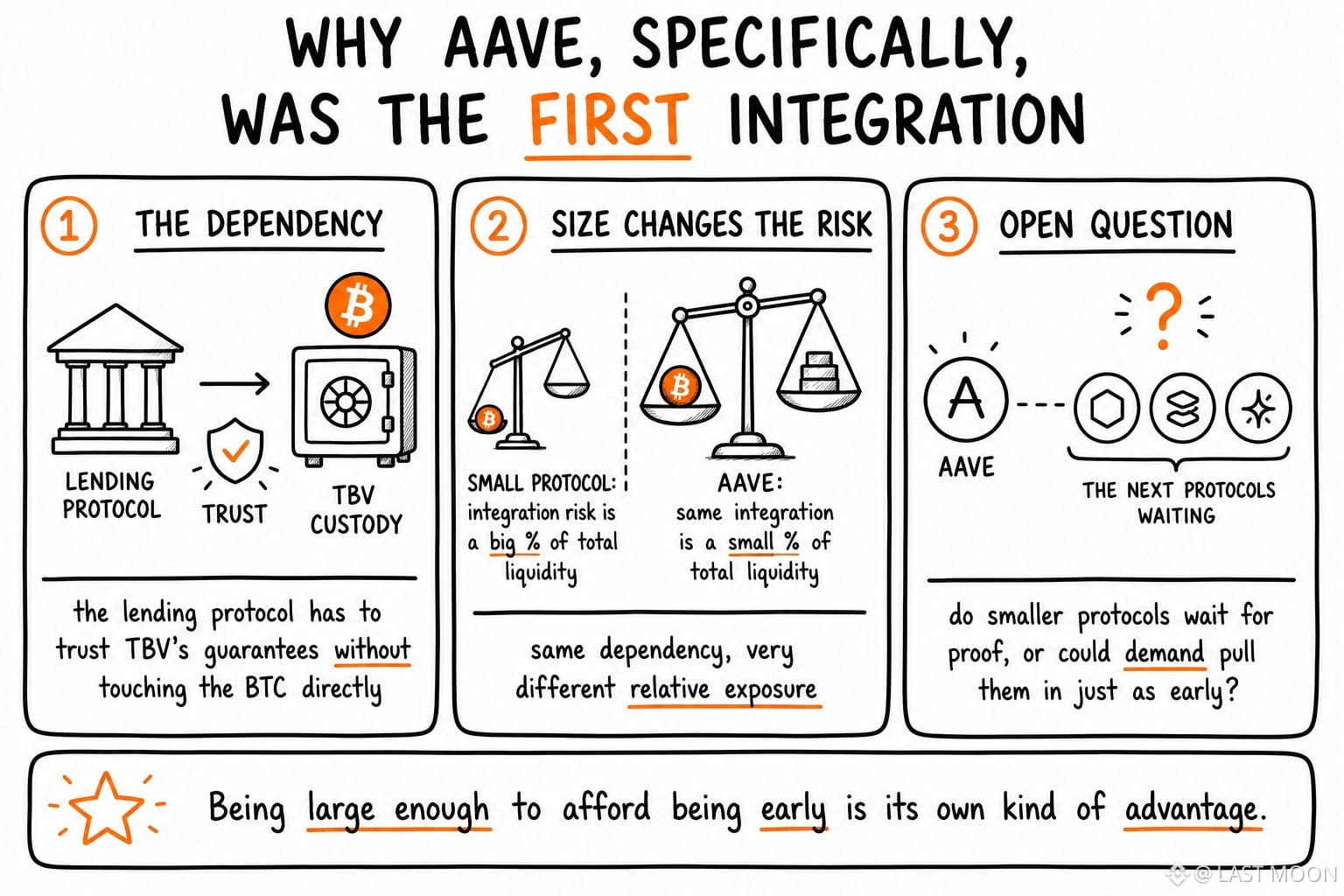
I used to assume the Aave integration was mostly about picking a big, recognizable name to make the partnership look credible. changed my mind once I thought about what a lending integration actually needs from the protocol on the other side.
native BTC as collateral means the lending protocol has to trust that TBV's custody guarantees hold, without ever touching the BTC directly itself. that's not a small ask. a smaller or newer lending protocol taking on that dependency is a much bigger relative risk for them, since a failure in TBV's assumptions could threaten a meaningful share of their total liquidity. Aave being the largest decentralized lending protocol means the same integration represents a much smaller fraction of their overall exposure.
that changes the incentive picture on both sides. Aave can afford to be an early integration partner precisely because the downside is contained relative to their size. a smaller protocol integrating first would either need outsized confidence in TBV's design or be taking a disproportionate bet relative to what they're risking.
what I don't know is whether that also means smaller lending protocols will only integrate once Aave's already proven the model out in practice, or whether depth of liquidity matters less than I'm assuming and other protocols could move just as early if the demand from BTC holders showed up first.
@BabylonLabs_io $BABY #baby
native BTC as collateral means the lending protocol has to trust that TBV's custody guarantees hold, without ever touching the BTC directly itself. that's not a small ask. a smaller or newer lending protocol taking on that dependency is a much bigger relative risk for them, since a failure in TBV's assumptions could threaten a meaningful share of their total liquidity. Aave being the largest decentralized lending protocol means the same integration represents a much smaller fraction of their overall exposure.
that changes the incentive picture on both sides. Aave can afford to be an early integration partner precisely because the downside is contained relative to their size. a smaller protocol integrating first would either need outsized confidence in TBV's design or be taking a disproportionate bet relative to what they're risking.
what I don't know is whether that also means smaller lending protocols will only integrate once Aave's already proven the model out in practice, or whether depth of liquidity matters less than I'm assuming and other protocols could move just as early if the demand from BTC holders showed up first.
@BabylonLabs_io $BABY #baby
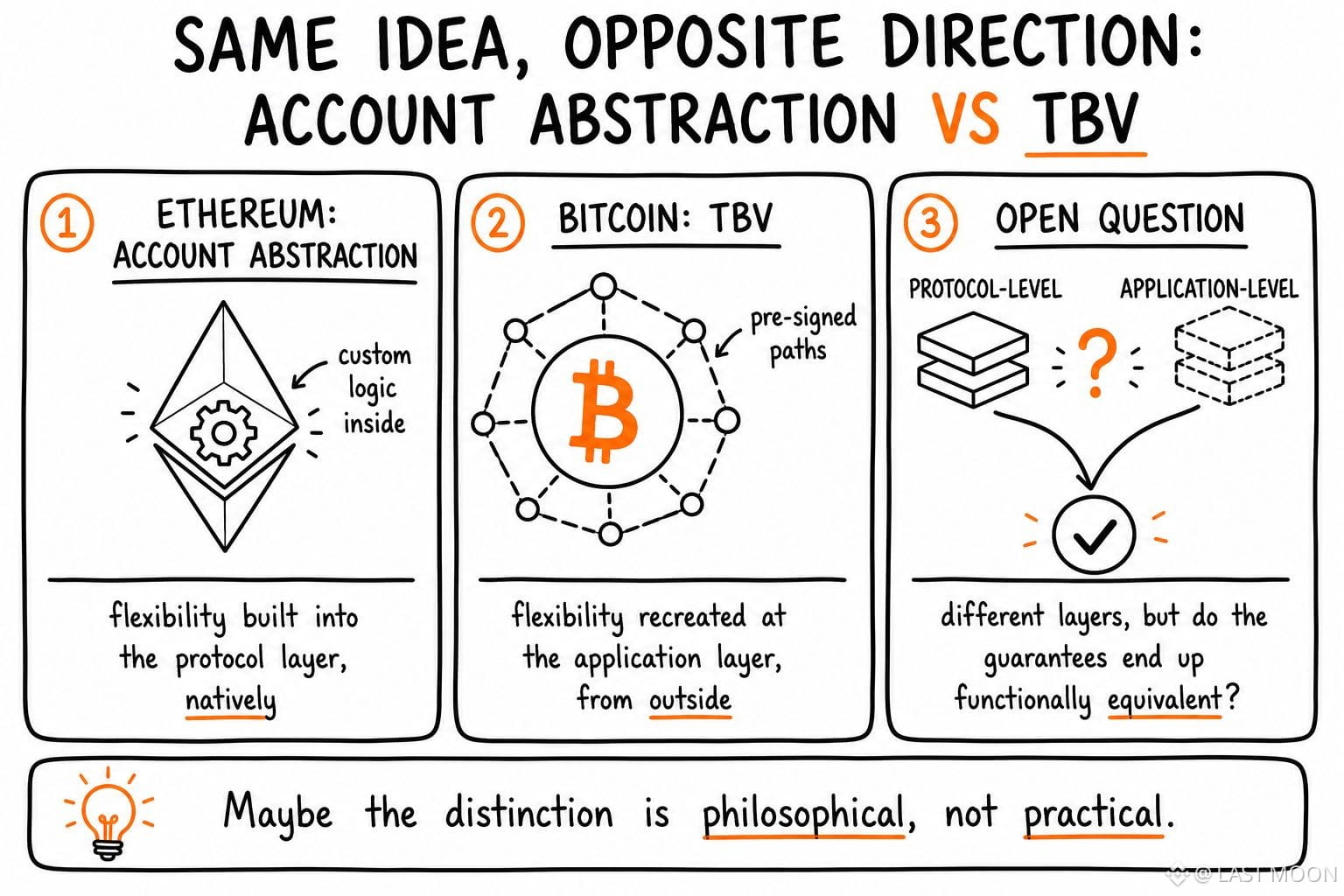
I used to think account abstraction and Babylon's vault design were solving completely different problems, one's an ethereum wallet upgrade, the other's a bitcoin custody model. changed my mind once I noticed they're both answering the same underlying question, just for different chains.
account abstraction lets a wallet define its own rules for what counts as a valid transaction, instead of bitcoin's rigid signature-only model. the logic for what's allowed gets baked into the account itself, ahead of time, rather than decided case by case. that's strikingly similar to what TBV does with vaults. spending paths get defined and pre-signed before the vault activates, so bitcoin only has to check whether a transaction matches something already agreed on, not evaluate new logic on the fly.
the difference is where that flexibility gets built. ethereum's account abstraction happens at the protocol level, any account can define custom logic natively. TBV has to recreate something similar entirely at the application layer, because bitcoin's base layer was never going to change to support it directly. same idea, opposite direction, one chain built the flexibility in, the other chain has to construct it from outside.
what I keep wondering is whether that difference actually matters in practice, or whether pre-signed setup-stage logic ends up functionally equivalent to native account abstraction once you're actually using it. maybe the distinction is more philosophical than practical, and what matters is just whether the guarantees hold, not which layer they're enforced at.
@BabylonLabs_io $BABY #baby
account abstraction lets a wallet define its own rules for what counts as a valid transaction, instead of bitcoin's rigid signature-only model. the logic for what's allowed gets baked into the account itself, ahead of time, rather than decided case by case. that's strikingly similar to what TBV does with vaults. spending paths get defined and pre-signed before the vault activates, so bitcoin only has to check whether a transaction matches something already agreed on, not evaluate new logic on the fly.
the difference is where that flexibility gets built. ethereum's account abstraction happens at the protocol level, any account can define custom logic natively. TBV has to recreate something similar entirely at the application layer, because bitcoin's base layer was never going to change to support it directly. same idea, opposite direction, one chain built the flexibility in, the other chain has to construct it from outside.
what I keep wondering is whether that difference actually matters in practice, or whether pre-signed setup-stage logic ends up functionally equivalent to native account abstraction once you're actually using it. maybe the distinction is more philosophical than practical, and what matters is just whether the guarantees hold, not which layer they're enforced at.
@BabylonLabs_io $BABY #baby
سجّل الدخول لاستكشاف المزيد من المُحتوى