

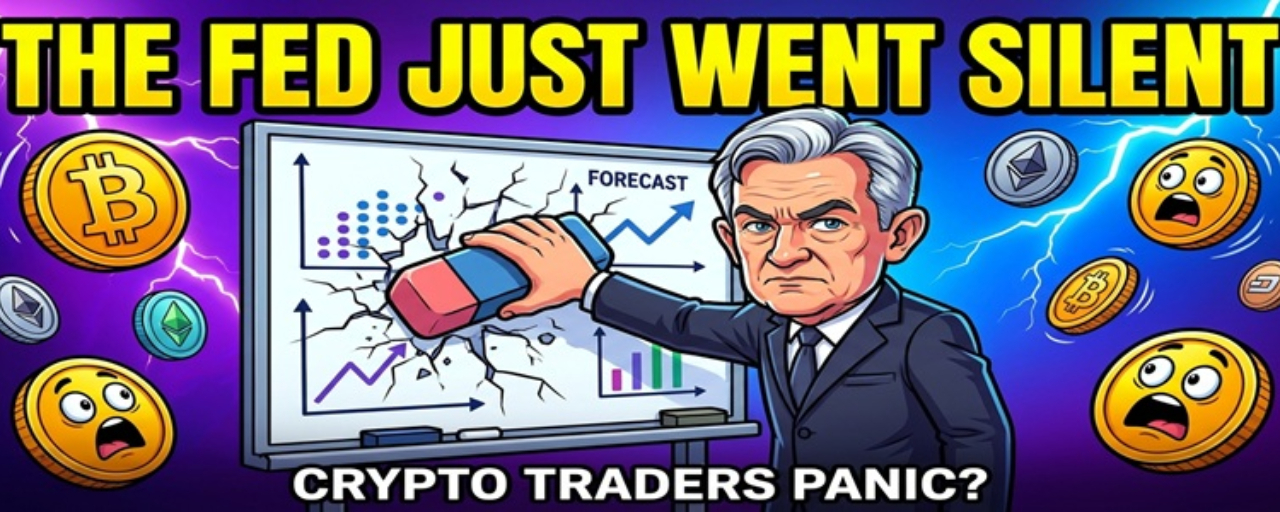

Something strange happened this week that most traders completely missed.
Kevin Warsh, the man now steering the Federal Reserve, just told markets to stop expecting him to telegraph every move. Forward guidance, the practice where Fed chairs basically hand traders a roadmap of future rate decisions, is being cut. The dot plot, that quarterly chart where officials project where interest rates are heading, is now under review.
Read that again. The most powerful central bank on Earth is removing the guardrails that markets have relied on for over a decade.
Let me tell you why this should make you sit up straight.
Since 2012, the Fed has used forward guidance as a tool to manage expectations. When Ben Bernanke introduced it, the goal was simple. Reduce uncertainty. Give markets a heads-up so rate hikes would not trigger panic selling. Traders loved it. Algorithms were built around parsing every syllable of Fed statements. Hedge funds hired linguists to analyze tone shifts in chairman speeches.
It created a false sense of security.
Warsh sees this differently. He has long argued that the Fed became too predictable, that markets stopped pricing in risk and started pricing in Fed promises. His view is blunt. Central banks should not be in the business of coddling investors.
Here is a fact most crypto traders do not know. During the 2008 financial crisis, Warsh was the youngest person ever appointed to the Federal Reserve Board at age 36. He watched the system nearly collapse. He saw what happens when markets become addicted to central bank support. That experience shaped everything about how he thinks today.
Now he is in charge. And he is pulling the plug on the very tools that made markets feel safe.
What does this mean for you as a crypto trader?
Everything.
Crypto does not exist in a vacuum. Bitcoin and major altcoins are deeply correlated with global liquidity conditions. When the Fed signals easy money, risk assets rally. When the Fed signals tightening, risk assets bleed. For years, traders could literally set their watches by Fed communications.
That era is ending.
Without forward guidance, every Fed meeting becomes a genuine surprise. The dot plot, which gave traders a quarterly peek at where rates might be in one, two, or three years, may lose its predictive power. Warsh wants to review whether it even serves a useful purpose anymore.
Think about what that means for volatility.
In the past, when the Fed raised rates, markets often rallied because the move was already priced in. The guidance had done the heavy lifting. Now, without that cushion, every policy decision hits markets fresh. Expect sharper moves. Expect more whipsaws. Expect the kind of volatility that makes leveraged traders get liquidated in minutes.
Here is an interesting historical parallel. In the early 1980s, Paul Volcker ran the Fed with almost zero communication. Markets had no idea what he would do next. The result was brutal volatility in equities and commodities. Warsh is not Volcker, but the philosophical DNA is similar. Less talk, more action.
For crypto specifically, this creates both danger and opportunity.
The danger is obvious. Bitcoin has spent 2025 and early 2026 rallying on expectations of Fed rate cuts. If those expectations get yanked away because the Fed stops signaling, the rally could lose its fuel. Altcoins, which are even more sensitive to liquidity shifts, could see violent corrections.
The opportunity is where smart traders make money.
When uncertainty spikes, prices often overshoot to the downside before finding real support. If Warsh's policy shift triggers a risk-off move, the best entries may come when everyone else is panicking. History shows that major crypto bottoms often form during periods of maximum fear about monetary policy.
Another fact worth noting. Warsh has expressed concern about the Fed's balance sheet expanding too much. He prefers quantitative tightening, letting assets roll off without replacement. This is hawkish for liquidity. Less money sloshing around the financial system typically means less money flowing into speculative assets like crypto.
But here is the twist that contrarian traders should pay attention to.
Warsh also believes the Fed has overreached into areas that are not its responsibility. He has criticized the focus on climate risk and financial inclusion as distractions from the core mission of price stability. This suggests he may actually be more focused, more disciplined, and less prone to the kind of policy confusion that spooked markets under Powell.
A focused Fed could eventually be good for crypto. Clear rules, even if those rules are strict, are better than unpredictable interventions.
So what should you do right now?
First, reduce leverage. If you are running high leverage positions, the increased uncertainty makes liquidation cascades more likely. Warsh's Fed will not bail you out with a reassuring tweet.
Second, watch the dollar. The Dollar Index often moves inversely to crypto. If Warsh's hawkish stance strengthens the dollar, expect headwinds for Bitcoin and altcoins.
Third, pay attention to the first few Fed meetings under Warsh's leadership. The market will be searching for signals in a world where signals are being removed. How traders interpret his silence will define the next major move.
Fourth, remember that uncertainty is not the same as disaster. The 1990s saw massive stock market gains despite significant monetary policy shifts. Crypto could thrive in a Warsh-led Fed if the broader economy stays strong and if crypto-specific catalysts, like institutional adoption and regulatory clarity, continue to develop.
The bottom line is this. The Fed just made the world a more unpredictable place. That is not necessarily bad for crypto, but it means the old playbook of trading the Fed's forward guidance is dead.
Traders who adapt will find opportunities. Traders who cling to the old certainty will get run over.
Warsh is telling you the rules have changed. The only question is whether you are listening.
Disclaimer: This article is for informational purposes only and does not constitute financial advice. Cryptocurrency trading involves significant risk. Always do your own research and never invest more than you can afford to lose.