


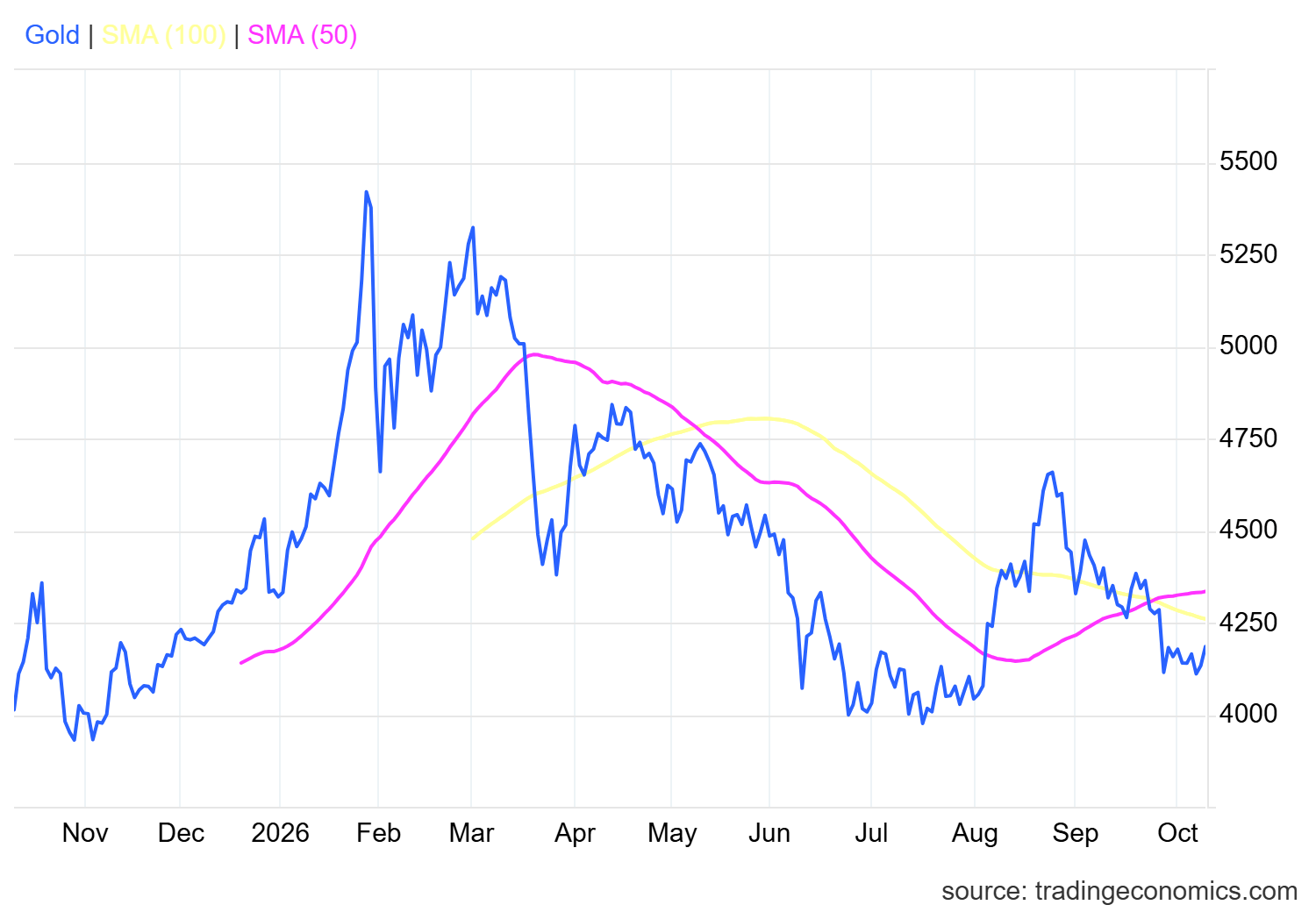
Gold is back above $4,180 an ounce in early New York trade on Friday, bouncing off Wednesday's two-month low. Treasury yields eased for a second session running, and that was all the metal needed. Don't mistake it for a breakout, though. Bullion is still boxed into a $4,100 to $4,200 range.
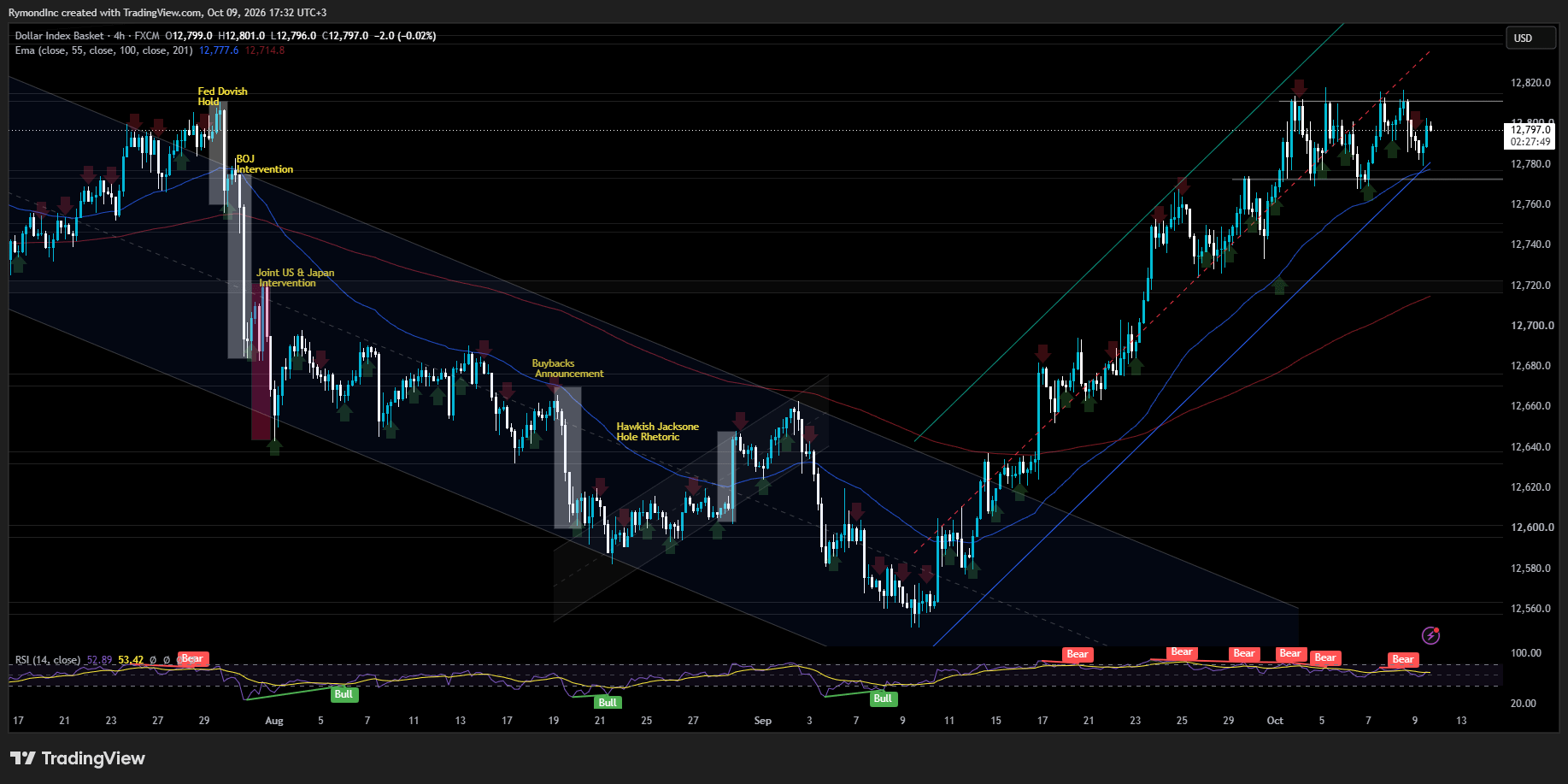
Credit three small shifts for the lift. The dollar went first, mostly by doing nothing. The index sits around 102, still on course for a fourth straight weekly gain and the greenback's strongest showing since April 2025. But a currency that stops climbing gives gold a little room. Dollar-priced bullion costs buyers elsewhere slightly less. That's the whole mechanism.
Then came the Fed. Governor Christopher Waller told an audience in Istanbul on Thursday that more rate increases are probably needed. He also eased off the throttle, saying the pace is flexible and the hikes needn't arrive at back-to-back meetings. CME FedWatch put the chance of a hike at the 27-28 October meeting near 19% on Friday, with roughly 82% for an increase by December.
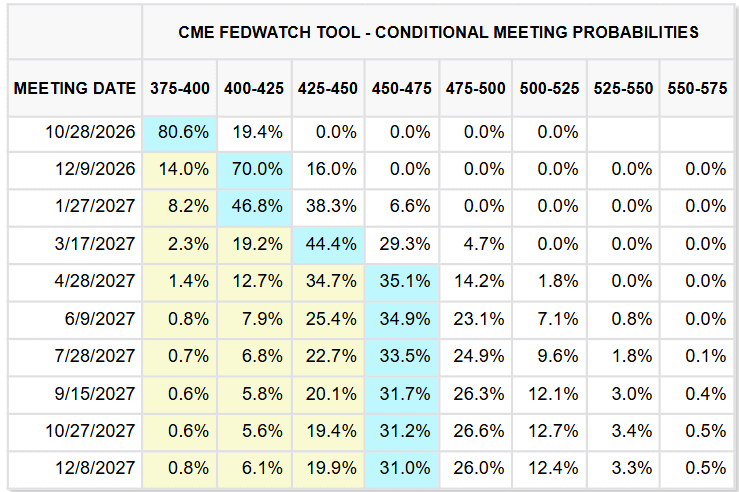
Hike bets cooled a touch. Here's the thing, though: the bigger idea survived. Traders still expect rates to stay higher for longer while the Fed pins down stubborn inflation, and that keeps hawkish pressure on gold.
Wednesday's minutes from the September meeting backed that up. All 19 policymakers voted for the quarter-point hike to a range of 3.75% to 4%, the first increase in roughly three years, and most felt another would likely be appropriate before the year ends.
The record showed broad agreement that inflation remains too high. The disagreement was less about whether inflation was a problem and more about why rates needed to rise. Some officials read the last policy move as insurance against energy and other supply shocks, while a more hawkish group worried that price pressures were turning demand-driven. One vote, two diagnoses.
Crude was the third push. It slid after President Donald Trump said Washington was holding "productive discussions" with Iran and would not take military action before the 3 November midterm elections. He said it in a week when Iran stepped up attacks on tankers in the Strait of Hormuz, with a hurricane approaching the U.S. Gulf Coast adding supply worries of its own. The recent one just came a few minutes before Friday's New York session started, with
Expensive oil exacerbates inflation fears. And those fears are what keep yields and rate expectations elevated.
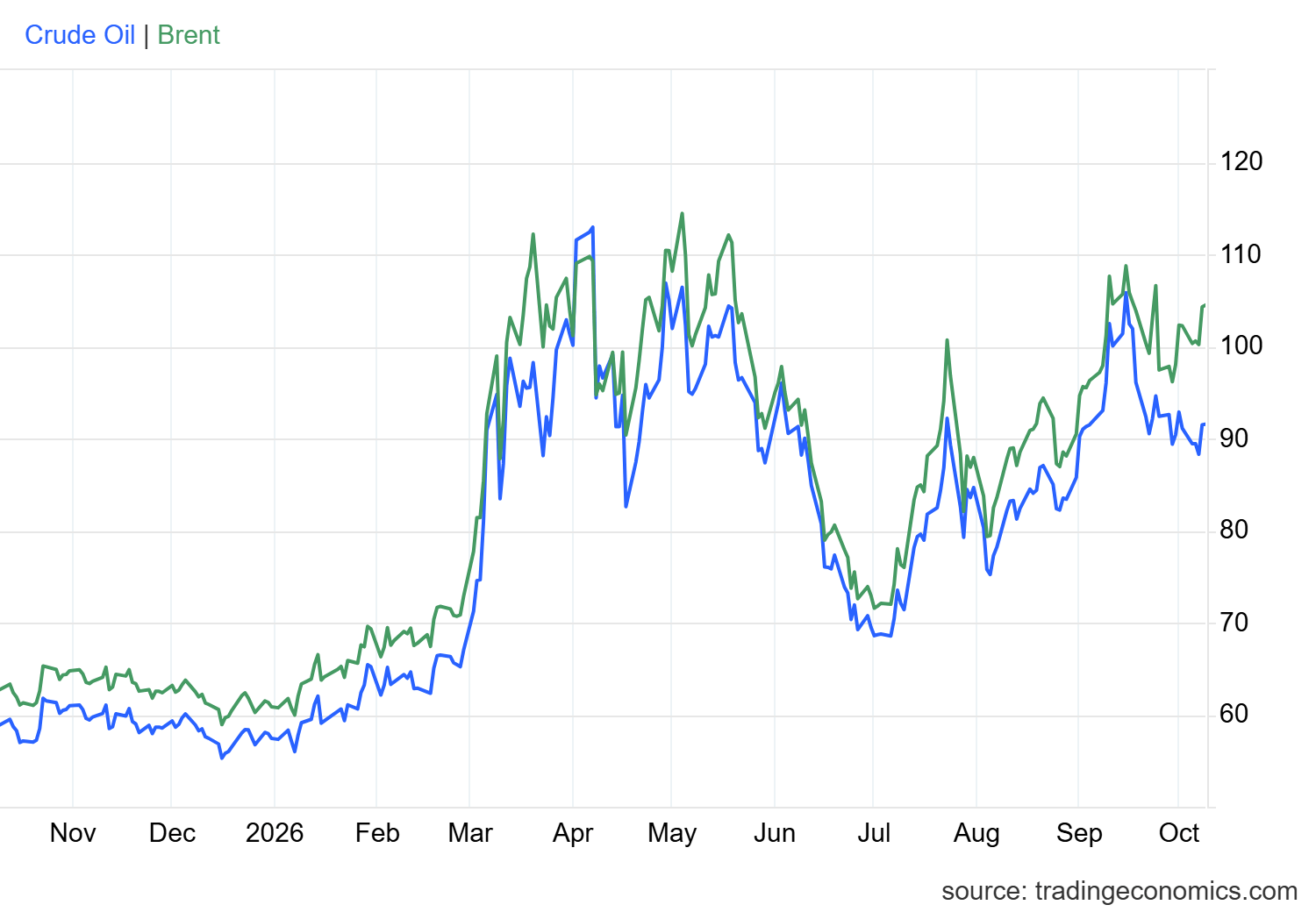
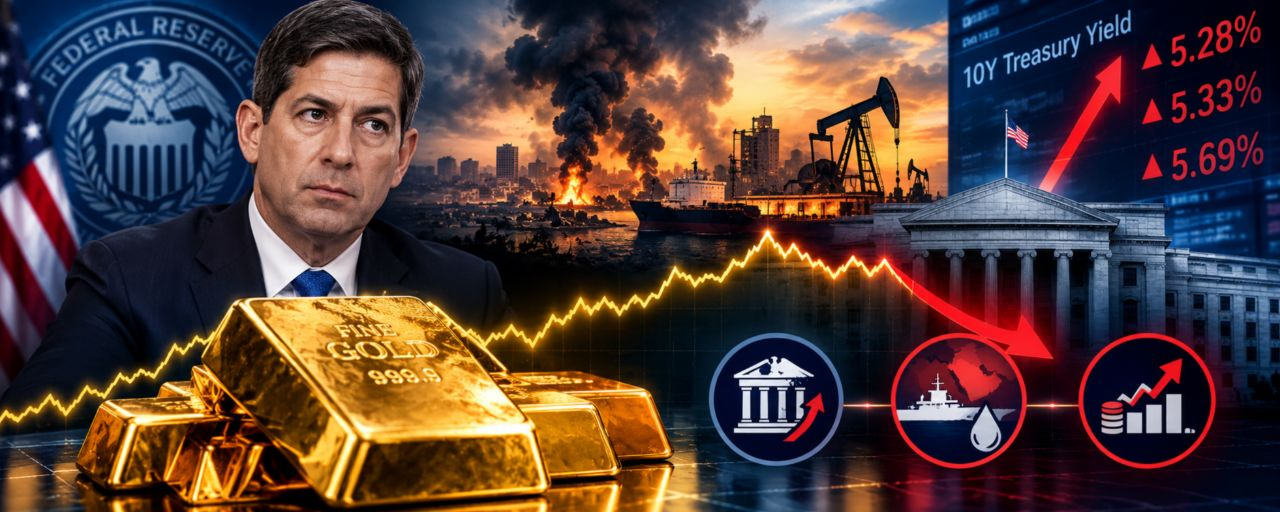
Zoom out and the two markets seem to be reading from different scripts. Gold is stuck. Brent isn't. The crude benchmark is back above $100 a barrel, changing hands near $103.50 on Friday, because renewed attacks on Gulf shipping rebuilt part of the geopolitical premium that had faded while U.S.-Iran talks looked to be making headway. Gold, meanwhile, is weighed down by stiff Treasury yields, a firm dollar and a Fed in no hurry to claim victory over inflation.
So why isn't it rallying?
On paper, a conflict in the Gulf should be the metal's best friend. In practice it has found no lasting support, even as the geopolitical picture gets messier. It remains near its lowest since early August and a long way under the late-August peak close to $4,650.
Bonds are the problem. The 10-year Treasury yield is hovering near 5.2% and the 30-year near 5.6%, just days after both hit their highest levels since 2002. The 10-year fell about 5 basis points on Thursday, helped by auctions that drew solid demand. The Treasury sold $39 billion of 10-year notes on Wednesday and $22 billion of 30-year bonds on Thursday, the latter at 5.618%, the highest yield at a 30-year auction since 2000. Buyers still showed up. That tells you investors remain happy to hold long-dated government debt, even after the recent selloff.
They're also still working out what the Middle East means for energy prices and, through them, inflation.
But real yields matter more to gold than any of this. The Federal Reserve's latest data put the 10-year inflation-indexed yield near 2.9%. Put a non-yielding bar of bullion next to that number and the opportunity cost jumps out. Treasuries can now cover part of the defensive job gold has traditionally done, and they pay a substantial real return for the trouble. No wonder geopolitical stress hasn't turned into the sustained rally an escalation in the Middle East usually delivers.
Academic research backs up what the screens are showing, and four ideas stand out.
First, the income problem. Treasuries pay interest; physical gold doesn't. When inflation-adjusted yields climb, investors get a stronger income-producing alternative, and that can cap demand for bullion even in nervous times. Erb and Harvey studied gold's investment characteristics closely in a 2013 paper, and the World Gold Council counts interest rates and the opportunity cost of holding gold among the main influences on its performance. Reuters tied Wednesday's slide to the same pair of forces: high Treasury yields and a stronger dollar.
Second, liquidity. The Treasury market is a deep pool for investors managing portfolio risk, and government bonds can act as defensive holdings when markets turn stressful, though how well they do depends on the kind of shock. Nguyen, Engle, Fleming and Ghysels examined liquidity and volatility in that market in 2020, covering the 2007-09 financial crisis and the periods around major economic announcements. Their paper underlines how much liquidity matters there. It doesn't say Treasuries always beat gold in a geopolitical crisis. Nobody should read it that way.
Third, oil can turn on gold. An energy supply scare doesn't automatically lift bullion. When conflict disrupts crude, the price jump can raise inflation expectations, lift the interest rates investors anticipate and push Treasury yields up, and those forces can erase gold's safe-haven appeal. 16 July was a textbook case. Gold dropped as much as 2% that day as escalating Middle East tensions drove yields higher and fuelled worries that surging oil prices would mean more rate hikes. Exactly the mechanism described.
Fourth, the haven has a short shelf life. Markets react to the type and duration of a crisis more than to its severity. Gold can shield a portfolio under extreme stress, but how well it does varies across markets and time horizons. Baur and Lucey found in 2010 that gold worked as a safe haven during extreme stock market conditions, though their portfolio analysis put the effect at only about 15 trading days. Treasuries, for their part, can look appealing when investors want income and liquidity, so long as inflation and rising yields don't damage their prices.
March reporting on the Iran conflict showed how unevenly these defensive assets can behave. Reuters quoted an analyst saying gold would arguably have traded higher without the dollar's gains. Weeks later, analysts said liquidity needs were outweighing haven demand, with gold down 15% since the conflict began. Government bonds, CNBC reported, were largely tracking equities lower.
None of this settles the next move. Treasury yields remain the main driver, and traders will study upcoming U.S. data for clues before the Fed meets on 27-28 October. The 3 November midterms, the date Trump pinned to his Iran pledge, sit right behind. If the bond selloff returns, Wednesday's low starts to look shaky. If things stay quiet, gold gets some breathing room, though the real-yield sums won't have changed.