Another country just said no to a national Bitcoin reserve — and the rejection came from its own central bank.
Latvia's central bank deputy governor Santa Purgaile told CoinDesk at the Fintech Pulse conference in Riga on Nov 28 that a national $BTC reserve has "never been discussed" inside Latvijas Banka, and any such move would have to be "the whole of Europe's decision." That directly deflates Economics Minister Viktors Valainis's October pitch for a Latvian reserve — and his plan for tokenized government bonds in 2027 is now "not confirmed" either.
The same week, Latvia's Financial Intelligence Unit raised crypto firms' risk rating to medium-high, while parliament opened a one-time window (Apr 1–May 31, 2027) letting residents declare unreported crypto at a flat 10% tax instead of the usual 25.5%. Carrot and stick in one package.
The context matters: ECB chief Lagarde said in January 2025 that no Eurosystem central bank would hold bitcoin, and her successor Pablo Hernández de Cos, picked Nov 26, is a known sceptic. Europe's institutional wall is holding — even as Washington debates its own Strategic Bitcoin Reserve bill.
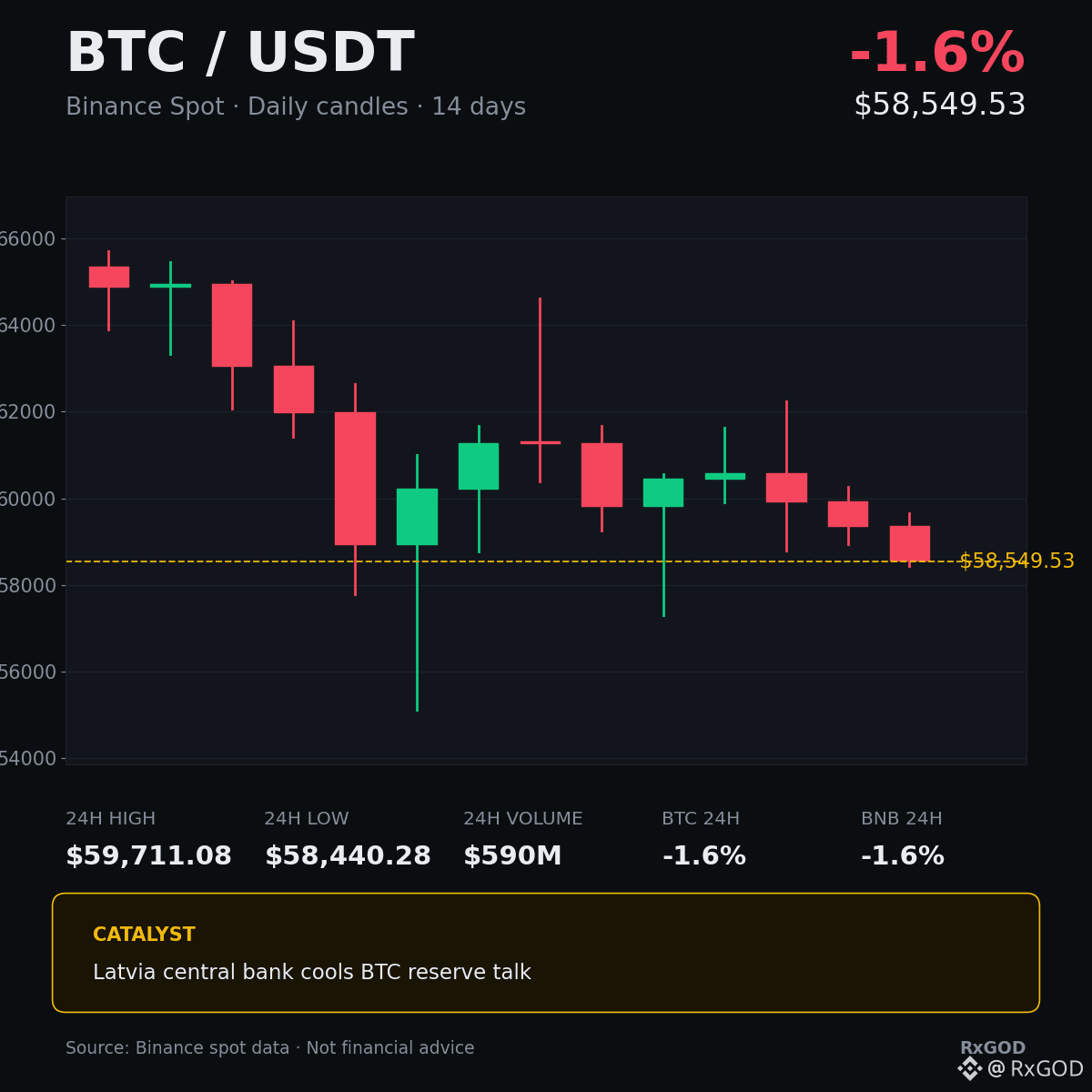
The market barely blinked: $BTC trades at $58,550, down 1.6% in 24 hours and 9.8% over 14 days, sitting in the bottom third of its two-week range ($55,130–$65,696) with fear at Extreme Fear 11. Latvia is small, so this is a signal about sentiment, not price.
So the real question: should central banks hold bitcoin at all — or is a volatile asset the last thing a public balance sheet needs? And if Europe says no while the US keeps debating, which side is reading the future right?
Not financial advice — DYOR.
#Bitcoin #BitcoinReserve #ExtremeFear #CryptoNews