$MMT: Emotional Independence from Market Color
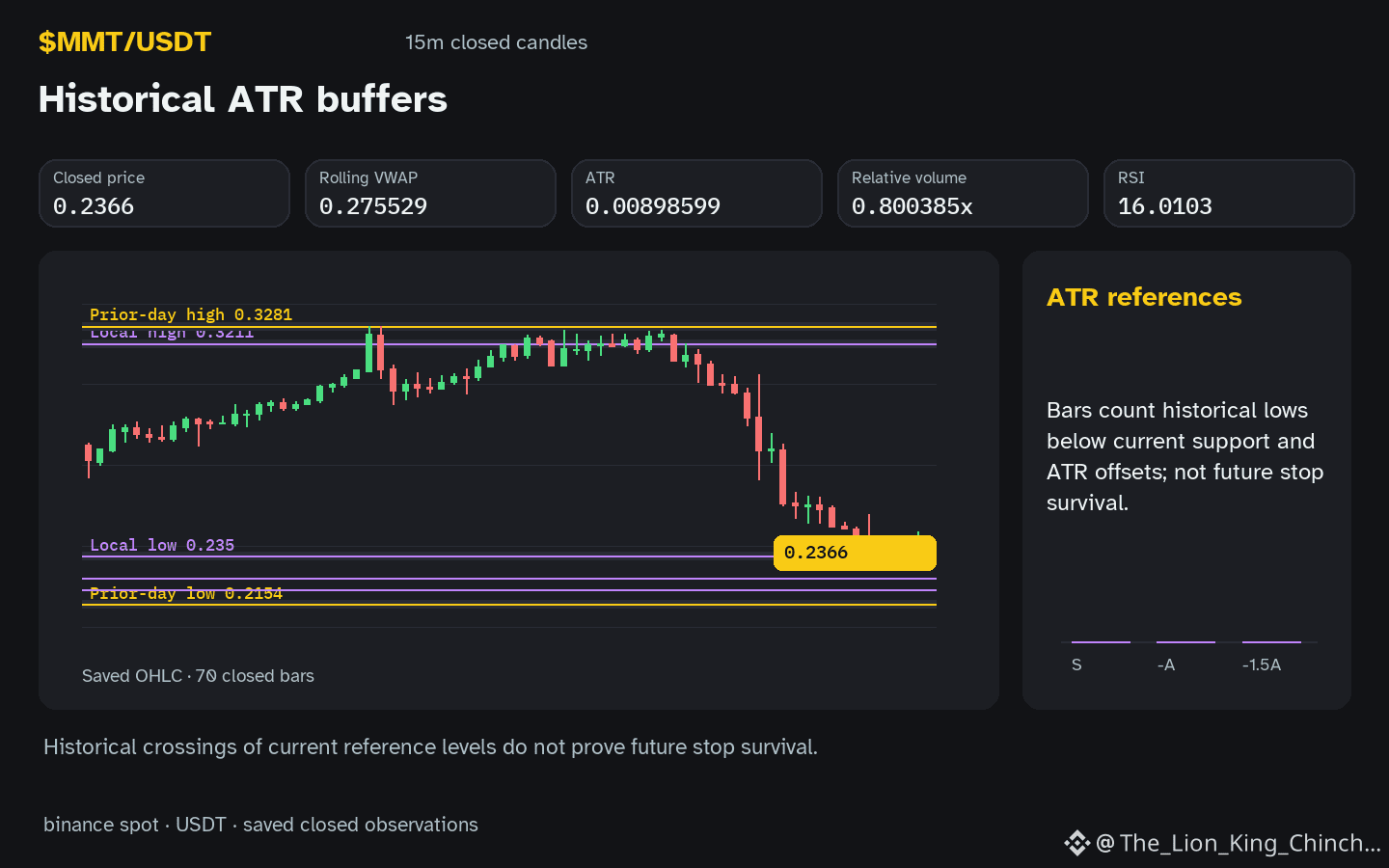
$MMT: MMT shows an hourly direction down while volume is not above baseline. Does the quiet decline invite a reflexive entry, or should a trader pause to test emotional independence? The tempting shortcut is to chase the perceived low‑price bias, assuming that a quiet market guarantees a safer entry. Yet a more careful interpretation treats the observation as a thought experiment: imagine two scenarios, one where a trader jumps in immediately, and another where they wait for a confirming candle. The first scenario offers a tighter entry price but increases the risk of chasing a false signal; the second sacrifices immediacy for a clearer validation, potentially widening the stop distance.
A practical trade‑off emerges between entry quality and the urge to act. If the trader chooses the immediate entry, the stop might need to sit close to the recent support 0.235 to limit loss, but a sudden reversal could trigger it quickly. Waiting allows placement of the stop near the prior range bar 20, providing a wider buffer at the cost of a less favorable price.
A useful next observation would be a closed hourly candle that either confirms the down direction with a stronger RSI 16.0 divergence or shows a reversal pattern. Such evidence could invalidate the initial interpretation and prompt a reassessment of the emotional bias toward instant action.
Probabilistic market research, not a recommendation or guaranteed return.
Watchlist contrast: $BTC has hourly direction down and volume not above its baseline; $MANTRA has hourly direction up and volume not above its baseline. This alone does not establish correlation.
#MMT #BTC #MANTRA