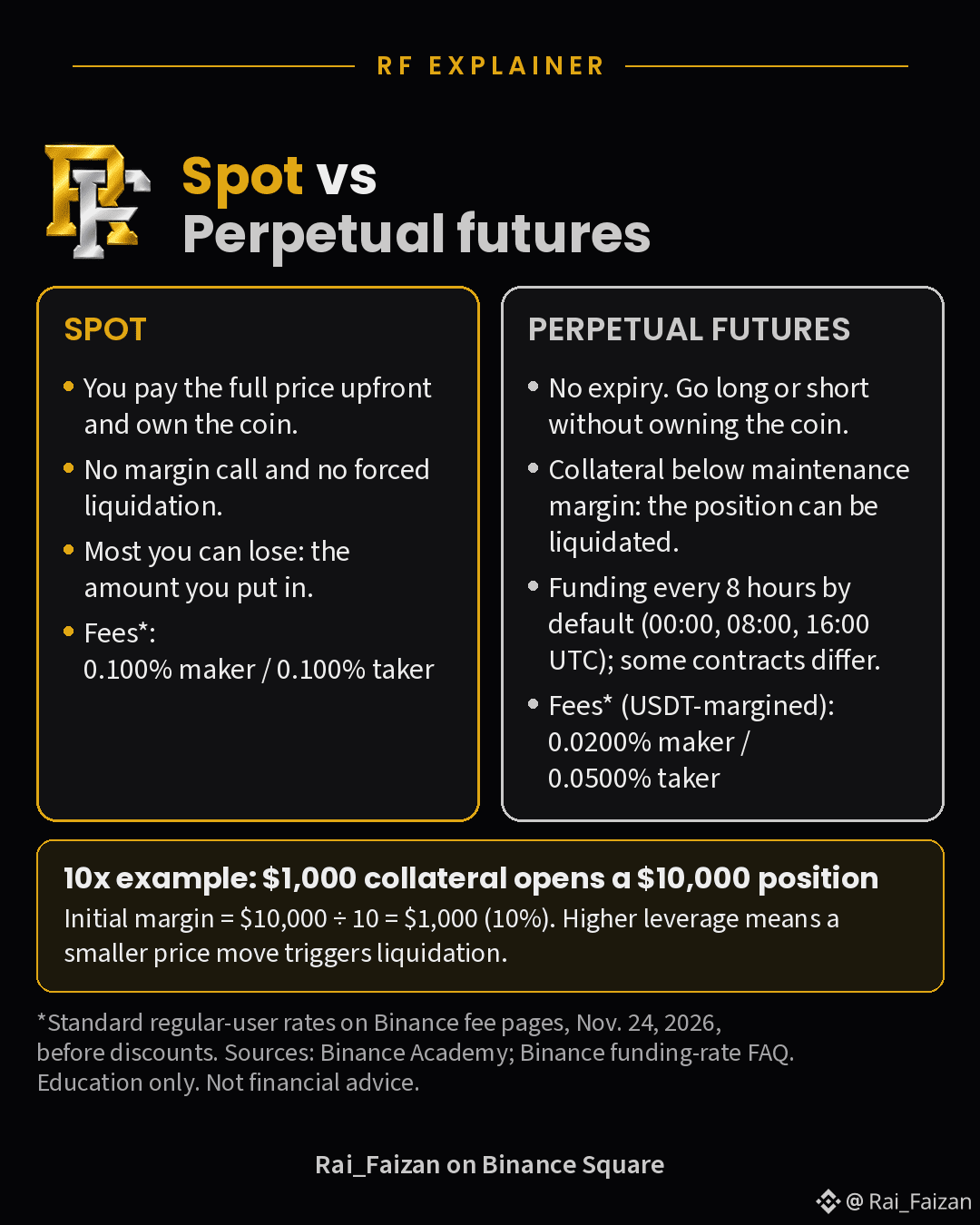
Spot vs perpetual futures on Binance: in spot you own the coin, while with a perpetual at 10x leverage, $1,000 of collateral controls a $10,000 position that can be liquidated.
Key facts
- In spot trading you pay the full price upfront and can only sell coins you already hold, according to Binance Academy. Crypto spot trades generally settle in real time.
- Because nothing is borrowed, a spot position has no margin call and no forced liquidation. The most you can lose is the amount you put in.
- A perpetual future, such as Binance's USDⓈ-M BTCUSDT contract on $BTC , is an agreement to buy or sell a coin at a set price with no expiration date. You can go long or short without owning the coin.
- A perpetual position must keep collateral above the maintenance margin. If it falls below that level, the position can be liquidated, which means closed automatically.
- Perpetuals also have a funding rate, a regular payment between long and short holders that keeps the contract near the spot price. Binance does not charge a fee on funding payments, according to its funding-rate FAQ.
What to watch for
On the default 8-hour interval, Binance settles funding at 00:00, 08:00 and 16:00 UTC. Some contracts settle every 4 hours, and a contract can switch to hourly after funding hits its cap or floor, so check each contract's details.
Big number: 10x
In Binance Academy's example, $1,000 of collateral at 10x leverage opens a $10,000 position. Step: $10,000 ÷ 10 = $1,000 of initial margin, or 10% of the position. Higher leverage means a smaller price move is enough to trigger liquidation.
Key background
Fees differ too. On Nov. 24, 2026, Binance's fee pages listed standard regular-user rates of 0.100% maker and 0.100% taker for spot, and 0.0200% maker and 0.0500% taker for USDT-margined futures, before discounts. Binance Academy lists leverage, short exposure and hedging as the main uses of perpetuals.
AI-assisted, reviewed by RF. I may earn Binance Write to Earn rewards from this post. Not financial advice.
I hold $BTC .