An equipment supplier can guide for fewer orders and higher sales at the same time.
ASMPT's Q3 2026 results explain how.
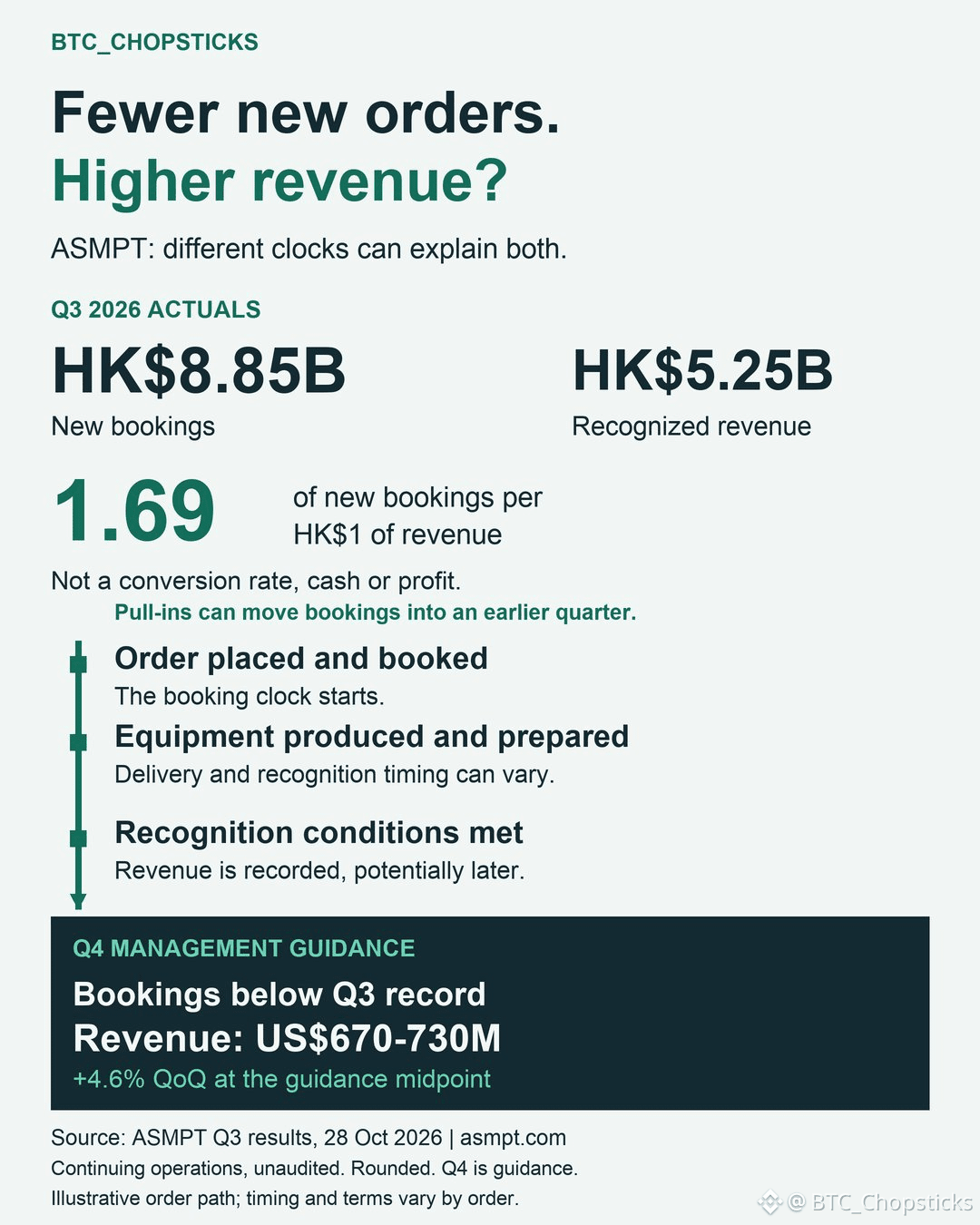
Its continuing operations booked HK$8,845.1M of new orders and recognized HK$5,247.0M of revenue. Dividing the first by the second gives a book-to-bill ratio of 1.69.
That's HK$1 .69 of new orders per HK$1 of reported revenue. It doesn't tell us how much of those orders shipped, how much cash arrived or what profit they will earn.
The timing matters. SMT bookings included more than US$100M of bulk orders and pull-ins combined. The pure pull-in amount wasn't disclosed.
Management expects Q4 bookings below Q3's record, partly because of those one-offs and pull-ins. Yet its Q4 revenue guidance is US$670M to US$730M, up 4.6% at the midpoint from Q3.
An order brought forward strengthens one quarter and weakens the next comparison. Previously ordered equipment can still move toward delivery and revenue recognition.
I'd compare reported revenue with guidance, then check fresh orders after the pull-in window. Orders that keep arriving would support the demand story; weakness that persists beyond that timing effect would deserve more scrutiny.
These are unaudited continuing-operations figures and management forecasts, not evidence that every order becomes cash or profit.
ASMPT's Q3 2026 results explain how.
Its continuing operations booked HK$8,845.1M of new orders and recognized HK$5,247.0M of revenue. Dividing the first by the second gives a book-to-bill ratio of 1.69.
That's HK$1 .69 of new orders per HK$1 of reported revenue. It doesn't tell us how much of those orders shipped, how much cash arrived or what profit they will earn.
The timing matters. SMT bookings included more than US$100M of bulk orders and pull-ins combined. The pure pull-in amount wasn't disclosed.
Management expects Q4 bookings below Q3's record, partly because of those one-offs and pull-ins. Yet its Q4 revenue guidance is US$670M to US$730M, up 4.6% at the midpoint from Q3.
An order brought forward strengthens one quarter and weakens the next comparison. Previously ordered equipment can still move toward delivery and revenue recognition.
I'd compare reported revenue with guidance, then check fresh orders after the pull-in window. Orders that keep arriving would support the demand story; weakness that persists beyond that timing effect would deserve more scrutiny.
These are unaudited continuing-operations figures and management forecasts, not evidence that every order becomes cash or profit.