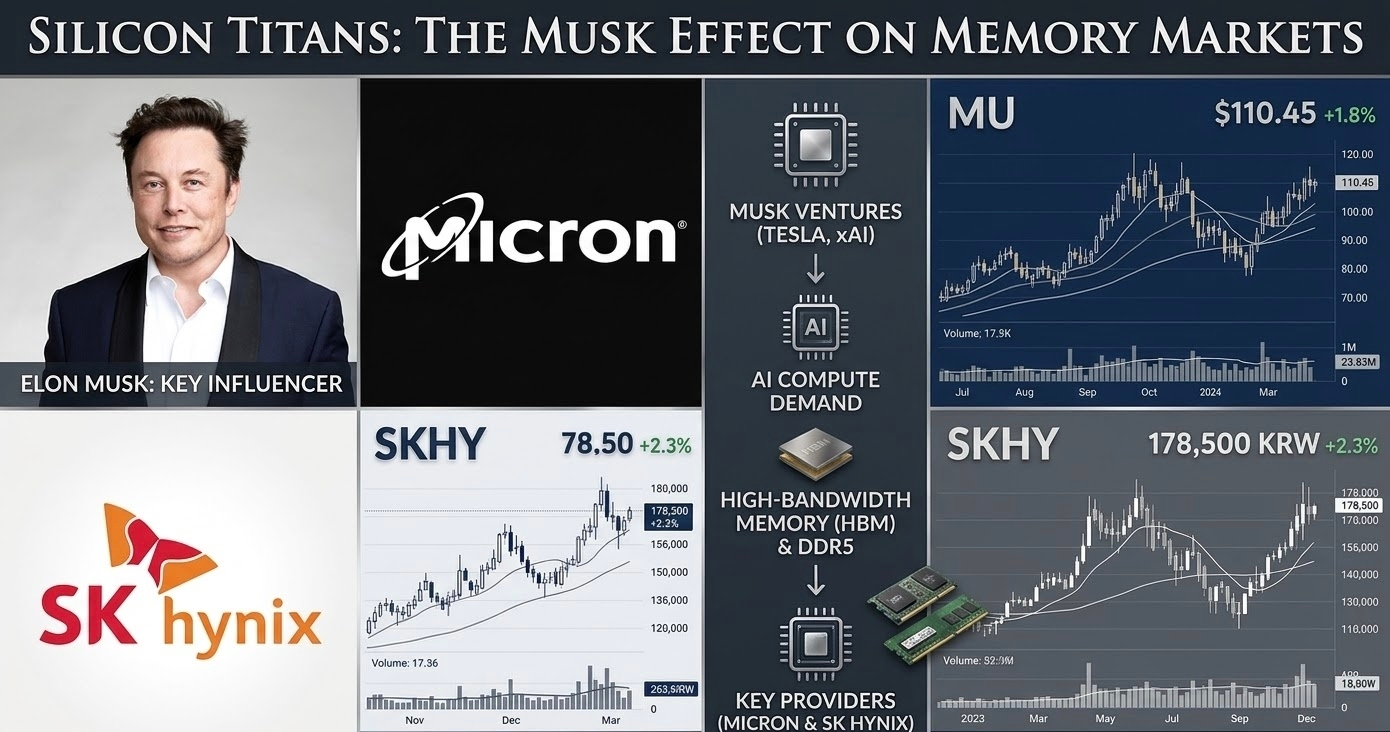

Elon Musk has floated a bold vision: humanoid robots could soon eclipse all other sources of computer memory demand on Earth!
Picture a scenario where Tesla scales production to 10 million Optimus units annually. If each unit demands 72 GB of working memory, that translates to a staggering 720 petabytes of memory consumed every single year—driven by just one manufacturer!
While current market focus remains heavily locked on data centers fueling the artificial intelligence boom, Musk argues that the next paradigm shift will dwarf it. AI is breaking out of server rooms and stepping into the physical realm, where millions of autonomous robots will rely on continuous memory processing to navigate and make split-second decisions.
This evolution opens up a massive opportunity for major memory pioneers like $MUB and $SKHYB . Unlike server-centric AI accelerators that lean heavily on High Bandwidth Memory (HBM), physical robotics depend on energy-efficient LPDDR memory configurations. This creates a completely new, high-volume growth vector for chipmakers, fueled by mass-market production.
Looking even further ahead, Musk suggests that the eventual realization of superintelligence might even require expanding computational grids directly into space.
Naturally, these horizons are still speculative and hinge entirely on manufacturing breakthroughs and widespread economic adoption. Yet, it raises a compelling investment thesis: could memory hardware manufacturers emerge as the ultimate victors of the robotics revolution, mirroring their success during the rise of AI infrastructure?
If you appreciate this deep dive, drop a vote to show your support! Follow @Coin-QQ to stay ahead of the curve on the economics of AI.
#BinanceSquare #cryptotrading #TrendingCrypto #FOMCWatch #CanMicrosoftDeliverOnAI