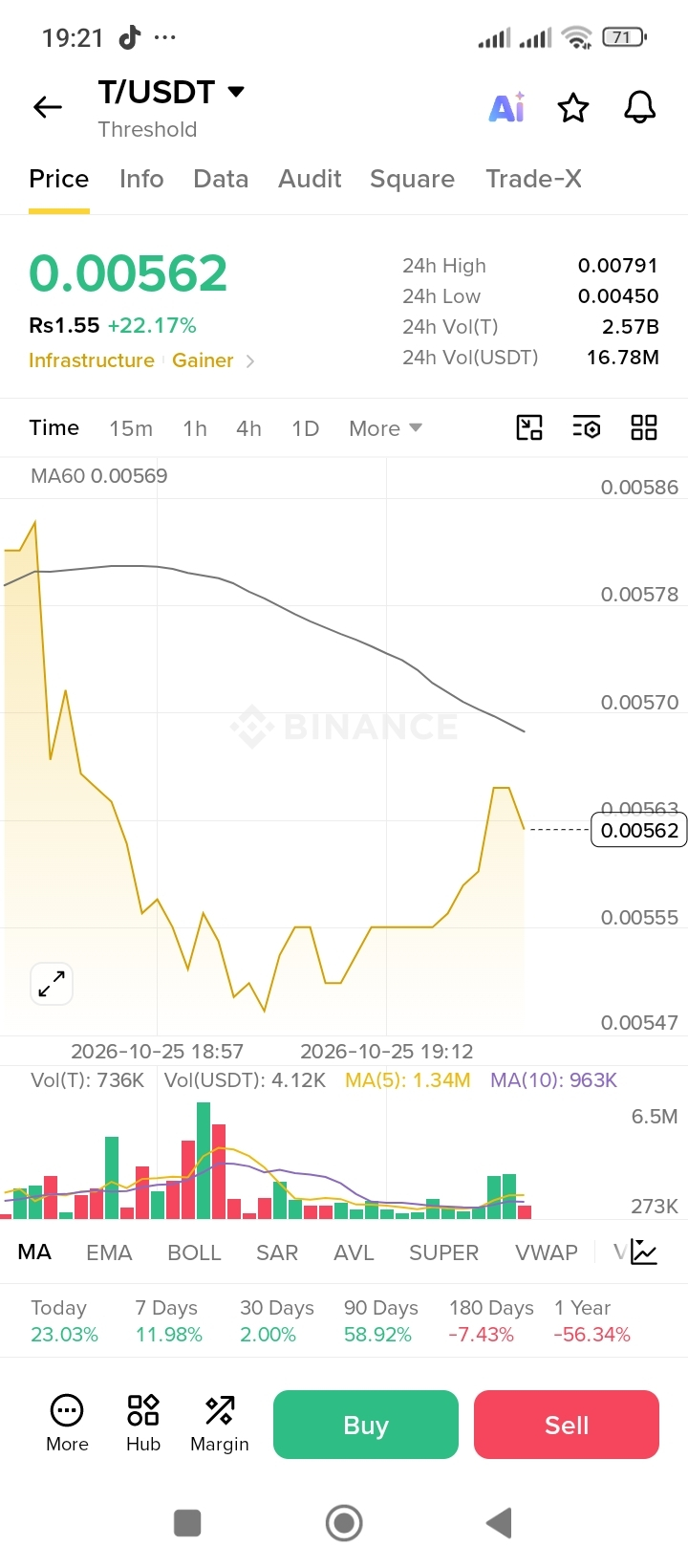
professional trader’s write-up framework and strategic breakdown for Threshold Network (T coin).
📊 Threshold Network (T) Crypto Write-Up & Trader Strategy
1. Executive Summary / Asset Overview
Project Context: Threshold Network (T) is the merged entity of Keep Network and NuCypher, serving as a privacy-focused infrastructure layer for public blockchains (offering threshold cryptography, tBTC bridge, and decentralized access control).
Trader Sentiment: Altcoins with deep utility and specialized infrastructure hooks heavily depend on broader market liquidity and BTC dominance trends.
2. Current Position Analysis (Where the Market Stands)
Market Structure: T typically moves in tandem with mid-cap altcoin liquidity cycles. During macro phases where Bitcoin consolidates or tests major range boundaries, utility tokens like T often experience localized compression or range-bound accumulation.
Volume & Momentum: Monitor 24-hour exchange volume relative to its circulating market cap. Low volume combined with tight price compression usually signals an accumulation phase by smart money before a volatility expansion.
Key Technical Levels to Monitor:
Immediate Support Zone: Look at local macro lows or heavy volume nodes on the daily/weekly chart where buyers previously stepped in to defend the floor.
Immediate Resistance Zone: The overhead supply cluster or previous local highs where breakout sellers or trapped long positions typically look to exit.
3. Essential Trader Tips for Trading T
Avoid Chumping Low-Liquidity Spikes: Because T can experience sharp, sudden order-book moves driven by narrative shifts, avoid chasing green impulse candles on lower timeframes (15m/1h) without volume confirmation.
Correlate with BTC & Total3: Keep a close eye on Bitcoin’s dominance (BTC.D). Altcoins like T require a stable or declining BTC dominance combined with a rising altcoin market cap index (TOTAL3) to sustain multi-day breakout rallies.
Risk Management Rules:
Never risk more than 1% to 2% of your total trading capital on a single T swing trade.
Place technical stop-losses strictly below established structural swing lows rather than relying on arbitrary percentage drops.
4. Future Position Scenarios & Game Plan