

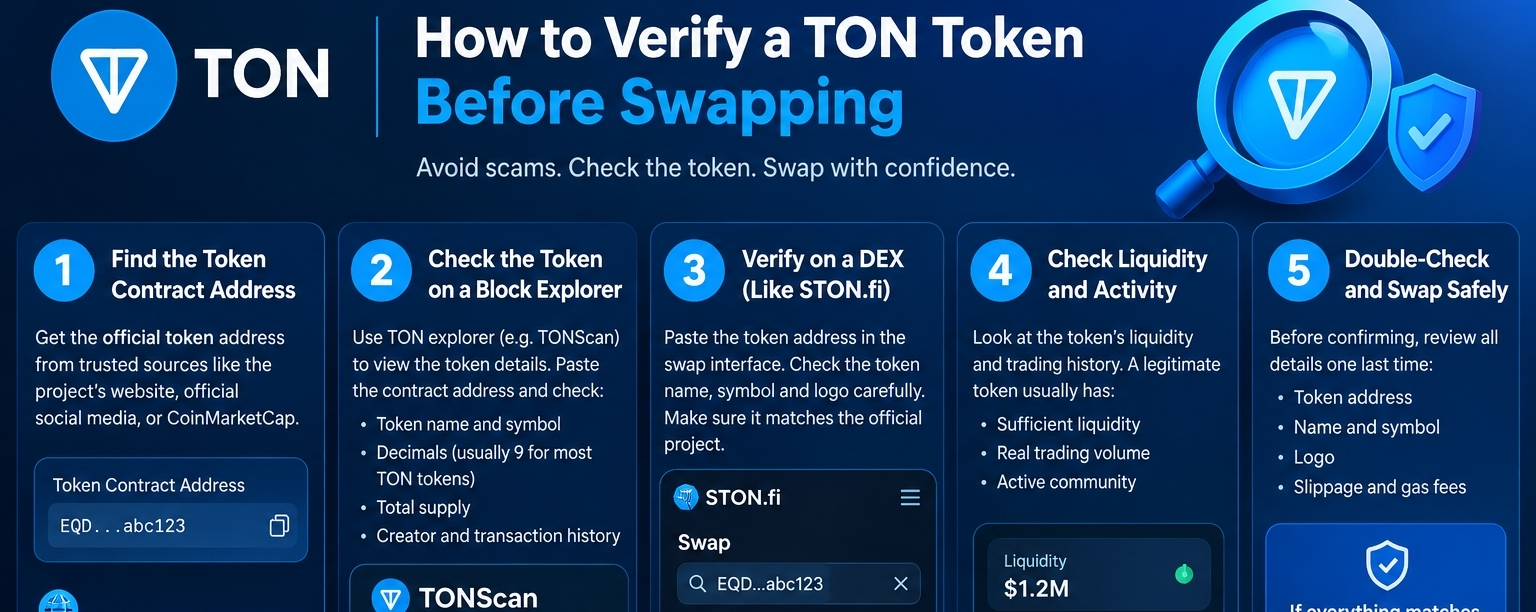

Finding a new token on a decentralized exchange does not automatically make it legitimate.
Before swapping an unfamiliar TON token, take a few minutes to verify its identity, examine its liquidity, and understand the risks.
Step 1: Verify the token address
Token names, symbols, and logos can be copied. A fake token may look almost identical to the asset you intended to find.
Start by obtaining the token's contract or address from the project's official sources. Confirm that it belongs to the correct network and compare it with available blockchain explorer information.
Never rely on a familiar name alone.
Step 2: Examine liquidity
Next, check whether a trading pool exists and whether it has meaningful liquidity.
Look at Total Value Locked (TVL), pool balances, and trading volume where available. Consider how your intended trade size compares with the pool's depth.
A token can technically be tradable while having so little liquidity that even a small swap produces substantial price impact.
Step 3: Read security warnings
DEX interfaces may display warnings for assets associated with suspicious behavior or known risks.
STON.fi provides token-related labels, including warnings such as Fake and Honeypot where applicable. These signals can help guide further investigation.
However, no warning does not mean a token is verified safe. Automated detection has limitations, and risks may remain undiscovered.
Do not treat a warning-free interface as a guarantee.
Step 4: Review the swap carefully
Before confirming a transaction on STON.fi:
1. Verify the token address and network.
2. Review the estimated amount and price impact.
3. Check minimum received and the blockchain fee.
4. Investigate unexpected warnings or unusual token mechanics.
5. Stop if the information remains unclear.
Importing a token by address can help locate it, but importing does not certify its legitimacy.
Final thoughts
Token research is about reducing uncertainty, not eliminating risk.
Verify the address, examine liquidity, review available warnings, and understand the transaction before signing.
In DeFi, taking time to verify an asset is part of protecting your wallet