


Moving crypto between blockchains sounds simple until you actually have to do it.
You may have USDT on TON but need an asset on Base. Or you may hold USDC on one network and want USDT on another.
That’s when two options usually come up: bridges and cross-chain swaps.
They can both move value between networks, but they work differently. Understanding the difference can help you choose a route based on what you actually need not just the fee you see on the screen.
What does a bridge do
A bridge is mainly designed to move an asset, or a representation of that asset, from one blockchain to another.
For example:
Asset on Ethereum → Asset on Base
Depending on the bridge architecture, you may receive a bridged or wrapped representation on the destination network.
That doesn't automatically make it bad. The important thing is knowing what you will actually receive before confirming the transaction.
A bridge can be useful when your main goal is simply
“I want this asset available on another blockchain."
What is a cross-chain swap
A cross-chain swap can combine two things:
Changing the network + changing the asset.
For example:
USDT on TON → USDC on Base
You're not simply moving USDT from TON to Base. You're also receiving a different asset.
This can matter because a bridge-first route may require several separate steps:
Bridge → receive asset → swap → pay another transaction fee
A cross-chain swap can instead be built around the destination asset you actually want.
Which one is cheaper?
This is where it's easy to make the wrong comparison.
Don't look only at the advertised transaction fee.
When comparing two routes, consider:
• Network/gas fees
• Cross-chain execution costs
• Exchange rate
• Price impact
• Additional swaps
• Number of transactions
• Final amount received
Imagine you start with $1,000.
If Route A leaves you with $991 worth of the asset you need, while Route B leaves you with $996, Route B produced the better overall result even if one individual fee displayed along the way looked higher.
The important question is:
How much value actually reaches my destination in the asset I need?
Where does Omniston fit?
This is where Omniston becomes relevant.
Omniston is designed to coordinate cross-chain swaps between supported networks and assets.
A practical example is moving from TON to Base.
STON.fi has a dedicated guide explaining this type of flow:
https://ston.fi/cross-chain-swap-from-ton-to-base
The point isn't simply to tell you to use one route.
It's to understand what you're doing before you sign.
Check:
Source: What asset and network am I sending?
Destination: What asset and network am I receiving?
Quote: How much should arrive?
Costs: What fees are involved?
Wallet: Is the destination address correct?
Execution: What conditions apply?
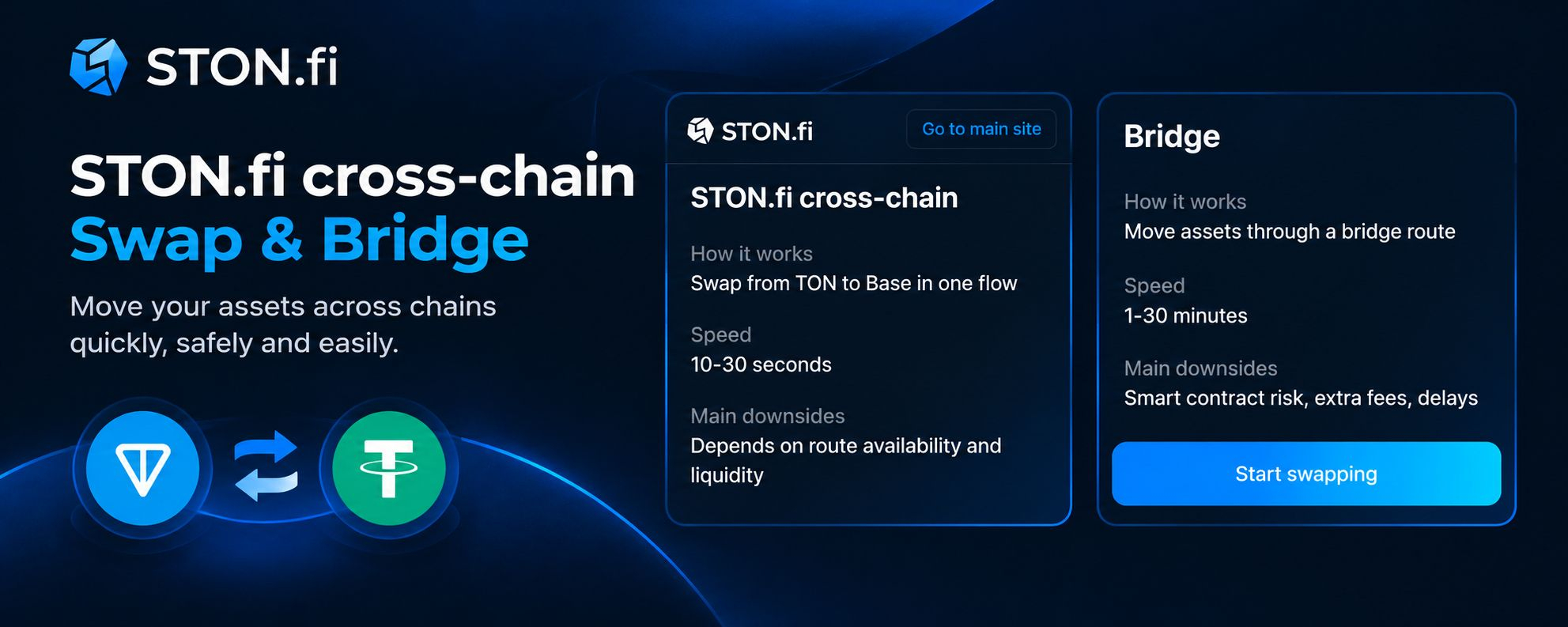
Bridge vs Cross-Chain Swap
Bridge
Main purpose: Move an asset between networks
Network changes: Usually
Asset can change: Not necessarily
Extra swap may be needed: Sometimes
Main thing to check: What arrives
Cross-chain swap
Main purpose: Exchange assets across networks
Network changes: Yes
Asset can change: Yes
Extra swap may be needed: Potentially reduced
Main thing to check: What you receive + total route cost
Neither option is automatically better for every situation.
It depends on where your asset is, what you want to receive, the available route, liquidity and the current quote.
The easiest way to remember it
If you're asking:
“How do I move this asset to another blockchain?”
You're probably looking at a bridge.
If you're asking:
“How do I turn this asset on one blockchain into another asset on a different blockchain?”
You're looking at a cross-chain swap.
Once you understand that distinction, comparing routes becomes much easier.
Before clicking Confirm
Take a few seconds to check:
✓ Source network
✓ Source token
✓ Destination network
✓ Destination token
✓ Expected amount
✓ Total costs
✓ Price impact
✓ Destination wallet
And always check the live quote immediately before signing. Routes, liquidity and pricing can change.
The goal isn't to find the route with the smallest advertised fee.
The goal is to understand the whole route and know exactly what you're receiving.
Educational content only. This is not financial advice. Always verify the current route, quote, network and destination address before confirming a transaction.