



#nil $NIL @Nillion Nillion is building a powerful infrastructure layer for a future where data can be both useful and private. As blockchain and AI applications become more advanced, the ability to securely store and compute sensitive information is becoming increasingly important. This is where Nillion’s approach to blind computation stands out.
What I find most interesting about Nillion is its core product, Covenants. The concept of allowing applications to work with protected data without exposing the underlying information could unlock completely new possibilities for Web3 and AI. Instead of forcing valuable information to become publicly visible before it can be used, Nillion aims to make encrypted data computationally useful.
This has major potential for areas such as AI agents, trading, financial applications, and other systems that handle sensitive information. Imagine AI agents that can work with private user data while keeping that information confidential, or trading applications that can process valuable strategies and information without unnecessarily exposing them. These are the kinds of use cases that make privacy-preserving infrastructure increasingly relevant.
Another development I am watching closely is Dusk, Nillion’s first release on Ethereum. Having Dusk live on Ethereum mainnet is an important milestone because it brings Nillion’s privacy-focused capabilities closer to one of the largest and most established blockchain ecosystems. It could provide developers with new opportunities to experiment with applications that require both blockchain connectivity and confidential computation.
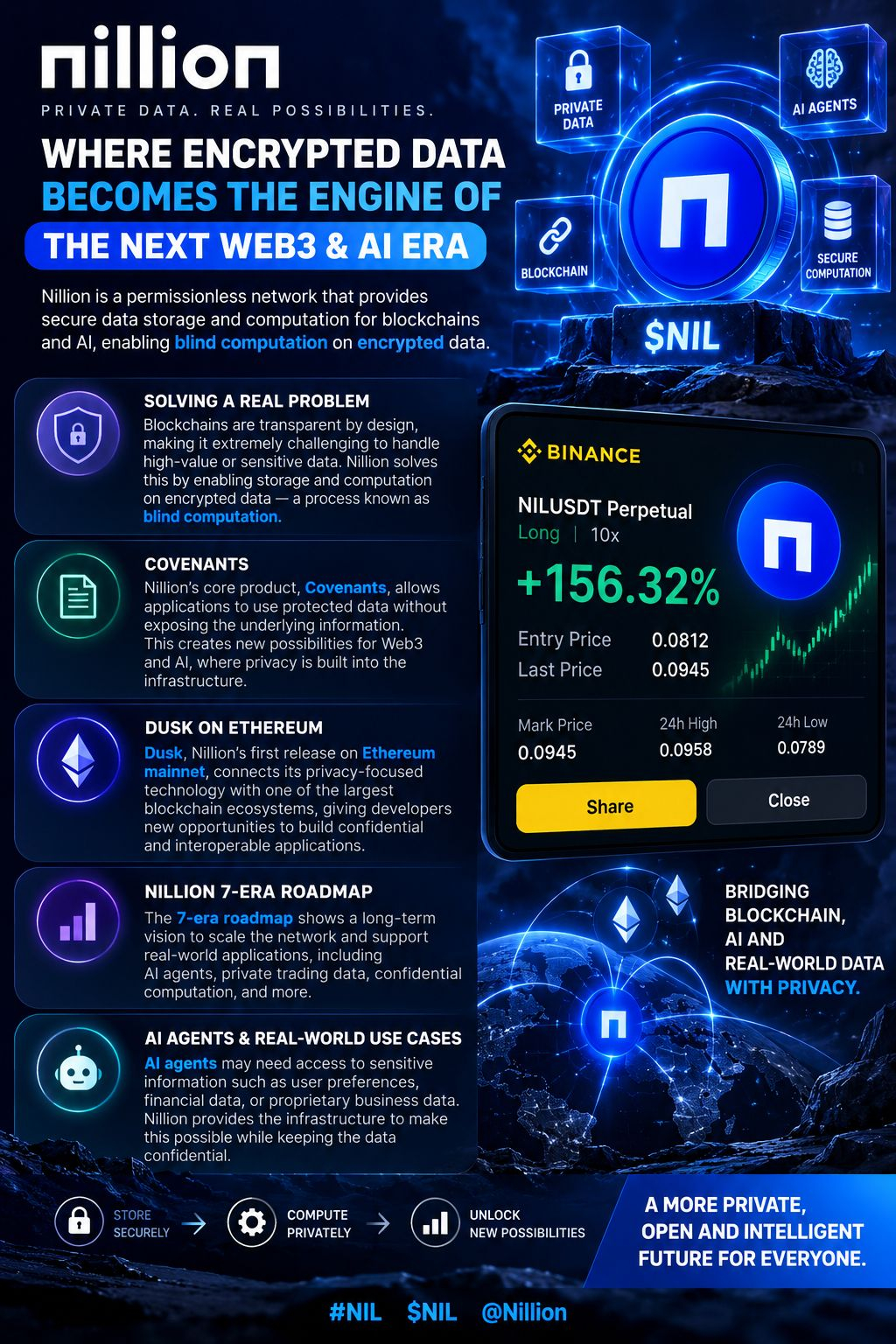
The Nillion 7-era roadmap also makes the project particularly interesting. I am most excited to see how the network evolves from infrastructure into practical applications that can support the growing intersection between Web3, AI, and private data.
The AI-agent sector could be especially important. As autonomous agents become capable of managing valuable information and performing increasingly complex tasks, privacy will become more than just a desirable feature. It could become a fundamental requirement. Agents may need access to personal preferences, financial information, proprietary business data, or other sensitive inputs while still maintaining confidentiality.
That is why Nillion’s vision is compelling to me. The opportunity is not simply to encrypt data, but to make encrypted data usable for computation without sacrificing privacy.
Covenants, Dusk, and the broader 7-era roadmap give the ecosystem several interesting areas to watch. If Nillion can scale its technology and translate its infrastructure into real-world applications, privacy-preserving computation could become an important building block for the next generation of Web3 and AI.
For me, Nillion represents an intriguing direction: a future where data does not have to be exposed in order to create value from it.
