


🌍 #PositiveMindsGlobalResults | Binance Square | October 10, 2026
Historical market trends suggest that the S&P 500 could see further gains following the 2026 US midterm elections. However, inflation, interest rates, corporate earnings, and broader economic conditions will remain key factors influencing market performance.
As the November 2026 midterm elections approach, investors are closely watching how political uncertainty could affect US equities and broader financial markets. Historical data suggests that midterm election years have often been followed by strong stock market performance, with the fourth quarter frequently marking a turning point for equities.
Although history offers reasons for cautious optimism, past performance does not guarantee that the same pattern will repeat in 2026.
1. Historical Data Points to Strong Post-Midterm Returns
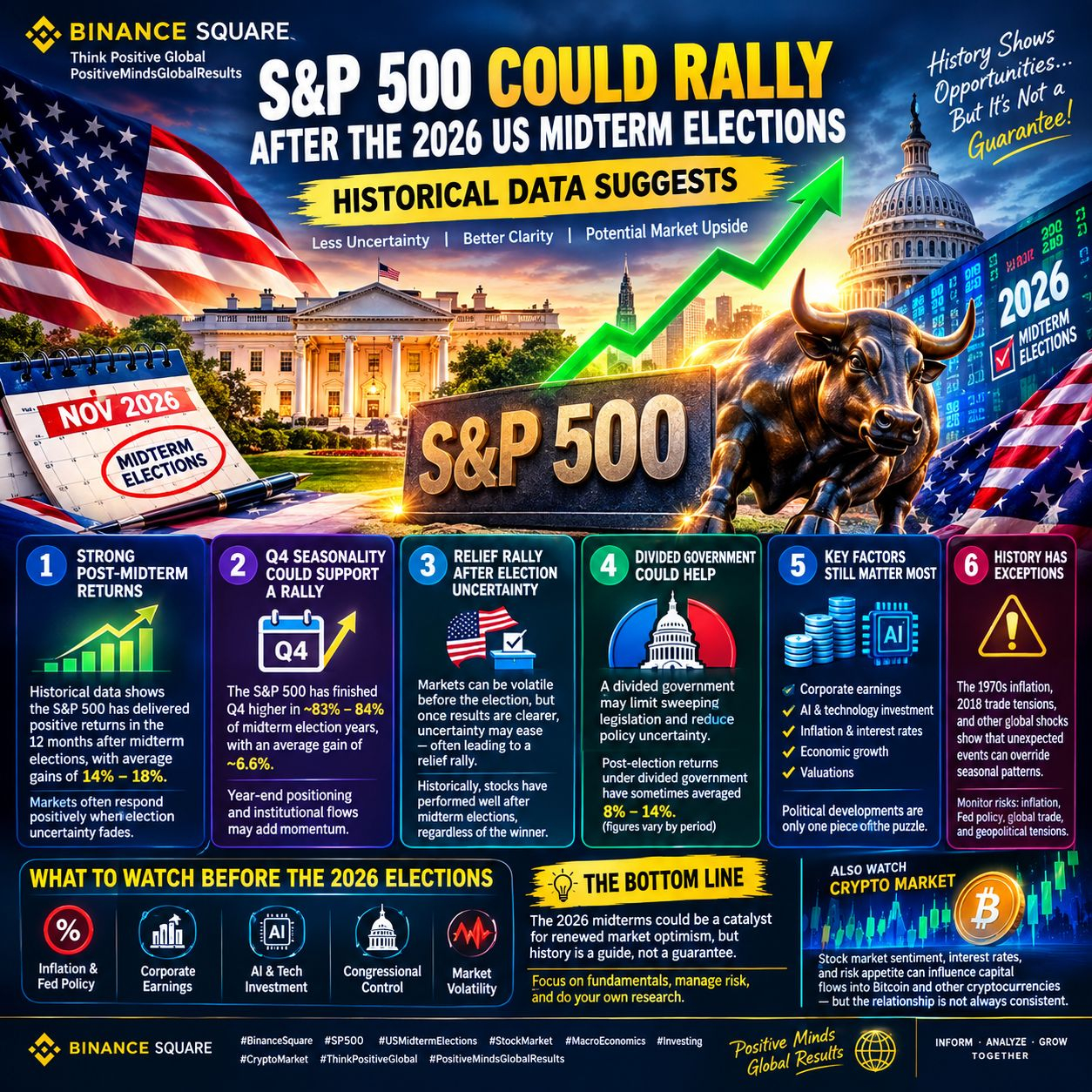
Historical analysis of US stock market performance suggests that the S&P 500 has delivered positive returns in the 12 months following every midterm election in several commonly cited datasets dating back to the mid-20th century.
Average returns over these post-election periods are often reported in the range of 14% to 18%, although the precise figures depend on the dataset, measurement period, and calculation methodology.
One possible explanation is that markets respond positively when election uncertainty begins to fade. Greater clarity about congressional control and potential policy changes can help businesses and investors make more informed decisions.
Nevertheless, these historical patterns should be viewed as statistical tendencies rather than reliable forecasts of future returns.
2. Q4 Seasonality Could Support a Market Rally
The fourth quarter has historically been an important period for US equities during midterm election years.
According to historical figures commonly cited in market analysis, the S&P 500 has finished the fourth quarter higher in approximately 83% to 84% of midterm election years, with an average gain of around 6.6%.
This pattern suggests that the final months of a midterm election year can offer a more favorable environment for stocks, particularly when political uncertainty subsides and economic fundamentals remain supportive.
Institutional portfolio adjustments and year-end positioning may also influence market movements. However, seasonal trends alone cannot determine whether the S&P 500 will rally in the final quarter of 2026.
3. Election Uncertainty Could Give Way to a Relief Rally
Before election day, financial markets may experience heightened volatility as investors assess opinion polls, fiscal proposals, potential tax changes, and the possibility of shifts in congressional control.
Once the election results become clearer, some of that uncertainty may ease, potentially supporting a relief rally in equities.
Historically, stocks have often performed well following US midterm elections, regardless of which political party wins. This suggests that reduced uncertainty can be an important market driver.
However, the market's reaction will depend on whether the election outcome meets investor expectations and how the resulting political balance affects government spending, taxation, regulation, and economic growth.
4. Why Divided Government Could Matter in 2026
A divided government occurs when control of the White House and Congress is split between political parties, or when congressional control is divided between the two chambers.
Some investors view this arrangement as potentially supportive of equities because it can limit sweeping legislative changes and reduce uncertainty surrounding certain tax, spending, and regulatory proposals.
Historical analyses cited in market commentary suggest that post-election stock returns under divided government have sometimes averaged between 8% and 14%. However, these figures should be interpreted cautiously because outcomes vary according to the historical period, political configuration, and return horizon examined.
If the 2026 elections result in divided government, investors may view the outcome as a source of policy continuity. Nevertheless, the actual market impact will depend on the election results and their implications for fiscal policy and the wider economy.
5. Corporate Earnings, AI Investment, and Interest Rates Remain Crucial
Political developments are only one part of the broader market outlook.
Over the longer term, the S&P 500's performance will continue to depend heavily on corporate earnings, economic growth, inflation, interest rates, and investor valuations.
Continued investment in artificial intelligence, data centers, and technology infrastructure could support earnings growth and business productivity. If corporate earnings remain resilient in the third and fourth quarters of 2026, they could provide additional support for equities.
On the other hand, persistent inflation, tighter monetary policy, disappointing earnings, or a weakening economy could outweigh any positive effects associated with the election cycle.
For this reason, investors should evaluate historical market patterns alongside current economic data rather than relying on election-related seasonality alone.
6. Historical Exceptions Show Why Caution Is Necessary
Although post-midterm market performance has historically been strong, gains are not guaranteed.
Broader economic and geopolitical developments can override seasonal patterns. For example, the inflationary pressures and restrictive monetary conditions of the late 1970s, as well as the US-China trade tensions and Federal Reserve tightening of 2018, illustrate how economic risks can weigh on equity markets.
These examples highlight the importance of monitoring inflation, central bank policy, corporate earnings, global trade developments, and overall financial conditions.
Even when historical indicators appear favorable, unexpected economic shocks can significantly alter the market outlook.
7. Key Factors Investors Should Watch Before the 2026 Elections
As the US midterm elections approach, investors should pay close attention to several indicators that could influence the S&P 500:
Inflation and Federal Reserve policy: Changes in inflation and interest-rate expectations can affect equity valuations and investor risk appetite.
Corporate earnings: Earnings growth and company guidance will help determine whether stock market gains are supported by fundamentals.
AI and technology investment: Continued spending on AI infrastructure and data centers could support growth, although high valuations remain a potential risk.
Congressional control: The election outcome could influence expectations for taxation, government spending, regulation, and fiscal policy.
Market volatility: A reduction in political uncertainty could support a relief rally, while unexpected results could trigger further volatility.
Together, these factors will help determine whether the historical post-midterm pattern remains relevant to the market outlook for 2026 and 2027.
Conclusion: Could the S&P 500 Rally After the 2026 Midterms?
Historical data offers reasons for cautious optimism about the S&P 500 following the 2026 US midterm elections. Strong post-midterm returns and favorable fourth-quarter seasonality suggest that equities could benefit if political uncertainty declines and economic fundamentals remain supportive.
However, history is a guide, not a guarantee. The direction of the market will ultimately depend on the interaction between election results, inflation, interest rates, corporate earnings, and broader economic conditions.
For cryptocurrency investors, the US stock market is also worth watching. Changes in equity market sentiment, interest-rate expectations, and overall risk appetite can influence capital flows into and out of risk-sensitive assets, including Bitcoin and other cryptocurrencies. However, the relationship is not always consistent.
The key takeaway: The 2026 midterm elections could provide a catalyst for renewed market optimism, but investors should continue to prioritize economic fundamentals, risk management, and independent research over historical patterns alone.
Disclaimer: This article is for informational and educational purposes only and does not constitute financial or investment advice. Historical performance does not guarantee future results. Always conduct your own research before making investment decisions.
#BinanceSquare #SP500 #USMidtermElections #StockMarket #MacroEconomics #Investing #CryptoMarket #ThinkPositiveGlobal #PositiveMindsGlobalResults
