


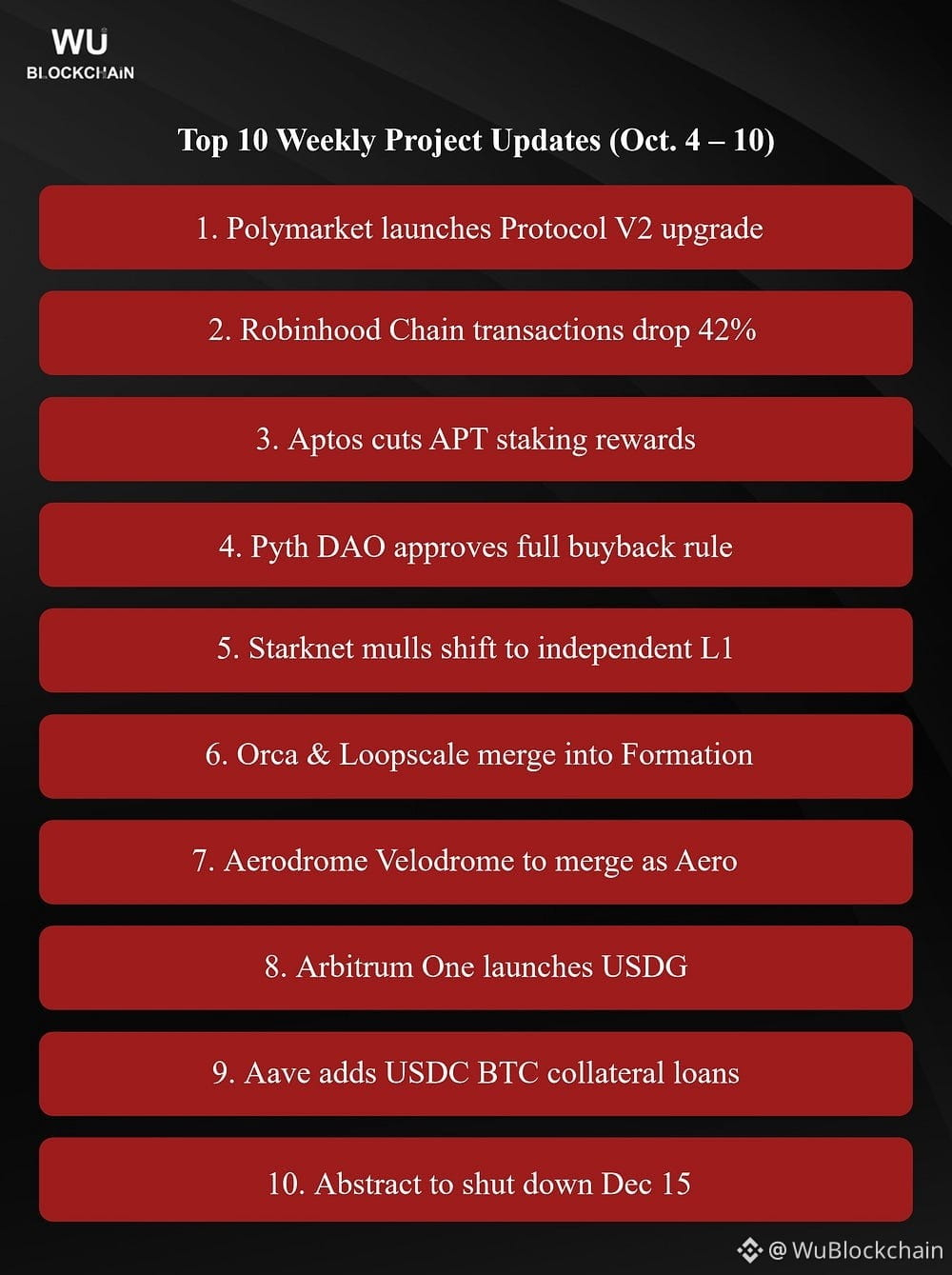
1. Polymarket Launches Protocol V2 with Full Contract Overhaul, Mainnet Switch on Nov 2 link
Polymarket Protocol lead Rajath Alex announced the launch of Polymarket Protocol V2, which fully rebuilds the Gnosis Conditional Tokens Framework (CTF) used since 2019. The V2 architecture unifies position token contracts into a single ERC-1155 standard, uses pUSD exclusively as collateral, and provides one unified exchange and router for all market types. Its modular design natively supports binary, atomic negative-risk, incremental negative-risk and combinatorial markets. It also introduces OracleAggregator enabling integration with multiple oracle sources including UMA and Chainlink, plus a native cross-chain bridging module. The official mainnet testing runs from October 5 to 30, with full migration for new markets scheduled for November 2, alongside the release of the Rust-based Data API V2.
2. Robinhood Chain Transactions Drop 42% Since Mid-September, DeFi TVL Rises 2% MoM link
From October 2 to 8, Robinhood Chain recorded an average of 6.2 million daily transactions, a 42% drop from 10.8 million during September 10–16 and a 20% week-on-week decline. Average daily active addresses stood at approximately 322,000, down 31% from mid-September. In the same period, on-chain spot trading volume reached $7.45 billion, falling 21% week-on-week, while average daily network fees were around $65,000, representing a 39% week-on-week decrease. Nevertheless, on-chain DeFi total value locked rose roughly 2% to $1.04 billion, and stablecoin supply edged up to about $1.1 billion. Robinhood has extended its wallet fee subsidy to December 31, continuing to cover network fees for token swaps exceeding $0.50 executed via Robinhood Wallet.
3. Aptos Foundation Proposes Cutting APT Staking Rewards to 2.6%, Capping Supply at 2.1B and Permanently Locking 210M Tokens link
The Aptos Foundation unveiled its tokenomics adjustment plan, proposing a governance proposal to cut the annual APT staking reward rate from 5.19% to 2.6%, raise gas fees tenfold, and set a hard cap of 2.1 billion APT on total supply. The foundation commits to permanently locking and staking 210 million APT, approximately 18% of the current supply. It will not sell or distribute these tokens and will rely solely on staking rewards to support operations. The foundation also plans to tie future ecosystem grants to performance metrics and explore APT buybacks using cash and future revenue. With the conclusion of the initial token unlocking cycle in October 2026, annual unlock volume is projected to drop by 60%. The foundation aims to gradually shift APT toward a deflationary state by reducing new supply, increasing transaction fee burns and enabling potential buybacks.
4. Pyth DAO Approves 100% Rule, All Revenue for PYTH Buybacks link
Pyth Network, an oracle network, released its Q3 2026 financial report. Its active annual recurring revenue (ARR) reached $11.49 million, up 86.5% quarter-on-quarter with a net ARR addition of $5.33 million in Q3, and the number of paying customers hit 276. Among its three core business segments, Pyth captured a 94.1% data share in the RWA perpetual contract market with a Q3 volume of $2.09 trillion. It provides pricing data for prediction markets including Polymarket and Kalshi, and partners with Exa to deliver structured market data for AI agents via MCP. In addition, Pyth became an external data distributor for Nasdaq Basic real-time US equities feeds. The PYTH DAO also voted to adopt the “100% Rule”, allocating all external revenue generated by protocol products to open-market buybacks of PYTH tokens, up from the previous one-third ratio.
5. StarkWare CEO Warns of Quantum Risks; Starknet Considers Independent L1 for Post-Quantum Upgrade link
StarkWare CEO Eli Ben-Sasson stated in a post that as breakthroughs in quantum computing and AI computing power draw near, blockchain security faces urgent threats. Networks need post-quantum cryptography via ZK-STARKs and crypto agility. He noted that while Starknet has its own post-quantum migration roadmap and is on track to achieve post-quantum readiness in 2027, as an L2 it currently heavily relies on the underlying security of Ethereum L1. Ethereum targets full L1 post-quantum capability by the end of 2029, and Bitcoin has yet to establish a timeline. Instead of waiting passively, Starknet is evaluating multiple options including “becoming an independent L1” to take control of its security upgrade schedule and build a base public chain resilient to quantum and AI risks.
6. Solana DEX Orca and Lending Protocol Loopscale Merge into Formation link
Orca, a decentralized exchange on Solana, and lending protocol Loopscale have merged and rebranded as Formation. Luke Truitt, co-founder of Loopscale, will serve as CEO. Formation will combine Orca’s trading infrastructure with Loopscale’s lending and investment vault products to deliver end-to-end services for emerging assets spanning issuance, financing and trading. It plans to expand into capital-intensive sectors including AI, energy, robotics and defense, ultimately granting these assets access to regulated US capital markets. Over the next 12 months, Formation will launch tools for asset issuers and new investment strategies. It has partnered with Figure, Shinhan Asset Management, Superstate, R3 and Securitize to facilitate asset market entry and distribution.
7. Aerodrome and Velodrome to Merge and Upgrade to Aero on Oct 22, Initial Supply ~2.11B link
Aerodrome and Velodrome will merge and upgrade into Aero at 08:00 UTC+8 on October 22, consolidating their liquidity businesses within the Ethereum ecosystem. Existing AERO tokens can be swapped for new AERO at a 1:1 ratio, while VELO tokens can be exchanged at approximately 1:0.044. veAERO and veVELO holders may upgrade to staking token sAERO, enabling cross-chain allocation of AERO incentives and claims to trading revenue from corresponding liquidity pools. The initial total supply of the new AERO is projected at roughly 2.11 billion tokens, with 94.5% allocated to Aerodrome holders and 5.5% to Velodrome holders. After the upgrade, emissions of the original AERO and VELO tokens will cease, and new AERO emissions plus conversion channels will go live simultaneously.
8. Arbitrum One Goes Live with USDG, Plans 100M ARB Incentive Boost link
Arbitrum One has natively launched USDG, the stablecoin issued by Paxos, and joined the Global Dollar Network. Fluid, Morpho, GMX, Maple, Kraken, Stargate and LayerZero are among the first batch of integrators. Partners of the Global Dollar Network can share yields generated by the USDG reserve assets held on the platform, and such revenue will be used to drive USDG adoption and project integrations within the Arbitrum ecosystem. Separately, a new governance proposal seeks to designate USDG growth as a strategic objective of ArbitrumDAO and add 100 million ARB to the DRIP incentive program, though the proposal has not yet been put to a vote.
9. USDC Integrated into Aave Market; Eligible Users May Borrow USDC Against BTC Collateral link
Circle’s USDC official announcement states that Aave markets have integrated Circle Mint’s Digital Asset-Backed Borrowing product. Eligible Circle Mint LLC customers may deposit BTC, mint Circle Wrapped Bitcoin (cirBTC), and borrow USDC via Arc or supported third-party lending markets on Ethereum. The addition of Aave expands the existing BTC-backed borrowing service previously available on Morpho. The relevant USDC is supplied by third-party market lenders, with loan-to-value ratios, interest rates and liquidation rules determined by the corresponding lending protocols.
10. Abstract to Shut Down on Dec 15; Igloo Reports Tens of Millions in Losses Over Two Years link
Consumer-focused crypto network Abstract announced it will wind down operations gradually and officially shut down the network on December 15, 2026. Users must migrate their assets via the Migration Hub or native cross-chain bridge before this date; funds left untransferred after the deadline will become inaccessible. Igloo, Abstract’s parent company, stated that operating an independent blockchain incurred excessive costs, compounded by insufficient on-chain liquidity, a constrained DeFi ecosystem and declining market demand, leaving Abstract unable to achieve sustainable product-market fit. Igloo also noted it has lost tens of millions of US dollars over the past two years sustaining Abstract’s operations and searching for a viable path to profitability. Following Abstract’s shutdown, Igloo will refocus its personnel and resources on Pudgy Penguins, Pudgy NFTs and PENGU.
Follow us
Twitter: https://twitter.com/WuBlockchain
Telegram: https://t.me/wublockchainenglish