



Fed Watch: NFP Day Under Warsh’s New Framework – What Traders Need to Know
Today, October 2, 2026, markets stand at a pivotal moment. The U.S. September Nonfarm Payrolls (NFP) report is due around 12:30 UTC, arriving against the backdrop of a freshly recalibrated Federal Reserve under Chair Kevin Warsh. Here’s a clear, complete synthesis of the current landscape — expectations, policy path, framework, and implications — so you finish with full context and fresh ideas.
The Immediate Catalyst: September NFP
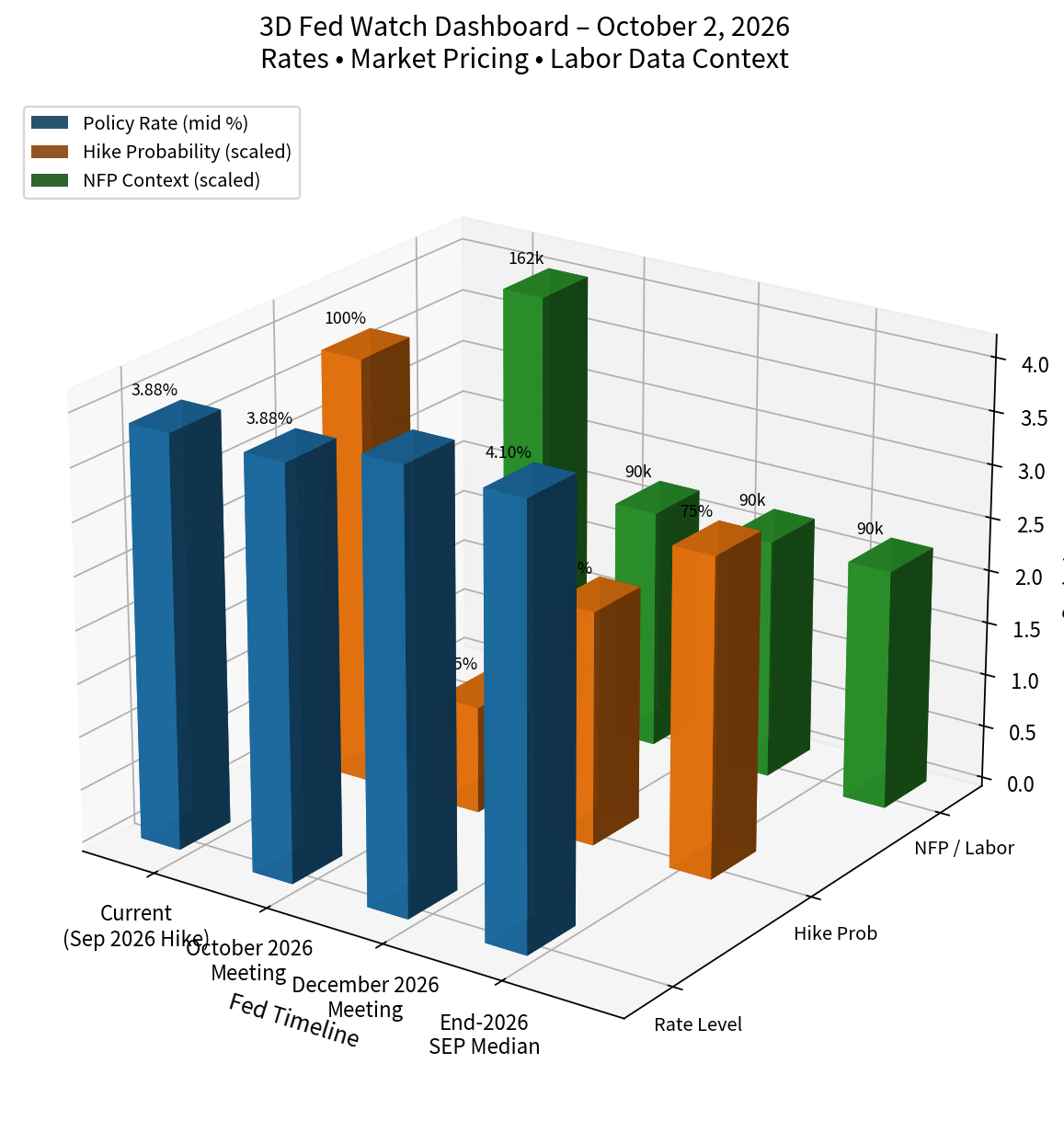
Consensus expectations center on a moderation in hiring: roughly +90,000 jobs (range mostly 84k–100k), unemployment steady at 4.1%, and average hourly earnings around +0.3% month-over-month. This follows August’s strong +162,000 print (far above the ~56k forecast), which helped set the stage for the Fed’s September rate hike.
A significant upside surprise (well above 100k with firm wages) would reinforce labor resilience and could revive near-term tightening expectations. A clear miss would ease pressure and support a more patient stance. Either way, the data will influence pricing for the dollar, Treasury yields, gold, and equities — and by extension risk assets including crypto.
Where Fed Policy Stands Right Now
The federal funds target range is 3.75%–4.00% after a unanimous 25 bp hike in mid-September — the first increase in years. The accompanying Summary of Economic Projections showed a median year-end 2026 rate of 4.1%, with most participants seeing at least one more hike this year.
Market pricing has shifted meaningfully in recent days. Odds of another hike at the late-October meeting have fallen to around 25% or lower (hold strongly favored), down from peaks near 70%. Soft August core PCE data and comments from senior officials emphasizing “no need for urgency” and the value of additional data drove the recalibration. December remains the more probable window for any further move in the base case. Cumulative expectations still point to a modest further tightening by year-end rather than a rapid series of hikes. The path is firmly data-dependent.
Kevin Warsh’s Policy Framework
Warsh has outlined a distinct approach that prioritizes results over prediction:
A firm, fixed 2% PCE inflation target. Price stability is not automatic; the Fed must deliver it. He has explicitly accepted institutional responsibility for prolonged elevated inflation.
A “quieter Fed”: reduced traditional forward guidance, shorter statements, and no personal contribution to the dot plot. The goal is for markets to focus on economic data (“play the ball”) rather than constantly decoding Fed signals (“the referee”).
Greater weight on broad financial conditions (asset prices, credit availability and cost, the dollar, Treasuries, commodities) and the role of money and credit creation.
Short-term interest rates as the primary tool; unconventional measures used sparingly.
Explicit view that the dual mandate is compatible — controlling inflation does not require deliberately harming a healthy labor market.
Ongoing institutional reviews via task forces covering communications, the balance sheet, inflation frameworks, data quality, productivity/jobs, and AI’s implications for the economy and policy.
The style is adaptive and meeting-by-meeting rather than pre-committed to a rate path.
Is This Framework Constructive for the U.S. Economy?
It carries clear potential benefits in the current context of multi-year inflation overshoots and still-resilient growth and employment:
Stronger credibility around the inflation target can re-anchor expectations, protect real incomes, and support better long-term capital allocation.
Greater flexibility reduces the risk of policy inertia.
Attention to financial conditions and money provides a broader information set.
Preference for a disciplined balance sheet limits certain distortions.
Risks exist as well: reduced explicit guidance can raise near-term uncertainty and market volatility; heavy focus on financial conditions requires careful judgment to avoid pro-cyclicality; and any transition carries implementation challenges. Success will ultimately be measured by outcomes — sustainable return of inflation to target alongside solid employment and growth — rather than by the principles alone. In a resilient real economy with elevated inflation, the emphasis on delivering price stability has a coherent economic logic, provided it is applied judiciously.
Forward Look and Ideas for Traders
Today’s NFP is the next data point in a regime that values incoming information over pre-announced paths. Strong data could firm the dollar and yields while pressuring gold; softer data could do the opposite and support risk appetite. Over a longer horizon, a Fed that speaks less, watches financial conditions closely, and prioritizes inflation credibility may produce different liquidity and volatility patterns than the heavy-guidance era.
This environment rewards preparation over prediction: scenario planning around the full NFP suite (headline, unemployment, wages, revisions), monitoring how yields and the dollar respond, and considering how shifts in real rates and risk sentiment flow through to crypto and other assets. The quiet shift in Fed communication style itself may become a structural factor — less hand-holding can mean sharper moves when data surprises, but also cleaner market signals over time.
Stay focused on the data, the framework’s emphasis on results, and the evolving path. The combination of today’s labor report and Warsh’s approach sets the tone for the final quarter of 2026.



#BitcoinSurpasses$86KUp2.99% #ZcashFalls21%FromSeptemberPeak #XRPPostsFirstThreeGreenMonthsInQ3 #BitcoinRisesToward$85K
Click Here For Article "Evernorth XRP Treasury Clears Final Shareholder Hurdle"
Click Here For Article "IMF Approves 138Million Dollar Disbursement for EL Salvador"