

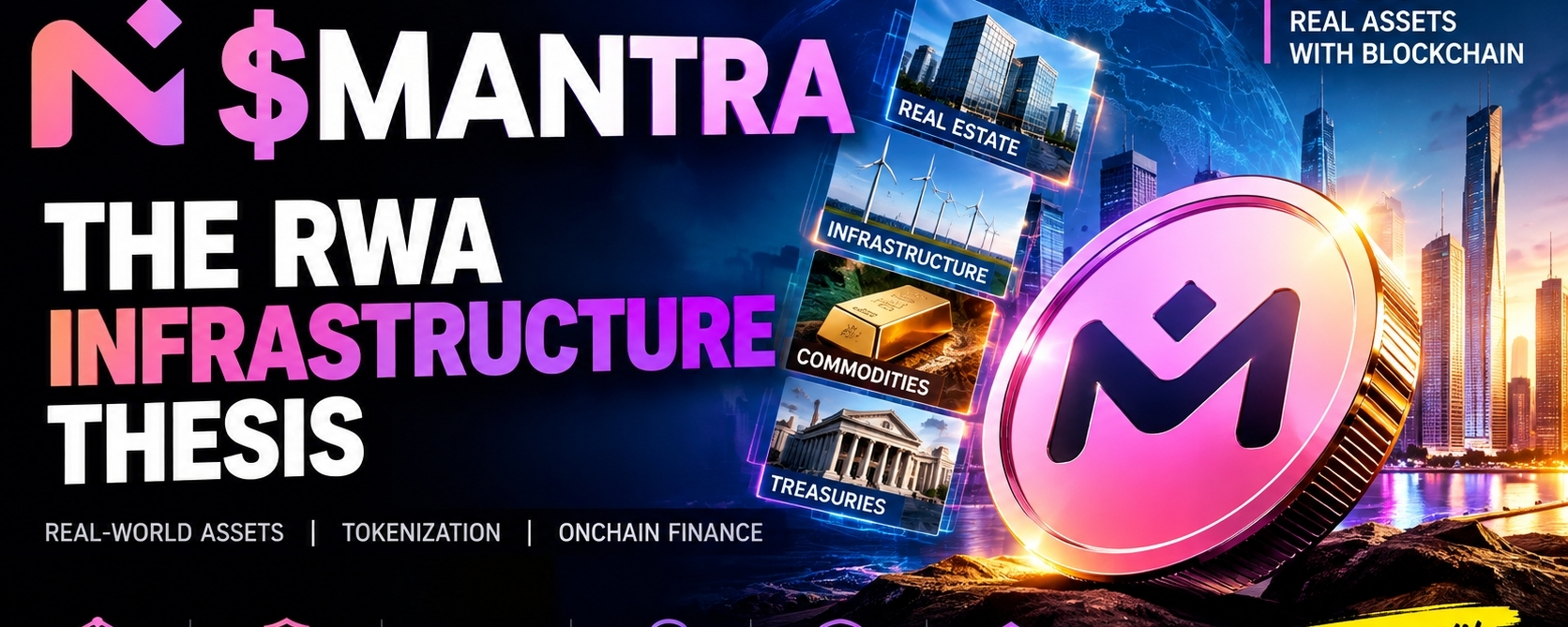

MANTRA is positioning itself as an EVM-compatible Layer-1 blockchain purpose-built for Real-World Assets (RWAs).
The core thesis is simple:
Bring regulated financial assets onchain — and build the infrastructure required to make them usable.
🏦 WHAT IS MANTRA?
MANTRA Chain is designed specifically around tokenization, regulatory compliance and institutional use cases.
Rather than being a general-purpose blockchain that later added an RWA narrative, MANTRA built its Layer-1 around the requirements of real-world financial assets.
Its infrastructure supports:
• RWA tokenization
• Permissioned applications
• EVM smart contracts
• Cross-chain interoperability
• Staking and governance
• Onchain financial applications
• Institutional-focused infrastructure
MANTRA describes its model as a permissionless chain for permissioned applications.
That distinction is important for institutional RWAs, where regulatory requirements can be fundamentally different from those of purely permissionless DeFi.
🪙 WHAT IS $MANTRA?
$MANTRA is the native staking coin of MANTRA Chain.
Its functions include:
SECURITY
$MANTRA is used to secure the network through delegated proof-of-stake.
GOVERNANCE
Token holders participate in the network's governance process.
NETWORK ECONOMICS
The token is integrated into the chain's fee and incentive structure.
ECOSYSTEM UTILITY
As applications and RWA markets develop on MANTRA, the native token sits at the base-layer infrastructure level.
🔄 THE OM → MANTRA TRANSITION
One important point for existing holders:
The former $OM ticker transitioned to $MANTRA through a 1:4 redenomination.
1 OM → 4 MANTRA
This was a denomination change rather than a simple 4× increase in economic value.
The price was correspondingly divided by four while token balances increased fourfold, leaving the holder's value unchanged at the point of conversion.
The new maximum supply is 10 billion MANTRA.
📊 TOKENOMICS
According to MANTRA's current dashboard:
Circulating supply: ~6.55B
Total supply: ~8.21B
Maximum supply: 10B
That means approximately 65.5% of maximum supply is currently circulating.
The remaining supply is associated with categories including ecosystem allocations, contributors, investors and airdrops.
There is also an important inflation component.
MANTRA's current documented inflation rate is 8%, with 60% of inflation allocated toward staking rewards and 40% toward community rewards while the network bootstraps.
⚠️ THIS IS IMPORTANT
MANTRA isn't simply a "cheap RWA token."
Investors need to consider:
RWA adoption + network usage + token demand
against
inflation + remaining supply + execution risk.
That is one of the biggest parts of the MANTRA thesis.
🏗️ THE RWA DIFFERENTIATOR
The broader RWA sector includes several different infrastructure models.
Some projects focus primarily on:
Tokenizing assets
Others focus on:
Credit / lending
Others focus on:
Institutional settlement infrastructure
MANTRA's approach is broader:
A dedicated Layer-1 designed to support regulated RWA applications.
The network is intended to provide the underlying infrastructure while applications can build financial products on top.
MANTRA also operates MANTRA Finance and has developed an ecosystem around tokenization and onchain financial markets.
💵 mantraUSD
Another interesting component is mantraUSD, an ecosystem stablecoin backed by U.S. Treasury assets through M^0 infrastructure.
The objective is to create a stable asset that can function within the MANTRA ecosystem and connect RWA yield with onchain applications.
This is strategically important because an RWA ecosystem needs more than tokenized assets.
It needs:
Assets → Stablecoins → Liquidity → Trading → Lending → Applications
If MANTRA can develop that full stack, the network's utility could extend considerably beyond simply issuing RWA tokens.
🚨 THE BIGGEST RISK
MANTRA also has significant execution and security risks.
In August 2026, MANTRA Chain experienced a security incident involving an upstream software dependency. The network temporarily halted block production and froze transactions while developers investigated and prepared a patched release. The incident also pushed the token to a reported record low at the time.
That event is important because institutional adoption requires reliability, security and operational confidence.
So the MANTRA thesis isn't risk-free.
🔥 WHAT COULD DRIVE THE NEXT PHASE?
The major catalysts to watch are:
1. RWA adoption
More real-world assets being issued on MANTRA.
2. Institutional activity
Banks, asset managers and financial institutions using the infrastructure.
3. Network activity
Growing transactions, applications, users and fees.
4. Stablecoin growth
Greater usage of mantraUSD and other ecosystem liquidity.
5. EVM ecosystem expansion
More Solidity-based applications deploying on MANTRA.
6. Token demand
Increasing network activity translating into actual demand for $MANTRA.
🧠 THE BIG QUESTION
The question isn't:
"Can MANTRA become another RWA token?"
There are already many competitors.
The more important question is:
Can MANTRA become meaningful infrastructure for regulated financial assets moving onchain?
If the answer eventually becomes yes, the investment thesis becomes much more interesting.
But that outcome depends on actual adoption, network usage, institutional execution and token economics — not simply the size of the RWA narrative.
FINAL TAKE
$MANTRA represents a high-beta RWA infrastructure thesis.
Its strongest argument is its specialization:
**RWA-focused L1
regulatory infrastructure
EVM compatibility
tokenization
stablecoin infrastructure
staking
institutional focus**
The counterargument is equally important:
**Inflation
remaining supply
security/execution risk
intense RWA competition
the need to convert partnerships and infrastructure into measurable network usage.**
For me, the key metric isn't simply the MANTRA price.
It's:
ARE REAL-WORLD ASSETS ACTUALLY MOVING ON MANTRA?
Because if adoption follows infrastructure, the token utility becomes much easier to understand.
$MANTRA | RWA | TOKENIZATION | LAYER-1 | REAL-WORLD FINANCE