

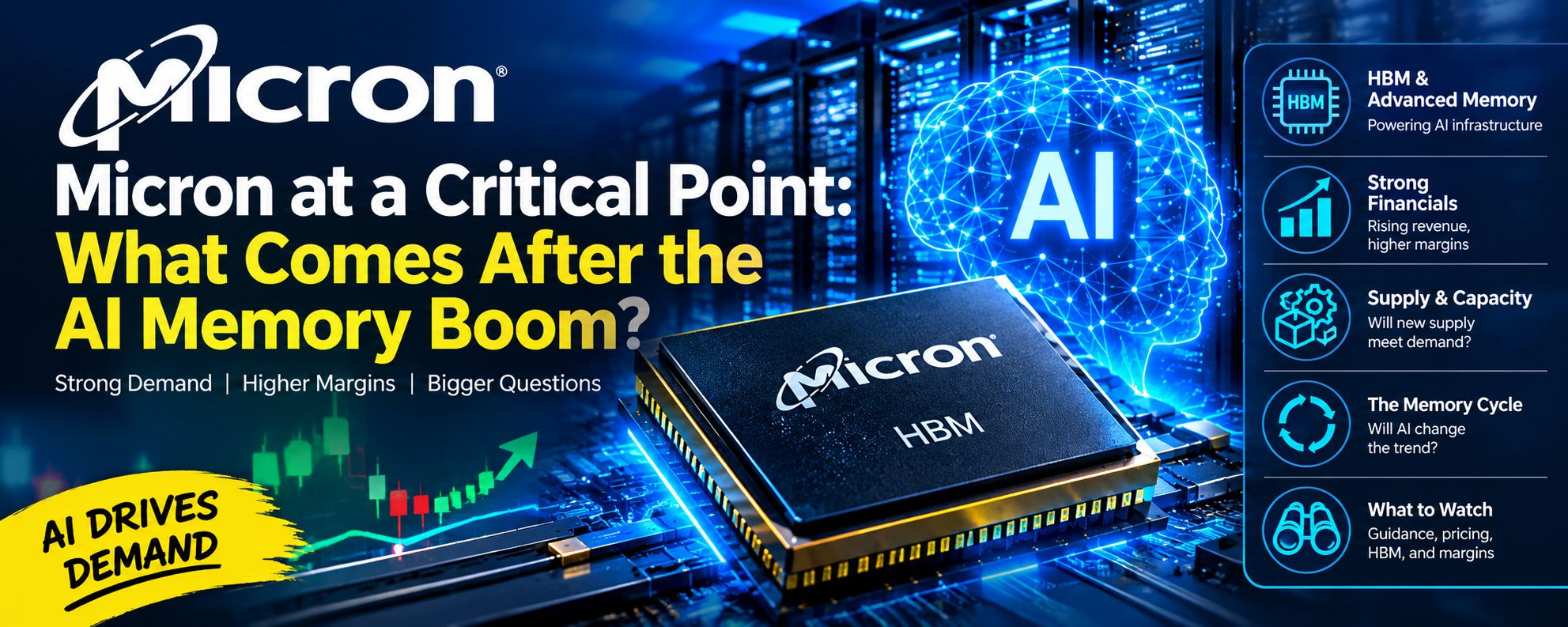


Micron Technology $MU has become one of the clearest examples of how AI infrastructure is changing the semiconductor industry.
But as the company approaches its next earnings report, I think the more interesting story is no longer just AI demand.
It is what happens if that demand remains strong while the memory industry moves into its next phase.
A Different Memory Market
For years, memory stocks were heavily influenced by the traditional cycle of oversupply, falling prices, production cuts, and eventual recovery.
AI is adding a new layer to that cycle.
High-bandwidth memory (HBM), advanced DRAM, and data-center memory are becoming increasingly important as AI systems require much greater amounts of high-performance memory.
That gives companies such as Micron an opportunity to benefit from a stronger mix of products rather than depending only on traditional PC and smartphone demand.
The Numbers Are Strong
Micron's recent financial performance shows just how significant the current cycle has become.
Revenue has accelerated sharply, while gross margins have reached levels that would have looked unusual during weaker parts of the previous memory cycles.
The important question now is whether these economics can continue as customers increase their AI infrastructure spending.
A strong quarter would confirm current demand.
But future guidance will tell us much more about the durability of that demand.
Where I See the Uncertainty
The biggest uncertainty is supply.
When an industry experiences strong pricing and attractive margins, manufacturers naturally have an incentive to invest in additional capacity.
That does not necessarily create an immediate problem. Building advanced memory capacity takes time.
However, if supply eventually catches up with demand, pricing power could weaken.
There is also another possibility: AI demand could continue growing quickly enough to absorb new capacity.
That is why the next several quarters may be more important than any single earnings report.
HBM Could Be the Key Variable
I will be paying particular attention to HBM.
If HBM becomes a larger and more profitable part of Micron's business, the company could have a different earnings profile from previous memory cycles.
But investors should also remember that strong demand does not automatically mean unlimited margins.
Competition, manufacturing costs, capital spending, customer concentration, and future capacity all matter.
What I Want to See From Micron
Instead of focusing only on whether the company beats estimates, I want to hear management discuss:
• HBM demand and future production
• Data-center memory growth
• Pricing trends across DRAM and NAND
• Customer commitments
• Capital expenditure plans
• Expected margins over the next few quarters
Those details could help determine whether today's exceptional conditions are becoming more durable.
Final Thoughts
Micron is operating in an unusual environment where AI is creating a major new source of memory demand.
That opportunity is significant, but so is the uncertainty surrounding the next stage of the cycle.
The market will eventually have to answer one question:
Can AI-driven memory demand grow faster than new supply, or will the traditional memory cycle eventually return?
That is the part of the Micron story I will be watching most closely.