Why STON.fi Separates DAO Votes from Foundation Execution
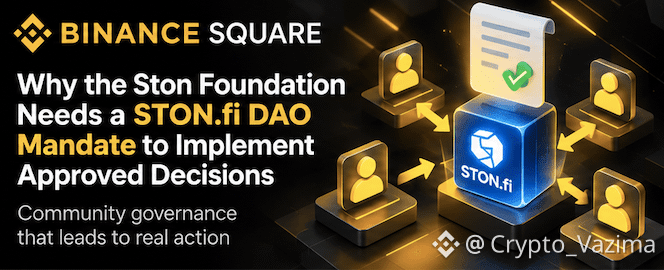
A passed STON.fi DAO proposal only answers what the community approved. It does not, by itself, move funds, sign contracts or finish technical work. That is why the Ston Foundation needs a separate DAO mandate to implement accepted decisions.
🔥 Two stages, not one
STON.fi governance has a clean split.
- The DAO decides: stake STON, receive ARKENSTON voting power, discuss, vote and accept or reject.
- The Foundation executes: transfers, contractors, agreements, multisig operations and admin work.
The official interface lists implementation as a later stage after a successful vote.
🚀 Why the vote is not enough
Not every STON.fi decision is a single smart-contract call.
- A protocol budget can require receiving assets, picking contributors, paying invoices and coordinating providers.
- Governance Rules treat the DAO as a forum for strategy and treasury disbursements.
- The Foundation can act only subject to governance, legal and operational requirements.
🧠 What the mandate actually does
In December 2025 the DAO accepted "Delegation of authority to Ston Foundation as the DAO's representative" and it is shown as implemented. The Foundation can carry out approved treasury transactions, hold allocated assets, manage authorized budgets, engage service providers and represent the DAO with counterparties. It is not unlimited power, and specific transfers can still need their own proposal.
⚡ The 2026 budget proves the boundary
The April 1, 2026 operational budget authorized up to USD 2.5 million in qualifying assets and 4 million STON, with reporting and another vote required for material changes. Policy stays with the DAO, while operators handle the details inside that scope.
Would you review Accepted and Implemented as two different STON.fi states? 👇
Share how you currently check who is allowed to execute a passed vote.
Not investment advice - research on your own! 🚀
$GRAM @STONfi DEX
A passed STON.fi DAO proposal only answers what the community approved. It does not, by itself, move funds, sign contracts or finish technical work. That is why the Ston Foundation needs a separate DAO mandate to implement accepted decisions.
🔥 Two stages, not one
STON.fi governance has a clean split.
- The DAO decides: stake STON, receive ARKENSTON voting power, discuss, vote and accept or reject.
- The Foundation executes: transfers, contractors, agreements, multisig operations and admin work.
The official interface lists implementation as a later stage after a successful vote.
🚀 Why the vote is not enough
Not every STON.fi decision is a single smart-contract call.
- A protocol budget can require receiving assets, picking contributors, paying invoices and coordinating providers.
- Governance Rules treat the DAO as a forum for strategy and treasury disbursements.
- The Foundation can act only subject to governance, legal and operational requirements.
🧠 What the mandate actually does
In December 2025 the DAO accepted "Delegation of authority to Ston Foundation as the DAO's representative" and it is shown as implemented. The Foundation can carry out approved treasury transactions, hold allocated assets, manage authorized budgets, engage service providers and represent the DAO with counterparties. It is not unlimited power, and specific transfers can still need their own proposal.
⚡ The 2026 budget proves the boundary
The April 1, 2026 operational budget authorized up to USD 2.5 million in qualifying assets and 4 million STON, with reporting and another vote required for material changes. Policy stays with the DAO, while operators handle the details inside that scope.
Would you review Accepted and Implemented as two different STON.fi states? 👇
Share how you currently check who is allowed to execute a passed vote.
Not investment advice - research on your own! 🚀
$GRAM @STONfi DEX