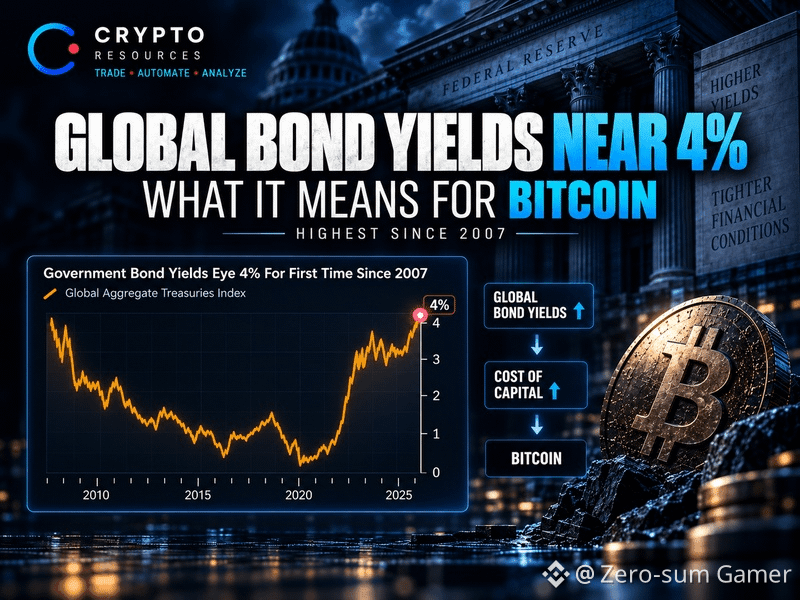
🌍 GLOBAL BOND YIELDS ARE NEAR 4%. THAT MATTERS FOR #crypto .
Global government bond yields are approaching levels last seen in 2007.
For #bitcoin , this is not #bullish by itself. Money is expensive, government debt offers competitive returns, and capital has less reason to move further out on the risk curve.
📉 The chain is straightforward:
Bond yields ↑ → real yields ↑ → cost of capital ↑ → demand for risk ↓
#altcoins feel it even harder. High yields usually mean weaker market breadth, capital staying concentrated in BTC, weak ETH/BTC and short-lived pumps.
But there is another side.
The longer borrowing costs stay elevated, the more pressure builds on government debt, refinancing, mortgages and credit. At some point, policymakers may need to soften financial conditions.
That does not mean 4% automatically triggers rate cuts or QE.
The real regime change starts when several things happen together:
▪️ Global yields stop making new highs
▪️ #US real yields move lower
▪️ USD loses momentum
▪️ Bitcoin holds market structure
▪️ BTC dominance cools and market breadth expands
⚠️ And one trap: falling yields are not automatically bullish.
If yields fall because inflation cools while the economy holds up — good setup for risk.
If they collapse because markets are pricing recession or financial stress — crypto can get hit first.
The 4% level is not the signal. The signal is when expensive money starts forcing the regime to change.
$NOM $NIL $LSK
Global government bond yields are approaching levels last seen in 2007.
For #bitcoin , this is not #bullish by itself. Money is expensive, government debt offers competitive returns, and capital has less reason to move further out on the risk curve.
📉 The chain is straightforward:
Bond yields ↑ → real yields ↑ → cost of capital ↑ → demand for risk ↓
#altcoins feel it even harder. High yields usually mean weaker market breadth, capital staying concentrated in BTC, weak ETH/BTC and short-lived pumps.
But there is another side.
The longer borrowing costs stay elevated, the more pressure builds on government debt, refinancing, mortgages and credit. At some point, policymakers may need to soften financial conditions.
That does not mean 4% automatically triggers rate cuts or QE.
The real regime change starts when several things happen together:
▪️ Global yields stop making new highs
▪️ #US real yields move lower
▪️ USD loses momentum
▪️ Bitcoin holds market structure
▪️ BTC dominance cools and market breadth expands
⚠️ And one trap: falling yields are not automatically bullish.
If yields fall because inflation cools while the economy holds up — good setup for risk.
If they collapse because markets are pricing recession or financial stress — crypto can get hit first.
The 4% level is not the signal. The signal is when expensive money starts forcing the regime to change.
$NOM $NIL $LSK