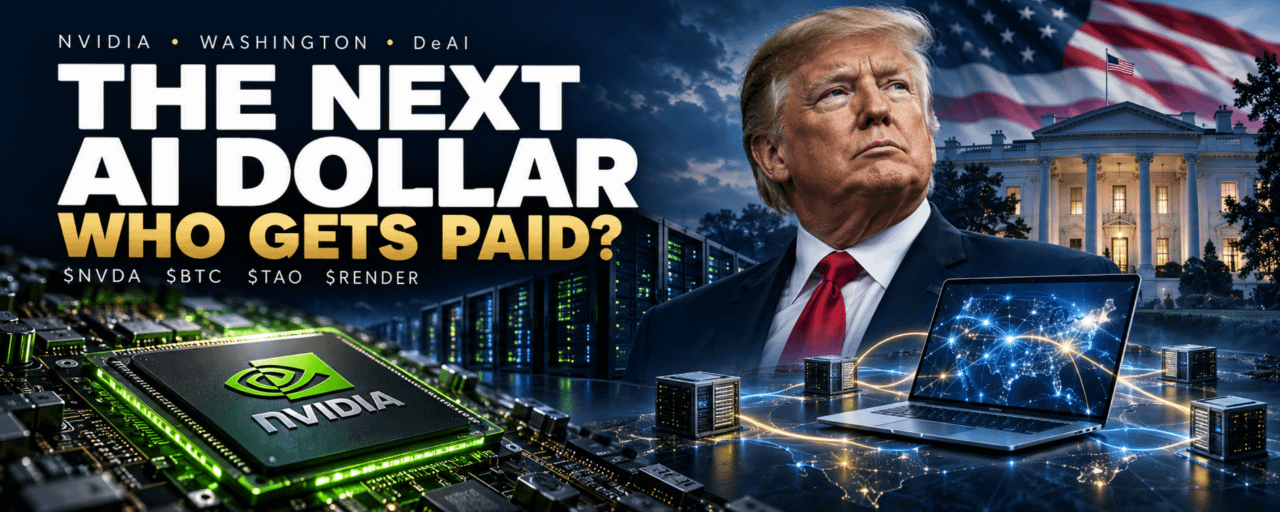

Record chip revenue and a new White House push both confirm AI is the Era's defining trade but state backing and a 25GB laptop running a 744-billion-parameter model are pulling that trade in opposite directions.
Two things happened within a month of each other that should be read together, not separately. Nvidia ($NVDA -adjacent trade themes aside) posted the largest quarterly Data Center revenue in its history, and President Trump announced plans for a national "AI Force" and a new AI adviser, claiming the sector could eventually represent 25% of U.S. GDP. Traders watching $BTC ,$TAO ,$RENDER and are sitting at the intersection of both stories: state-level validation that the AI buildout isn't slowing down, and a parallel, quieter story about software and decentralized compute proving that some of that buildout may not be strictly necessary.
KEY FACTS
▪️ Nvidia's Q2 FY2027 revenue (quarter ended July 26, 2026) hit $96.2B, up 106% year-over-year; Data Center revenue was $89.0B, up 117%
▪️ Nvidia guided Q3 FY2027 revenue to $108B, plus or minus 2%, and holds $279B in supply/capacity commitments
▪️ On September 19, 2026, Trump said via Truth Social he will appoint a new AI adviser ("AI czar") and create an "AI Force," modeled on the Space Force, while predicting AI could reach 25% of U.S. GDP - he gave no implementation details
▪️ Colibrì, an open-source engine from developer JustVugg, runs the 744-billion-parameter GLM-5.2 model on roughly 25GB of RAM with no GPU, streaming its "experts" from an NVMe drive
▪️ The IEA projects global data-centre electricity demand roughly doubling from ~485 TWh (2025) to ~945 TWh by 2030 under its Base Case - a number both the hardware bulls and the efficiency skeptics point to, for opposite reasons
HOW IT WORKS: TWO FORCES PULLING ON THE SAME TRADE
The state-backing pillar. Trump's announcement carries no funding, agency structure, or timeline yet - Reuters, Axios, and Al Jazeera all reported the same thing: a social-media post, not a policy document. What it does signal is that AI infrastructure is now being framed in Washington as strategic, comparable to the Space Force. Historically, that kind of framing precedes energy-grid prioritization and government contracts flowing toward incumbent hardware and cloud providers - the traditional AI-stock trade.
The efficiency/decentralization pillar. At the same time, Colibrì demonstrates a structural fact about how these models actually run: GLM-5.2 has 744 billion total parameters, but only about 40 billion activate per token. Colibrì keeps the ~9.9GB "always-on" dense layer in RAM and streams the rest from disk. It's slow at baseline - roughly 0.05 to 0.1 tokens per second, meaning 100 tokens can take 17 to 33 minutes - so it's nowhere near commercially competitive with a data center today. But it lowers the floor for running frontier-scale inference, and it ships faster CUDA and Apple Silicon backends for anyone with more than the baseline 25GB. Decentralized compute networks like TAO and RENDER work the same angle from the infrastructure side: instead of concentrating GPUs in one facility, they pool idle global hardware and use token incentives to route inference to it.
Both pillars can be true at once. Thats the point traders keep missing when they treat this as a binary.
WHY IT MATTERS (ANALYSIS)
Trump's announcement is a tailwind for the centralized AI-stock narrative: it removes some regulatory uncertainty and reframes AI as a national-security priority, which tends to favor incumbent hardware and cloud players who can win government contracts and grid access. But state backing also creates exactly the kind of centralized choke point - one regulatory regime, one set of export/access controls - that pushes developers and enterprises toward permissionless alternatives when they want to avoid API cutoffs or nationalization risk. Meanwhile, Nvidia's $96.2B quarter and $279B in supply commitments say enterprise hardware demand is nowhere near saturated in the near term; Colibrì's 0.1 tokens/second says local and decentralized inference isn't remotely there yet either. The honest read is that both trades - hardware/state-backed AI stocks, and decentralized/software-efficient crypto AI - are being validated in different time horizons, not competing for the same dollar today.
WHAT TO WATCH
▪️ Whether Trump's "AI Force" produces an actual funding structure, agency, or named adviser - an announcement is not a program
▪️ Nvidia's Q3 FY2027 print against its $108B guide
▪️ Energy grid allocation decisions between state-backed AI data centers and private/crypto compute
▪️ Whether TAO or RENDER land any enterprise-grade paying SLA, as opposed to retail/hobbyist usage
▪️ Export and API access controls - tighter restrictions historically accelerate migration toward decentralized alternatives
THREE SCENARIOS
▪️ Dual-engine growth: State backing drives record enterprise hardware revenue while regulatory overreach simultaneously pushes capital into censorship-resistant decentralized protocols.
▪️ Centralized hegemony (baseline): State-backed contracts and incumbent hardware dominate; decentralized AI stays a niche, privacy-focused market.
▪️ Grid bottleneck: Political backlash over data-centre energy use stalls both state-backed buildout and crypto-linked compute expansion at once.
FREQUENTLY ASKED QUESTIONS
Does TRUMP's AI Force actually fund anything yet? No. As of this writing, it's a stated intention with no agency, budget, or named adviser - Reuters explicitly noted the lack of implementation details.
Is Colibrì fast enough to replace data-center inference? Not currently. It's a proof of feasibility on minimal hardware, not a production-ready alternative to GPU clusters.
BOTTOM LINE
Nvidia's $96.2B quarter and Trump's "AI Force" both confirm the same thing from different directions: AI infrastructure spending is not slowing down, and it's now a stated national priority. But neither headline settles who captures the next dollar of value - a state-backed hardware incumbent, or a decentralized network and a laptop running a 744-billion-parameter model on an SSD. That question is still open, and it's the one worth trading, not the headline.
Which carries more weight for you: Nvidia's balance sheet, or Washington's new attention on AI?
Sources: NVIDIA Q2 FY2027 earnings release (Aug 26, 2026); Reuters, Axios, Al Jazeera reporting on Trump's Sept 19, 2026 AI Force/AI czar announcement; Colibrì project (GitHub, JustVugg); IEA "Energy and AI" report.
Not financial advice. Always DYOR.
#AIStocksWhatNext #DeAI #NVIDIA #CryptoTrading #TRUMP