⚖️
BALANCING DECENTRALIZED AI COMPUTE: HOW BTTINFERGRID SOLVES THE DEPIN OVERSUPPLY TRAP
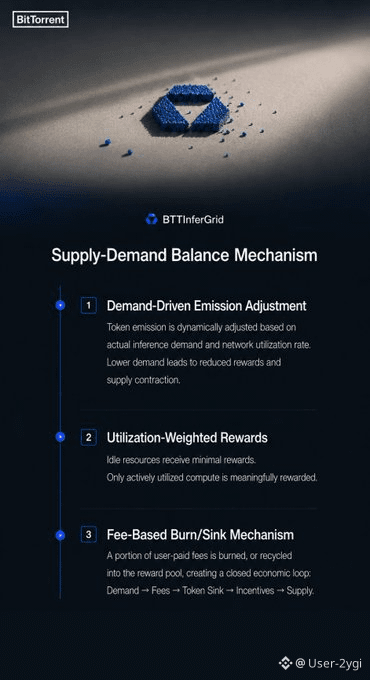
BTTInferGrid resolves this structural vulnerability by decoupling from static block inflation and anchoring compute economics to the Dynamic Supply-Demand Balance Mechanism.
1. The Core Problem: Static Inflation vs. Elastic AI Workloads
No Subsidies for Idle Silicon: Traditional models reward miners simply for registering an online device, creating ghost networks of unutilized compute. BTTInferGrid calibrates emissions strictly to verified, successfully executed inference queries.
Elastic Resource Scheduling: AI inference workloads exhibit sharp peak-to-trough fluctuations throughout the day. Elastic compute scheduling dynamically expands and contracts active compute pools around live developer task queues rather than paying fixed reservation fees.
2. Architectural Triad: Supply, Demand & Cryptoeconomic Verification
Architectural LayerOperational MechanismDePIN Economic FunctionPhysical Supply585M+ BitTorrent FleetTaps existing consumer and workstation GPUs across global clients with zero upfront CapEx debt.Organic
DemandPay-As-You-Go API GatewaysIndependent AI teams and developers run scalable model inference (Qwen, Llama) without centralized cloud markup.Decentralized StorageBTFS
3. Cryptoeconomic Verification & Slashing Safeguards
To prevent miners from returning synthetic or fabricated inference responses, BTTInferGrid implements a weighted verification layer:
Probabilistic Challenge Injection: Validators interleave cryptographically randomized challenge queries into real user inference streams. Because challenge tasks are indistinguishable from live production queries, miners cannot predict audits or selectively drop workloads.
4. Join the Architectural Debate & Ecosystem Access
Engage directly with the core engineering group, participate in node onboarding tests, and review validator deployment benchmarks:
@BitTorrent_Official @Justin Sun孙宇晨 #TRONEcoStar
BALANCING DECENTRALIZED AI COMPUTE: HOW BTTINFERGRID SOLVES THE DEPIN OVERSUPPLY TRAP
BTTInferGrid resolves this structural vulnerability by decoupling from static block inflation and anchoring compute economics to the Dynamic Supply-Demand Balance Mechanism.
1. The Core Problem: Static Inflation vs. Elastic AI Workloads
No Subsidies for Idle Silicon: Traditional models reward miners simply for registering an online device, creating ghost networks of unutilized compute. BTTInferGrid calibrates emissions strictly to verified, successfully executed inference queries.
Elastic Resource Scheduling: AI inference workloads exhibit sharp peak-to-trough fluctuations throughout the day. Elastic compute scheduling dynamically expands and contracts active compute pools around live developer task queues rather than paying fixed reservation fees.
2. Architectural Triad: Supply, Demand & Cryptoeconomic Verification
Architectural LayerOperational MechanismDePIN Economic FunctionPhysical Supply585M+ BitTorrent FleetTaps existing consumer and workstation GPUs across global clients with zero upfront CapEx debt.Organic
DemandPay-As-You-Go API GatewaysIndependent AI teams and developers run scalable model inference (Qwen, Llama) without centralized cloud markup.Decentralized StorageBTFS
3. Cryptoeconomic Verification & Slashing Safeguards
To prevent miners from returning synthetic or fabricated inference responses, BTTInferGrid implements a weighted verification layer:
Probabilistic Challenge Injection: Validators interleave cryptographically randomized challenge queries into real user inference streams. Because challenge tasks are indistinguishable from live production queries, miners cannot predict audits or selectively drop workloads.
4. Join the Architectural Debate & Ecosystem Access
Engage directly with the core engineering group, participate in node onboarding tests, and review validator deployment benchmarks:
@BitTorrent_Official @Justin Sun孙宇晨 #TRONEcoStar