
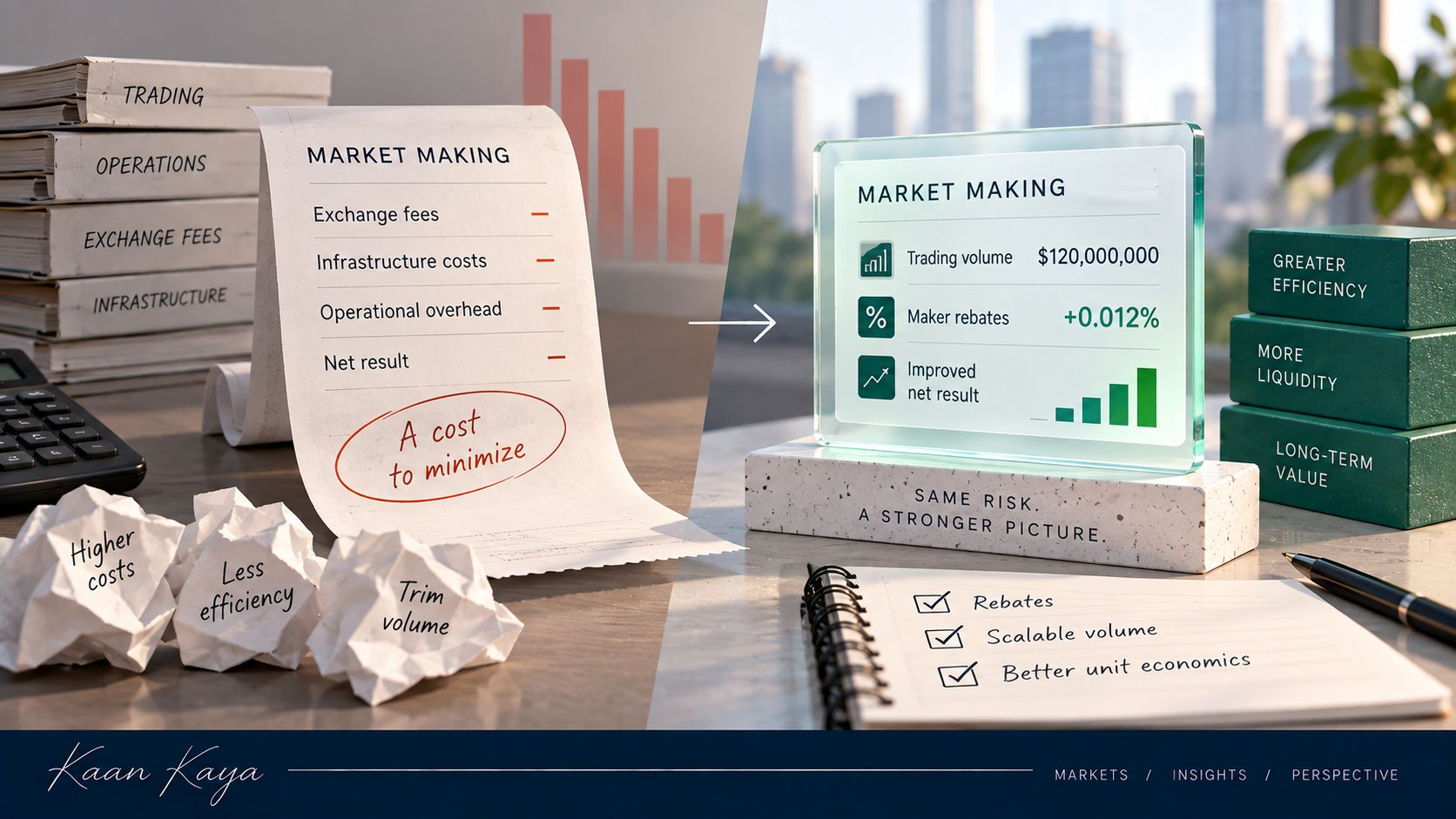
She's Been Minimizing the Wrong Number This Whole Time A business analyst I know spends every quarter close staring at one line on a trading desk's P&L: market-making volume, most of it in $BTC pairs, filed under fees. For years that number moved one way, a cost to minimize. The logic was simple: every unit of volume the desk generated by posting quotes cost fees, so the activity got evaluated like overhead, trimmed where possible, justified where not. What's shifting that view across the industry is rebate income for orders that add liquidity instead of taking it. A rebate line beside the fee line means market making reads as partly self-funding rather than pure cost. One option she might weigh is WhiteBIT's Market Making Program, listing maker rebates up to -0.012%. 🧮 What matters more than the rate is the tier system: staying in the MM grid runs on a percentage of volume, not a fixed target, so a slower month wouldn't cost the desk a rebate already earned. A flexible API comes bundled in too. https://institutional.whitebit.com/market-making-program?utm_source=coinmarketcap&utm_medium=mmpkkaan&utm_campaign=post The other option could be Kraken's offering for market makers and HFTs, advertising maker fees as low as -0.02% on eligible spot pairs with sub-millisecond execution and yes, that number would be hard to ignore. https://www.kraken.com/ca/institutions/market-makers?utm_source=coinmarketcap&utm_medium=mmpkkaan&utm_campaign=post Either way, the rebate would be earned by carrying inventory and eating adverse selection as a maker. Same risk, but which line a board is looking at changes what it decides is worth doing. ⚖️ Disclaimer: This is not financial or investment advice. Do your own research before making any decisions. Use at your own risk. #BTC Price Analysis# #Bitcoin Price Prediction: What is Bitcoins next move?#

Đăng
Tuyên bố miễn trừ trách nhiệm: Nội dung bao gồm cả quan điểm của bên thứ ba, không phải lời khuyên. Có thể sử dụng nội dung do Binance Ai đưa ra nhưng không được đảm bảo. Xem Điều khoản & Điều kiện.