
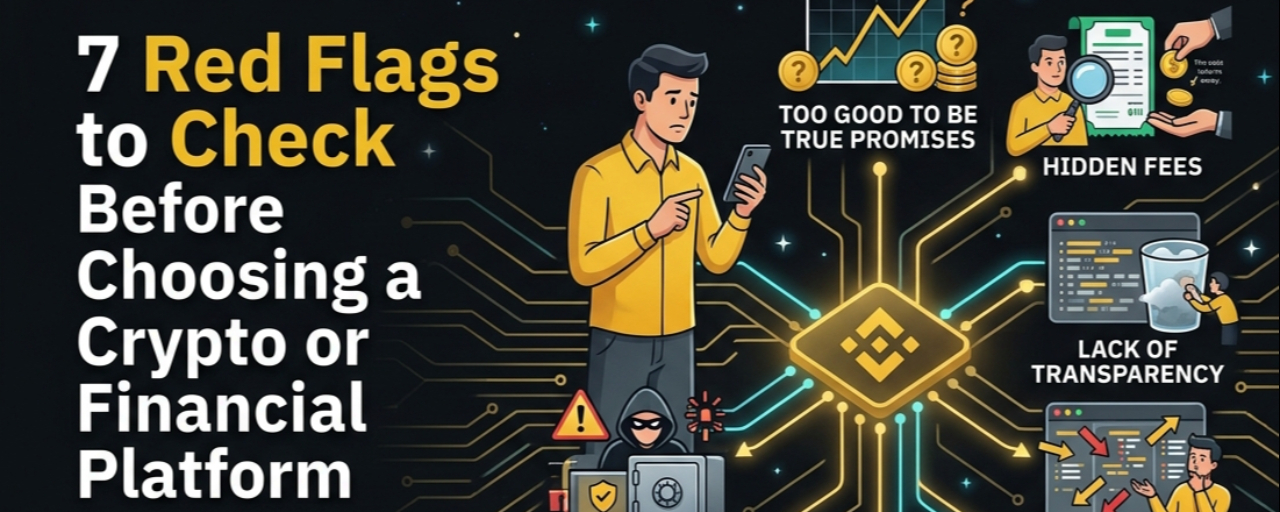
Before choosing a crypto or financial platform, check its regulatory status, security protections, custody arrangements, fee structure and withdrawal policies. Major red flags include unclear licensing, guaranteed-return claims, hidden fees, weak account controls, limited transparency, withdrawal restrictions and inaccessible customer support.
The crypto industry has matured considerably, but that does not eliminate the need for users to investigate where their money is held, which company is providing the service and what protections actually exist.
Here are seven areas worth checking before depositing funds.
Red Flag 1: Unclear Licensing or Regulatory Status
One of the first questions to ask is simple:
Who legally provides the service to me?
A platform may operate internationally while using different legal entities for different products and jurisdictions. Users should therefore check the entity named in the platform's terms, the regulator overseeing that entity and whether the relevant service is permitted in their jurisdiction.
For Ethiopian users, this distinction is particularly important.
Binance's global platform operates through a new regulatory structure under the Abu Dhabi Global Market (ADGM). Binance announced that three ADGM-licensed entities provide different parts of its global platform operations, covering areas including trading, clearing, custody and brokerage.
That does not mean Binance is licensed by the National Bank of Ethiopia (NBE). A foreign platform's authorization in another jurisdiction should not be described as Ethiopian regulatory authorization.
At the same time, Binance services have been accessible to Ethiopian users, subject to the products and eligibility available to them.
The lesson applies to every platform: do not confuse global regulation, local availability and local licensing. They are three different questions.
Red Flag 2: No Transparency Around Customer Assets
Another important question is:
What happens to customer assets after I deposit them?
Users should understand whether assets are held separately from the platform's operating funds, which entity provides custody and what controls exist around wallets and transfers.
Binance says its customer assets are backed 1:1, with additional reserves, and its current global structure separates exchange, clearing/custody and brokerage functions across regulated entities under the ADGM framework.
Binance's Proof of Reserves system is another layer of transparency because it allows users to examine evidence concerning assets held in custody for customers. This does not mean users should stop asking questions. Custody structure, legal entity, reserve evidence and withdrawal rules are all worth understanding before depositing significant funds.
Red Flag 3: No Proof of Reserves or Verifiable Asset Information
If a centralized crypto platform holds customer assets, users should ask whether the platform provides any independently verifiable information about those assets.
Binance's Proof of Reserves (PoR) system is designed to show that customer assets are backed 1:1, plus reserves. Binance uses cryptographic techniques including Merkle Trees and zk-SNARKs so users can verify that their account balance was included in the relevant reserve calculation.
Binance currently takes a monthly snapshot of user balances on the first day of each month at 00:00 UTC, with the results released by the seventh day.
How can you verify your Binance balance?
The process is designed to allow a user to check whether their balance was included in the Proof of Reserves calculation.
The important concept is the Merkle Tree.
Rather than simply asking a company to say, "Your funds are there," cryptographic verification allows users to check that their account was included in the published reconciliation. This is one reason transparency matters when comparing centralized financial platforms.
However, Proof of Reserves should not be interpreted as a complete audit of every possible risk associated with a financial company. Users should still consider liabilities, legal structure, custody arrangements, security controls and the specific terms governing their assets.
Red Flag 4: No Emergency Fund
Even with strong security systems, platforms need to consider what happens in an extreme incident.
That is where Binance's Secure Asset Fund for Users (SAFU) comes in.
SAFU was established in 2018 as an emergency reserve intended to protect users in extreme situations such as security breaches or platform-level incidents. Binance's latest published information states that the fund is maintained at approximately US$1 billion in value. Its composition can change with market conditions.
The fund is designed as a last-resort protection mechanism, rather than a substitute for ordinary account security.
That distinction matters. A user should not think, "The platform has an emergency fund, so I don't need 2FA."
Security works through layers. The platform's infrastructure, reserves and emergency mechanisms are one part of the equation; the user's own account controls are another.
Red Flag 5: Weak Account-Security Controls
A platform can have sophisticated infrastructure and still be a poor choice if users have few tools to protect their individual accounts.
At minimum, look for strong authentication and withdrawal controls.
Binance supports several relevant security tools.
Passkeys use cryptographic authentication stored on a user's device and can provide passwordless authentication with biometrics on compatible devices. Binance also allows passkeys to be used as part of its customizable 2FA strategy.
Two-factor authentication (2FA) adds another verification layer for important account actions. Binance allows users to configure 2FA methods for scenarios such as login, asset access, account settings and security management.
Anti-phishing codes help users distinguish legitimate Binance emails and SMS messages from fraudulent communications. Once enabled, the user's chosen code appears in genuine Binance communications.
Withdrawal allowlisting restricts withdrawals to previously approved wallet addresses. Binance also provides a withdrawal-whitelist limit that can temporarily restrict withdrawals to newly added addresses.
These controls address different attack surfaces. Using several together is generally more robust than relying on a password alone.
Red Flag 6: Hidden Fees and Difficult Withdrawals
A platform may advertise low trading fees while charging elsewhere.
Before depositing money, check:
Trading fees
Spread
Deposit fees
Withdrawal fees
Network fees
Conversion fees
Minimum withdrawal amounts
Withdrawal limits
Processing times
Withdrawal policies deserve particular attention.
A platform should clearly explain how users can move their assets out, which networks are supported and whether additional verification can delay withdrawals.
Restrictions are not automatically evidence of wrongdoing, legitimate compliance and security controls can require additional verification but unclear or unexplained withdrawal conditions are worth investigating before depositing funds.
Red Flag 7: Guaranteed Returns or Poor Customer Support
Two final warning signs can appear together: unrealistic promises and a lack of meaningful support when something goes wrong.
Claims such as "guaranteed profits," "risk-free returns," or "you cannot lose" should immediately trigger additional scrutiny in any market involving financial assets.
Real investments involve risk.
Users should also test how easy it is to obtain support before committing significant funds. Check whether the platform offers official support channels, how account-security problems are handled and whether there is a clear process for reporting suspicious activity.
Binance provides 24/7 customer support through its official support channels, alongside security resources and reporting mechanisms.
A good platform should make it reasonably clear where to go when something goes wrong.
What Should You Check Before Depositing?
A useful way to evaluate any crypto or financial platform is to separate the question into five areas:
Who regulates it?
Identify the legal entity serving you and the regulator responsible for that entity.
Where are my assets held?
Understand custody arrangements and whether customer assets are separated from operating funds.
Can the platform demonstrate its reserves?
Look for verifiable reserve information rather than relying solely on marketing claims.
What happens in an emergency?
Check whether the platform has an emergency protection mechanism and understand its limitations.
Can I protect my own account?
Look for passkeys, 2FA, withdrawal controls, anti-phishing tools and other security features.
No platform can eliminate every financial, technical or market risk. But transparency makes it easier for users to understand those risks before they commit their funds.
Relevant FAQs
Is Binance regulated in Ethiopia?
Binance has global regulatory authorization under the ADGM framework, with licensed entities responsible for different parts of its platform operations. However, this should not be described as a license from the National Bank of Ethiopia.
For Ethiopian users, availability of Binance services and individual products can depend on the user's eligibility and the applicable jurisdictional restrictions.
How do I know if Binance is safe?
There is no single test that can establish that a financial platform is completely safe.
Instead, examine several factors: regulatory structure, custody arrangements, Proof of Reserves, security controls, emergency protection, withdrawal policies and customer support.
For Binance specifically, users can examine its Proof of Reserves, use account-security tools such as passkeys and 2FA, enable anti-phishing protection and restrict withdrawals to approved addresses.
How does Binance protect customer assets?
Binance states that customer assets are backed 1:1, with additional reserves, and provides Proof of Reserves that users can verify using cryptographic methods. Its broader regulatory structure also separates exchange, clearing/custody and brokerage functions among different ADGM-regulated entities.
Binance also maintains SAFU as an emergency reserve for extreme situations.
What is Binance Proof of Reserves?
Proof of Reserves is Binance's system for providing evidence that customer assets held in custody are backed 1:1, plus reserves.
Binance uses Merkle Trees and zk-SNARKs to allow users to verify that their account balance was included in the reserve calculation. The reserve process uses monthly snapshots, with the snapshot taken on the first day of the month and results released by the seventh.
Ultimately, choosing a crypto or financial platform should involve more than comparing fees or counting available assets.
Check the legal entity. Check the custody model. Check the reserves. Check the security controls. Check the withdrawal rules.
The more clearly a platform can answer those questions, the easier it is for users to understand what they are actually trusting with their money.