
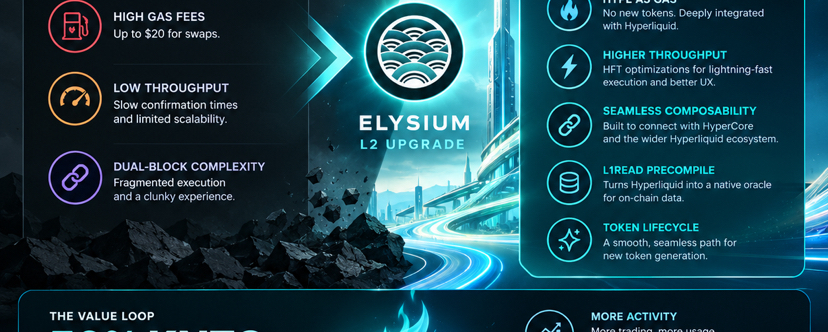

I’ve been spending more time looking at what Elysium could mean for the Hyperliquid ecosystem, and the more I study the architecture, the more interesting the idea becomes.
Hyperliquid has already built something remarkable around its high-performance trading infrastructure, but success creates its own problems. As more users, applications, liquidity, and builders arrive, the underlying execution environment has to keep evolving. That is where Elysium enters the picture.
For me, the most interesting part isn’t simply calling Elysium another Layer 2. It is the attempt to build an execution layer that can expand what Hyperliquid is capable of while creating a direct economic relationship between network activity and $KNTQ.
Why does Hyperliquid need Elysium?
HyperEVM gives developers access to an EVM-compatible environment connected to the Hyperliquid ecosystem. But EVM execution comes with familiar limitations when applications become increasingly demanding.
High-frequency applications, sophisticated spot markets, automated market makers, and complex on-chain strategies can place significant pressure on execution capacity, latency, and fees.
Imagine trying to run a Formula 1 race on a road designed for normal traffic.
The road may work perfectly under ordinary conditions, but once thousands of high-speed vehicles arrive simultaneously, the infrastructure becomes the limiting factor.
That is the opportunity Elysium is targeting.
Rather than replacing Hyperliquid, Elysium can be viewed as an additional execution layer designed to push performance further while remaining economically connected to the ecosystem.
And this is where $HYPE becomes particularly important.
$HYPE as gas
One of the concepts I find especially interesting is using $HYPE as the gas asset.
Gas is more than just a transaction fee. It creates an economic connection between users and the network they are interacting with.
If applications on Elysium use $HYPE for execution, activity can remain closely connected to Hyperliquid rather than creating an isolated economy around an unrelated gas token.
That matters because developers can build applications while users interact with an environment that still feels native to the broader Hyperliquid ecosystem.
For me, that is a powerful design choice: expansion without completely disconnecting the new execution environment from the existing economic base.
Supercharging spot trading and PropAMMs
Another area where Elysium becomes particularly interesting is trading.
Spot markets require efficient execution, deep liquidity, and infrastructure capable of handling frequent interactions. PropAMMs can push those requirements even further because they introduce sophisticated liquidity strategies and market-making logic directly into the application layer.
This is where high-performance execution becomes more than a technical achievement.
It becomes a product advantage.
If Elysium can provide faster and more efficient execution for these applications, developers have more room to experiment with trading infrastructure that may not be practical under a more constrained execution environment.
That could mean more sophisticated decentralized exchanges, automated strategies, liquidity systems, and financial applications being built around Hyperliquid.
The token generation lifecycle
Then there is the part that really caught my attention: how value generated by the ecosystem can flow through the token lifecycle.
A token becomes much more interesting when there is a clearly defined relationship between network usage, revenue, and token economics.
Elysium is designed around this principle.
Instead of simply launching another token and hoping increased activity eventually creates demand, the model attempts to connect ecosystem activity directly to $KNTQ.
That brings us to what I consider the most important piece of the architecture:
The Sequencer Fee model
The proposed allocation is straightforward:
25% → Builders
25% → Treasury
50% → $KNTQ buy & burn
This is where the economic design becomes fascinating.
The first 25% goes to builders.
That creates an incentive for developers to actually build useful applications, attract users, generate transactions, and contribute to the ecosystem.
More meaningful applications can generate more activity.
More activity can generate more sequencer fees.
And builders participate directly in the value created by that activity.
The second 25% goes to the Treasury.
That provides an ecosystem-level pool that can potentially support infrastructure, development, growth initiatives, partnerships, and other long-term requirements.
So there is an incentive at both the application level and ecosystem level.
But then comes the 50%.
Half of the sequencer fees are directed toward $KNTQ buybacks and burns.
This is the mechanism that creates the potential deflationary flywheel.
Think about the sequence:
More applications → more users → more transactions → more sequencer fees → more $KNTQ purchased → more $KNTQ burned.
If ecosystem usage grows sustainably, the amount of value directed toward the token can grow alongside it.
And because burned tokens are permanently removed from circulation, successful network activity can potentially reduce the available token supply over time.
That is what makes the model different from simply creating token incentives.
The objective isn't only to distribute tokens to participants.
It attempts to make economic activity itself contribute to token scarcity.
Why I find the alignment interesting
The strongest part of this model, in my view, is the alignment of incentives.
Builders want users because users generate activity.
The ecosystem wants successful applications because activity generates fees.
And $KNTQ holders have an economic interest in sustainable activity because 50% of sequencer fees are directed toward buy-and-burn.
Everyone has a reason to care about actual usage rather than purely speculative attention.
Of course, there is an important distinction: deflationary mechanics do not automatically guarantee token appreciation.
The system still needs genuine users, useful applications, sustainable transaction volume, and responsible economic design. Burning tokens alone cannot manufacture demand.
But if the underlying ecosystem grows, the mechanism creates an interesting connection between usage and scarcity.
My personal perspective
What excites me most about Elysium isn't simply the speed.
It is the attempt to combine technical scalability with economic value capture.
Hyperliquid already has a strong trading-oriented ecosystem. Elysium's opportunity is to give developers more room to build, especially around high-performance applications, while keeping the economics connected to $HYPE and $KNTQ.
I see it as a potential transition from simply having a powerful blockchain ecosystem to having an ecosystem where infrastructure, applications, builders, users, and token economics reinforce one another.
That is the technical leap I’m watching closely.
Because in the end, the biggest question isn't:
“How fast is Elysium?”
It is:
“Can increased activity on Elysium translate into sustainable value for the entire ecosystem?”
If the answer becomes yes at scale, then Elysium could represent much more than another L2.
It could become an important value-accrual layer for the Hyperliquid economy.
And personally, that is the part I find most compelling.