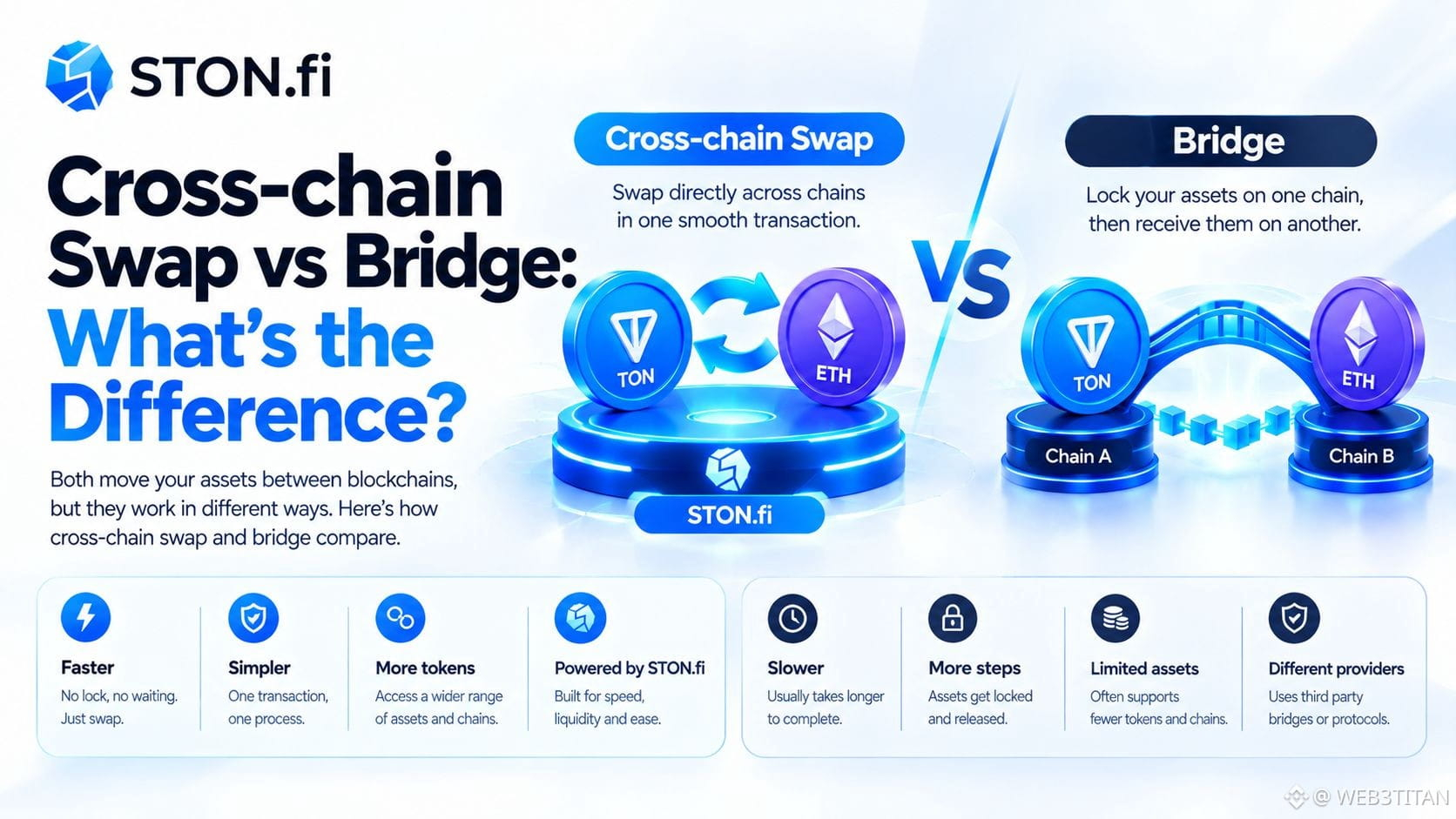
Cross Chain Swap vs Bridge: What’s the Difference?
Moving assets between blockchains can happen in different ways. Two common approaches are bridges and cross chain swaps, but they solve different problems.
WHAT IS A BRIDGE?
A bridge is designed to move an asset from one blockchain to another.
Depending on its architecture, the original asset may be locked or held while a corresponding wrapped or bridged version is created on the destination network.
WHAT IS A CROSS CHAIN SWAP?
A cross chain swap lets you exchange an asset on one network for another asset on a different network.
Instead of simply moving the same asset, you can receive a different native or supported asset on the destination chain.
THE KEY DIFFERENCES
Bridge: Move an asset between networks, often involving locking and representing it on the destination.
Cross chain swap: Exchange one asset for another across different networks.
They can also differ in custody assumptions, route complexity, fees, and how failed transactions or refunds are handled.
WHERE OMNISTON FITS
Omniston focuses on cross chain execution and liquidity aggregation. It coordinates available liquidity and routes to help users exchange assets across supported networks.
That doesn't make bridges universally wrong.
Bridges can be useful when you specifically want to move an asset between networks, while cross chain swaps are useful when you want to exchange one asset for another.
MY TAKE
The right model depends on the goal.
If you need the same asset on another network, a bridge may fit. If you want a different asset on another network, a cross chain swap offers a different approach.
Understanding the architecture first makes it easier to choose the right tool.
$GRAM $XRP
#MemeLaunchpads82%OfArcDayOneVolume
Moving assets between blockchains can happen in different ways. Two common approaches are bridges and cross chain swaps, but they solve different problems.
WHAT IS A BRIDGE?
A bridge is designed to move an asset from one blockchain to another.
Depending on its architecture, the original asset may be locked or held while a corresponding wrapped or bridged version is created on the destination network.
WHAT IS A CROSS CHAIN SWAP?
A cross chain swap lets you exchange an asset on one network for another asset on a different network.
Instead of simply moving the same asset, you can receive a different native or supported asset on the destination chain.
THE KEY DIFFERENCES
Bridge: Move an asset between networks, often involving locking and representing it on the destination.
Cross chain swap: Exchange one asset for another across different networks.
They can also differ in custody assumptions, route complexity, fees, and how failed transactions or refunds are handled.
WHERE OMNISTON FITS
Omniston focuses on cross chain execution and liquidity aggregation. It coordinates available liquidity and routes to help users exchange assets across supported networks.
That doesn't make bridges universally wrong.
Bridges can be useful when you specifically want to move an asset between networks, while cross chain swaps are useful when you want to exchange one asset for another.
MY TAKE
The right model depends on the goal.
If you need the same asset on another network, a bridge may fit. If you want a different asset on another network, a cross chain swap offers a different approach.
Understanding the architecture first makes it easier to choose the right tool.
$GRAM $XRP
#MemeLaunchpads82%OfArcDayOneVolume