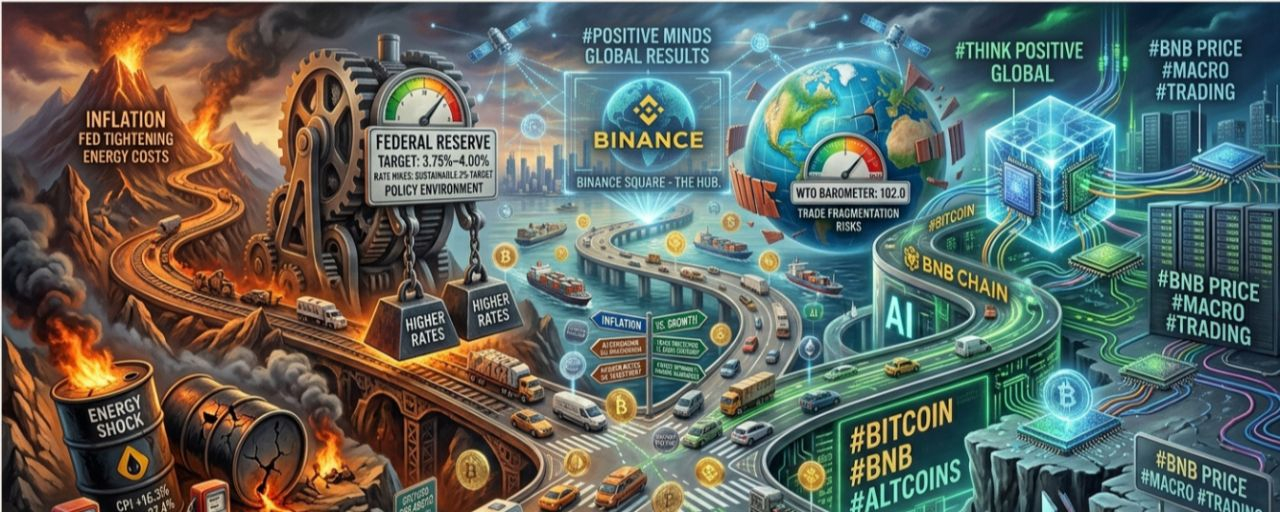

🌍 @PositiveMindsGlobalResults — @Binance Square Official
Thursday, September 17, 2026
Inflation, Fed Tightening, AI Investment, Energy Costs and Trade Fragmentation Reshape the Economic Outlook
Global financial markets are entering a more complex phase as persistent inflation, elevated energy costs, tighter Federal Reserve policy, massive artificial-intelligence investment, high technology valuations and continuing trade-policy uncertainty interact across the global economy.
The latest developments have materially changed the interest-rate landscape.
On September 16, 2026, the U.S. Federal Reserve raised the federal-funds target range by 25 basis points to 3.75%–4.00%, marking the first U.S. rate increase since July 2023. The decision came as inflation remained above the Federal Reserve's 2% objective and energy-related price pressures continued to complicate the outlook.
The latest projections also showed that 16 of 18 policymakers expect at least one additional quarter-point rate increase during 2026, highlighting continued concern about inflation.
Markets are therefore assessing a more restrictive monetary-policy environment at the same time that corporate investment in artificial intelligence remains exceptionally strong.
🇺🇸 1. FEDERAL RESERVE: INFLATION HAS CHANGED THE RATE STORY
The latest U.S. inflation data help explain the Federal Reserve's renewed tightening.
According to the U.S. Bureau of Labor Statistics, the Consumer Price Index rose 0.4% in August, while headline CPI increased 3.4% from a year earlier.
Core CPI, which excludes food and energy, increased 2.4% year over year. Energy prices were a particularly significant source of pressure: the energy index rose 16.3% over the previous 12 months, while gasoline prices increased 27.4% over the same period.
That creates a difficult policy environment.
The Federal Reserve is seeking a sustainable return of inflation toward its 2% target, while higher energy costs can feed through into transportation, production and consumer prices.
The September rate decision lifted the federal-funds target range to 3.75%–4.00%. Reuters reported that the Fed's latest projections showed 16 of 18 policymakers anticipating at least one additional increase before the end of 2026.
The key question now:
Can inflation moderate without causing a significant slowdown in employment, consumer spending and business investment?
That balance will remain crucial for equities, bonds, currencies, commodities and digital assets.
🤖 2. AI INVESTMENT: ENGINE OF GROWTH — AND A POTENTIAL MARKET VULNERABILITY
Artificial intelligence remains one of the strongest investment themes in the global economy.
The AI investment cycle is supporting demand for:
Semiconductors
Data centers
Cloud computing
Networking equipment
Power infrastructure
Advanced computing systems
Software and AI services
Fitch Ratings has highlighted the scale of this investment cycle. Its June 2026 global economic outlook reported that U.S. IT investment increased 18% year over year in Q1 2026, while global semiconductor sales were also rising sharply. Fitch identified the technology boom as an important force supporting global trade.
However, concentration in technology investment and valuations can also create vulnerabilities.
Stress scenarios involving a sharp decline in AI-related equities illustrate how a major technology-market correction could transmit to the broader economy through wealth effects, corporate investment and financial conditions.
Such scenarios are stress tests, not forecasts.
The transmission mechanism could look like this:
Equity prices ↓ → household wealth effects weaken
Technology valuations ↓ → financing conditions tighten
Corporate investment ↓ → capital expenditure slows
Business confidence ↓ → hiring and expansion weaken
Global demand ↓ → trade and industrial activity slow
The broader concern is therefore not simply whether technology stocks decline.
The key issue is whether a substantial repricing of highly valued technology companies could simultaneously weaken investment, household wealth, corporate confidence and financial conditions.
📊 3. U.S. ECONOMY: SLOWER GROWTH, BUT NO RECESSION
The latest official U.S. GDP data do not indicate that the economy is in recession.
The Bureau of Economic Analysis reported that real U.S. GDP increased at a 1.5% annualized rate in the second quarter of 2026, equivalent to approximately 0.4% quarter over quarter. Q1 growth was revised to 2.1%.
The second-quarter expansion was supported by consumer spending, exports and investment, although government spending declined and imports increased.
The current economic picture therefore contains two opposing forces.
Growth-supporting factors
Resilient consumer spending
Strong productivity
Heavy technology investment
AI-related capital expenditure
Continued business investment
Strong demand for technology products
Growth-threatening factors
Higher interest rates
Persistent inflation
Elevated energy costs
Geopolitical uncertainty
Trade-policy changes
Potential financial-market repricing
Pressure on interest-sensitive sectors
The important distinction is that slower growth is not automatically a recession.
A recession would require a broader and sustained deterioration in economic activity.
🌎 4. GLOBAL GROWTH: RESILIENT, BUT UNEVEN
The latest IMF baseline does not support a global-growth estimate of only 1.3%–2.5%.
The IMF's July 2026 World Economic Outlook Update projects global growth of:
2026: 3.0%
2027: 3.4%
The IMF describes the global economy as resilient but uneven. Energy shocks are weighing on energy-importing economies, while AI-driven demand is supporting countries integrated into the global technology value chain.
At the same time, the IMF warned that the global disinflation process has stalled and revised its 2026 global headline-inflation forecast upward to 4.7%.
This creates a difficult policy combination:
Growth continues → but inflation remains elevated.
That can complicate central-bank decisions because aggressive rate cuts could risk renewed price pressure, while restrictive policy maintained for too long could weaken economic activity.
🛢️ 5. ENERGY PRICES: A CRITICAL INFLATION TRANSMISSION CHANNEL
Energy has become one of the most important variables in the global economic outlook.
Higher oil and energy prices can affect the economy through multiple channels:
Energy prices ↑ → transportation costs ↑
Transportation costs ↑ → production costs ↑
Production costs ↑ → consumer prices ↑
Inflation ↑ → central banks remain restrictive
Rates ↑ → borrowing and investment become more expensive
This creates a potential feedback loop connecting geopolitics, energy markets and monetary policy.
Fitch's June global economic outlook raised its 2026 average oil-price assumption to $87 per barrel, from $70 previously, reflecting the impact of the energy shock. Fitch also described the oil shock as a significant headwind to global growth.
The latest U.S. CPI data reinforce the importance of energy. The energy index increased 2.1% in August alone and was 16.3% higher year over year, while gasoline prices were up 27.4% from a year earlier.
For global markets, the key question is therefore not simply where oil trades on any given day.
The bigger issue is whether elevated energy prices remain persistent enough to influence inflation expectations, household purchasing power and central-bank policy.
🌐 6. TRADE & TARIFFS: GLOBALIZATION UNDER PRESSURE
Global trade has remained more resilient than some worst-case scenarios suggested.
The WTO's September 2026 Goods Trade Barometer registered 102.0, above its baseline of 100. A reading above 100 indicates that merchandise trade is running above its recent trend. The WTO said strong demand for electronic components and other goods linked to AI investment helped offset some weakness associated with geopolitical tensions.
However, the global trade environment remains complicated.
Tariffs, industrial policy, supply-chain restructuring and geopolitical alignment are increasingly influencing corporate investment decisions.
The WTO has also warned that deeper fragmentation of the international trading system could impose substantial long-term costs on global output and trade.
These are scenario estimates rather than forecasts.
The important point is that global trade has not collapsed.
Instead, businesses and governments are increasingly operating in an environment where trade barriers, supply-chain security and geopolitical considerations play a larger role in economic planning.
⚠️ 7. THE RECESSION QUESTION: WHAT COULD TRIGGER A DOWNTURN?
There is currently no official declaration that the U.S. economy is in recession.
However, several developments could increase downside risks.
🔴 Scenario 1 — Inflation remains persistent
If energy prices remain elevated and inflation fails to moderate, the Federal Reserve could maintain restrictive monetary policy for longer.
That could increase pressure on:
Housing
Consumer credit
Business borrowing
Commercial real estate
Smaller companies
Highly leveraged businesses
🔴 Scenario 2 — AI valuation correction
A significant decline in AI-related equities could affect household wealth, corporate investment and business confidence.
The technology sector's growing importance to investment and market capitalization means a major repricing could have effects beyond the technology industry itself.
🔴 Scenario 3 — Trade fragmentation
Higher tariffs and geopolitical fragmentation can increase costs and reduce efficiency across international supply chains.
The WTO has modeled substantial long-term output and trade losses under severe fragmentation scenarios.
🔴 Scenario 4 — Consumer slowdown
If higher prices and borrowing costs reduce household spending, weakness could spread from consumers to businesses.
🔴 Scenario 5 — Financial-market repricing
A simultaneous decline in equities, tighter credit conditions and higher bond yields could produce a broader tightening in financial conditions.
📌 8. THE CURRENT MACRO PICTURE
IndicatorLatest evidenceWhat it meansU.S. CPI3.4% YoY in AugustInflation remains above the Fed's 2% targetU.S. Core CPI2.4% YoYUnderlying consumer-price growth remains above targetU.S. GDP+1.5% annualized in Q2Growth continues at a moderate paceFed funds target3.75%–4.00%Policy is tighter following the September increaseGlobal growth forecast3.0% in 2026Global expansion continuesGlobal growth forecast3.4% in 2027IMF expects stronger growth next yearAI investmentStrongSupports technology demand, capital expenditure and tradeAI valuation riskStress scenarios indicate potential spilloversA correction would be a risk scenario, not a forecastGlobal tradeWTO barometer: 102.0Merchandise trade remains above trendEnergy inflationEnergy CPI +16.3% YoYEnergy remains an important inflation pressure
Sources: U.S. Bureau of Labor Statistics, U.S. Bureau of Economic Analysis, Federal Reserve, IMF, WTO and Fitch Ratings.
🔎 9. WHAT MARKETS ARE WATCHING NEXT
The next phase of the global market cycle will likely be determined by several interconnected variables rather than a single economic indicator.
1️⃣ Inflation
Will U.S. inflation begin to moderate, or will energy and other price pressures remain persistent?
2️⃣ Federal Reserve policy
Following the September rate increase, markets will focus on incoming inflation, employment and economic data for clues about the next policy decision.
3️⃣ Energy markets
Persistent energy-price pressure could complicate the global disinflation process.
4️⃣ AI earnings and investment
Markets will increasingly focus on whether enormous AI infrastructure spending translates into sustainable revenues, productivity gains and long-term economic returns.
5️⃣ Trade policy
Tariffs, supply-chain restructuring and geopolitical fragmentation remain important variables for multinational companies.
6️⃣ Consumer spending
The resilience of the U.S. consumer will remain critical to the domestic and global growth outlook.
🌍 THE BIGGER PICTURE
The global economy is not currently defined by a single recessionary event.
Instead, markets are confronting a collision of tighter monetary policy, persistent inflation, energy shocks, technological investment and trade fragmentation.
The IMF's latest baseline continues to project global expansion, while U.S. GDP remains positive. At the same time, inflation remains above central-bank targets and the Federal Reserve has moved its policy rate higher.
The AI boom remains an important source of investment and potential productivity growth, but the growing concentration of capital and market expectations around technology also creates a potential financial vulnerability.
Meanwhile, global trade remains resilient, although the WTO continues to highlight the risks associated with deeper fragmentation.
The global market is therefore balancing:
Inflation vs. growth
Higher rates vs. investment
AI expansion vs. valuation risk
Energy security vs. price stability
Trade protection vs. global efficiency
Market optimism vs. financial vulnerability
The coming months will show how these forces interact.
The most important signal may not come from any single headline, but from the combined direction of inflation, interest rates, energy prices, corporate investment, consumer demand, financial conditions and global trade.
For investors and businesses, understanding these relationships is increasingly important as monetary policy, technology investment and geopolitical developments become more closely interconnected.
This article is for educational and informational purposes only and does not constitute financial, investment, trading or legal advice. Cryptocurrency and other financial markets can be highly volatile and may react sharply to geopolitical developments, monetary-policy decisions, macroeconomic data and changes in market sentiment. Always conduct your own research, assess risk carefully and consider your own financial circumstances before making investment decisions.
#PositiveMindsGlobalResults #ThinkPositiveGlobal #BinanceSquare #GlobalMarkets #Bitcoin #BNB #Crypto #Macro #Trading #BNBChain #Binance #CryptoMarket #Altcoins #BNBPrice
@PositiveMindsGlobalResults
$BNB