

Bitcoin's $76K Stalemate: Why the Federal Reserve, Not the CLARITY Act, Now Dictates the Floor
Executive Summary
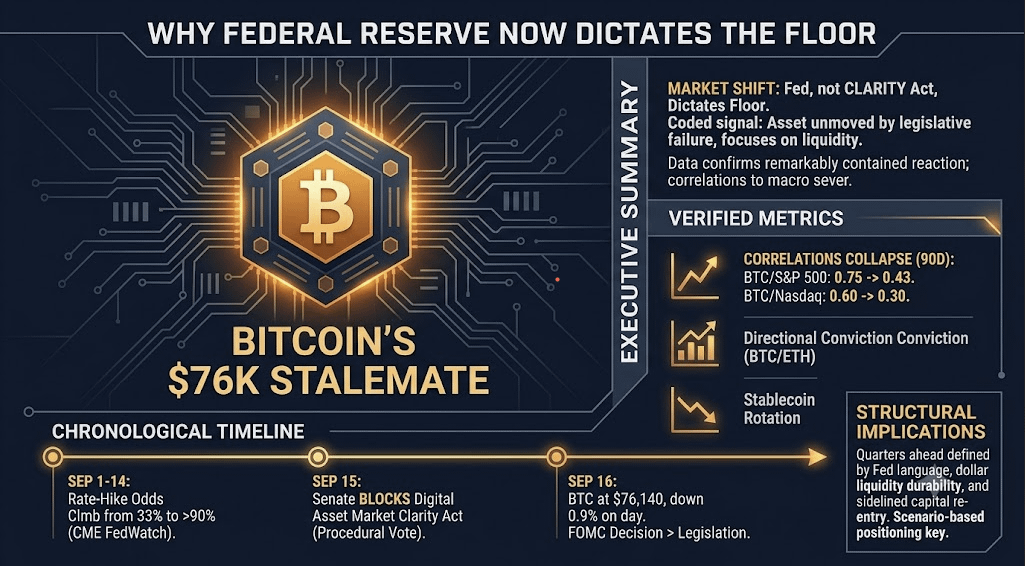
Bitcoin is trading near $76,000 in the aftermath of a failed Senate procedural vote on the Digital Asset Market Clarity Act, yet the market's attention has decisively shifted away from Washington and toward the Federal Reserve. The consensus among institutional analysts is unambiguous: Wednesday's FOMC decision carries far greater weight for Bitcoin's near-term trajectory than the legislative setback that dominated headlines just 24 hours earlier. This represents a meaningful regime signal. When a landmark piece of crypto market-structure legislation fails and the asset barely flinches, it tells professional allocators that the marginal price-setter is no longer regulatory narrative but dollar liquidity and the cost of capital.
The data supports this interpretation. Bitcoin printed around $76,140 Wednesday morning, down 0.9% on the day and 4% for the week, a remarkably contained reaction to a genuine policy disappointment. Meanwhile, short-window correlations between Bitcoin and both the Dollar Index and U.S. equities have collapsed toward zero, severing the macro linkages that have historically governed its behavior. Trading desks report a pronounced rotation into stablecoins and a sharp decline in directional conviction across both Bitcoin and Ethereum. The market is not pricing a regulatory outcome; it is pricing a rate decision.
For institutional and high-conviction retail participants, the implications are structural. The coming quarters will be defined by the Fed's language, the durability of the dollar-liquidity backdrop, and whether the capital currently parked on the sidelines re-enters risk assets once uncertainty clears. This report examines the historical context, the verified metrics, the market-structure mechanics, and the probabilistic scenarios that should anchor positioning into year-end.
Deep-Dive Analysis
Historical Context and the Macro Catalyst
To understand why the CLARITY Act's failure produced such a muted reaction, one must first understand the macro regime Bitcoin currently inhabits. The asset has spent the better part of 2026 oscillating between two competing narratives: a regulatory-clarity thesis that promised to unlock institutional capital through formal U.S. market-structure legislation, and a liquidity thesis that treats Bitcoin as a high-beta expression of global dollar conditions. For much of the year, these narratives ran in parallel, occasionally reinforcing one another. That alignment has now broken.
The proximate catalyst is Tuesday's Senate procedural vote, which blocked the Digital Asset Market Clarity Act from advancing. The bill had been positioned as the most consequential piece of crypto market-structure legislation in U.S. history, promising to delineate jurisdictional boundaries between the SEC and CFTC and provide the legal certainty that large allocators have cited as a precondition for deeper engagement. Its defeat was, by any reasonable measure, a setback for the regulatory-clarity thesis.
Yet the market's response was telling. Bitcoin's decline was orderly, contained, and quickly overshadowed by anticipation of the Federal Reserve's rate decision. Analysts characterized the legislative failure as "disappointing" but not structurally damaging, a framing that reflects a deeper truth: the marginal buyer of Bitcoin in 2026 is far more sensitive to the discount rate than to the statutory framework. When the risk-free rate moves, every duration-sensitive asset reprices. When a bill fails, the existing regulatory environment simply persists—and the existing environment has proven workable enough to sustain a multi-trillion-dollar asset class.
The macro backdrop amplifies this dynamic. Rate-hike expectations have undergone a dramatic repricing. According to CME FedWatch data cited by market participants, the probability of a quarter-point increase stood at 93% ahead of Wednesday's decision—up from just 33.1% a month earlier. That is a violent shift in the expected path of policy, and it explains why traders have spent the past several sessions de-risking rather than agonizing over legislative minutiae. The Fed, not the Senate, is the variable that matters.
Chronological Timeline and Verified Metrics
The sequence of events over the past week provides a clean case study in how the market has repriced its priorities.
Early-to-mid September: Rate-hike odds begin climbing sharply, rising from roughly one-in-three a month prior to near-certainty by mid-September. This repricing coincides with Bitcoin's gradual retreat from higher levels, culminating in a 4% weekly decline.
Monday, September 14: Bitcoin's correlation to the S&P 500 sits at 0.75, and to the Nasdaq at 0.60, indicating that the asset is still trading as a conventional risk proxy. Hedging strategies predicated on this beta relationship remain viable.
Tuesday, September 15: The Senate blocks the CLARITY Act in a key procedural vote. Bitcoin's correlation to the S&P 500 collapses to 0.43, to the Nasdaq to 0.30, and to gold to 0.28 from 0.69 over the trailing 30 days. The asset dec
