
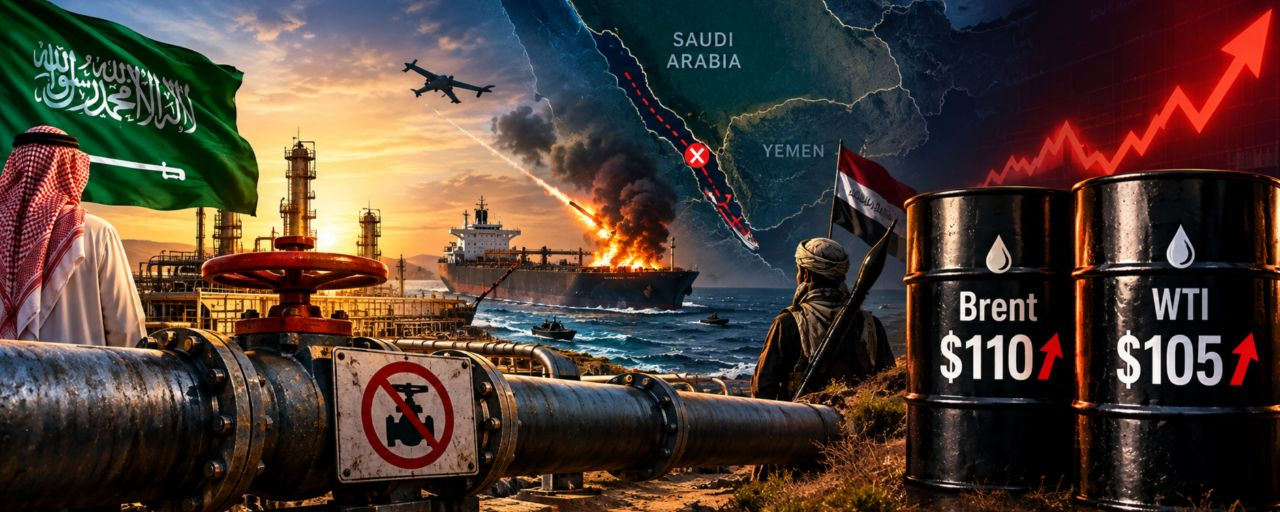

Brent crude closed Tuesday at $108.75 a barrel, up almost 3% on the day, while WTI added more than 4% to hit $105.83. Both benchmarks are back above $100 for the first time in weeks. By early Wednesday, some of that gain had drained away, with WTI down to $104.58 and Brent to $107.84, but nothing about the disruptions that pushed prices there in the first place has changed. Call it a breather, not a reversal.
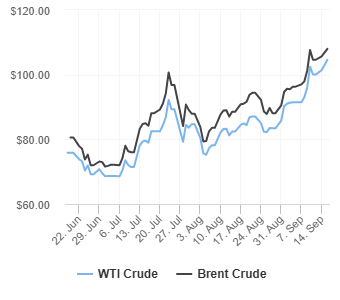
Oil spiked after Saudi Arabia's East-West pipeline closed down after drones launched from Iraq tore into it last week, one more entry on the list of Iran-backed strikes on the kingdom's oil infrastructure. Riyadh has already told a handful of European refiners their September cargoes aren't coming. Whatever supply cushion the market had going into this month, it's gone, and buyers are now hunting for barrels somewhere else.
Ask the U.S. energy secretary how long that takes to fix, and you get one answer. Ask an independent oil analyst, and you get another. Chris Wright told CNBC from Houston, where G20 energy ministers were meeting, that the shutdown "will be measured in days." Andy Lipow, who runs Lipow Oil Associates, took one look at satellite photos of the damage and wrote in a note Monday that it would take months to repair, not days.
Yemen's Militia Problem Just Got More Sophisticated
A year ago, few would have bet on Yemen's Houthis holding real strategic territory. Now they control the port of Mokha and claim the run of the Red Sea's southern gateway, a jump in capability that outstrips their old reputation for firing weapons out of the back of pickup trucks. Some of that leap is homegrown: the group has been building more advanced weapons of its own rather than leaning entirely on Iran for hardware.
Part of it, according to Anthropic, came with help from artificial intelligence. A cell operating out of Houthi-held northern Yemen used the company's Claude models, including Claude Code, to help build missile guidance software and test-fire a guided rocket, Anthropic said in a recent threat-intelligence report. The company never named the group outright, and it says the effort never produced a working weapon. Other outlets have made the Houthi connection anyway.
Inside Iran, the Revolutionary Guard Corps hasn't lost its grip, and it's still directing proxy attacks on American and allied targets across the region. Some officials in Washington see a pattern in the timing: pushing oil prices higher now, ahead of November's midterms, would cost Republicans their congressional majorities and put the Trump administration on the defensive at the worst possible time.
Washington seems to be aware of this. Vice President JD Vance, in an interview with the New York Post, predicted the war would enter "a much different phase" within a couple of months, in line, he said, with what the president has been saying about a wind-down after the midterms. Iran, he added, is still taking shots at commercial vessels now and then.
The Guard also claims a fourth MQ-1 drone shot down in as many days near the Strait of Hormuz, this one supposedly taken out by a newly deployed air-defense system. None of that has been independently confirmed. On Qeshm island, residents reported hearing several explosions Tuesday, the sound apparently rolling in off the water, and state media didn't say what caused them.
Counting What the War Actually Costs
None of this is cheap, and the accounting is starting to catch up with the rhetoric. A Pentagon inspector general report used the phrase "strategic inventory shortfalls" to describe what months of fighting have done to U.S. munitions stocks, which is the polite, bureaucratic way of confirming a shortage the White House has spent months denying existed.
The nonpartisan Congressional Budget Office went further Tuesday, putting the war's cost to the Pentagon at $38.1 billion through Aug. 1, with $2 billion to $3 billion more likely for every month it drags on.
Diesel is part of that math too. Senate Majority Leader John Thune says he's open to exploring a ban on U.S. diesel exports if it would bring pump prices down.
Away from the microphones, the coordinating never stopped. Senior military officers from the U.S., Israel and several Arab states quietly met in Germany last week to compare notes on the war and the wider region, Axios first reported. Around the same time, a Gulf foreign minister took a call from the U.S. Secretary of State, the kind of conversation that produces the usual language about lowering tensions and keeping the door open.
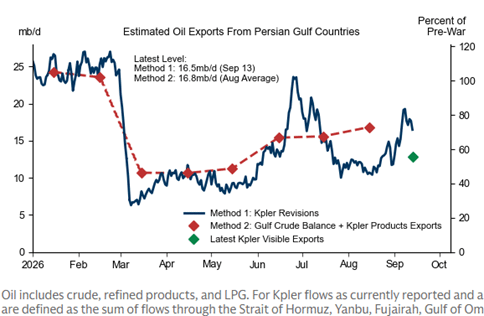
Goldman Sachs put a number on the broader picture: total oil exports out of the Persian Gulf, the bank says, now run 16 million to 17 million barrels a day, 70% of the total pre-war levels, based on two separate tracking methods.
Where the Money Moves
Two crypto exchanges are learning how expensive an Iran connection can get. CoinEx, which the Wall Street Journal reported in June had become a favored platform for Iranian users, some with ties to the Islamic Republic, announced this week that it's shutting down for good, blaming a prolonged market slump and compliance costs it could no longer carry.
The Justice Department has a bigger number attached to a different platform. Prosecutors say several companies used Binance to move roughly $1.5 billion through a web of digital wallets, laundering payments for black-market Iranian oil sold to buyers in China and helping finance Iran's military along the way. Billions more in Iranian money, they say, still pass through clearing accounts at American banks every year, sanctions or no sanctions.
A Different Kind of Shipment
Then there's the other side of the ledger. A U.S. official says the administration is moving a $2.8 billion sale of heavy bombs to Israel through the early stages of congressional review, a package that would rank among the largest U.S. munitions transfers in years, even as American public support for Israel keeps sliding.
The deal, first reported by the Washington Post, covers 40,000 one-ton bombs, 20,000 MK-84s and 20,000 BLU-117s, the same 2,000-pound weapons that have drawn condemnation from human rights groups and foreign governments over the civilian toll of their blast radius in Gaza and Lebanon. Another 20,000 I-2000 bunker-busting warheads are in the package too, built to punch through soil, rock, or concrete before going off on a delay. It's currently sitting with two congressional committees, waiting on an informal sign-off that isn't guaranteed.