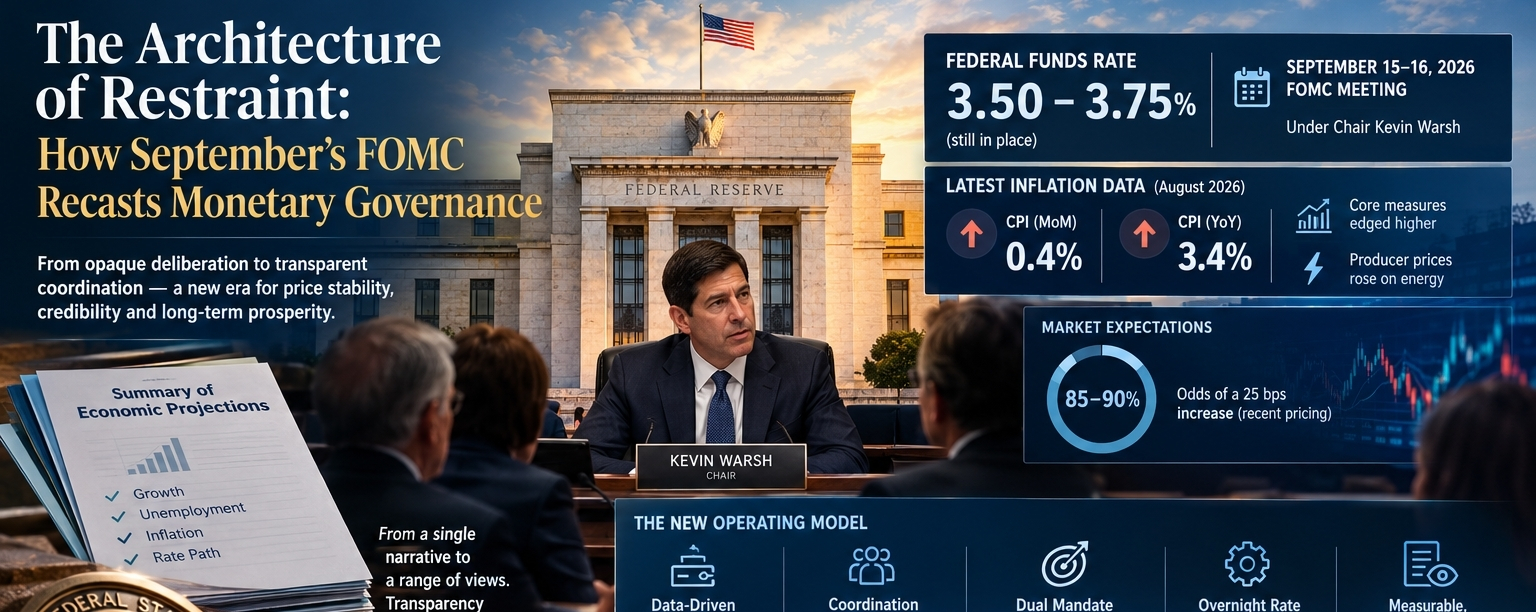

For years the machinery of monetary policy ran like a sophisticated black box. Forward guidance offered the appearance of predictability while often delivering ambiguity. Models projected neat paths that markets treated as near-certainty until the next data surprise forced abrupt revisions. Persistent inflation, energy shocks, and shifting real-economy signals eventually exposed the limits of that arrangement. The September 15–16, 2026 FOMC meeting, held under Chair Kevin Warsh with the federal funds rate still sitting at 3.50–3.75 percent, is more than another rate decision. It marks the emergence of a different operating model—one that treats price stability as the product of transparent coordination rather than an outcome that somehow emerges from opaque deliberation.
**Building on Verifiable Foundations**
The shift begins with a clear-eyed rejection of the old equilibrium. After a string of holds through 2026, including a revealing 9–3 vote in July, the Committee faces inflation that has simply refused to settle cleanly at 2 percent. August’s CPI rose 0.4 percent on the month and 3.4 percent over the year; core measures edged higher while producer prices climbed on the back of energy. These numbers are not abstract. They function as the system’s real-time sensors.
In place of extended narrative commitments, the new approach elevates incoming data and the Summary of Economic Projections as the primary tools of accountability. September is a projections meeting. Updated forecasts for growth, unemployment, inflation, and the rate path will appear alongside the decision itself. This is more than disclosure. It converts private judgment into a public, inspectable record. Uncertainty does not disappear—no serious system pretends it does—but it becomes measurable. Markets, households, and firms can see the range of views instead of decoding a single carefully polished statement. Replacing black-box consensus language with explicit ranges and conditional paths is the foundational change: governance moves from projecting certainty to maintaining a continuously calibrated feedback loop.
**Coordination Without Pretending to Omniscience**
The older model implied that a small group of experts could steer the economy largely by managing expectations through carefully worded guidance. That approach scaled poorly once supply shocks and geopolitical energy pressures arrived together. What is taking shape instead redistributes the cognitive load. Voting members still hold formal authority, yet the process is structured so that dissenting signals—already visible in July—and market pricing (recently assigning roughly 85–90 percent odds to a 25-basis-point increase) become useful inputs rather than noise to be managed away.
Coordination now runs through the dual mandate treated as a hard constraint, not a flexible aspiration. Warsh’s emphasis on delivering 2 percent inflation without accepting a permanent trade-off against employment reframes the Committee’s job as simultaneous optimization under real limits. The overnight rate remains the primary instrument; balance-sheet policy stays secondary. This is distributed in spirit even while remaining institutionally centralized: each participant’s projection contributes to a collective map that outsiders can audit. Trust is earned not by promising future accommodation but by showing a willingness to adjust when the map diverges from the territory. A system that updates on observable metrics can absorb successive shocks without needing ever-more elaborate narrative scaffolding.
**Evolution, Governance, and the Path Ahead**
The evolution is already visible in the move from repeated holds toward proactive calibration. A decision to raise the target range to 3.75–4.00 percent would be the first increase since 2023 and would signal that the post-2025 period of accommodation has closed. More important than the discrete move itself is the governing principle it embodies: policy must stay responsive to the observed path of underlying inflation rather than to political calendars or short-term market comfort.
Safety and ethics sit at the center of this choice. Prolonged deviation from the inflation target quietly erodes the real incomes of those least able to protect themselves. Allowing expectations to drift only invites the financial instabilities that tighter policy must later correct at higher cost. The ethical claim of the emerging model is straightforward: credible commitment to the target is not austerity theater. It is the precondition for durable expansion. Looking further out, institutionalizing transparent projection discipline and data-contingent adjustment should reduce the size of future policy surprises. Markets can price risk more accurately; households and firms can plan with clearer parameters. Returning to extended periods of guidance that markets eventually test and reject would simply recreate the conditions that produced today’s sticky inflation.
The September decision will not resolve every tension. Energy markets remain volatile, technology continues to reshape productive capacity, and political pressures will not vanish overnight. Yet the architecture now forming treats those realities as inputs to a verifiable process rather than reasons to obscure the process itself. By substituting measurable mechanisms for narrative insulation, the FOMC is offering something rarer than temporary accommodation: a monetary regime whose legitimacy rests on its capacity to be inspected, challenged, and updated in public view. That capacity, more than any single rate level, will determine whether the system can sustain both price stability and the conditions for broad prosperity in the years ahead.