
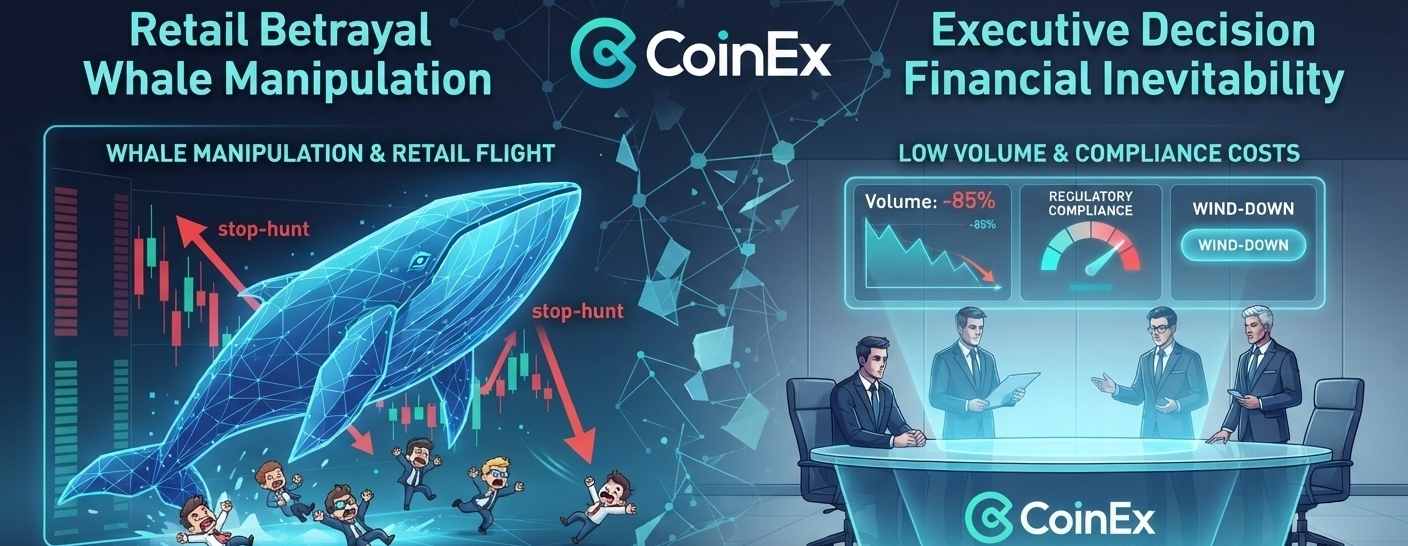

The recent announcement that CoinEx is shutting down operations after nine years marks the end of an era for the mid-tier exchange. While executive leadership points to macro headwinds and compliance burdens, the real autopsy of the platform's failure reveals a much deeper, systemic issue: the systematic failure to protect retail traders from predatory market manipulation.
As we look toward the final December 2026 deadline, we must analyze why CoinEx truly collapsed—not just from the corporate press release, but from the perspective of the traders who watched it happen.
🐋 The Core Failure: Whales, Manipulation, and the Retail Vicious Cycle
While corporate executives love to blame external economic factors, the primary catalyst for CoinEx's terminal drop in trading volume was its inability—or unwillingness—to protect its everyday users from systemic market manipulation.
Smaller, mid-tier exchanges operate on "thin" order books. Because liquidity was relatively low, CoinEx became a playground for institutional trading bots, market makers, and whales to manipulate prices at will. Retail traders routinely witnessed aggressive "stop-hunting"—where large players intentionally crashed or spiked prices to trigger stop-losses, liquidating retail positions before the price immediately corrected.
When a platform fails to implement strict anti-spoofing algorithms and whale surveillance, it breaks the foundational trust of its community. Retail traders realized the game was rigged against them, packed their bags, and left. This massive retail flight directly starved the exchange of the organic volume it needed to survive.
💼 The Executive Perspective: Compliance and High Costs
To understand the full picture, we must also look at the official reasons provided by CoinEx leadership, which ultimately made the business financially unviable:
Skyrocketing Compliance Costs: Navigating the fragmenting global regulatory landscape became incredibly expensive. For a platform with shrinking revenue, the cost of legal overhead and compliance infrastructure became a primary financial drain.
The Liquidity Trap: A prolonged crypto winter and lower retail spot-trading volume meant that transaction fee revenues dried up, making it impossible to cover operational costs.
Choosing a "Clean Ending": Rather than risking a chaotic bankruptcy or a forced restructuring that could lock up user funds, management chose a voluntary wind-down while their asset reserves were still safely above 100%.
🛠️ Moving Forward: What Exchanges Must Do to Survive
The CoinEx shutdown should serve as a stark warning to other mid-tier exchanges. If platforms want to avoid a similar fate, the industry must pivot toward the following solutions:
Implement Aggressive Anti-Manipulation Protections: Exchanges must deploy advanced market-surveillance tools to detect and ban predatory trading behaviors like wash-trading, spoofing, and artificial stop-hunting.
Enforce Whale-Slippage Safeguards: Platforms need to introduce dynamic trading safeguards that protect smaller accounts from being disproportionately wiped out by massive, single-block institutional orders.
Transition Toward Hybrid Models: To restore absolute trust, exchanges should integrate decentralized ledger technology for clear, real-time proof of reserves and algorithmic order matching that cannot be manipulated behind closed doors.
Ultimately, CoinEx didn't just run out of money; it ran out of the retail trust required to generate it.