
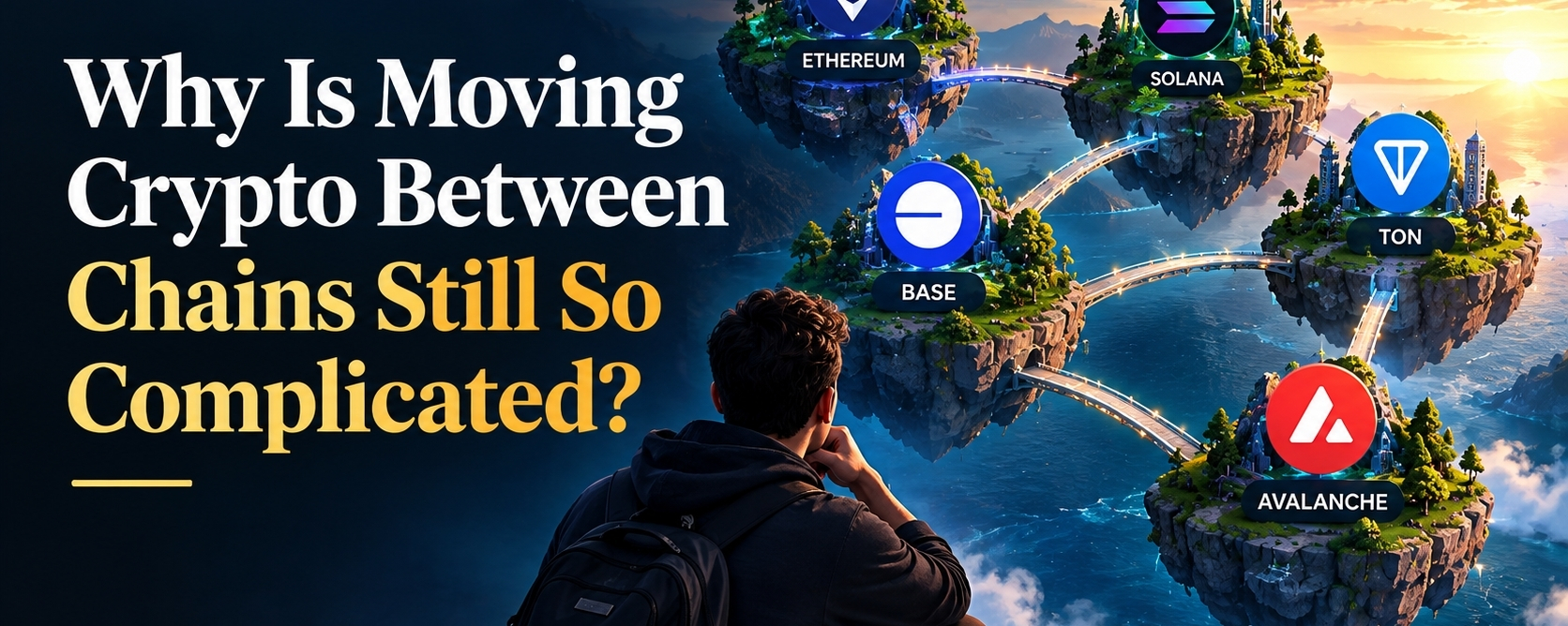

One of the biggest promises of crypto is that you can move value without relying on traditional financial institutions.
No bank manager.
No central clearing system.
No borders.
Yet there is still a strange problem that the industry hasn't completely solved.
Moving your crypto from one blockchain to another can be surprisingly complicated.
Imagine you have some ETH on Ethereum and suddenly want to use that value on TON.
Or maybe you have USDT on TON and want to move it to Solana.
Or you're holding assets on Avalanche and need them on another network.
You might expect the process to be as simple as selecting the destination network and pressing Send.
Instead, you may find yourself asking:
Which bridge should I use?
Is this the right network?
Do I need to swap first.
How many transactions will I have to approve?
Where is my transaction right now?
And perhaps the most frustrating question of all:
Why is moving money between blockchains still this complicated?
This becomes even more confusing when you realize how much the crypto industry has developed.
Ethereum is no longer the only major ecosystem. We now have Base, Arbitrum, Optimism, TON, TRON, Solana, Avalanche, BNB Chain, and many other networks competing to provide faster, cheaper, and more scalable infrastructure.
There is more liquidity.
There are more wallets.
There are more decentralized exchanges.
There are more bridges and cross-chain protocols.
There are also more tools designed specifically to connect these ecosystems.
And yet, from a user's perspective, the experience can still feel remarkably similar to what it was several years ago.
You have one asset on one chain.
You want to use it somewhere else.
And suddenly, you're navigating an entirely new layer of infrastructure.
So I decided to take a closer look at how cross-chain technology actually works and how some of the major players are trying to solve this problem.
I looked at solutions including @THORChain, @RangoExchange, @lifiprotocol, @StargateFinance, @Chainflip, and Omniston by @ston_fi.
What I found was interesting.
The industry has made significant progress.
The problem today isn't necessarily that blockchains can't communicate.
The bigger challenge is making that communication simple, reliable, and understandable for the person actually using it.
To understand why, we first need to understand why blockchains are so difficult to connect in the first place.