
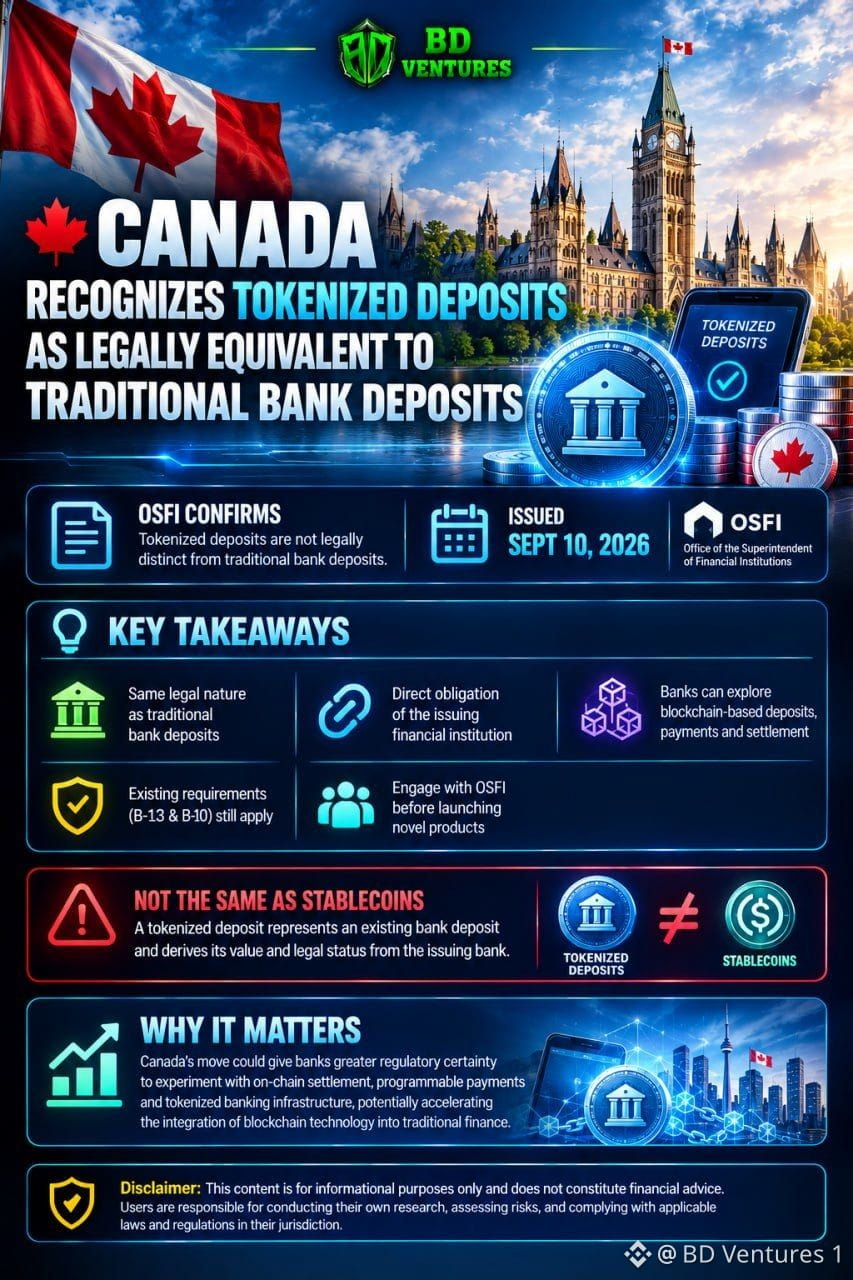
🔈🔈 CANADA RECOGNIZES TOKENIZED DEPOSITS AS LEGALLY EQUIVALENT TO TRADITIONAL BANK DEPOSITS 💥 Canada’s banking regulator has removed a major legal uncertainty around blockchain-based banking, confirming that tokenized deposits are not legally distinct from traditional bank deposits. 🏦 The Office of the Superintendent of Financial Institutions (OSFI) issued the clarification on September 10, 2026, emphasizing a technology-neutral approach: the technology used to create or deliver a financial product does not determine its legal nature. 👑 Key Takeaways: ✔️ Tokenized deposits retain the same legal nature as traditional bank deposits ✔️ The underlying claim remains a direct obligation of the issuing financial institution ✔️ Banks can explore blockchain-based deposits, payments and settlement without automatically creating a new legal category ✔️ Existing requirements, including B-13 technology & cyber risk and B-10 third-party risk management, still apply ✔️ Federally regulated institutions are expected to engage with OSFI before launching novel products 🔴 Tokenized deposits are NOT the same as stablecoins. A tokenized deposit represents an existing bank deposit and derives its value and legal status from the issuing bank. 💎 Why it matters: Canada’s move could give banks greater regulatory certainty to experiment with on-chain settlement, programmable payments and tokenized banking infrastructure, potentially accelerating the integration of blockchain technology into traditional finance.

Đăng
Tuyên bố miễn trừ trách nhiệm: Nội dung bao gồm cả quan điểm của bên thứ ba, không phải lời khuyên. Có thể sử dụng nội dung do Binance Ai đưa ra nhưng không được đảm bảo. Xem Điều khoản & Điều kiện.